New blogs

Leherensuge was replaced in October 2010 by two new blogs: For what they were... we are and For what we are... they will be. Check them out.

Friday, March 20, 2009

Timeline of human Y-DNA (2)

Here there is a refinement and expansion of my previous post on the matter.

I have now analyzed DE, C, IJ and NO structure too. The result is as follows:


Please compare with climatic data for possible fine tuning (my first impression is that it fits reasonably well but that minor corrections may be done too).

So let's see how it did man's history (man to be taken literally: human male lineages are the only ones considered here).

1. Root:

The so called "Y-DNA Adam", i.e. the common ancestor by pure father-son line of all living humans may have lived some 107,000 years ago. Humankind is of course much older, possibly double that figure, but "Mr. Adam" seems to have lived much later, soon before the out-of-Africa epysode.

2. Out of Africa:

The C,F line split c. 99,000 years ago. This lineage is clearly of Eurasian coalescence: all derived lineages in Africa (not many) represent back-migrations at much later dates. Hence the main migration out of Africa must have happened then. At similar dates we also have the oldest AMH remains in North Africa (Aterian) and West Asia. Some South Asian indirect evidence might also point to AMH presence at those dates, though this is arguable.

Significatively, the third Eurasian lineage, D, may have been at that time still in Africa. This is intriguing, as it suggests a second migration for this lineage alone at a later time, maybe 83,000 years ago.

In Africa, at similar dates to those of the C,F migrating adventure, we witness the expansion of haplogroup A, which is widely spread from Sudan to South Africa. This may signal that the C,F migration happened within the context of an Eastern African expansion. C,F would then have been the ones migrating to the North, to the Mediterranean coasts and beyond into Asia.

3. Toba and first Eurasian expansion:

We know with great certainty that some 74,000 years ago, Toba caldera (Sumatra) exploded, causing a major catstrophe in Asia and a sharp freeze around the globe. We also know that populations in India (Jawalpuram culture) survived the catastrophe. The Eurasian humankind probably experienced a bottleneck and then an expansion after this epysode. It is only logical to date this first expansion (the rapid succesive branching of F, IJK, K and NOP nodes) soon after Toba therefore.

This expansion was limited anyhow, as we witness a rather long period of latency after it (65-55,000 BP). It is likely though that the major proto-lineages were distributed as follows:
  • C, still undivided, in South or SE Asia
  • D*, D1, D2 and D3, already outlined, maybe in SE/East Asia
  • G in Central/West Asia
  • H in South Asia
  • IJ in West Asia
  • L in South Asia
  • M in SE Asia or Melanesia
  • S in SE Asia or Australia
  • T in West Asia
  • NO in SE/East Asia
  • P in South/Central Asia
Notice that none of these lineages (excepted M) would expand for at least other 10,000 years, in some cases (L, T) for even a much longer period, so there is a lot of uncertainty about their actual locations at this stage. In all that parenthesis, a lot of drift and fixation may have happened in the different populations.

But the overall distribution of these clades does indeed suggest that there was some spread to the East (4-5 clades) and West (3-4 clades) of the probable South Asian homeland (2-4 clades) already. Another possibility would be that all clades were restricted to some geographical province like South Asia.

In Africa, at similar dates, we see the first expansion of haplogroup B (split into B1 and B2), which may signal a first expansion of Humankind westward in that continent.

4. The second Eurasian expansion:

This is probably the main real expansion, and one for which we do have some clear fossil evidence. I have estimated it to have taken place between c. 55-46,000 years ago and would have certainly pushed humankind all around Asia and continental Oceania.

At this phase:
  • C split into its major subclades, which went variedly to Japan (C1), Melanesia (C2), NE Asia (C3), Australia (C4) and South Asia (C5). There's another subclade (C6) whose geography has not been reported.
  • H split into H1 and H2 (in South Asia)
  • IJ split into I and J (in West Asia)
  • NO split into N and O (in southern East Asia probably)
  • P split into Q and R (in South or Central Asia)
In Africa also, E split into E1 and E2 at this timeframe, with E1 branching out soon after.

5. Later expansions:

The later expansive trend seems to have no clear bounds. We can point some moments though:

5.1. The great North: The first branching of the two major clades of the great Eurasian North: N and Q (C3 would seem to have a later timeframe) happened before 40,000 years ago, it seems.

5.2. West Eurasia:
  • I branches out since 39,000 BP, what makes it a good candidate for the "Aurignacian clade" (would need to be 2,000 years older but close enough). Scandinavian I1, anyhow would be lurking as minor haplogroup until the Epipaleolithic, while I2 instead appears expansive through all the European UP.
  • J branches at a similar time (maybe a little later).
  • The spread of G is also parallel to that of J and I2 (since c. 37,000 BP)
5.3. East Asia:

The division of haplogroup O in its three main branches seems to have happened also c. 39,000 years ago. The spread of each of these clades, as well as C3, seems to have happened some time later: around 30,000 BP.

5.4. Haplogroup R:

The somewhat controversial haplogroup R, extended by Europe, Central and South Asia mostly, may have split c. 35,000 years ago. This can be considered as the origin of South Asian R2, which seems to be an old clade in the subcontinent.

R1 appears to have divided c. 27,000 years ago, which probably meant that proto-R1b migrated out of South Asia (or maybe Central Asia) about that time, while proto-R1a remained behind. Destination? Almost without doubt West Asia. There is a serious possibility that it could have taken part in the Gravettian expansion in Europe, which began c. 28,000 BP. Its parallels with confirmed Gravettian mtDNA H do suggest it (but this is somewhat controversial).

R1b1 may have split c. 25,000 years ago, though the position of the other clades (African R1b1c and Mediterranean R1b1a) is still unclear. R1b1b would have split c. 23,000 years ago (origin of R1b1b1 and R1b1b2).

Some 19,000 years ago R1a started evolving into R1a1, which may mean a migration between Central and South Asia, though the exact direction is at this moment unclear. Roughly, R1a1 was formed by c. 17,000 BP, R1a1a by 13-12,000 BP and the various subclades (R1a1a3 as prototype) could be as recent as c. 6000 BP, what fits almost perfectly with the Kurgan model of Indo-European expansion.

R1b1b2a apparently c. 16,000 years ago, while Western European typical R1b1b2a1 would have been formed c. 14,000 BP and derived R1b1b2a1a by c. 13,000 BP. These latter dates fit too well with the time of Magdalenian expansion to Central Europe (and later to southern Iberia) to be ignored.

The relatively rare R1b1b2a1a subclades would have begun appearing c. 9,000 BP, what would mean limited Epipaleolithic and maybe even Neolithic local founder effects. Notice please that these subhaplogroups include only a small apportion of all R1b1b2a1, even if some of them have some localized relevance.

If European R1b is not of Gravettian origin, it would require a migration from West Asia at the foundation of Magdalenian culture, some 17,000 years ago. This is not what archaeology tells us: it says that Magdalenian was a local Aquitanian developement, maybe influenced by Aurignacian remnants of Central Europe (Magdalenian and Aurignacian are very similar). So I remain inclined to think that R1b arrived to Europe with Gravettian, drifting massively with the Late Glacial Maximum, what virtually erased all other Y-DNA lineages, be them R1b or I2 or whatever else. Then, as generally accepted, R1b1b2a expanded into Central Europe and Iberia with the Magdalenian expansion and later, in the Epipaleolithic, into Scandinavia and the Atlantic Islands.

I am anyhow intrigued more and more about the exact nature of SW European I, which has not been properly tested for the most part. Some of it is clearly I2a that arrived with Neolithic expansions from the Western Balcans but the rest is just I* as of today.

Comparison with mtDNA:

For the parallel mtDNA possible timelines, see these posts: 1, 2, 3.


It's noticeable that with a similar SNP-based method I also detected two apparent expansive pulses in the mtDNA timeline, separated by a "valley" of limited growth. The overall pattern would be the same:

1. First Expansion
2. Pause
3. Second Expansion
4. Aftermath of regionalized and rather continued expansion, which included the first colonizations of Europe and the Eurasian North
.

Thursday, March 19, 2009

Intelligence, quality wiring and inheritance


From
Science Daily. Original paper: Ming-Chang Chiang et al., Genetics of Brain Fiber Architecture and Intellectual Performance, Journal of Neuroscience, 2009.

UCLA researchers have discovered that intellectual performance is strongly correlated with the quality of the mieline covering of neuronal axons in the brain. Which in turn is strongly dependent on genetics.

For starters, mieline is the isolation layer around the "cables" (axons) in our brain and nerves. While neurons have many sinapsis (connections with other nearby neurones), they have one or two longer extensions called axons, which are the "cables" of our nervous system, brain included.

When axons' mieline is thick and therefore provides a good quality isolation, the neuronal signal is stronger and clearer. Instead, when mieline is thinner, the electrical isolation is worse and the neuronal signal weaker. The first case provides for good intelligence, while the latter does not; additionally bad mieline covering is also related to mental illnesses like autism and alzheimer. Mieline thickness also shows a U-shaped pattern in life that is optimized for middle age (the acmé of classical Greeks, located around the age of 40), what explains increase and decrease of intellectual prowess with age.

The UCLA team compared pairs identical twins (natural "clones") and normal syblings, finding more marked differences in mieline quality among the latter, all which correlated with intelligence. This seems to support a genetic background for these differences, as regular syblings share only c. 50% of the genes that are variable in humans (can be more or less but around that median figure anyhow), while identical twins share virtually 100% of their genes.

I find this interesting because the main classical anthropometrical correlation with intelligence used to be brain size (though independent for each gender) but many of us suspected that size was not the only thing that mattered. This in fact comes to prove that the quality of wiring, something that cannot be measured in cubic centimeters of cranial capacity, also influences intelligence strongly. It will be surely long before we can discover other such "design" factors (mieline quality being again a relatively easy to measure element, yet only now studied), things like the design of the neuronal network itself, probably a less genetic and more plastic one, organized largely in life by experience, but I'm sure such factors are acting right now. Of course the quality of the materials is influential, maybe fundamental, but how they come to be organized, something that only happens within life, which is surely as dependent on education, general experience and access to knowledge, also matters. The best computer of Earth, if only programmed to add 2+2 won't be able to do anymore, while the worst one can surely do much more than that with due attention.
.

Tuesday, March 17, 2009

European and Anatolian R1b structure


I have been recently involved in two discussions on R1b origins and structure. Some of the information I or others dug for them has helped me to make up my mind a little better on the issue.


At the moment the we know that R1b has a main subclade, dominant in Western Europe, which is R1b1b2a1. Most known R1b is R1b1b2a1* and R1b1b2a1a*. Additionally there are other upstream subclades:
  • R1b1b1, common in SE Europe, West Asia and Uyghuristan
  • R1b1a (exact location within the tree unclear), found in Lebanon and Sardinia
  • R1b1c (exact location within the tree unclear), found in Northern Cameroun (Ouldeme and others)
An important matter that arose in the discussion at Dienekes' blog was the so-called haplotype 35 (defined by DYS-393=12). This subclade actually seems to represent exclusively R1b1b2* and R1b1b2a*, excluding R1b1b2a1, which is dominated by DYS-393=13.

All this certainly suggest that, once upon a time, the ultimate origins of the haplogroup were in West Asia, but also that R1b1b2a1 must be treated as a separate reality within R1b, and that this clade most likely coalesced or at least expanded ("exploded", as its starlike structure strongly suggests) within Western Europe.

In any case, I have revisited Alonso et al, 2005 and, based on my newly acquired knowledge on ht35, reviewed my old reconstruction of the R1b tree accordingly, placing Anatolian ht35 at the root instead of the Western modal haplotype. The result is as follows:


The DYS used by Alonso, and also in the above graph, are: 19-390-391-392-393. [Note: I wrongly wrote originally 90 instead of 390, bringing confusion even to myself. My apologies and thanks to Xavier for pointing out that important error at the comments section. Corrected on Oct 11].

Like in the original version, the four haplotypes in larger type are the most common ones:
  • 14-24-11-13-12 (light blue in Alonso's map) is common in Anatolia and found at lower frequencies in SE Europe and also at small ammounts in Central-Western Europe (Germany, Belgium, Friesland).
  • 14-24-11-13-13 (red in Alonso's map) is widely distributed, being most common if anywhere among Basques. It is the modal haplotype.
  • 14-23-11-13-13 (purple-blue in Alonso's map) has mostly a northernly distribution, with highest frequencies in the Low Countries and Austria.
  • 14-24-10-13-13 (black in Alonso's map) has also a northerly distribution, especially around the North Sea, but is also found in SW Europe and even Africa and Anatolia at rather high frequencies.
I have dotted some of the possible genealogical derivations of haplotypes 14-25-10-13-13 and 14-24-10-14-13 because, having the crucial marker DYS-393=13, they seem now quite clearly within the Western R1b1b2a1 branch. Even if there may be some rare exceptions, at this point it seems that DYS-393=12 means generally R1b(xR1b1b2a1), while DYS-393=13 means R1b1b2a1. This helps a lot to clarify the haplotype structure.

____________________________________________________________

Postscript:

[Section revised on Oct 11, after taking note of the important DYS sequence error - see above. Significatively new areas are in this color (blue)].

Checking again on the Family Tree DNA hg35 site (only the properly tested samples), I realize that they fit as follows:

  • R1b1b2* (L23-, L51-, L11-) most typical haplotype is 14-24-10-14-12, which above appears as derived "Berber/Anatolian" subclade. Also less common is 14-25-11-13-12, not registered here (though maybe listed in the supplementary materials table).
  • R1b1b2a* (L23+, L51-, L11-) most common haplotype is 14-24-11-13-12, which is the "modal" Anatolian subclade, the apparent root in the graph above. Also 15-24-11-13-12 (Middle European distribution that could mathc Neolithic spread, for some odd reason not shown in the post's graph) and others less common.
  • R1b1b2a1* (L23+, L51+, L11-) common haplotypes are 14-24-11-13-13 ("R1b modal"), 14-23-11-13-13 ("Belgium-Austria") and 14-25-11-13-13 ("Welsh"). Importantly 14-23-11-13-13 is one of the major haplotypes in Europe and seems to suggest an early divergence in Central Europe at this para-haplogroup stage.
  • R1b1b2a1a (L23+,L51+, L11+) most common haplotype is again "modal" 14-24-11-13-13. Some of the rest have 15-24-11-13-13, a small Middle European subclade. 14-24-11-14-13 is also seen in several cases at FTDNA and it's a minor Atlantic clade of Britain and Iberia. The "Scottish" (plus North Sea/Basques) major haplotype 14-24-10-13-13 also falls mostly in this haplogroup.
I am hence thinking that most R1b1b2* is maybe a distinct haplogroup (would be "R1b1b2b") and that most R1b1b2a* also (would be "R1b1b2a2"). Furthermore, after noticing the DYS numbering error, I am beginning to suspect that the Central European HT2 (14-25-11-13-13) might be symptomatic of yet another un-described haplogroup at the R1b1b2a1 level, corresponding geographically mostly to Central Europe (Danubian Neolithic?, distinct UP lineage?). I will probably need to review all the matter anyhow (but cheer up: it's always good to spot novelties, otherwise life would be boring).
.

Friday, March 13, 2009

Timeline of human Y-DNA (1)


Tired of relying on unlikely TRMCA esimates by others, I decided to take a look at human Y-DNA structure on my own. Unlike with mtDNA, which is relatively asy to study in full, the Y chromosome is very large and, with very few exceptions, it has never been studied in such lenghts. Instead geneticists have been gradually adding SNPs to their collections and that way perfecting our understanding of human paternal genalogy.


But the different branches are very unequally studied. Some like Western European R1b are very well studied (partly via private genealogy companies) and we can presume that we know already most of the SNPs that exist in that line. In comparison others are barely sketched.

This uneven reality of knowledge makes very difficult to compare the different lineages as I did with mtDNA using SNPs (see here, here and here). So I did the following: using the YSOGG data, took a reference lineage (the longest one from root to tip: R1b1b2a1a4a, 104 known SNPs from "Adam") and took also sample lineages in each of the other branches (always the longest apparent line within each). With simple maths I determined the "informative value" of each SNP in those lineages (always in comparison to the reference) and then calculated the equivalent value of the lineal sequences of SNPs at the root of each branch.

The resulting chart is as follows:

Of course, there is some uncertainty, greater for branches that are very badly studied, like C or H, whcih could well be older than they appear here. But the result is at least pretty much illustrative of how things might have been. There is also great uncertainty regarding what exactly "recent past" means. I assume that it means at least two extra reference SNPs, maybe more, as these had no real time to expand and must be restricted to private lineages. Any clade that is widespread enough as to be sampled more than once (i.e. non-private) is probably a founder effect from some time ago: it did not spread this century or even this milennium certainly.

Whatever the case, I did some afterwork on the raw diagram, trying to find out some logical timelines. I ended with the following:


This is by no means definitive: some fine tuning may generate much improved estimates, but it does give a rather consistent overall scheme of how things might have been. It was only natural to place Toba catastrophe where it is, just before the great expansion at rapidly succeeding nodes: F, IJK, K and PNO, as well (with some uncertainty) C. But also after the DE and CF nodes. There is archaeological evidence of the presence of H. sapiens in Eurasia before Toba and of continuity in South Asia, so moving the Toba timeline to before the CF node makes no sense to me. It was just very convenient (and also natural) to assign 1000 years per reference mutation along the R1b line, so I did.


Analyzing the intrepretation a little bit:

1. R1b

R1b may be than 20,000 years BP (the R1b apparent node falls exactly in the 21 kya line and the R1 node is at the 23 kya line), what is more coincident with Solutrean than Magdalenian. But the most common subclade R1b1b2a (and notice that the other subclades' position is unclear) appears diversified as recently as c. 5000 BCE. At that date Europe was like this and even if we stretch the timeline a little (map), we can only attribute this homogenity within R1b safely to the post-Magdalenian Epipaleolithic context (Tardenoisian especially). So it is possible that most modern European R1b (R1b1b2a) only consolidated in Epipaleolithic times and may have a more northernly origin than the Basque Country (France-Belgium-Rhineland). It might also be Neolthic but it's extremely difficult to find a single Neolithic source for that.

R1b is not just present in Europe and West Asia but it's also frequent in Africa and Central Asia. The latter is mostly R1b1b1, while the (ill-studied) African one falls within two categories: Euro-like R1b1b2a and exotic R1b*. Egyptian R1b is evenly divided in these two categories while Ouldeme R1b appears to be R1b* (some distinct subclade, not yet categorized) in its totality. If the current understanding of non-European R1b is correct (it may be not), then the overall expansion of R1b may have happened c. 20,000 years ago, maybe in connection with Solutrean and related cultures like Iberomaurusian (Oranian), while the "European" R1b instead would have expanded closer to the Epipaleolithic/Neolithic timeline, it seems.

2. R1a

The node shown (c. 18,000 years ago) represents the earliest bifurcation, which surely happened in South or Central Asia. It does not represent the R1a1a main subclade, which expanded much later with all likehood.

3. R2

We know nothing yet of the substructure of R2 but from the estimates it seems it diverged from R1 c. 32,000 years ago, deep in the Paleolithic.

4. Q

The divergence of R and Q appears even older, c. 42,000 years ago, before most of Europe was colonized by h. sapiens.

5. NO

It's been recently discovered that NO and P share one basal mutation. Still their split falls wholly in the main period of K branching out, that, according to my estimates is earlier than 60,000 BP. I will try to adress NO substructure and internal timeline in the future.

6. K

The K multifurcation appears to represent the main Eurasian expansion better than anything else. It may have happened some 63,000 years ago. Some of the branches (L, T) may have gone by very long coalescence periods, while others expanded soon after the K node instead.

7. IJ

Another recently discovered connecion is that of IJK. IJ separated from K not long before the main K divergence and not long after the main F multifurcation. I and J appear to have split c. 50,000 years ago, maybe in connection with the earliest European colonists in Bulgaria. I will try to adress IJ internal structure and possible timeline in the future.

8. F

F may have been the first lineage to diverge after Toba. If H and G actually hang from the F node directly, this may have happened somewhere in NW South Asia.

9. C

The estimated timeline for the coalscence of C may be too long. I am rather inclined to think its multifucation happened earlier, closer to the F-K spread. Whatever the case, this clade must have participated in the "main Eurasian expansion" right after Toba.

10. DE

I also promise some greater insight in the internal structure of this macro-clade (soon to comeTM). Like in the case of C, the main bifurcation node may be missdated a little too late anyhow.

11. B

It's very curious how this African lineage appears to have an expansion time that parallels that of F-K, right after Toba. This catastrophe surely also affected Africa and may have caused some major alterations and opportuities. Of course, as B is only poorly understood, it may be just an illusion.

12. A

The oldest distinct human lineage would seem to have expanded in a parallel timeline to that of the out-of-Africa epysode. Probably there were favorable climatic conditions in that window, helping everybody.

Enjoy.
.

Tuesday, March 10, 2009

The Zionist Story (documentary film)


Made by Israeli film-maker Ronen Berelowich, The Zionist Story is a critical view of Zionism and a realistic history of the Israeli-Palestinian conflict.


Found at Filasteen. Originally from Pulse.
.

Monday, March 9, 2009

What comes now, once democracy has been abolished


When democracy is nothing but a farce anymore, at least here in the Basque Country, when political factions that barely gather 25% of popular support hold the majority of parlamentary seats and get ready to estabilish a new fascist goverment, we can already see what the future offers.


A few days ago the social center of Vitoria-Gasteiz Zaramazulo was clausurated and searched by Spanish military police with unknown pretexts. The building has been serving as social center for the last 25 years for the neighbourhood of Zaramaga, hosting all kind of activities: theater, music, dance, popular academies, the unemployed workers' assembly, a distibutor of books and records, an altenative magazine, antimilitarist groups, a pro-cannabis platform and the ecologist grpup against the High Speed Train, all were hosted there.

Overnight the Guardia Civil, that in spite of its name is purely military in nature, has take over the place and clausurated it.

I imagine this is only the prelude, the entrance of many more bitter dishes that will come in this increasingly undemocratic period in the Western Basque Country.

The ghost of Franco laughs but we feel no fear, just rage... and rage is what feeds hope, because it feeds the struggle for a better world.

Source for the central info: Eutsi - antiauthoritarian left's page.
.

Sunday, March 8, 2009

Catalans demand self-determination in Brussels


Some 10,000 Catalans and supporters from various other nationalities demonstrated yesterday in Brussels demanding the EU authorities the recognition of the right of self-determination for the Catalan nation.


The slogan: "We want a Catalan state". Besides Catalan four-barred banners, ensigns from other opressed nations of Europe and the Mediterranean could be spotted as well: Basque, Breton, Flemish, Corsican, Venetian and even Berber flags were present.


"Spanard who doesn't jump" was one of the cries heard in Brussels.

Source: Gara.
.

Status inheritance cultural not genetic


At least among hyenas.


Cubs adopted by high-ranking hyenas inherit the status of their surrogate mothers, not their biological ones. The silver-spoon effect is not genetic but a product of social learning.

Source: Science Daily. Originally from M.L. East et al., 2009.
.

Friday, March 6, 2009

The bantustanization of Palestine

The term Apartheid sounds more and more in relation with Israel and its occupation of the formally unannexed areas of Palestine. One of the central elements of South African Apartheid was the bantustan, micro-states carved out in South African territory, often discontiguous, with no real competences in foreign or even internal policies, created basically to deprive South African Blacks from their citizenship, making the country a little more white and little less black on paper.


South African bantustans in the 1970s and later

The situation is strikingly similar in Palestine, as this Quaker video shows:


There's no two states solution largely because Israel doesn't want it. The term is only waved as support for the creation of a Palestinian bantustan and nothing else.

Source:
Desert Peace, originally from Inspired Path.
.

Tuesday, March 3, 2009

Israel shoots farmers and internatonal cooperators (video)


From Window into Palestine. The attacks happened when the famers and cooperators (voluntary human shields from around the world) tried to work some lands 300m from the apartheid wall, at the village of Khoza, Khan Younis, West Bank.


These shootings are not any isolated event. Just that in this occasion they have been captured in video.
.

Monday, March 2, 2009

Undemocratic "elections" in the Western Basque Country


The total banishmen of one the major political forces in the Basque Country (general described as Basque Nationalist Left, that has been between 2nd and 4th force along the years when they actually could run) has left the Western Basque Country deprived of options in the farce represented today, leaving to a mutilated, not representative, autonomous parliament, for the first time ever dominated by the Spanish Nationalists, even if they have only some 25% of the potential votes.


This farce of democracy, denounced even by the United Nations, has been met with many protests, as the images show:


"It's enough! Democracy now!!!" - "This is not democracy"


"This is not democracy"


R. Rato, former IMF Director, also had to put up with protesters


"We will keep applying life sentences" - "Zero democracy"

Source: Gara.
.

Friday, February 27, 2009

People losing everything. Worried.


Yesterday night two different people with whom I play at classical online game said they were financially bankrupt (in real life) and were being evicted from their homes within a month. The word "homeless" was used, with all it implies.


They are from the USA, a state that has a very weak welfare. It made me suddenly realize how deep in the crisis we are already and also that the people I play with are not just friendly toons in a virtual reality, that they may have serious issues in real life and that these issues are right now primarily of economic nature.
.

Wednesday, February 25, 2009

Survival of the weakest?


There is an intriguing article at Science Daily: researchers from Ludwig-Maximilians-Universitaet (Munich) have found, both in simulaions and real experiments, that the "weakest" species seems to be the survivor within cyclical competition, contradicting somewhat the usual interpretations of Darwinian evolution and emphasizing the random (or hidden) factors at play. Read more...

.

Saturday, February 21, 2009

Shaking images from the Gaza Holocaust


Warning: the images are terribly shaking, children brutally killed and horribly injured. Still everyone should see them to know, to feel, what is really happening under the Zionist boot and why every single human being who is not an undercover Nazi must stand against Israel with all our power and rage.


Photos of some of the more than 300 children assassinated in Gaza by the Zionist SS (aka "Israeli Defense Force") - at La Voz de Atlatl.
.

Wednesday, February 18, 2009

Yes we can... end Apartheid

.


This ad has been prohibited in several TV channels.

Found at EAAZ.
.

It's official: Basques won't have democratic elections


Tonight at 21:00 CET, the especial political tribunal of Spain, Audiencia Nacional, has decreed that Demokrazia 3 Miloi and Askatasuna are illegal and will not be able to run in the upcoming elections in the Western Basque Country.


Nevertheless, the decission was already made: the violent attitude of the Basque Autonomous Police against, then perfectly legal, campaigners was a clear signal that all who mattered was in agreement to make sure that the Basque Nationalist Left could not run to these elections either.

The sentence also rules that the online site of Demokrazia 3 Miloi must be shut down as they were offering ballots to be downloaded online and casted in the upcoming elections (would be considered "null" ballots legally).


The Basque Nationalist Left has a historical support ranging from 12% to 18% of the effective voters, being at times the second largest party nationwide and always among the four largest ones. With this expected, yet pathetic, decission, a major sector of Basques is in practice excluded from the electoral process again, delegitimazing the institutions.

This hurts particularly when the Basque Country is one of the oldest democracies (if not just the oldest one) of Europe, with representative goverments dating from the Middle Ages (if not before). It has to be a foreign invader who deprives us of our traditional democracy.

Source: Gara.
.

Saturday, February 14, 2009

Police attacks Basque electoral campaigners


After
the banishement of Demokrazia 3 Milloi (D3M) from the upcoming Western Basque elections and their statesment that they will campaign like anybody else because "it is our right", Basque autonomous police agents have attacked people who were placing posters of the nationalist platform, using abusive language and threats and in some cases physical violence.

In Sestao, some 15 policemen ganged upon a group of activists and, after mocking them, smashed two of them agains the posters' board, leaving one bleeding. Another person was beaten by several policemen in a separate inccident in the same town.
.

Friday, February 13, 2009

Shoe throwing against Israel (in Argentina)


Funny video... and full of rage 'n hope at the rythm of anti-fascist, anti-zionist, anti-yahvistic music of Ska-P:


Found originally at Gaza; Peace n' Freedom.
.

No democracy for Basques (again)


The Spanish political tribunal Audiencia Nacional has declared illegal the formations Askatsuna (Freedom) and Demokrazia 3 Miloi (Democracy 3 Million), in practice banning some 15% of Basque citizens (12-18% historically) to freely choose their representatives in the upcoming autonomical elections in the Western Basque Country.


At this point there is absolutely no doubt that "democracy" under the Spanish boot means absolutely nothing: it's only for the fascists and their cowardly allies.


Protests were held against the ruling

Source: Gara.
.

Thursday, February 12, 2009

Zionist troops shooting at peaceful demnstrators


Source:
Maan News Agency, found originally at Filasteen.

Every Friday people demonstrates across Palestine against the Apartheid Wall. Every Friday, Israeli snippers shoot at their legs. They use silencers to create even more confussion and they shoot with special ammunition intended to break inside the body of the victim, filling the injury of shrapnel.

How does anybody expect Palestinian resistence to be pacific?, I wonder.

Boycott Israel! Boycott Coca-Cola, Nestlé, McDonalds, etc.
.

Repeats, deletions and other rare mutations separate humans and chimps


Found
at News Daily. Original paper by H. Huges et al. published in Nature.

According to this research it was not normal mutations (i.e. the change of G into T or similar, known as SNPs) which caused the rapid divergence between great apes and monkeys and, later on, also humans from great apes. Instead these were apparently caused by copy number variations, including sequence repeats, deletions and even reversions. These kind of mutations are often associated to dieseases in humans but may have also been the origin of species divergence.

As expected, they found humans and chimps were very close in terms of overall sequence. The main differences lie in copy number variations -- repeats of the same genetic sequence over and over, deletions of the sequence, or even instances in which a sequence runs backward.

Among humans, these variations have been associated with diseases ranging from AIDS to autism. They may also underlie the differences between species, Eichler said.

The analysis suggested that in the ancestral branch of primates leading to humans and the African great apes, the number of these duplications began to increase at the same time that the more classic genetic mutations were slowing down.

Humans and chimps, in particular, tend to have extra copies of these sequences, they reported.

Tuesday, February 10, 2009

British high officials acknowledge this crisis as the worst ever


Found
at BBC.

Ed Balls, former financial advisor to Gordon Brown, admits that this crisis is worse than in the 1930s. He made these declarations at a Labour meeting at Yorkshire and are reported by the media as follows:

The economy is going to define our politics in this region and in Britain in the next year, the next five years, the next 10 and even the next 15 years.

These are seismic events that are going to change the political landscape.

I think that this is a financial crisis more extreme and more serious than that of the 1930s and we all remember how the politics of that era were shaped by the economy.

We now are seeing the realities of globalisation, though at a speed, pace and ferocity which none of us have seen before.

The reality is that this is becoming the most serious global recession for, I'm sure, over 100 years as it will turn out.

Also the deputy governor of the Bank of England, C. Bean, admitted in October that:

This is a once in a lifetime crisis, and possibly the largest financial crisis of its kind in human history.

So here is the truth. And it is the moment of truth for Capitalism as whole: globalization, extreme productivism and even more extreme consumerism, as well as totally deregulated markets were its goals. They achieved them as much as they could and now we are facing the logical conclussion.

It has been a very short lived this phase of Toyotism: just some four decades, but that's the same as my whole lifetime. It is very possible that I may die in a post-capitalist world but that new reality is yet to be created and the uncertainties are immense. In fact we are now entering in a chaotic multifurcation where maybe everything is possible: a unique moment of opportunity, the chance for human creativity and willpower to shape the future, a chance probably not seen since the late 18th century, when there was also an old regime collapsing everywhere.

Brace yourselves: it's going to be very tough, tougher than you probably ever imagined. But the window of opportunity is being opened and that is good news in itself.

Monday, February 9, 2009

Basque sepherds of California


Found
at Eusko Blog - Ingeleraz, originally from BBC. Worth a look.


.

Sunday, February 8, 2009

Interview with Mordechai Vanunu in Gara


Gara:
«El poder nuclear de Israel se volverá algún día contra los mismos que lo crearon» (interview with Mordechai Vanunu, in Spanish).

It is a long interview with the man, that true Jewish hero, that unveiled the nuclear arsenal of Israel and paid for it with his freedom and almost with his life. I can't really translate it all but here there are some excerpts:

My revelation helped the world to wake up and prevent that Israel could use the bomb. That was my contribution.

Here [in Israel] democracy is not like in the USA or Europe. Israel has a very special legal system that allows it to do as it wants. A very peculiar democracy as it can be seen in my case: they do not let me to leave the country or talk with foreigners. Democracy means to have human rights: freedom of speech or movement. Nothing like that exists in Israel. Besides the government does not tell the truth to the people. What kind of democracy is this one? (...) The USA confronts Iran because they say that they have the bomb. But Israel also has it and nothing happens to them. So I am happy and proud of being considered a traitor.

For 18 years in prision I was alone in a room. A cell of two by three meters.

For 18 years I was alone. After twelve years they told me I could go out and mix with other prisioners. I said I wanted to be with Palestinian prisioners. They said no. So I was other six years alone.

For the two first years the light was always on, 24 hours a day.


Where did you got the strength from? It is a big question. I do not know. I believe in freedom, in Humankind, in freedom of speech and in following the dictates of our consciousness.

I was not worried about my life. When I took the decission I assumed the risk.

The problem with my liberation is that I cannot leave Israel. I do not feel free in Israel. I used to be in a small jail and now I live in a huge prision. (...) I feel that at any moment they can arrest me and do whatever they want with me. This is not real freedom.

I am not alone, I have many friends. All who live with me now and all who support me are now my family. (...) I live here, in East Jerusalem, in the Palestine area of the city. Besides I have many friends through the world, everywhere.

I feel abandoned by the USA and Europe. Nobody has worried about me. Would I have been a Jew from Europe or Russia, then France, Sweden, England, everyone... would have fought for me. But I am here in Israel with nobody to defend me. I feel abandoned because in all those 18 years they could have taken me out of prision but nobody even tried.

And in a separate comment:

I support the independence of the Basque Country. I agree that all nations in the world, large or small, have the right to self-determination by means of political activism and non-violence.
.

Rapidly evolving speciation gene found.


From
Science Daily.

New research on fruit fly's different species' genome has found some immunity related genes that have evolved quickly causing that hybridation among these two species often fails (the offspring die).

It seems that they evolve as response from viral threats as well as defense against the animals' own "malicious" genes (those that are not really of any use other than replicating themselves but that can condition the carrier species' evolution). In the long run this has caused that the two species, isolated from each other by some 3 million years, have not anymore compatible genomes.

After all, like with technology, this seems to be mostly a matter of compatibility and we all know that what works in Windows, seldom does in a Mac (and viceversa).
.

Saturday, February 7, 2009

SE Asia before Hoabinian (just a note)


Searching a bit in the Net on Asian Paleolithic, specially Southern and SE Asian because of their importance regarding the early human expansion in Eurasia, found this e-book:
Prehistory of the Indo-Malaysian Archipielago by P. Bellwood (p. 159-161).

My interest focuses in what existed prior to Hoabinian (c. 17,000-3,000 BP):

1. Sonviian: N. Vietnam, S. Thailand and peninsular Malaysia (c. 23-11,000 BP uncalibrated). Somewhat different from Hoabinian but also a "cobble culture". Both cultures overlap in space and time.

2. Kota Tampan (peninsular Malaysia): c. 31,000 BP (dated by fission racks in zircon) over a Toba explosion ash layer. Resembles Sonviian. Unlike further north, there is a blank between Kota Tampan and full Hoabinian (c. 13,000 BP)

3. Lang Rongrien (southern Thailand): c. 38,000-28,000 BP (uncalibrated), and related site Moh Khiew (c. 26,000 BP), with a bifacial retouch industry. Distinct from the other "cobble cultures". The author suggests it could be similar to another culture in Sabah. Lang Rongrien also has a Hoabinian of later date, with a thick sterile layer in between.

The LGM hiatus seems unique to the Malay peninsula and southern Thailand and does not exist furthern north in SE Asia or China.

...

I'd thank any reader who could point me to useful links (not books) on Asian Middle and Upper Paleolithic, very specially those that provide synthetic data with dates (and, yeah, I love maps and illustrations too)
.

Friday, February 6, 2009

UN warns of the lack of political rights in Spain


The Special Relator for the Promotion of Human Rights and Fundamental Freedoms in the Fight Against Terorism, Martin Schenin, has issued a new report on his mission to Spain where he denounces that:


  • Political parties and electoral lists can be forbidden without guarantees of any sort thanks to a very vague law that allows almost any reason to declare a party illegal and to the lack of guarantees in the trials where all is decided.
  • That terror scare is used to repress NGOs, media and political activities, without respecting the principles of proportionality and necessity.
  • That the term "terrorist organization" lacks of any rigorous definition and is used as a blank clause for political repression.
  • That incommunicated arrest, trials in a especial tribunal, arrests without trial for as long as four years and the increment of punishments pose too many risks for human rights and legal guarantees to be acceptable.
  • That totally new electoral lists are being repressed without any evidence of legal breach.
  • That political pluralism is essential for a society to be truly democratic and therefore any restriction should be exceptional and be clearly regulated.
Source: Gara.
.

Capital-driven decodification. Or the so-called "westernization".


In 1972 Gilles Deleuze and Felix Guattari published which is probably the most important philosophico-political book of the 20th century:
L'Anti-OEdipe, Capitalisme et schizophrénie (known in English as Anti-OEdipus). In it, the French authors dissected the processes unleashed by Capitalism in the collective (and individual) psyche.

The central process that defines Capitalism as schizoid, is decodification.

Capitalism buys all and corrupts all. What actually works within Capitalism is actually pre-Capitalist, what has not yet been rotten by the drive of profit. Hence the old morals (conservative-reactionary drag) are used by Capitalism to keep the system working for still a few years more but these are simultaneously annihilated by the mere generalization of free market economy.

The result is a society that has no values other than profit and hedonism. In the extreme such society cannot survive because any social organization needs of cooperative values of some sort but Capital is incredibly versatile and dynamic in this its own peculiar "cultural revolutionary" process and normally manages to get sometheing else serving its purposes and keeping the social order for yet another decade or generation.

D. and G. described a psycho-social pendulum that has "progressive" schizophrenia in one extreme and "conservative" paranoia in the other. Capitalism in this context is seen as "progressive" becuase it destroys the old order, the conservative pole belongs always to the past and gets most of its imaginary from pre-Capitalist elements and times. Nevertheless now and then the pendulum goes back and fascisms and the like take over... for a while. This paranoid reaction is a desperate attempt to balance the movement "to nowhere", nowhere with solid ground at least, that Capital generates. But it's a doomed reaction: they can't live without Capitalism and can't offer an alternative, hence they are again decodified, corrupted and annihilated by the dominant schizoid trend.

These are historical processes, of course, and therefore can take decades to complete. And they are anything but simple, of course.

We are now witnessing some reactionary paranoid trend, especially in some areas of the so-called developing world. Of course, Islamism is the one that comes to mind first of all... but there are many others. Actually I was set to think (again) about all this by an apparently shallow news article on the conflict in India about kissing. It is a good example of the decodifying pulse of Capitalism and the paranoid reaction that tries, in vain, to preserve the old morals.

It is also a good example of the (surely intentonal) confusion between decodification and "westernization". If you think about it, 100 or 150 years ago the same moral conflict existed in the West. Only gradually, in the 20th century, the attitudes changed. A lot of people surely had to suffer fines and moral scolding, maybe even jail, for expressing their feelings freely in the West too. So, calling these kind of things "westernization" (or "westoxication") is actually a tendentious argument. That the West has been going one step ahead in this cultural revolution is only because of greater and earlier Capitalist developement.

Decodified societies, where they exist, have weak morals and weak family ties. It happens in some colonial societies, it happens to some extent among some huntergatherers and it happens in modern "western" Capitalist societies. In a sense, one can think of this as a celansing therapy, where all the moral toxins accumulated by centuries are eliminated to allow the body, the human society, to exist as it is: pristine and without pre-determined rules other than the basic genetic frame.

Nevertheless, as this process is dominated by the "virtual" reality of money, it does also arise some very nasty processes like human trafficking, drug abuse, etc. Also people used to live in a moralistic set, when confronted with the final result of decodification: only you and the world, no rules... often panick.

Of course there is an answer to this void. But it does not lay within Capital-driven decodification, unable to build anything in the social realm except piles of virtual "wealth", nor it lays within any paranoid reactionary panick, that is unable to build the new society and also unable to escape the corrupting paws of Capitalism.


The answer is outside the dialectic pendulum: in our ability to create a new ethos and to build a society and an economy that trascends Capitalism. Humanism is the path and is already building a new ethos that belongs to no culture other than that of Naked Humankind. But the process to make this a solid achievement by building the new society and economy is still in its infancy.

Importantly, without morals and without the rotting true "invisible hand" of Capitalism, there is nothing predefined. It is the moment for willpower, for free collective creation. We are the ones that will build the future, that are building it. And no, we cannot look back or, as in the Jewish legend, you will become a salt statue.
.

Thursday, February 5, 2009

Smallest exoplanet found


The European Space Agency informs that a new very small, less than twice the size of Earth, rocky planet has been found orbiting a star much like our Sun. Nevertheless the planet is in a very close orbit to its parent star, so much that a whole local "year" happens in only 20 of our hours. The temperatures in the exoplanet therefore must be around 1000-1500ºC.


The planet has been named COROT-exo-7b and no information is provided in the news release about where it is.


How many civilzations share the Galaxy?

In a somewhat related news article at the BBC, on a recent report at the Journal of International Astronomy by Duncan Forgan. He has simulated a galaxy like our own under different premises and the results are:

1. If life was difficult to form but evolves easly into intelligent forms, then the likely number of civilizations in the Milky Way is of 361

2. If life evolved easily but intelligence was difficult to achieve, then the likely number of civilizations is 31,513.

3. If life could migrate between planets and solar systems via asteroid collisions, then the number of civilizations would be something like 37,964.

So guess there are some 30-40,000 "alternative humankinds" out there and, more importantly, that this number is only conditioned by the difficulties that life could find to form, not by the difficulties of its evolution into intelligent (i.e. human-like) forms.

Contacting with them would be another issue, because of the huge distance involved any "conversation" could only happen in the course of centuries or even milennia, the shortest time needed for light (radio signals included) to travel between our respective planets.

Another issue not yet sufficiently pondered is wether there is really intelligent down here on Earth. I have some doubts, honestly.
.

Victim of terrorism plaza name is "offense to victims of terrorism"


J.M. Beñaran Ordeñana, Argala ("Slim" in English), was a leader of ETA(m) in the 1970s who was killed by Spanish paramilitary groups, something that caused political upheaval in the Basque Country back in the day. Since then there is a plaza in his hometown, Arrigorriaga, named "Argala Enparantza / Plaza Argala".


Argala

Yesterday a tribunal ordered it to be renamed because it is "offensive" to "victims of terrorism". One wonders if these "victims" are not but a subset of all victims of this war, and that some "victims" have more rights than other victims in this long war.
.

Wednesday, February 4, 2009

Breaking news: Neanderthal genome fully sequenced


Found
at A Very Remote Period Indeed (and thanks to Tim for mentioning it at supper) : the full Neanderthal genome from Vindija Cave (Croatia) has been sequenced and will be published later this year. The same team of the Max Plank Institut is already working on other five different Neanderthal genomes.

Once this is published and analyzed the claims of Neanderthal introgression in modern humans will be finally proven or disproven.

More at Nature News.
.

Portuguese ancient DNA


Via
Mathilda's Anthropology Blog, one of my favorites because even if she often dwells in non-recent papers, these are almost always very interesting for those who, like myself, are fascinated by human prehistory. Also is probably the only anthropology blog that dedicates a lot of articles to North Africa.

The paper is: Using ancient DNA to examine genetic continuity at the Mesolithic-Neolithic transition in Portugal (H. Chandler, B. Sykes and J. Zilhao, 2005). More than two years old but still a novelty for me.

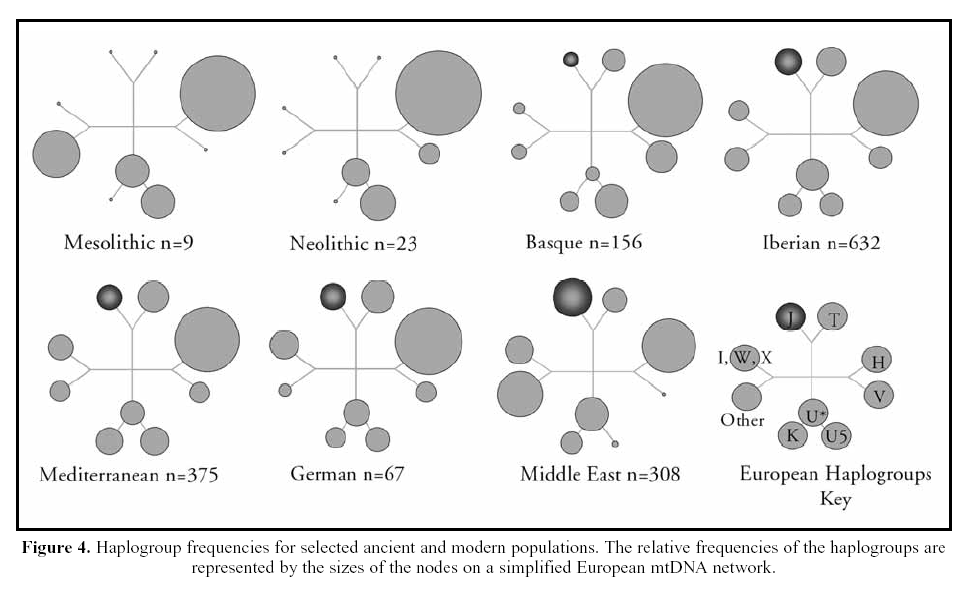
There's an interesting introduction on Zilhao's view of the Epipaleo-Neolithic transition in central and southern Portugal and then the interesting stuff comes all in figure 4:

What do you see? I see continuity. Sure: some unexpected N* has vanished and some V has appeared. But this variance is normal between any two different samples and the rest remains all the same: H dominance and some U (U5 and U* that is surely all U6)

Chandler et al. instead read discontinuity: immigration from some nearby West Mediterranean (European) source and population replacement. Well in the line of Zilhao's vision of Portuguese Neolithic transition.

Whatever the case, it is noticeable that none of the so-called Neolithic clades (especially but not only J) were present then. J, T, K, X and W must have arrived to Portugal (and presumably to all SW Europe) later on, at least in the Chalcolithic, maybe even later. These clades are also the smallest ones (together with U6) among Basques (of all modern samples). This would seem to ratify the generally accepted belief that Basque people are among the least influenced by post-Neolithic genetic influx in Western Europe and that H, V, U5, U6 (along with some mysterious N*, maybe R*, and U8a in the Basque case) constituted the Paleolithic mtDNA pool of SW Europe.

Haplogroup U* (U6):

It is noticeable that U* (U6) was already important in southern Iberia in pre-Neolithic times, what may contradict Maca-Mayer's rather forced interpretation of the U6 variability and spread. She argues for Iberian U6 to be not older than 10,000 years ago but she fails to provide an archaeological mechanism for that migration (while disregarding as merely accidental the fact that the highest variability of U6 is in Iberia and Western Berbers, and not in her alleged urheimat of the Nile). All that reasoning is founded in two factors:

1. That U6 is almost not found in Europe outside Iberia (though in fact it is occasionally found in France and Italy, with an unnamed distinct subclade unique to Sardinia)

2. That Oranian (Iberomaurusian culture) expanded from East to West (against the C-14 actual datations).

I suspect (and this suspicion grows stronger the more I read on the matter) that Oranian does actually honor its original name of Iberomaurusian and is derived from the Gravetto-Solutrean of southern Iberia, expanding from West to East in North Africa, bringing with it European haplogroups like U6, H and V (and maybe also Y-DNA R1b, rather common in Sudan and Upper Egypt) as well as technlogical and artitistic manifestations. U6 would then be the product of an early UP founder effect in southern Iberia, much like U8a among Basques. The counter-tide would belong to Capsian culture, which would have brought Y-DNA E1b1b (maybe together withmtDNA L, too common in North Africa to be just product of the rather minor trans-Saharan slave trade) as well as Afroasiatic languages.
.

Tuesday, February 3, 2009

Chimpanzees, politics and alpha males


If you're a fan of nature documentaries you have surely watched now and then the real adventures of our chimp cousins at the Gomba reservation. In that case, the names and even personality of these chimpanzees will be very familiar, as thanks to modern media you have become for a brief but intensive time a guest in their home.


But the researchers were not just filming documentaries, they were researching chimpanzee sociology and, by extension, also ours.

They have found that alpha males among chimps are not always the largest more brutish guys. Sometimes they are: Frodo a very large male, weighting 51 kg, never ever groomed others and yet he was the alpha male for some time. In contrast, Wilkie, weighting only 37 kg. (under male chimp average) became the alpha male with a most diplomatic strategy, grooming others almost compulsively. Freud, an intermediate guy weighting 44 kg (above average) used both strategies, grooming at times and imposing himself by force in other occasions.

Source: Science Daily, based on materials of the University of Minnesota.
.

The rich enviroment of Southern Iberia in the Ice Age


Just a quick note:
a new study led by J.S. Carrión (behind paywall) concludes that the area near Gibraltar, and overall in southern Iberia, was very rich and quite warm in the Upper Paleolithic, with a vegetation that included pines, oaks and other deciduous trees.

While Carrión emphasizes before the media this as the enviroment of the last Neanderthals, the dates given, 32,000-11,000 years ago, rather suggest the period of AMH (H. sapiens) occupation of the area, who arrived there c. 28,700 BP (uncalibrated oldest date for Gorham's Cave Aurignacian).


Gorham's Cave today (above) and as it could have been in the Ice Age (below),
as reconstructed by the Museum of Gibraltar .


Direct source: divulgative article at Science Daily.
.

Brands that support Apartheid in Palestine


Some of them:


Boycott them!
Boycott Israel!


Why? If you have still the slightest doubt:


.

Monday, February 2, 2009

Some 85% of US Jewish are Zionazis


I did not made up this, nor took from any "angry Arab" site... I found it (
via Body on the line) at a Zionist entity: the Anti Defamation League, self-described as "to stop the defamation of the Jewish people... to secure justice and fair treatment to all".

Well, according to their own data, only 14-17% of US Jewish are critical of Israel in relation with the Gaza genocide. The rest, either by ignorance, complacency, ethnocentrism, hypocrisy or a little bit of all, support Israel unconditionally.

There seems there is no need to defamate anyone: they are bluntly admitting to be Jewish Nazis. Only a small minority seems to have feelings beyond their own ethnocentrism and honor their people with some dignity and free thought.
.

Around the Web: Palestine Genocide goes on


Lots of news and analysis. Can only make a short mention of some of them:


Genocide by thirst: Israeli authorities block a French water purification system for Gaza and force it back to Marseilles (from Sabbah's Blog). Water is one of the main problems faced in Gaza right now.

Genocide by starvation: the destruction of farmland in overcrowded Gaza strip is dramatically increasing the hunger in the open air prision (from Annie's letters).

Widespread and disabling torture in the West Bank (by the forces of kappo Abu Abbas) financed by British (found at Sabbah's Blog and Filasteen, originally from the Daily Mail).

Spain will ammend the War Crimes' Law after several Israelis are charged (found at Palestine Free Voice).

Also, Joachim Martillo argues that Israel is nothing but another Ponzi Scheme. Such a tiny country with such a limited economy can't really afford the payments of its huge foreign debt and that, if massive direct aid would stop flowing from the USA, Israel would just collapse in a matter of days.

And there's also some info at Palestine Video on the important gas reserves offshore of Gaza, surely one of the elements behind the genocide.

The complicity with the criminals is all around us. Can we make it stop, can we make it reversed into zero tolerance, into active boycott for the most racist regime of our times? We can at least try, we must try.

If not you, who? If not now, when?
.

Sunday, February 1, 2009

The plain truth


Found at EAAZ, originally from Mondoweiss.

And be prepared for the worst, not passively but taking action as much as you can. Olmert is again making murderous threats. No matter that Israel is the one that has borken the truce not once but many times, the Zionazis still feel impune to murder indiscriminately.

This has to stop. And has to stop now. Why do all the "democratic" leaders of the West remain silent or even supportive before these crimes? Shouldn't they be preparing to intervene militarly against Israel, like they did in Kosovo or Bosnia?
.

The dance of the Eurasian haplogroups (mtDNA)


Updated and bumped: Feb-1-09. New paragraphs in ochre red.


Let's try to approach the issue of the human Eurasian expansions (adressed in previous posts via analysis of mtDNA structure) visually. Lines are used instead of dots when the geographical scope of a clade is large and the core of it can be argued.


1. 1st expansive pulse (maybe soon after Toba super-eruption, c. 74,000 BP):

This map shows the clades that (at their diversification moment) are separated from the L3 node by 5 or 6 SNPs (i.e. right after the formation of M and N). Clades in red are descendant of M, while those in blue are descendant of N. M and N as such are not shown but can be infered from their derivates.

If we could divide this pulse in fine detail following strictly the number of SNPs (something I am not sure it's realistic), we would get:

1.1. M node (preliminary M expansion/diversification).

1.2. N node. Simultaneously expansion of 5 M subclades, notably in SE Asia (M21 and M9-E). Other haplogroups expand (avant-guards?) in each of the three neighbouring regions.

1.3. Expansion mostly in South Asia (4+ subclades) with offshots also in all neighbouring regions: East Asia (M7), Australia (S) and West Eurasia (macro-X-N1).


The whole pattern argues for a homeland either in South or SE Asia. Or maybe at both regions at the same time.

There is no clear difference between M and N patterns, except that, at this stage, M is clearly present in SE, East Asia and Melanesia, while N is not (but is in Australia and West Asia). This could suggest a more westward tendency for N since the beginning and maybe an association with A blood type (most common in West Eurasia and among Australian Aborigines precisely).

In any case both macro-haplogroups moved through South and SE Asia. There is no clear barrier.

2. Interlude: brief pause of expansion and formation of haplogroup R:

This map shows the clades separated from L3 by 7 SNPs. They seem to form a narrow valley in the process of expansion/diversification (see previous post) and the moment is also worth a separate snap because it is when macro-haplogroup R was formed.

This is the first moment we see any N-derived presence in East Asia. This fact would argue for a South Asian (or at most SE Asian) origin for the R-N9 super-clade.


3. 2nd expansive pulse (some 60-50,000 years ago?):


This map shows the main clades that are separated from the L3 node by 8-10 SNPs. There is a peak of haplogroup nodes at 8-9 SNPs, which I understand as the second expansive pulse or early Eurasians. The 10 SNPs mark would rather be the end of that pulse and, in general, of the main expansive period.

In this and the next map, R derivated clades are marked in green, while blue is reserved for the N(xR) haplogroups.

We can again take a risk and divide this epysode in three possible "moments":

3.1. The first and main expansion of R (5 clades) reaches from India (R30 and R31, the latter reaching also to Australia) to New Guinea (P - seems I forgot to draw it in the map, sorry), including quite naturally SE Asia as well (B and macro-F). Simultaneously, in the M family, there is expansion in East Asia (M8-CZ) and of a rare clade (48) found at least in Saudi Arabia.

3.2. This subphase (the most expansive "instant" of the whole process) would rather belong to M, with four clades expanding in South Asia (M2, M35, M39 and M40), one into Andaman islands (M31), one in East Asia (G) and yet another one in all Sahul (Q). The expansion of R0-HV into West Asia also appears to happen in this moment. In East/NE Asia we also see the expansion of CZ (separated already from M8)

3.3. Less important "photogram". It includes three
apparent haplogroup expansions: M34 in South Asia, M42 in Australia and U (R-derived) between South and West Asia. It seems to be fully within the line of the previous "moment" and includes the last significative expansion into Sahul before Modern Age.

Overall the phase appears to show a fast expansion of R from India to Sahul, followed by an even more impressive second expansion of M in all the regions except SE Asia. Also R-derived clades begin making clear inroads into West Asia.


4. Aftermath, more diffuse expansion through a longer period:


This map shows the main events between 11 and 15 SNPs after the L3 node, including most of the expansion into West Eurasia and North Asia. Events after that I'm ignoring here.

The most eye-catching features here are that Eastern Eurasia and Sahul appear now disconnected from South Asia, which still shows some (weak) connections with West Eurasia. We can consider this phase as the beginning of "racialization" therefore, once the different Eurasian regions appear to have become mostly autonomous from each other.

It is also noticeable the inroads into Europe and North Africa by West Asian lineages at this rather extense phase.


Enjoy.

________________________

Reference: most global mtDNA structure can be found at Ian Logan's mtDNA site.
.