There's a nice article of economist I. Esnaola at Gara today, illustrating how the "rescue plan" of the IMF-EU tandem is a recipe for disaster. It is exactly the same "medicine" Latvia got in 2008 and things have only got worse for them since then: growing unemployment (even higher than Spain!), "growth" of -18% in a single year, and all without being able to stop public deficit from running wild at all. That's exactly what they want to impose to Greece, just that the Greek people seem much less sheeply than Latvians and may just send IMF, EU and everything of the like to the trash bin in the process. Spain does not seem to need an IMF package: it is already applying one: on its own will nearly all state income is reliant on a growing VAT (consume tax, now to be raised to 18%) and from tobbacco, alcohol and gasoline special taxes. Meanwhile the wealthy enjoy the best deals, what makes Spain unable to collect enough money for its expenses. Instead, the only conservative government of the three South European countries, that of Portugal, has decided to tackle the tax crisis by raising taxes to the wealthy segment, up to 45%. It's clear that they are the only ones who know how to deal with the budget crisis: redistributing and not just loading the scales against the working class even more.
Mundo Neandertal leads me to a new research paper that shows that the teeth of the Lagar Velho child, arguably the most clear case of Neanderthal-Sapiens hybridization, in spite of being several thousand years more recent than the last known Neanderthals, had teeth that compare well with those of extant modern humans and, in particular, with young H. sapiens from La Madeleine (LM4).Ref.: Priscilla Bayle et al. Dental maturational sequence and dental tissue proportions in the early Upper Paleolithic child from Abrigo do Lagar Velho, Portugal. PNAS 2010 (paywall or free access depending on your world region, supplementary material freely accessible in any case).
It is noticeable that more and more the support for the specimen being any type of hybrid seems to vanish. Computer Assisted Paleoanthropology clearly states that a comparative geometric-morphometric analysis of the Lagar Velho cranium clusters this individual with modern human children of age 3 to 4 and does not reveal Neanderthal affinities.
So I understand that is fair to say that at the present stage of research there is not a single specimen that can clearly be described as hybrid of H. sapiens and H. neanderthalensis, which is coincident with the growing genetic evidence against such hybridation.
There seems to be several of these structures in SW Iberia but many are under urbanized areas. However the one at Perdigoes (Reguengos de Monsaraz) is not and is hence being researched by the University of Malaga.They are made up of concentric ditches that, for what has been discovered so far, were created sequentially, with the ones at the interior being filled when the exterior ones were dug. The different texture of the fillings, which retain water better, allows for these to be seen in air photographs after rains (photo below). In Perdigoes, the interior (oldest) rings seem to be dated to the second half of the fourth milennium (c. 3500-3000 BCE), while the most recent are from well into the third milennium. They have found varied stuff in them, including human and animal remains.
We believe that these were spaces that hosted scattered groups for ceremonial purposes such as marriages or funerals. When these ceremonies were over, they made the enclosure to disappear, throwing everything into the ditches.
Source: Terra Antiquae (in Spanish). It also includes a link to a PDF (also in Spanish) on the maybe related mysterious and ubiquitous Chalcolithic silos/wells of this area, which are argued to be local manifestations of more widespread practices of the Megalithic area. See also this news item (ADN, in Spanish too).
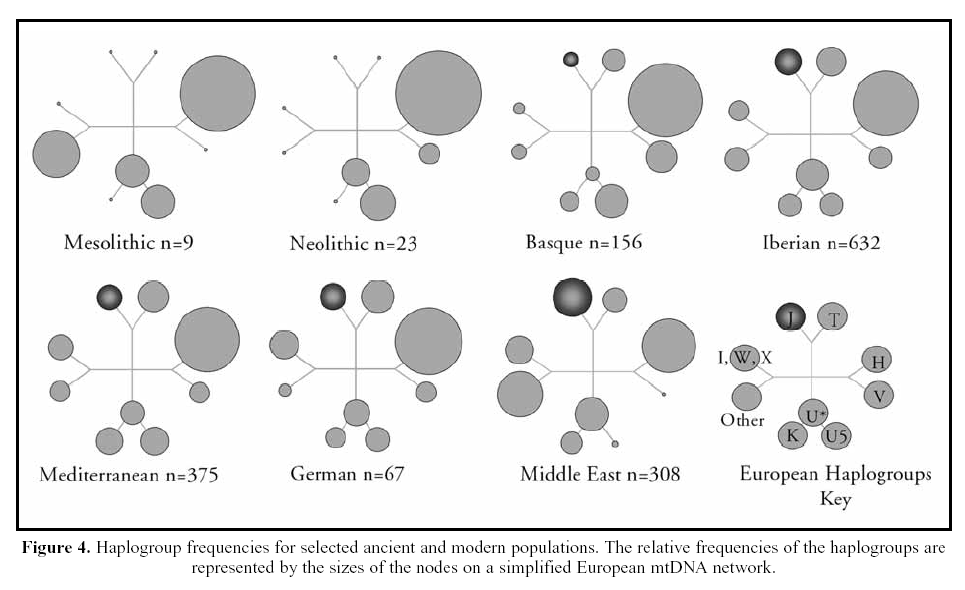
Via Mathilda's Anthropology Blog, one of my favorites because even if she often dwells in non-recent papers, these are almost always very interesting for those who, like myself, are fascinated by human prehistory. Also is probably the only anthropology blog that dedicates a lot of articles to North Africa.The paper is: Using ancient DNA to examine genetic continuity at the Mesolithic-Neolithic transition in Portugal (H. Chandler, B. Sykes and J. Zilhao, 2005). More than two years old but still a novelty for me.There's an interesting introduction on Zilhao's view of the Epipaleo-Neolithic transition in central and southern Portugal and then the interesting stuff comes all in figure 4: What do you see? I see continuity. Sure: some unexpected N* has vanished and some V has appeared. But this variance is normal between any two different samples and the rest remains all the same: H dominance and some U (U5 and U* that is surely all U6)
.

 Posts