New blogs

Leherensuge was replaced in October 2010 by two new blogs: For what they were... we are and For what we are... they will be. Check them out.
Showing posts with label extra-solar planets. Show all posts

Tuesday, August 24, 2010

Stellar system somewhat like ours found


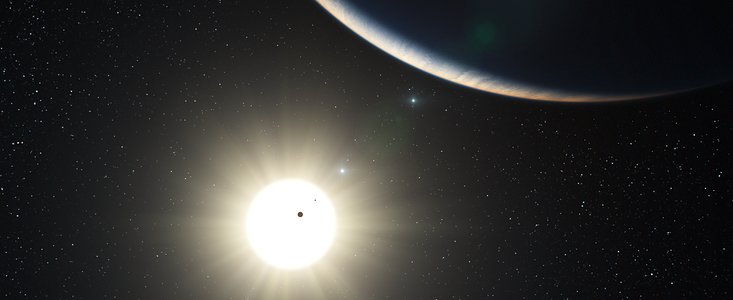
The European Southern Observatory (ESO), which owns some of the most sophisticated Earth-based telescopes (all them located in Chile's Atacama Desert), has detected at least five Neptune-sized planets orbiting star HD 10180 in the constellation of Hydrus. Other two smaller planets have been detected as well but with some uncertainty, one of them orbiting very close to the parent star and measuring 1.4 times the mass of Earth.


Artist's impression of a detail of the new system

The finding represents the first time a planetary system so similar to ours, with planets organized following the Titus-Bode law (each planet is roughly twice the distance of the one immediately closer to the Sun) and with almost circular orbits. It is also sign of a new phase in the exploration of extrasolar planets, not anymore searching for individual planets as much as for whole planetary systems.

This has been possible thanks to the HARPS or High Accuracy Radial velocity Planet Searcher, a highly sophisticated spectrograph. Other 75 exoplanets have been discovered with this instrument.

The details are explained at ESO's site. BBC also has an article on this discovery.

Thursday, March 18, 2010

First "normal" extrasolar planet found


We were getting bored of hot super-jupiters and massive super-earths, right? Well, finally a normal planet has been found by ESA's
CoRoT satellite telescope in a star of the constellation Serpens Cauda (snake's tail).

The new exoplanet is a regular gas giant like Jupiter or Saturn and is in a temperate zone, reasonably distant from its parent star, which is similar to our Sun (a very normal star, by the way).

Source: Science Daily.

Update: The same story at BBC reports that the planet has an orbit "like Mercury", which is clearly too close to the parent star to be considered a "temperate zone". They still dare to speculate (just that) about the possibility that the planet might have water clouds.

Friday, December 4, 2009

First extrasolar planet ever imaged


This certainly deserves an entry here: for the first time ever, human eyes, aided with telescopes, have been able to image directly what seems to be a planet (or probably two) orbiting a star other than the Sun. We had detected them before by the slight decay of luminosity when a planet passes before its sun but never before had a planet outside the Solar System been taken a photo.


This is an extremely important event in space exploration. Never before now human eyes could see something like this:


The star GJ758 is artificially occulted at the center of the image (though it's light obviously hides most of its vicinity anyhow) and the possible planets are circled and tagged with the corresponding letter. They might be brown dwarves or hot Jupiters, otherwise we'd probably would not be able to see them.


C. Thalmann et al., Discovery of the Coldest Imaged Companion of a Sun-Like Star.

Found originally via Science Daily. Image credit: Max Planck Institute for Astronomy/National Astronomical Observatory of Japan.

Thursday, February 5, 2009

Smallest exoplanet found


The European Space Agency informs that a new very small, less than twice the size of Earth, rocky planet has been found orbiting a star much like our Sun. Nevertheless the planet is in a very close orbit to its parent star, so much that a whole local "year" happens in only 20 of our hours. The temperatures in the exoplanet therefore must be around 1000-1500ºC.


The planet has been named COROT-exo-7b and no information is provided in the news release about where it is.


How many civilzations share the Galaxy?

In a somewhat related news article at the BBC, on a recent report at the Journal of International Astronomy by Duncan Forgan. He has simulated a galaxy like our own under different premises and the results are:

1. If life was difficult to form but evolves easly into intelligent forms, then the likely number of civilizations in the Milky Way is of 361

2. If life evolved easily but intelligence was difficult to achieve, then the likely number of civilizations is 31,513.

3. If life could migrate between planets and solar systems via asteroid collisions, then the number of civilizations would be something like 37,964.

So guess there are some 30-40,000 "alternative humankinds" out there and, more importantly, that this number is only conditioned by the difficulties that life could find to form, not by the difficulties of its evolution into intelligent (i.e. human-like) forms.

Contacting with them would be another issue, because of the huge distance involved any "conversation" could only happen in the course of centuries or even milennia, the shortest time needed for light (radio signals included) to travel between our respective planets.

Another issue not yet sufficiently pondered is wether there is really intelligent down here on Earth. I have some doubts, honestly.
.

Thursday, December 11, 2008

Official: Black Hole is "the sun of the Sun"


Nothing really new for those with some interest for astronomy but the 16-years research at
Max-Planck-Institut für extraterrestrische Physik (Germany) have confirmed that there is a black hole at the center of the Milky Way. After long years of observations, the astronomers involved have concluded that there is no other possible explanation for the behaviour of the stars near Sagittarius A*. They found that there is an inner group of very fast rotating stars with randomly inclined orbits and an outer one of stars orbiting the black hole in an ecliptic-like plane.

The most important evidence has come, for what I could infer, from the orbit of S2, a star that moves so quickly that has completed one whole orbit around the GC black hole in those 16 years of watch. In their own words:

Observations by our group and by the UCLA group of the velocities and accelerations of stars in the Galactic Center over the course of the last decade have already provided strong evidence that SgrA* is in fact a black hole of about 2.6 million solar masses. However, these measurements could not rule out some alternatives to the black hole model. Two such alternatives are a ball of massive, degenerate fermions, like neutrinos, or a cluster of dark astrophysical objects, such as stellar mass black holes or neutron stars. These two alternative explanations can now be excluded by analyzing the orbit of S2:

In spring 2002 S2 was passing with the extraordinary velocity of more than 5000 km/s at a mere 17 light hours distance -- about three times the size of our solar system -- through the perinigricon, the point of closest approach to the black hole. By combining all measurements of the position of S2 made between spring 1992 and summer 2002, we have obtained enough data in order to determine a unique keplerian orbit for this star, presented in Figure 1. It is highly elliptical (eccentricity 0.87), has a semimajor axis of 5.5 light days, a period of 15.2 years and an inclination of 46 degrees with respect to the plane of the sky. From Kepler's 3rd law we can determine the enclosed mass in a straightforward manner to be 3.7±1.5 million solar masses. Therefore at least 2.2 million solar masses have to be enclosed in a region with a radius of 17 light hours. It is not possible to explain this result with a neutrino ball model because the required neutrino masses would be too large, or with a dense cluster of dark astrophysical objects because such a cluster would have the extremely short lifetime of at most a few hundred thousand years. Compared to the lifetime of our Galaxy of the order of 10 billion years this configuration is highly improbable. The only remaining alternative to the black hole model is a ball of bosons, which would be hard to distinguish from a black hole because of its small size. However, eventually, after some time such a ball would eventually collapse to a black hole after having accreted enough matter from its surroundings. Hence, the observed keplerian orbit of S2 around SgrA* provides compelling evidence for the existence of a massive black hole at the center of our Galaxy.


The inner cluster of fast rotating stars, artistic reconstruction

In the media:
- Science Daily
- BBC


Water and CO2 in extrasolar planet:

This also called my attention and has been mediatically relevant: an extrasolar "Jupiter" shows clear signs of having CO2 and water, substances that we immediately associate with life (though this extreme is, of course, unconfirmed yet).

(At BBC, at SD)

Wednesday, September 24, 2008

Earth-like planets orbiting binary stars found... destroyed


As exciting and frustrating as it sounds: the first evidence of planets oribiting a double stellar system and one of the few so far on the very difficult to detect terrestrial planets happens to be a terrible collision of two of these planets.


From Science Daily: Two Planets Suffer Violent Collision.

The US astronomers had been studying a dust ring around one of the stars in this binary system, thinking it might be the signature of a young solar system in formation. But they now think that the dust ring has actually been caused by a brutal crash of two Earth-like rocky planets, after finding that the stars are actually too old to represent a young forming stellar system.


Artist rendering of the collision

The closest similar incident ever happening in our vicinity was possibly the collision that created the Moon, but that happened when the Solar system and Earth itself were very young. Currently the odds of something similar happening here are nimious.

I wonder if the fact that these ill-fated objects are part of a binary star system may have increased the odds of such outcome, maybe because of the gravitational unstability caused by the other star...

Tuesday, June 3, 2008

Small earth-like planet found


MOA-2007-BLG-192Lb is 3.3 times our Earth and orbist what seems to be a brown dwarf at a distance of 0.6 AU (like Venus from our Sun). The star seems too weak to directly allow life (at least as we know it) so far away but scientists suspect the planet may have a thick enough atmosphere to warm the planet via greenhouse effect.

Source: BBC: Tiniest extra-solar planet found.


artist's impression of the new planet and its dim sun