New blogs

Leherensuge was replaced in October 2010 by two new blogs: For what they were... we are and For what we are... they will be. Check them out.
Showing posts with label Iberia. Show all posts

Thursday, September 30, 2010

Boy buried near Stonehenge was from the South


A teenager who died c. 1550 BCE and was buried near Stonehenge with an amber necklace was not raised in Britain but further south, near the Mediterranean, reports BBC. 

The burial was discovered in 2005 5 km south of Stonehenge, in a mound at Boscombe Down, while doing roadworks for military housing. His age at death is estimated to have been 14-15 years old.

The burial shows the characteristic fetal position of Bell Beaker but not the usual grave goods of this subculture

The oxygen isotopes found in his enamel evidence that he grew in a warmer climate than Britain, near the Mediterranean. Date and context suggest to me Portugal, where an important Megalithic civilization was still active at that time. However other places of Megalithic culture in Iberia, Southern France or even North Africa or Italy cannot be discarded with the available information. 

Other people buried near Stonehenge known to have arrived from afar are the Amesbury Archer, a member of the Bell Beaker subculture, known to have grown at the Northern Alps, and the Boscombe Bowmen, also with a Bell Beaker style burial, known to be from Wales or Brittany or maybe even farther away. However all these belong to a much earlier period, 750 years earlier than the boy of the amber necklace. This strongly suggests that Stonehenge and the religious/cultural (and maybe political) complex around it kept attracting people from the wider Megalithic and Bell Beaker area for almost a whole millennium, possibly more.

Stonehenge, no doubt, was a Mecca of its time. Pity that we know so little about the beliefs and society that motivated such pilgrimages.

Saturday, September 25, 2010

Online edition of the origina Siret study on Iberian Metal Ages


Belgian archaeologist Louis Siret (also known as Luis Siret y Cels) was a pioneer of archaeology in Spain and the discoverer of the Chalcolithic and Bronze Age civilizations of Los Millares and El Argar in SE Iberia.

His original book Les premiers ages du metal dans le sud-est de l'Espagne (The early Metal Ages in the Southeast of Spain) has now been made available online, after restoration, by the Junta de Andalucía (Andalusian autonomous government). It can be accessed online at Archive.org in several formats including scanned facsimile. It is only available in French though.


Tuesday, September 21, 2010

Upper Paleolithic and Epipaleolithic vegetation and climate of NW Iberia


Just a brief mention of an important palaeoclimatic paper (in Spanish language):


Pablo Ramil Rego, Cambio climático y dinámica del paisaje en Galicia (Climate change and environmental dynamics in Galicia). Recursos Rurais, 2009. (Direct PDF link).

Most informative is maybe figure 12, that I reproduce here:

Click to expand

It is pretty evident that in the Last Glacial Maximum (first map), the region was dominated by grass and mountain dwarf shrubs, but with importance of forest in the south (Northern Portugal) and even in Asturias (something I was not clearly aware of and that should be general for all the Cantabrian strip).

Forests gradually expanded in the Late Upper Paleolithic, as climate warmed gradually, becoming clearly dominant in the Epipaleolithic (last map), when climate was already pretty much like today's. Epipaleolithic would anyhow last for some three millennia after the period covered here.

Later deforestation is apparent (fig. 15) but mild at some locations since c. 5000 calBP (beginnings of Neolithic), in the Iron Age, but specially since the Roman and Medieval periods.


Found at Arquêociencias[por].

Tuesday, August 31, 2010

Dog remains from Epipaleolithic Portugal


As suspected, the dog was already domestic before the Neolithic and that was certainly the case in Europe. This seems confirmed by new findings of dog remains in the shell middens of the Muge area, the main clutural group of pre-Neolithic Portugal.

Cleia Detry and Joao Luis Cardoso, On some remains of dog (Canis familiaris) from the Mesolithic shell-middens of Muge, Portugal. Journal of Archaeological Science, 2010. Pay per view.

Just for the record. Notice that the oldest known dog skeleton is from Aurignacian Belgium although its mtDNA line is now extinct.

Wednesday, August 4, 2010

Genetic flow across the Strait of Gibraltar


Researchers from the University of Geneva try to address the somewhat complex problem of genetic flow across the Strait of Gibraltar, between SW Europe and NW Africa, in a new paper:


Mathias Currat et al., Human genetic differentiation across the Strait of Gibraltar. BMC Evolutionary Biology, 2010. Open access.

They analyze a number of genetic variables such as Y-DNA, mtDNA, blood groups ABO and Rh, and other antigen/antibody systems (HLA, MNS and GM) and produce a number of statistical analysis for them. However they acknowledge that their modeling on continuous, rather than punctual, gene flow, may have some difficulties providing clear-cut answers.

Still they do produce results that are in general favorable for the P scenario (flow since 20,000 years ago), excepting to some extent the Y-DNA, which is probably a secondary sex-biased element overall.

Above: The scenarios are described in page 10 and in the supplementary material. P is "Paleolithic" flow beginning 20,000 years ago (Ibero-Maurusian or Oranian culture) among small populations, N instead is "Neolithic" flow among larger populations. PN is intermediate and PNI is intermediate but also considering the Islamic expansion (though details are not provided).

They also produce results of quite greater affinity within each region (SW Europe and NW Africa) than between them, as expected.


Notice in this graph (and also fig. 3) how autosomal markers' curves and that of mtDNA (MT-HV1, in blue) are very similar, however while mtDNA tends to lesser homogeneity within regions, it strongly tends to higher homogeneity instead across the Strait. This I interpret as meaning greater affinity across the strait in the Paleolithic, before the primarily male expansions reflected in the Y-DNA, altered the scenario.

Sadly no graphs for each of the two regions is provided, what does not allow us to make a more detailed assessment, like whether the Y-DNA expansion happened at both coasts or not, and, if so, if they were fully comparable or somehow different. I say this because the apparent SW European origin of North African mtDNA H (c. 25%) detected by Cherni 2008, and probably other haplogroups like V and K, would be consistent with a more European-like population before the E1b1b1 expansion in the context of Capsian culture (in North Africa) which is probably associated also to the expansion of Afroasiatic languages. However I see no reason to support a similar male-biased expansion in SW Europe.

Let the authors conclude:

Conclusion

While contrasted conclusions were obtained by previous studies based mostly on single genetic loci, our study clarifies the role of the Strait of Gibraltar regarding its permeability to gene flow. Indeed, our multi-locus approach led us to take into account variations between loci when trying to infer past history of human populations around the Gibraltar area. We were thus able to show that the Y chromosome on one side, and HLA-DRB1 on the other side constitute two extreme cases of very strong and very weak (respectively) genetic differentiations between populations across the Strait. The lack of genetic differentiation for HLA-DRB1 is particularly interesting because it can be explained by balancing selection (with a coefficient of selection estimated here to be around 2%). Given the huge worldwide dataset available for this locus, a better understanding on the mechanisms of selection at HLA loci could be very helpful to the study of human evolution, and more generally MHC. Our results obtained for Gibraltar have to be confirmed by further studies in other areas, especially where gene flow between populations is reduced. This work thus constitutes a step forward towards a better characterization of the combined effects of selection and demography on the genetic structure of populations, and especially on their genetic differentiation.

Saturday, July 3, 2010

More Paleolithic rock art found deep in La Peña de Cándamo (Asturias)


The generally quite informative Spanish archaeology blog
Pileta de Prehistoria reports that archaeologists have found more rock art in a deep hidden gallery of La Peña de Cándamo cave in Asturias (often mentioned as La Peña but sometimes as Cándamo too), which is Patrimony of Humankind since 2008.

The new findings include some 200 artworks, including dot marks and other abstract symbols, hand and finger applications and a large headless horse.


While the cave was reopened in 1994 after a period of closure, the new gallery will only be available to "visit" online because it is not easy to access at all.

More info: Cándamo Town Hall - Cave[es].

Friday, June 25, 2010

Odd chalcolithic burial in Atapuerca


The archaeological site of
Atapuerca, Burgos province, Spain (Basque territory in the Middle Ages at least) is most famous for its Neanderthal and H. antecessor remains but there is much more to it.

The Cueva del Mirador in particular has provided some data on Late Upper Paleolithic, Neolithic, Chalcolithic and Bronze Age, including about ten burials. But one of them, reported only now, is very unusual because the young woman (c. 15 y.o.) was buried in fetal position, which is something unheard of in Iberia (or elsewhere in Europe out of the Balcano-Danubian Neolithic area) before the arrival of the Bell Beaker subculture (phenomenon). The normal burial position elsewhere was in extended form, often accompanied with ochre, a practice that has its roots in the Paleolithic.

The woman was buried apart from the other tombs, suggesting some sort of special status.


The source of this news item, the blog of the Catalan Institute of Human Paleoecology - Social Ecology (IPHES - Catalan with automatic translator to other languages) hints that the remains are dated c. 4500 years ago, several centuries before the arrival of Bell Beaker or even its inception in Central Europe. Also there's no mention of anything else that reminds of Bell Beaker. The recovered burial goods mentioned are pottery (no type specified), mollusk shells (Dentalium sp.) and remnants of what might be a belt or collar.

The presence of mollusks strongly suggest some sort of connection with the Bay of Biscay coastal areas and they might have had an ornamental or medicinal use (Dentalium was considered an excellent source of alkali in pre-modern medicine).

I am thinking that it is very possible that the young lady belonged to some group of travelers (refugees, traders, pilgrims, diplomats...?) from the Danubian cultural area area, which at this date reached as far south as the Garonne at some moments (reconquered by the bowmen's Artenac culture soon after). This would explain the separate burial and the distinctive characteristics of it. The geographical situation of Atapuerca, the main pass between the Duero and Ebro basins and a key connection between Atlantic Iberia and mainland Europe does suggest it.

See also: Pileta de Prehistoria entry[es] and visual description of El Mirador Cave (PDF)[es].

Friday, June 11, 2010

North Iberian Neolithic seeds


Found
at Arqueocienciências, a Portuguese archaeology blog.

It refers to a poster (quasi-paper, in English) presented to the last conference of the IWGP by Inés López, Pablo Arias and Roberto Ontañón detailing the carpological findings in two Neolithic caves of Northern Spain, Los Gitanos (Cantabria, near the Basque border) and Aranga (Asturias, near the Cantabrian border).


Synthesis of findings:


Aranga cave (Asturias):

The Mesolithic period (stratigraphic units 4 and 3) is dated to between c. 7500-7000 cal BCE and includes mainly hazelnut (Corylus avellana) remnants but also a few instances of barley (Hordeum vulgare) and another undescribed cereal, as well and Sorbus sp. (rowan).

The Late Neolithic period (unit D) is dated c. 3350-2600 cal BCE and contained mostly barley, as well as some instances of hazelnut and one acorn (Quercus sp.)

In addition to these, it is reported in the text the presence of wild apples. Apple seeds have also been recovered in a Basque cave (Aizpea, Zapata 2002).


Los Gitanos cave (Cantabria):

Neolithic (units A4, A3 and A2) is dated to c. 5000-2600 cal BCE and included only a few instances of hazelnut and acorn, plus a single instance of Brassica sp. (genus including mustard and cabbage)

Chalcolithic (unit A1) is dated more precisely to c. 3600-3100 BCE and is still dominated by hazelnuts and acorns but already showing some instances of cereal (wheat, oat and an undetermined cereal), as well as one instance of Rumex sp. (sorrel or dock)

The authors are unsure on whether the Brassica and Rumex instances were collected for food or arrived as part of some weeding activity.


The consumption of acorn bread was reported for Northern Iberia as very common in Roman times.

It is noticeable that not a single instance of pulse was found.

Wednesday, May 26, 2010

New paper on Spanish genetics


There's a new paper of some interest on Spanish population genetic structure:


J. Gayan et al. Genetic Structure of the Spanish Population. BMC Genomics. Open access.

The main aim seems to be to provide a Spanish dataset for population genetic research. And so far so good.

However the sampling strategy is awkward to say the least:

In the above map (my creation on the paper's data), red dots indicate sampling locations, while blue areas are regions (autonomous communities) not included in the sample. Most noticeable is that not just the Basque Country has been excluded but also all the surrounding area.

As I say, quite awkward.

Other surely distinctive unsampled areas are the Canary Islands and Galicia.

The whole design of the sample has a Castile-centric bias that is difficult to understand.

But, well, that's what they did. And, once we know that, we can go on to look at the results:

In this graph (fig. 6 annotated by me) we can see how Catalans and Andalusians tend to diverge from neutrality in orthogonal directions. To a less clear extent, the North Castilian samples (Arévalo, Segovia) also diverges somewhat.

We can say that PC1 describes a Catalan-other axis and PC2 an Andalusian-other one. The lack of distinctiveness of some geographically eccentric samples such as the Asturian one (Avilés)may well be caused by the small size of the sample. It is very possible that a PC3/PC4 graph would evidence some distinctiveness that is not apparent here.

Remember that PC graphs are merely bidimensional representations of some of the apparent structure, with all the limitations that this implies.


European comparison

When compared with other populations of European ancestry the PC graph is as follows (annotations by me on fig. 7):


Catalans appear to have some tendency towards Italy and NW Europe, while the less defined eccentricity of Andalusians only seems to tend towards Italy. There are also a couple of Castilian individuals who cluster with NW Europeans, maybe because the North Castile area sampled was the core of Visigothic settlement (just a hunch).


Global comparison

There's not much to say about Spaniards in the global scatterplot (fig. 8), really: all Europeans just cluster very tightly, the same as East Asians (Chinese and Japanese).

What I found intriguing and worth posting this graph is the curious coincidence of the scatter of Kenyan Maasai (MKK) and US African-Americans (ASW). Notice that the LWK sample (Luhya) are also from Kenya but Bantu and they cluster best with Nigerian Yoruba (YRI). Not really sure because it'd need further research but certainly the almost identical disposition of MKK and ASW samples is suggestive of the Maasai (and maybe other Nilotes) being somewhat admixed with West Eurasians. Alternatively the distribution might be reflecting some African-specific differences (just like Indians in the Eurasian context) and its overlap with African-Americans is to some extent an artifact of the limitations of PC analysis.

I do miss a comparison with North Africans, which seems to be a taboo in Iberian and European population genetic studies. However I do detect (and not only here) a slight "African" tendency among some Iberians which may well reflect a greater affinity with North Africans, in turn slightly more akin to ultra-Saharan Africans. This would be an interesting matter to analyze.


Update: I totally forgot to mention that just a few days ago I commented on another paper by a Catalan team that did compare Iberians and North Africans, which may serve for comparison. The results appear wildly different in the PC graph, with Catalans, Basques and Cantabrians clustering on one corner and the other Iberians scattered with a clear tendency towards the Eastern Mediterranean. No apparent North African affinity was detected.

Sunday, April 25, 2010

Nineteen: hemeretzi


Andalusian archaeology blog Pileta de Prehistoria has
a nice video archive on Spanish caves (in Spanish language what I've seen so far) that I have just began browsing (earlier I was suffering of some JavaScript bugs that did not let me enjoy all their features).

But it's not about this archive what I want to talk but about a detail of the main panel of the Peñaescrita shelter that I found there. I took this still:


In at least two of the figures I can see the number 19 following the method I read years ago on a book on Iberian archaeoastronomy (sorry but I can't remeber any better reference).

The method, apparently found in many drawings of the period (Chalcolithic) through southern Iberia as well as in the perforated plates of the VNSP-Zambujal civilization in Portugal consists essentially in drawings with the following patterns:

(a) |||||||||/

(b) \\\\\\\\\|/////////

In the second case (b), you count all the lines to 19 but they are distributed in a 9-1-9 pattern, in the former instead (a), the 19 is "hidden" in a 9-1 pattern that you have to read again backwards to form the 9-1-9 or 19 number.


Why 19? What does it mean? For what I recall it was a key number, together with 4, to follow the lunar cycles. They argued that they also produced larger numbers such as 223, which is the key to predict lunar ecclipses (as they happen every such period of lunations or natural months). For some reason that I don't grasp well enough, the number 19 was the most evident and maybe most common in these drawings, of which the above image has two examples (the horizontal bar with 10 other bars hanging from it (a) and the plant drawing to the right (b)).

And this discovery brought me to consider the origin of two Basque numeral names: hamaika (11) and hemeretzi (19). I noticed them because they are the only numbers betwen 10 and 20 that are not said 10-something (i.e. hamabi: 12 < hamar: 10 + bi: 2)

Hamaika or amaika (the 'h' is a mute modern standarization rule that does not exist in most dialects) means of course 'eleven' and is also used in figurative sense to mean 'lots', 'many', but it may equally mean 'finishing' or 'in the way of ending' (from amai(-tu): 'to end', 'to finish'). I hypothesize that in this Chalcolithic astronomical context the name would indicate something like "last count", "begin finishing here".

Hemeretzi also can be understood quite straightforwardly to be hemen etzin: 'here lay'.

I also speculated a bit on whether another number of long name, bederatzi (9), might mean something in this context (bider atzi: 'access the prominence'??) but it has too many possible interpretations so I can't tell with minimal certainty.

In any case, this is a reason why I think that Basque language might have its roots in an important language of the Megalithic area of that era: because these two numerals appear to make sense only in this esoteric context. Surely, back then, large numbers above 10 (some linguists speculate that Basque originally had only numbers up to five) would not be used too much by the commoners, instead priests, druids or witches working with these concepts to be able to make calendaric predictions, in particular eclipses, had to know them and used them often, at least in these esoteric cryptographic calendars.

It's well known that experts in the Megalithic cultural area had an ample and often surprisingly good understanding of astronomy, a key knowledge in an agricultural or mariner context. So the calendars should not raise too many eyebrows. What I'm sure will put some people in a defensive attitude is to relate this knowledge with Basque language with such a clear native etymology.

But that's what I see in any case.

Tuesday, March 16, 2010

The Neanderthal-Sapiens transition at Cova Gran (Catalonia)


Found at Pileta de Prehistoria.


J.M. Moreno et al., The Middle-to-Upper Palaeolithic transition in Cova Gran (Catalunya, Spain) and the extinction of Neanderthals in the Iberian Peninsula. Science Direct, 2010. Pay per view.

A good article can be found at El País in both Spanish and English.

Most relevant seems to be that the transition between the occupations by the two species is separated by a thick sterile layer, meaning that there was no sudden replacement but maybe just the colonization of an empty land.

Cova Gran is located at the Catalan Pyrenees in the province of Lleida.

Thursday, February 18, 2010

Macrolithic Epipaleolithic in NE Iberia


I have just found about a very interesting and intriguing phase of the Epipaleolithic in the NE Iberian peninsula, which I did not know about before. Thanks to
Millán Mozota for the reference.

It seems that what used to be thought as a facies of Mousterian, defined by the saw-like edges of the tools, was eventually dated with radiocarbon to a very narrow period of the Epipaleolithic, between 10 and 8 thousand years ago.

The following papers (all in Spanish) deal with the issue:

A. Alday Ruiz, El Mesolítico de muescas y denticulados en la Cuenca del Ebro y el litoral Mediterráneo peninsular: síntesis de los datos. 2006.

Carlos Mazo Pérez et al., El Epipaleolítico macrolítico en Aragón en el contexto del valle del Ebro y la Cataluña costera. 2006.

Manuel Vaquero Rodríguez, El Mesolítico de Facies Macrolítica en el centro y sur de Cataluña. 2006.

All these articles, as well as others, are gathered in a book.

This map (from Mazo's paper, dates in thousand years ago) explains a bit how it happened:


Group 1: the macrolithic industries close the ocupation of the site after a period of abandonment

Group 2: the macrolithic industries are intercalated between early Epipaleolithic levels (Azilian/Sauveterrian) and late Epipaleolithic levels with geometrics of Cocina style (Tardenoisian of Iberian facies).

Group 3: the macrolithic industries initiate the occupation of the site, continued later with geometrics of Cocina style.

This other graph, from Vaquero's article illustrates the chronology in Catalonia:

Above: dated levels by millennium (in Roman numbers, often used in Spanish for ordinals). Below total of dates by millennium. The patterns indicate: Upper Paleolithic Magdalenian industries (black), Early "Sauveterroid" Epipaleolithic industries (horizontal stripes) and Macrolithic Epipaleolithic industries (vertical stripes).

I won't extend much on the matter as of now, as I'm still learning about it. But I find important the fact that this strange industry, allegedly related to a temporary and dramatic increase of the forests (Alday), seems to indicate the end of the so-called Microlaminar Epipaleolithic (Azilian/Sauveterrean) and precedes the establishment of the Geometric Epipaleolithic (Tardenoisian-derived).

As I have mentioned recently this last industry, though widespread, did not achieve full implantation in all the Iberian peninsula. It seems almost non-existent in Ronda (Andalusia) and as far as I know also in Murcia, where the Neolithic transition happened with the oldest Epipaleolithic facies (Microlaminar) still in use.

Instead in all this North/NE area, the Neolithic transition happens in a context of Geometric industries, also older than Neolithic itself but more recently arrived from France than the Microlaminar industries.

I wonder therefore if the Y-DNA lineage R1b1b2a1a2 (of which three subclades are found in the area described here, the others present in mainland Europe and Ireland, but very rare in West or South Iberia) may be related to the Tardenoisian spread, with the other major sublcade of R1b1b2a1, R1b1b2a1a1, being maybe related to Maglemosean and related epi-Magdalenian industries of the North Sea basin. It would make good sense if one accepts that R1b1b2a1 as a whole spread with Magdalenian culture.

Friday, February 12, 2010

The Neolithic transition in Ronda (Andalusia)


Found
at Pileta en Blogger [es].

Natalia González Hidalgo, PROCESOS DE NEOLITIZACIÓN. EL CASO DE LA MEDIA MONTAÑA SUBBÉTICA OCCIDENTAL: LA DEPRESIÓN DE RONDA. Arqueología y territorio, nº6. 2010. (PDF - open access - [es]).

The author reviews the transition from Epipaleolithic to Neolithic in the Ronda Depression, Andalusia, Spain. The archaeology of the area is dominated by extensive prospections but few detailed excavations, what make a comprehensive analysis somewhat more difficult. In any case, I gather two important elements from this synthesis:

1. There was very limited impact of the Geometric microlithism (Tardenoisian-related), remaining the area essentially in the Laminar stage (Azilian-related) for all the Epipaleolithic.

2. There was clear continuity between Epipaleolithic and Neolithic, with gradual incorporation of agriculture and cattle to an economy that remained basically hunter-gatherer at first.

Above: stratigraphic sequence of La Pileta cave, presented as example of the Ronda sites. Notice the continuity between the Upper Paleolithic (Paleolítico Superior - D) and Neolithic (Neolítico - C), while there is a sterile layer (B) on top this phase separating it from the Chalcolithic period (A), being this the only moment of discontinuity that can be spotted in all the sequence from Gravettian to the Middle Ages.

Tuesday, January 19, 2010

In search of Tartessos at Doñana marshes


The Tartessian (proto Tartessian, Tartessian and Tartessian-Orientalizing) culture is a well known stage of Iron Age Southern Iberia, however the semi-mythical city of
Tartessos (Tarshish in the Bible), allegedly destroyed by the Phoenicians, has never been located, so the understanding of this civilization is lacking the cornerstone.

For long people has speculated that it might been hiding in the marshes of Doñana, a national park at the Low Guadalquivir river. However archaeological research in the area has been nil so far. Until now.

Some years ago aereal photos showed rectangular and circular structures in the marshes that must have been man-made. Now finally researchers of the Spanish Higher Council for Scientific Research (CSIC) are digging the area.

No results have been presented so far but the fact that there is an ongoing excavation is at least assuring.

Source: Telegraph (via Archaeology in Europe).

Note: I would totally disregard the speculations regarding "Atlantis" in the article, specially those related to that pseudocientific Cuban so-called archaeologist, who has no real cue and has been forging artifacts to make his Atlantean claims more appealing to the people he gets donations from.

In my opinion, the legend of Atlantis, as well as the Heraklean one on Erythia, must refer to the slightly better known Portuguese culture of Vila Nova de Sao Pedro and particularly its long living and large capital of Zambujal, many of whose characteristics resemble Plato's description, including that it had a large canal of about the dimensions stated by the Greek philosopher connecting it to the Atlantic Ocean. If I'm correct, then the events reflected in these two legends should have happened in the Bronze Age, when Greek (Mycenaean) influence in SE Iberia is more apparent (later Phoenicians would have the main role). Also the critical role of tin in this period would have been a major drive in whatever conflicts happened in the "far west" (the Hesperides), where the most important sources of this strategic metal used to be (Galicia, Cornwall).

Tartessos belongs to a later phase, surely taking the role of the ill-fated Zambujal and El Argar civilizations for some centuries before its own destruction (by Phoenicians, according to their own claims). Its legacy was nevertheless long-lasting, an is believed that the Turdetani living in the Guadalquivir basin were its cultural descendants.

For a wider review of Ancient Iberia, check my old article on this matter at All Empires.

Friday, December 11, 2009

Intriguing ring structures being researched in Portugal


There seems to be several of these structures in SW Iberia but many are under urbanized areas. However the one at Perdigoes (Reguengos de Monsaraz) is not and is hence being researched by the University of Malaga.


They are made up of concentric ditches that, for what has been discovered so far, were created sequentially, with the ones at the interior being filled when the exterior ones were dug. The different texture of the fillings, which retain water better, allows for these to be seen in air photographs after rains (photo below).


In Perdigoes, the interior (oldest) rings seem to be dated to the second half of the fourth milennium (c. 3500-3000 BCE), while the most recent are from well into the third milennium. They have found varied stuff in them, including human and animal remains.

We believe that these were spaces that hosted scattered groups for ceremonial purposes such as marriages or funerals. When these ceremonies were over, they made the enclosure to disappear, throwing everything into the ditches.


Source: Terra Antiquae (in Spanish). It also includes a link to a PDF (also in Spanish) on the maybe related mysterious and ubiquitous Chalcolithic silos/wells of this area, which are argued to be local manifestations of more widespread practices of the Megalithic area. See also this news item (ADN, in Spanish too).

Wednesday, February 4, 2009

Portuguese ancient DNA


Via
Mathilda's Anthropology Blog, one of my favorites because even if she often dwells in non-recent papers, these are almost always very interesting for those who, like myself, are fascinated by human prehistory. Also is probably the only anthropology blog that dedicates a lot of articles to North Africa.

The paper is: Using ancient DNA to examine genetic continuity at the Mesolithic-Neolithic transition in Portugal (H. Chandler, B. Sykes and J. Zilhao, 2005). More than two years old but still a novelty for me.

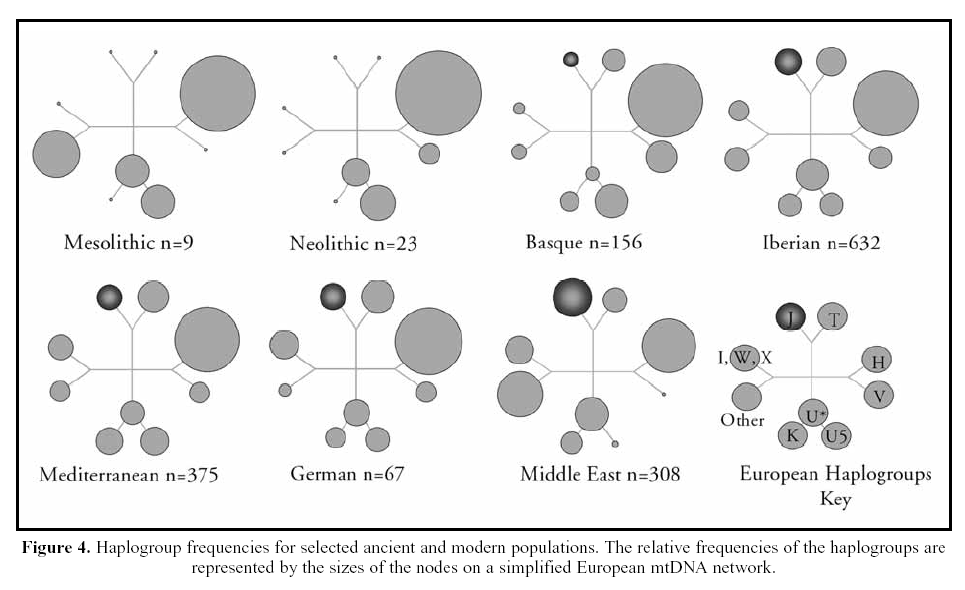
There's an interesting introduction on Zilhao's view of the Epipaleo-Neolithic transition in central and southern Portugal and then the interesting stuff comes all in figure 4:

What do you see? I see continuity. Sure: some unexpected N* has vanished and some V has appeared. But this variance is normal between any two different samples and the rest remains all the same: H dominance and some U (U5 and U* that is surely all U6)

Chandler et al. instead read discontinuity: immigration from some nearby West Mediterranean (European) source and population replacement. Well in the line of Zilhao's vision of Portuguese Neolithic transition.

Whatever the case, it is noticeable that none of the so-called Neolithic clades (especially but not only J) were present then. J, T, K, X and W must have arrived to Portugal (and presumably to all SW Europe) later on, at least in the Chalcolithic, maybe even later. These clades are also the smallest ones (together with U6) among Basques (of all modern samples). This would seem to ratify the generally accepted belief that Basque people are among the least influenced by post-Neolithic genetic influx in Western Europe and that H, V, U5, U6 (along with some mysterious N*, maybe R*, and U8a in the Basque case) constituted the Paleolithic mtDNA pool of SW Europe.

Haplogroup U* (U6):

It is noticeable that U* (U6) was already important in southern Iberia in pre-Neolithic times, what may contradict Maca-Mayer's rather forced interpretation of the U6 variability and spread. She argues for Iberian U6 to be not older than 10,000 years ago but she fails to provide an archaeological mechanism for that migration (while disregarding as merely accidental the fact that the highest variability of U6 is in Iberia and Western Berbers, and not in her alleged urheimat of the Nile). All that reasoning is founded in two factors:

1. That U6 is almost not found in Europe outside Iberia (though in fact it is occasionally found in France and Italy, with an unnamed distinct subclade unique to Sardinia)

2. That Oranian (Iberomaurusian culture) expanded from East to West (against the C-14 actual datations).

I suspect (and this suspicion grows stronger the more I read on the matter) that Oranian does actually honor its original name of Iberomaurusian and is derived from the Gravetto-Solutrean of southern Iberia, expanding from West to East in North Africa, bringing with it European haplogroups like U6, H and V (and maybe also Y-DNA R1b, rather common in Sudan and Upper Egypt) as well as technlogical and artitistic manifestations. U6 would then be the product of an early UP founder effect in southern Iberia, much like U8a among Basques. The counter-tide would belong to Capsian culture, which would have brought Y-DNA E1b1b (maybe together withmtDNA L, too common in North Africa to be just product of the rather minor trans-Saharan slave trade) as well as Afroasiatic languages.
.

Tuesday, February 3, 2009

The rich enviroment of Southern Iberia in the Ice Age


Just a quick note:
a new study led by J.S. Carrión (behind paywall) concludes that the area near Gibraltar, and overall in southern Iberia, was very rich and quite warm in the Upper Paleolithic, with a vegetation that included pines, oaks and other deciduous trees.

While Carrión emphasizes before the media this as the enviroment of the last Neanderthals, the dates given, 32,000-11,000 years ago, rather suggest the period of AMH (H. sapiens) occupation of the area, who arrived there c. 28,700 BP (uncalibrated oldest date for Gorham's Cave Aurignacian).


Gorham's Cave today (above) and as it could have been in the Ice Age (below),
as reconstructed by the Museum of Gibraltar .


Direct source: divulgative article at Science Daily.
.

Monday, December 8, 2008

Neolithic spread in Iberia, the Y-DNA perspective


What follow are my best guess on how Neolithic clades from the Eastern Mediterranean and North Africa may have spread in Iberia.


I understand that E3b2 corresponds to a North African clade (sorry but cannot recall which is which after so much renaming, specially as the supplemental material on which all is based does not list the mutations), while E3b1 is probably the Balcanic clade instead. At least that's what seems apparent from their respective distribution areas.

See my previous post on this matter for further details on specific clade distribution and references.


It seems apparent that:
  1. Cardium Pottery (and whatever came after it) had an irregular array of founder effects in Eastern Iberia: J2 and G are stronger in Catalonia, E3b1 in Valencia while T is strongest in Ibiza, while the Ebro Valley appears as a hub for both J2 and T specially.
  2. SW Iberia, a major civilization hub since Chalcolithic (probable focus of Megalithism, major hub of Bell Beaker, site of several important towns/cities), may have been a major focus of "Neolithic" Y-DNA expansion, specially in what regards to NW Iberia, an area colonized only in the eve of Copper Age, along with Megalithism spread. It seems specially the main hub of Norh African Y-DNA E3b2 and may have redistributed it elsewhere in Europe in the context of Megalithism and Bell Beaker.
Additionally I made a separate map (again my best guess) for haplogroup I, which may have several separate origins. Check this older post on Pyrenean Y-DNA period as well as its Hallstattic continuity, when Celtic to see that, while a good deal of Iberian haplogroup I is clearly the Balcanic/Sardinian clade, another important fraction is not and may have arrived with the Celts in the late Bronze and early/middle Iron Age. The Ebro Valley showing up again as an important hub for haplogroup I may relate to the late Urnfields presence in Iberia was being consolidated and expanded precisely following that route upstream the Ebro river (though they were later cut off from the continent, it seems - forgotten wars of which we only have fragments).


Note please that I'm focussing here in the minority clades (yet not erratics either). I have obviated any mention to the main haplogroup R1b, that makes up the vast majority of the ancestry, though varying through regions too (the Southwest, Ebro Valley and Asturies appear as abnormally low).

Saturday, December 6, 2008

Iberian Y-DNA


Found the reference to this interesting Y-DNA study
at Dienekes. The paper itself, by Adams et al., is behind a paywall, but curiously enough the supplemental material is not. And there is where all the hard data is anyhow.

It's maybe one of the most comprehensive Y-DNA studies of Iberian (and Gascon) populations. After some work, I got the following distribution maps:


Haplogroup R1b.

Nearly all R is R1b, with some R1b* at Valencia but mostly R1b3 (really old nomenclature, I know, but it's what the paper uses and does not mention the specific SNPs, so I'm follwing it here, much to my own displeasure). There's also some scattered R1a1 and even one R1* in Western Andalusia.

Within R1b3 most is R1b3* (if anybody is willing to compare the haplotypes, that would be an interesting thing to do and I'd love to hear from the results - overall, on first sight, they appear rather closely related anyhow). There are three SNP-defined subclades though:
  • R1b3b, only found in the Basque Country (2 individuals)
  • R1b3d, clearly stronger among Basque and Gascons and less important elswhere
  • R1b3f, centered in Catalonia (other studies suggest Mid/Eastern Pyrenees) and somewhat more common in the peninsula, specially in the East


R1b becomes somewhat rarer to the SW but it is also oddly low in Asturias and Aragon. These two regions show some peculiarities regarding other clades too, what suggests that they have been affected by major demic movements at or after the Neolithic.


Haplogroup I.

Neolithic or Celtic or both? Lacking clear data on what subclades are more common in each region is hard to judge. Overall other studies have suggested that the Iberian main clade is the same as that of the Balcans, what would suggest a Neolithic origin (Cardium Pottery) but hard to say without testing downstream SNPs.

Haplogroup I in Iberia is strongest at Aragon (a major Celtic hub in the Iron Age) but other locations appear to relate better with a Neolithic spread. The high presence in Galicia, Asturias and Extremadura could be explained by both prehistorical migrations.


Haplgroup E3b (now E1b1b).

While there are some E3b*, some E3b3 and even some E(xE3b), two clades appear dominant: E3b2 and E3b1. Not sure which is which (this nomenclature went obsolete long ago) but I think one correlates best with Greece/Albania and the other with North Africa. Nevertheless their distribution patterns are very similar, being both strong in the West specially.

Out of the Western Half, Valencia and Minorca appear significative in the East, what may relate to Neolithic founder effects.


Haplogroup J2.

While here is some scattered J(xJ2), most of the Iberian J is J2. This is a clearly Neolithic clade too, that must have originated in the Eastern Mediterranean, arriving with Cardium Pottery.

It's widespread but again the West (specially the SW, but also the enigmatic Asturias) appears unusually high.


Haplogroup G.

This is another clade that must be original from West Asia (Neolithic). It appears strongest in Portugal and overall in the West. There are other areas, notably Catalonia, where this clade is also very important.

Haplogroup T.

Described as K(xP), this clade must be T (formerly known as K2). It must be again a Neolithic clade and is strongest in Ibiza (Phoenician founder effect?).


And that's about all. Just to mention the two cases of Q(xQ3), found one in the Basque Country and the other in Andalusia that must be considered erratics of likely Anatolian origin (Neolithic).

Hope you like the maps.