
New blogs

Leherensuge was replaced in October 2010 by two new blogs: For what they were... we are and For what we are... they will be. Check them out.

Saturday, January 23, 2010

R1b1b2 and R1b1b2a1 distinct STR diversity


I'm borrowing here the work of
Aargiedude (again) because it's such a priceless addition that it really deserves to be paid some attention. If professional geneticists would be half as serious as this amateur, we'd know a lot more and a lot better about our the population history of humankind by now.

These two maps represent the haplotype diversity of R1b1b2a1 (ht15) and R1b1b2* (ht35) respectively:
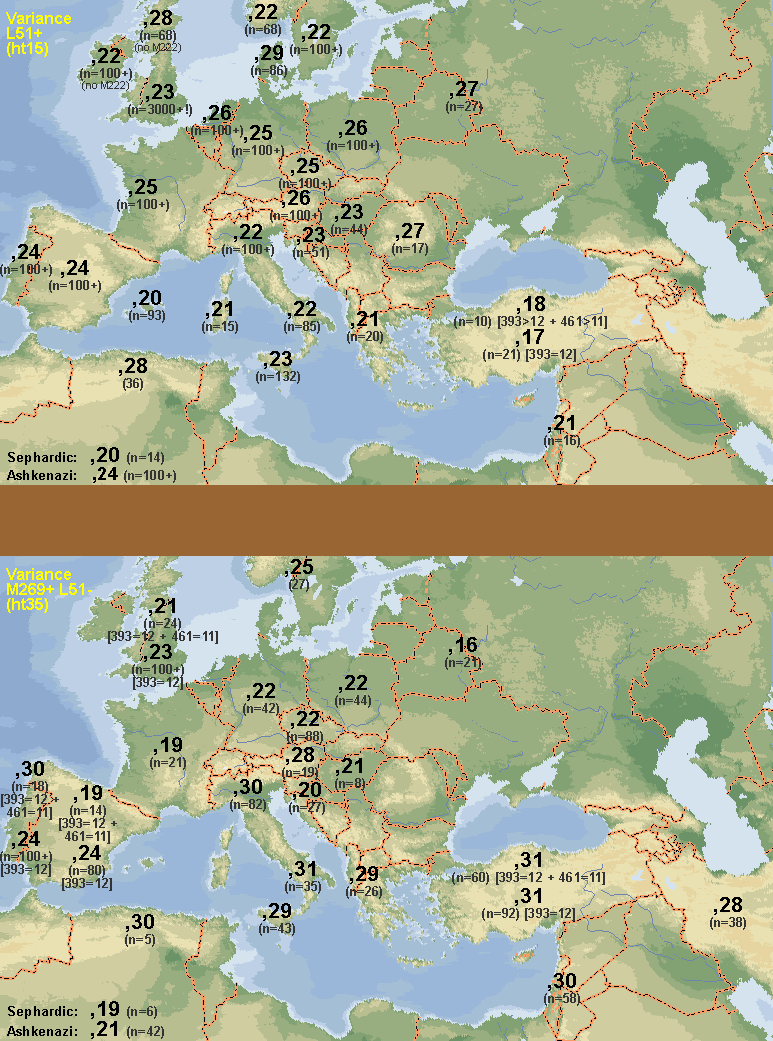
Click to expand

Aargiedude's own observations at Dienekes' blog follow:

I've finished estimating ht15 and ht35 diversity, it's taken me 2 days to do this, and I think the results are amazing. The diversity clines of ht15 and ht35 are almost polar opposites. I think these results seriously call into question the conclusion of the Balaresque study, which is what prompted me to look into this. There's no surfing-on-an-expanding-wave phenomenon occuring with ht15. It has its lowest variance in the supposed origination point: Anatolia.

Instead, as Maju pointed out brilliantly, the study's tree diagram of their R1b1b2 haplotypes seems the result of 2 separate events, not a single wave diffusion. And he was absolutely right.

The diversity of ht35 doesn't form a gradually decreasing cline. It seems to be uniformly similar from Iran to west Iberia, or at least up to Italy, because there are issues with the validity of the North African and Iberian data (small sample size in one case and confusion with ht15 samples, in the other). Its cline seems to be more north-south than diagonally from southwest to northeast. East European countries have the same ht35 diversity as West Europe, with the special consideration of the west Iberian results.

Some technical details to keep in mind. Ht15 can be differentiated from ht35 by barely 2 markers: 393 and 461. Few studies test 461, so most of the samples I used were chosen on the basis of 393 alone. But about 3% of ht15 and 10% of ht35 have the "wrong" value, becoming confused with the other group. This usually doesn't matter, exceot in countries where there is an overwhelming ratio difference between the frequencies of both groups, such as in Iberia, France, Britain, Netherlands, Anatolia, and the Levant. In these extreme cases, I've included, where possible, 2 pair of results. The top pair uses samples predicted as narrowly as possible, by using both 393 and 461. The bottom pair is the standard prediction using just 393. The top pair should be more accurate, but they tend to lack in sample size, so then again, maybe not. Notice in the case of Iberia, that the less restrictive result changes drastically from the more restrictive result, and results in identical values to Iberia's ht15 diversity estimate, suggesting most of the samples are in fact ht15 samples that are being confused for ht35 because they had a mutation in 393 to the modal value of ht35 on that marker. Curiously, this didn't happen in France, where I was only able to use the less accurate method (393 alone), and yet the result is notably low and different from France's ht15 diversity. I'd seriously take North Africa's high ht35 result (0,30) with a military-issue teaspoon of salt, it's just 5 samples. On the other hand, it's notoriously high ht15 diversity (0,28) is pretty solid.

To recap, Baralesque and all geneticists are stuck in a time warp, they're back in 2003, thinking R1b is just R1b. What a waste, after going through all the effort of collecting and processing the samples, to not have had the sense to test for a few extra key mutations that define some major subdivisions of R1b1b2 and are well known for more than 5 years. The conclusions they reached would then have been very different.

The Balaresque paper was discussed at Leherensuge a few days ago.

Friday, January 22, 2010

Motivation is different for different personalities


Interesting
this article at Science Daily. There seems to be two different types of personalities, those who strive for excellence and those who strive for fun.

Oddly enough they are similarly productive, it all depends on the motivation. For the first type (achievers), when something is presented as challenging or are motivated by subliminal messages of excellence and accomplishment, they work better... but when something is presented as fun, they are just not interested and fail. The other type (enjoyers), maybe more common, do exactly the opposite thing: they will perform well when something is presented as fun but will feel demotivated when it's presented as a competition for excellence. Again, with the wrong motivation, they just lose interest and do worse.

As a decided member of the club of anti-competitive enjoyers, I perfectly understand this type: Excellence? That's boring. Fun? Then I will give my best.

As the co-author of the research, Dolores Albarracín, suggests: enjoying life is not a bad goal. But placed in a competitive environment we will unavoidably feel disenchanted and, almost willingly, allow ourselves to "lose".

We just want some other kind of game, one that is, simply put, enjoyable and not just demanding. It's not that we are worse: we are just not interested in winning just for the sake of it. First of all it has to be emotionally gratifying.

That's what communism (well understood) is about: destroying alienation and making work and production again something cool, not just the worthless competition of of the living dead that is today.

Thursday, January 21, 2010

US military intervention effectively blocks aid in Haití


It was bad already and then the marines arrived.


They do not only do zero humanitarian work but severely hamper that of those who want and can help.

Yesterday I watched in TV returning Spanish rescue specialists that complained that they were forced by the invaders to stop their work at 5pm and severely restricted their activities on "security grounds", when they say that they never felt any threat at all.

Some propaganda images of the marines distributing aid have been spread by the media but RNE journalist Fran Sevilla absolutely denies that they are doing anything at all, not even patrolling much. They have taken indeed control of of the Port-au-Prince airport and give absolute priority to their own deployment and the evacuation of US nationals, in practice blockading the the aid distribution.

France and Brazil have joined the chore of complaints by many Latin American countries against the ugly reality of US unilateral intervention. Bolivian President Evo Morales is even organizing a UN meeting to demand the retreat of US troops on light of their harmful activity.

Physicians without Borders and Intermon OXFAM have complained that their aid is stuck at Santo Domingo unable to reach Port-au-Prince because the marines don't give them authorization. .

The maybe feeble but anyhow real, aid organizatiod by the Haitian government, that had moved its headquarters to a police station near the airport, has been totally overruled without legal authority by the disproportionate, meaningless and useless US military invasion, which seems more designed to promote obscure imperialist interests than to help in any meaningful way.

Source: Rebelión.

Molecular clock speculation obscuring the real Jurassic origin of primates


Again reality and reason clash frontally with the
molecular clock hypothesis (or at least the most common interpretations of it).

If we'd have to follow the molecular clock speculations, so fashionable these days, we'd have to have sailor monkeys, which would have crossed oceans to get into America already in the Eocene, when the Atlantic Ocean was already huge. Such a colossal feat is plainly impossible, even for humans before just some centuries ago, but the fanatics of the molecular clock religion have argued for transoceanic rafting and hypothetical "island hopping" en masse.


Non-human primate range.

Common Sense shakes its head in disbelief, Folly laughs delighted at the naivety of even some of the supposedly most brilliant human minds.

Luckily Reason still has good cards to play in this surrealistic meta-game of honest facts versus trickster blind faith. The card that Reason plays now reads:

Michael Heads, Evolution and biogeography of primates: a new model based on molecular phylogenetics, vicariance and plate tectonics. Zoologica Scripta 2010.

Abstract:

The ages of the oldest fossils suggest an origin for primates in the Paleocene (∼56 Ma). Fossil-calibrated molecular clock dates give Cretaceous dates (∼80–116 Ma). Both these estimates are minimum dates although they are often 'transmogrified' and treated as maximum or absolute dates. Oldest fossils can underestimate ages by tens of millions of years and instead of calibrating the time-course of evolution with a scanty fossil record, the geographical boundaries of the main molecular clades of primates are calibrated here with radiometrically dated tectonic events. This indicates that primates originated when a globally widespread ancestor (early Archonta) differentiated into a northern group (Plesiadapiformes, extinct), a southern group (Primates), and two south-east Asian groups (Dermoptera and Scandentia). The division occurred with the breakup of Pangea in the Early Jurassic and the opening of the central Atlantic (∼185 Ma). Within primates, the strepsirrhines and haplorhines diverged with volcanism and buckling on the Lebombo Monocline, a volcanic rifted margin in south-east Africa (Early Jurassic, ∼180 Ma). Within strepsirrhines, lorises and galagos (Africa and Asia) and lemurs (Madagascar) diverged with the formation of the Mozambique Channel (Middle Jurassic, ∼160 Ma). Within haplorhines, Old World monkeys and New World monkeys diverged with the opening of the Atlantic (Early Cretaceous, ∼130 Ma). The main aspects of primate distribution are interpreted as the result of plate tectonics, phylogeny and vicariance, with some subsequent range expansion leading to secondary overlap. Long-distance, trans-oceanic dispersal events are not necessary. The primate ancestral complex was already widespread globally when sea-floor spreading, strike-slip rifting and orogeny fractured and deformed distributions through the Jurassic and Cretaceous, leading to the origin of the modern clades. The model suggests that the topology of the phylogenetic tree reflects a sequence of differentiation in a widespread ancestor rather than a series of dispersal events.

The paper is behind paywall but you can read a synthesis at Science Daily.

The molecular clock, if it still makes any sense at all, is certainly much slower. Primates migrated to South America in the Jurassic, when it was still part of Gondwanaland.

Wednesday, January 20, 2010

R1b1b2a1: Neolithic or what?


I found at Dienekes the reference of a new paper on R1b1b2, focused on demonstrating (quite forcibly) that the lineage is Neolithic and not Paleolithic. Dienekes is, of course, happy that they chose to use his favorite (but rather disliked in the field) molecular clock methodology: the one based on the pedigree mutation rate, which make all haplogroups look extremely recent.

Patricia Balaresque et al. A Predominantly Neolithic Origin for European Paternal Haplogroups. PLoS Biology 2010. Open access. I'm provding a link to PubMed Central because at the time of writing this the original link remained broken.

I am not really happy: the pedigree rate can't be used for ages older than 5000 years (and all dates reported in this paper are clearly older) and, anyhow, the highly hypothetical molecular clock methodologies are anything but helpful when they become the main theme of a "research" paper.

I am not happy either because instead of using the already known SNP-based phylogeny of the haplogroup, they choose to treat the whole haplogroup as a single amorphous clade, when it is clearly structured. This isn't very helpful either.

Finally I am not happy either because they treat (again) the process of Neolithic spread in Europe as a single phenomenon, when it is in fact a complex array of various cultures, notably two different main vectors: one via the Morava-Danube and another via the Mediterranean coast. Both with origins not in Anatolia directly but in the Balcans. They ignore all these archaeological facts rather insultingly.

However for those who like to dig in the raw data, instead of just jumping to the too often biased and misleading conclusions, the paper still has some interest.

Notably I found figure 3 (haplotype structure) quite interesting. Here you have it with a crucial annotation for better understanding:

Click to expand

The crucial annotation is of course marking (with a dark red line) what is not part of R1b1b2a1, which is, as you can see a single branch of the star-like structure, but, unlike the others, is clearly not part of the fundamentally European haplogroup R1b1b2a1. Part of it is at the root of R1b1b2 and R1b1b2a but the rest of sub-branches must be derived, representing a distinct process centered in Turkey and nearby areas.

I dwelt on this matter in a previous post, so I'm not going to go all over it again here. Just for a quick reference a copy of the graph I posted then, showing major haplotypes and their relation with the various layers of the haplogroup:

Click to expand. Based on Alonso-2005.
DYS are 19-390-391-392-393.

As you can easily see most of the Turkish diversity belongs to the R1b1b2(xR1b1b2a1) part of the haplogroup structure. And sure I don't doubt that Anatolia or somewhere nearby is at the ultimate origin of R1b1b2. But there is a sharp distinction between that and what we find in Europe, which almost exclusively belongs to R1b1b2a1, a very specific sublineage.

And a sublineage that is very much ramified in a star-like structure, implying rapid demic expansion. When? That is not really the crucial issue as I see it. "Where?" should be the first question and a question that no paper has yet dealt with from the viewpoint of R1b1b2a1 on its own right.

In the past the lack of knowledge of the structure of the haplogroup may have served as excuse but not anymore. In fact any self-respecting geneticist should look at that SNP-based structure before dealing with STR-based haplotypes and take good notice of the distinctions.

And, if not, why not to include R1b1b1 (Central Asian) or even R1b1a (Italy and Africa mostly) and other R1b*? It is an arbitrary choice, poorly justified.

But, well, what do we get from this data set after we scrap off the extreme bias? For those who enjoy dealing with haplotypes in detail there is a long list in the supplementary material, which duly processed may provide very useful information.

I have not the time nor the resources to do that, so I have done something much simpler but also very informative: count the haplotypes by region as defined in figure 3 (above). Sadly France (incl. Basques), Germany, Netherlands, Denmark, England (incl. Cornwall) and Ireland are all dumped together in the category "other" ("West Europe" hereafter). Unlike the authors I do make the important distinction of what is R1b1b2a1 and what is not.

Follows the number of haplotypes by region and phylogenetic category (manual count so subject to minor error maybe):

R1b1b2(xR1b1b2a1):
  • Turkey: 37
  • West Europe: 20
  • Iberia: 8
  • Balcans: 2
  • Italy: none
R1b1b2a1:
  • West Europe: 198
  • Iberia: 90
  • Turkey: 13
  • Italy: 11
  • Balcans: 6
What does this say? That even between perfectly comparable regions such as Turkey, Italy and Iberia, the highest diversity for R1b1b2a1 is in the West. If you look again at figure 3 you'll notice that most Turkish haplotypes of this clade are derived from European ones, what implies back-migration after the formation and spread of R1b1b2a1, which must have happened in Western or Central Europe.

When did this happen? I am not sure but I have some things clear:

The structure of R1b1b2 does not correspond at all with what one would expect from a demic spread from the Balcans (not Anatolia directly) through two clearly distinct pathways, one to the Danube and Central Europe and the other through Italy to SE France and Iberia. Neither the Balcans nor Italy look particularly central nor we see two differentiated founder effects but only one.

Also the distribution of R1b1b2a1 in a cline that is, as the authors of this paper shamelessly admit, totally the inverse of what one could expect of a demic spread from SE Europe.

The structure of R1b1b2a1 in fact strongly suggests a spread from somewhere in the region described as "Other" and or Iberia, i.e. in Magdalenian Europe. This is in full agreement with the generally accepted theory that R1b1b2a1 spread from the Franco Cantabrian region after the Last Glacial Maximum, along with Magdalenian culture. It could have other explanations (Epipaleolithic flows, older Upper Paleolithic cultural dispersals like Gravettian or Aurignacian) but it just cannot fit within a Neolithic frame. No way!

How did it back-migrate to Anatolia? Possibly with the people who carried the rock art fashion to southern Turkey (Beldibi), which may have an offshoot also at Egypt, where some R1b1b2 is also found, as well as related haplogroup R1b1a. The exact process is still somewhat uncertain anyhow.

Sadly enough the authors have missed an opportunity to analyze the regional structure of this haplogroup in Europe. Hopefully someone else will eventually do it, helping to clarify the matter. The raw data is anyhow there for whoever wants to do it.


Update: a much more realistic geographic analysis of the diversity at the two different phylogenetic levels (by Aargiedude) can be found at this new post.

Imaz: key player in pro-Spanish Basque politics.


I remember very well how the now defunct magazine Ardi Beltza (dedicated to research journalism and hence one of the first victims of the
Neoinquisitorial process that began 1998) denounced Josu Jon Imaz as "the man of the Zionist Lobby in the Basque Country".

By that time he was already a rising star within the institutional Basque Nationalist Party (EAJ-PNV), that has a soft nationalist discourse but a mere regionalist praxis and which has ruled the region for the last many decades, benefitting from polarization. He became a key member of the Western Basque autonomous government in 1999 and in 2004 he managed to reach the highest position of the ruling party, representing the "moderate" faction.

In 2008 he left for a private (formerly public) company, Petronor, part of the Repsol-YPF corporation, and curiously after an important share (15%) was acquired by Argentine investor Enrique Eskenazi (not sure how Zionist is this guy but the surname is obviously Jewish, so probably a lot, considering he's also a major international investor).

He has kept a low profile since then but he remains quite obviously influential (his ultra-soft current remains in control of PNV, he managed to persuade Athletic football club to accept the sponsorship of his company).

This peculiar far-reaching influence of Josu Jon, as he is often called "affectively", is now again on the spot after he has been apparently appointed as advisor (along with several other high-profile capitalists - but no labor unionists) of the undemocratically elected new Lehendakari, Patxi López (unionist, PSE-PSOE). His party has declined to comment on grounds that is a private activity (is it?)

Gara newspaper dwells on the matter today, including the protest of major labor union LAB against such a spat of corporative appointments, and notices that the unionist proconsul López has several times declared his admiration for Imaz, whom he considers one of "those nationalists we have always had understanding with in the past, and will have in the future".

The newspaper also recalls how Imaz was the head of the representation at the last political negotiations at Loiola, in 2006, and how he seconded the breakup of them by the Socialist Party, ruling in Spain then and now. López has also used the figure of "moderate" Imaz against that of "radical" Juan José Ibarretxe (last democratically elected Lehendakari), much more popular for the electors, obviously. Imaz in turn has got absolutely no problem in showing up along the undemocratic new local ruler in spite of remaining a member, and a very influential one, of the Nationalist Party, now forced to be mere opposition, after some 12-18% of the electors have been deprived of their civic rights.

For me he's nothing but an opportunist squirrel but it seems that he holds some very unusual leverage.

Tuesday, January 19, 2010

In search of Tartessos at Doñana marshes


The Tartessian (proto Tartessian, Tartessian and Tartessian-Orientalizing) culture is a well known stage of Iron Age Southern Iberia, however the semi-mythical city of
Tartessos (Tarshish in the Bible), allegedly destroyed by the Phoenicians, has never been located, so the understanding of this civilization is lacking the cornerstone.

For long people has speculated that it might been hiding in the marshes of Doñana, a national park at the Low Guadalquivir river. However archaeological research in the area has been nil so far. Until now.

Some years ago aereal photos showed rectangular and circular structures in the marshes that must have been man-made. Now finally researchers of the Spanish Higher Council for Scientific Research (CSIC) are digging the area.

No results have been presented so far but the fact that there is an ongoing excavation is at least assuring.

Source: Telegraph (via Archaeology in Europe).

Note: I would totally disregard the speculations regarding "Atlantis" in the article, specially those related to that pseudocientific Cuban so-called archaeologist, who has no real cue and has been forging artifacts to make his Atlantean claims more appealing to the people he gets donations from.

In my opinion, the legend of Atlantis, as well as the Heraklean one on Erythia, must refer to the slightly better known Portuguese culture of Vila Nova de Sao Pedro and particularly its long living and large capital of Zambujal, many of whose characteristics resemble Plato's description, including that it had a large canal of about the dimensions stated by the Greek philosopher connecting it to the Atlantic Ocean. If I'm correct, then the events reflected in these two legends should have happened in the Bronze Age, when Greek (Mycenaean) influence in SE Iberia is more apparent (later Phoenicians would have the main role). Also the critical role of tin in this period would have been a major drive in whatever conflicts happened in the "far west" (the Hesperides), where the most important sources of this strategic metal used to be (Galicia, Cornwall).

Tartessos belongs to a later phase, surely taking the role of the ill-fated Zambujal and El Argar civilizations for some centuries before its own destruction (by Phoenicians, according to their own claims). Its legacy was nevertheless long-lasting, an is believed that the Turdetani living in the Guadalquivir basin were its cultural descendants.

For a wider review of Ancient Iberia, check my old article on this matter at All Empires.

Sunday, January 17, 2010

New "consensus" radiocarbon calibration curve


The INTCAL committee has forged a revised and consensual new calibration curve, which was published of Friday
at Science magazine (found via Archaeology in Europe).

A simplified format, useful for reference for amateurs like myself is openly available:

Very roughly, for an even quicker reference: 10,000 BP means 11,500 years ago, 20,000 BP means 23,000 years ago and 35,000 BP is equivalent to 40,000 years ago. Uncalibrated dates are noted as BP, while calibrated dates are usually tagged as calBP (or similar) or even, quite informally, as "years ago". Different calibration curves can bring confusion too and therefore having a single reference curve as this one may be quite important.

It is worth mentioning in this regard the review of this matter of C
14 dates, raw and calibrated, that Julien Riel-Salvatore made a few days ago at A Very Remote Period Indeed, which is very instructive.

New ETA communication: political means should lead the way


In a new communication to Basque newspaper Gara, militant group ETA assumes the initiative to fight by political means debated by the Basque Nationalist Left, however it warns that
repression must be confronted.

It looks like they are wishing for a scenario like that of North Ireland: ... carrying the Basque Country to self-determination in a gradual, regulated and consensual way...

However they do not seem naive at all about what to expect from Spain and request the people to organize and go active and the Spanish state to cease in its violence.

A quote from historical militant Argala (murdered by the Spanish secret services) serves to reinforce the message: not ETA nor any political party, it will be the Basque People who will give freedom to the Basque Country.

Sources:

Saturday, January 16, 2010

Homo erectus in Europe even earlier


Recent research at Herault (SE France) has uncovered bones of our genus that date to c. 1.57 million years ago, pushing the earliest presence of Homo erectus (or maybe H. habilis or H. georgicus...) back several hundred thousand years.


Read more at Stone Pages-Aechaeo News.

More Paleolithic rock art found in Central India


From
Stone Pages - Archaeo News:

A group of naturalists from Amravati districts (India) has discovered a set of 17 unique cave paintings in the Satpura range of Madhya Pradesh - which opens up new avenues of research as this art form are believed to be of Paleolithic period. The group has been working since the last six years on this project and include scientist Dr V.T. Ingole, wildlife writer P.S. Hirurkar, Padmakar Lad, Shirishkumar Patil, Dnyaneswar Damahe and Manohar Khode.

The first cave with a rock painting was spotted in January 2007. "It is really unique and must be preserved," says Ingol. "We have so far found and surveyed 65 rock shelters and we found 17 cave paintings," Hirurkar said. "We expect that there could be more such paintings in the 20-km range of our current discovery," he said, adding: "We expect this to be 15,000 to 20,000 years old." All these are located in the Tapti valley. Talking about his discovery, Hirurkar draws parallel with the Bhimbetka rock shelters, which is a World Heritage Site. "In these paintings one can see images of different animals," said Ingole.

The first cave which was visited is facing the north is in good condition and has more than 50 rock paintings comprising mainly of animal figures such as a herd of spotted deer, a herd of Samber, Rhinos, a group of wild dogs, bison, blue bull, tiger, and so on. The stags are painted very prominently with long antlers.

Many of the paintings are in red colour, perhaps made of red iron oxide. There are other paintings which are coloured in white mainly depicting human figures on horse with sword and other gears. Two smooth deep holes (mortar like) 10 cm diameter and 15 cm deep were also found near the cave. These holes might have been used to powder minerals used for paint.

Original link to Sankar News (Nov-30-2009) is broken but I trust Diego and Paula enough to understand it's a problem of the newspaper and nothing else.

Friday, January 15, 2010

The new fascist bishop of Donostia, Haiti and the foot-in-mouth syndrome


I don't often comment on religious matters, even if they have a political and social twist. Unless it's something exaggerated, a truly serious matter like child abuse or other kind of exploitation "in the name of God", it's the problem of the respective sect members, not mine.

But this guy is so deeply fascist that is insulting even to me.

The appointment of Spaniard and J. I. Munilla as bishop of Donostia (San Sebastian) raised more than just eyebrows among Basque Catholics, every day less in number and less committed. After all it was the second appointment of a non-Basque as bishop in the last years and he is seen as in line with the extreme right that controls the Catholic Church, in Spain and elsewhere. Most Gipuzkoan priests signed a manifest against his nomination and people protested at the ceremony of his appointment, a few days ago, while the fascists arrived from Madrid for the occasion asked the police what were they waiting to charge against them.

The feeling I have is more or less like one of those occasional landings by reduced bands of Spanish fascists under heavy police escort. What the Spanish call "poner una pica en Flandes" ("set a pike in Flanders", an allusion to the Dutch War of Independence).

But, well, whatever: problem of the Christians. If they don't like Ratzinger and Rouco, they should break apart, I believe.

But it seems that the guy is going to be outrageous, not like his also Spaniard colleague, Blázquez, who, probably aware of being outside his native Salamanca (where the Devil lives according to Basque legend), tries to keep a low profile.

First time (or almost) that Munilla opens his mouth and is to say something as brutal and improper for a priest as there are greater evils than what Haitians are suffering these days.

Woot?!

What the heck! While I throw my hands to my head and look around trying to find confirmation that this is real life and not a nightmare, I try to imagine what kind of evil can be worse than such a total disaster, with thousands of corpses causing true roadblocks and people dying of thirst without any assistance whatsoever... and even the worst depictions of Hell look benevolent in comparison.

Alone worth an no-return ticket to Port-au-Prince for him in the hope that he might at least serve as food or his blood be used to quench the thirst of someone in dire need.

But this is not all: when he tries to excuse himself about that, he does by saying that the evil that those innocents are suffering does not have the last word because God promises eternal happiness.

Alright, Munilla, why don't you go and embrace that "eternal happiness" that God promises and quit being such a highly insulting jerk?

It seems that the only utility that you may have, apart of possible uses as food for pigs or something like that, is to cause such widespread outrage that the already waning influence of the Catholic Church in our little country finally collapses completely.

News source: Gara.


Update (Jan 16):

There is a Spanish saying that goes: "otro vendrá que bueno te hará" (someone else will come that will make you [look] good).

In the case of Munilla this one is US fascist politician and televangelist Pat Robertson. He is of course also a "Christian", one of those that would make Jesus himself renegate.

This "Christian" has shamelessly declared in the aftermath of the Hati earthquake that:

... they got together and swore a pact to the devil. They said, "We will serve you if you will get us free from the French." True story. And so, the devil said, "OK, it's a deal. [...] ever since, they have been cursed by one thing after the other.

Source: Al Jazeera blogs - Americas.

Why isn't the guillotine working extra hours these days?

Further voices in favor of the authenticity of Iruña-Veleia's findings


Valencian archaeologist and epigraphist Luis Silgo Gauche is yet another voice to support the authenticity of the materials found in the important Basque site of Roman era, that have been inquisitorially persecuted by a gang of institutionally powerful linguists lead by Joseba Lakarra, with the sympathies of the Castilian nationalist school of historians (Celticists and generally anti-Basque) and the shameful complicity of some politicians.


In a recently published paper he states that the finding of inscriptions in situ, within a perfectly documented excavation procedure, discards in a total and definintive manner that it would be, in all cases, a falsification.

Luis Silgo Gauche, OBSERVACIONES SOBRE LOS RECIENTES HALLAZGOS EPIGRÁFICOS PALEOVASCOS DE IRUÑA-VELEIA (TRESPUENTES-VILLODAS, ÁLAVA). 2010. (PDF, in Spanish).

See also:

Thursday, January 14, 2010

R1b1 origin: Italy or West Asia?


One thing I have been chewing on
since I read the recent Cruciani paper on R1b1a-V88 is that, at least in that study, the region where R1b1-P25 has highest basal diversity (by haplogroups) are Italy and West Asia. Both regions have R1b1a, R1b1b and some other R1b1* (3/1173=0.25% in Italy and 1/328=0.3% in West Asia).

Another R1b1* was observed in the East Asian sample but this region lacks R1b1a.

The Italian R1b1* seems to belong (by haplotype) to two different subclades, what makes Italy provisionally a good candidate for the origin of R1b1. However notice that the Italian sample is much larger than the West Asian one, almost in direct proportion to the number of R1b1* individuals found.


Italy (incl. Corsica and Sardinia) also has high R1b1a diversity (by subhaplogroups: 2/4 basal sublineages, but lacks R1b1a*). This would suggest that the origin of R1b1a actually lays towards Africa, where basal diversity seems somewhat higher.

Of course it's a very tricky issue. Take with a grain of salt.

Santimamiñe: new data


Just a brief note while I gather more information.


Pileta en Blogger informs that the cave of Santimamiñe (Biscay, Basque Country) has seen further research, that have uncovered new Magdalenian harpoons and other materials. Interestingly it seems that mitochondrial DNA analysis of ancient dwellers are in course.

The entry includes a video from EiTB (Western Basque public TV) in Spanish language, that at the moment I have no idea how to embed here.

My paternal family comes from that area and a visit to the cave when I was a kid (now it's closed except for few guided visits) no doubt triggered my fascination for everything Paleolithic, so I am always interested in this site in particular, which includes one of the most extensive habitation sequences of Europe: from Chatelperronian to the Iron Age.

Tuesday, January 12, 2010

African R1b is distinct single haplogroup


I missed the relevant post at Dienekes and I'm not subscribed to the relevant magazine. Hence I'm posting on this matter somewhat late.

Whatever the case, a new subhaplogroup of Y-DNA R1b has been finally defined including all or most of African R1b1*. The defining SNP has been named V88. This lineage is found specially at the Nile area (more common in Sudan than Egypt and more in Upper Egypt than Lower Egypt) and in the Chad basin (Chadic speakers).

The authors conjecture an age of 9200-5600 BP for the haplogroup but I'd say that it should be rather from c. 16,000 BP, when rock art in the style of Europe and Anatolia (other regions high in R1b) is found in Upper Egypt. As always, molecular clock age estimates should be taken with extreme caution if not total disregard: it's much closer to pseudoscientific speculation than to empirical science.

Fluvio Cruciani et al. Human Y chromosome haplogroup R-V88: a paternal genetic record of early mid Holocene trans-Saharan connections and the spread of Chadic languages. European Journal of Human Genetics 2010. Behind a paywall.

___________

Update (Jan 13):

I finally put my hands on the paper (thanks to Vincent) and is quite curious. Anyhow it is worth mentioning first of all that the new phylogeny has already been added to ISOGG.

Second, it is also worth mentioning that this paper does not deal with Sudanese R1b1*, which is probably part of the new haplogroup but still awaiting confirmation.

Third, it is most interesting that, while the new R1b1a (V88) is most frequent in Central Africa (and secondarily North Africa, specially among Siwa Berbers, Egypt), two out of four basal sublineages are exclusively found in Southern Europe.

In detail:

  • R1b1a* (V88) is common in Central Africa (0-95.5% depending on the ethnicity), with some presence in North Africa (0-23.7%, this last among Siwa Berbers) and also found in West Asia and the Balcans at very low levels (0.3 and 0.2% respectively of regional composite samples).
  • R1b1a1 (M18), formerly R1b1a, is located in Corsica (0.7%), though is also known (older materials) to exist in Sardinia at high frequencies and, if my memory is correct, SE France as well.
  • R1b1a2 (V8) is a private lineage found only in one Tali individual (4.5%, n=22). The Tali are a Niger-Congo (Adamawa) speaking population of North Cameroon that also shows 9.1% (two individuals) with R1b1a*.
  • R1b1a3 (V35) is a very small lineage restricted to Italy (two individuals, one belonging to sublineage R1b1a3a-V7), where some R1b1* (P25) was also observed (3/1173).
  • R1b1a4 (V69) makes up the largest subhaplogroup of R1b1a and is found with about the same distribution as R1b1a*, that is in Central (0-62.5%) and North Africa (0-4.9%).
Conclusions? Few and cautious. The haplogroup shows a striking distribution in two branches: one in Africa (R1b1a* and R1b1a4 primarily) and the other in southern Europe (R1b1a* at very low levels with R1b1a1 as main subclade almost circumscribed to Sardinia). Based on its European distribution, apparently unrelated to Africa, it should have a timeline dating to at least Neolithic times. It might be older in Africa (see above), though I'd be willing to consider a Neolithic timescale if a consistent archaeological pattern is provided as support. A Nile area origin is very likely for this continent (but see the haplotype structure, with Central African R1b1a* at the very center - yet looks as an artifact because of the many lateral branches leading to R1b1* and other control subclades).

______________________________


Adendum (Jan 15):

Ebizur has posted some nice complementary information for this lineage, specifically the M18 subclade, in the comments section. I find it so informative that I can't but copy here:

Haplogroup R1b1a1-M18 has previously been observed in Sardinia and Lebanon.

Peter A. Underhill, Peidong Shen, Alice A. Lin et al. (2000), "Y chromosome sequence variation and the history of human populations," Nature Genetics, Volume 26:

Sardinia
1/22 = 4.5% Haplotype 2(=A3b2-M13/M63/M127)

1/22 = 4.5% Haplotype 32(=E1b1b1c1-M34(xE1b1b1c1a1-M136))
4/22 = 18.2% Haplotype 35(=E1b1b1a-M78(xE1b1b1a3a-M148))

11/22 = 50.0% Haplotype 50(=I2a1-M26(xI2a1a-M161))
1/22 = 4.5% Haplotype 56(=J2a4b-M67(xJ2a4b1-M92, J2a4b2-M163/M166))
2/22 = 9.1% Haplotype 71(=F-M89(xH(1?)-M52/M69, I-M170, J2-M172, K-M9, M62))

2/22 = 9.1% Haplotype 100(=R1b1a1-M18)

Daniela Contu, Laura Morelli, Federico Santoni et al., "Y-Chromosome Based Evidence for Pre-Neolithic Origin of the Genetically Homogeneous but Diverse Sardinian Population: Inference for Association Scans," PLoS ONE, Issue 1, January 2008:

Cagliari (southern Sardinia)
3/187 = 1.6% R1b1a1-M18

Sorgono (central Sardinia)
5/103 = 4.9% R1b1a1-M18

Tempio (northern Sardinia)
0/86 = 0.0% R1b1a1-M18

Pierre A. Zalloua, Yali Xue, Jade Khalife et al., "Y-Chromosomal Diversity in Lebanon Is Structured by Recent Historical Events," American Journal of Human Genetics 82, 873–882, April 2008:

Lebanon
5/914 = 0.55% R1b1a1-M18
(seems to have been found in 3/104 = 2.9% Lebanon Druze, 2/432 = 0.46% Lebanon non-Druze Muslim, and 0/378 = 0.0% Lebanon Christian).

Anyway, according to presently available data, the maximum frequency of R1b1a1-M18 is found in the same population in which the maximum frequency of haplogroup I2a1-M26 is found: that of the central highlands (i.e. the so-called "Barbagia") of Sardinia. Barbagia is one of the most sparsely populated areas in Europe.

Update: I uploaded the paper HERE.


Bering strait closure caused the end of last Ice Age in the long run


A very interesting new climate theory the one mentioned today
at Science Daily: while the cooling of Earth was caused by orbit perturbations, leading to the closure of Bering Strait and the formation of the Beringia isthmus, this last caused such perturbation in global oceanic currents that in the long run sentenced the Ice Age to its end.

The Atlantic Ocean is saltier than the Pacific, what leads to water flowing from this latter to the former. This circulation can only go through the south or via the Arctic Ocean. With Bering Strait closed, Atlantic salinity grew and the North Atlantic Conveyor (Gulf Stream) was enhanced leading to a gradual meltdown of the North Atlantic Ice sheets (in North America and Northern Europe), which in turn lead to higher sea levels and eventually to the reopening of the Bering Strait and the stabilization of climate in the Holocene.

It took many many thousand years though.

Monday, January 11, 2010

US Air Force tries to provoke Venezuela


Venezuelan President Hugo Chávez has denounced that US military airplanes have crossed twice into Venezuelan air space in a provocative manner, ignoring all the warnings. Chávez denounced that they are trying clearly to provoke Venezuela into a military clash.


I find again important to denounce the responsability of the Netherlands, who is ceding the military base of Curaçao, just offshore of Venezuela. Curaçao was the first colony of the Netherlands in the Caribbean Sea and was then used to attack the Spanish Empire, now it is used against democratic sovereign countries by just another imperialist state.

Source: Gara.

African-style quartz tools in Crete from 130,000 BP


From Science News (found via Archaeology in Europe).

Archaeologists have found quartz tools in the Mediterranean island of Crete, dated to c. 130,000 BP, that resemble the type of tools used in Africa c. 800,000 BP (Acheulean I presume). For that reason they speculate, in spite of the late date, that the makers could have been part of the Homo erectus para-species, rather than H. sapiens or H. neanderthalensis, who lived nearby anyhow.

Whatever the species, what this finding makes clear is that ancient members of our genus were able to navigate, as Crete has never been connected to the mainland, since the Mediterranean Sea exists.

However, and very cautiously, I'd consider the possibility that they could be Homo sapiens, who are known to have lived in Palestine and North Africa not much later than this date.

__________________

Update (Aug 19): Julien Riel-Salvatore mentions in his blog that the paper on this matter has finally appeared (LINK, pay per view). Importantly, he quotes:

The dating of the Palaeolithic in the Plakias region presents a considerable challenge, not least because of the long period of time that may have elapsed since the occupation of the earliest sites, during which postdepositional natural processes may have obscured the archaeological record. Additionally complicating the issue are the small number of sites, the lack of excavation, and the impact of modern development on the area, which has destroyed many sites.

Several approaches to dating were attempted, and our research on this topic continues. At Preveli 2, east of the Preveli Gorge, Palaeolithic artifacts are associated with a flight of marine terraces resulting from relatively high sea levels in the Pleistocene that were preserved by subsequent rock uplift. The lowest late Pleistocene marine terraces resulting from high stands of the sea at Preveli (14 ± 1 masl) and Schinaria (21 ± 1 masl) have 2-sigma calibrated radiocarbon ages of 45,400 ± 1,600 and 49,120 ± 2,890 years b.p., respectively, and are correlated with Marine Isotope Stages 3.3 and 3.4, both eustatic high stands. The higher terraces, at 59 and 96 masl, are unquestionably older. How much older? Assuming similar rates of rock uplift (1.4 ± 0.1 m/kyr) determined from the age-elevation relationships of the dated terraces at 14 and 21 masl, it is possible to estimate the approximate ages of the terraces associated with artifacts. This correlation provides an approximate age for the lithic artifacts. The higher terrace, at 96 masl, may belong to Marine Isotope Stage 5, possibly early 5e, ca. 110,000 b.p. Artifacts associated with the terrace at 59 masl could correlate with Marine Isotope Stage 5a, ca. 70,000 b.p. It should be stressed that these are rough approximations and these ages are probably minima that represent a terminus ante quem. If the uplift rate is changed, the terraces and the artifacts associated with them could be much older.

At Preveli 3, Preveli 7, Timeos Stavros 1, and Schinaria 5, Palaeolithic artifacts were found in outcrops of paleosols that exhibit the characteristics of the oldest maturity stage for such features, that is, Maturity Stage 6, or in geological terms, Marine Isotope Stage 6. Together these observations suggest an age of ca. 190,000–130,000 b.p. and serve as a terminus ante quem for the artifacts embedded within them. The stone tools were incorporated in the paleosols as part of a process described by Runnels and van Andel in Epirus: “the top of the Bt horizon itself would move gradually upward as a result of slow deposition, so engulfing any artifacts laid down on former land surfaces above it.” In other words, the Bt horizon, especially as much of the clay comes from eolian sources, will increase in thickness through time, slowly engulfing clasts, such as stone tools, that were formerly in the A horizon.

In sum, the dating of the Palaeolithic sites is based on geological data derived from the study of marine terraces on the southwestern coast of Crete and our identification of paleosols, and these data place the Palaeolithic lithic artifacts firmly in the Pleistocene, ca. 130,000 b.p. or earlier. The chronology can be further refined, however, and a dating program currently in progress may provide data for doing so.

Saturday, January 9, 2010

Snow on beaches: not seen since the 80s


Just a silly postcard post from "Ice Age Europe", so to say.


While forecasters have been warning that snow could reach the coast, their previous warning of this kind simply failed. So I suspected it would also be the case now, in spite of watching this impressive satellite image of frozen Britain, which is some many degrees further north anyhow, largely because it has not happened since more than 20 years ago.

But it did arrive in the end, just that not really here but further east. Some curious pics from Gara:


Donibane Lohitzune (St. Jean de Luz)


Donostia (San Sebastian)

Not here anyhow. Biscay is the only Basque region that seems largely unaffected by the storm, though it's damn cold anyhow.

Friday, January 8, 2010

Lagar Velho child had modern human teeth


Mundo Neandertal leads me to a new research paper that shows that the teeth of the Lagar Velho child, arguably the most clear case of Neanderthal-Sapiens hybridization, in spite of being several thousand years more recent than the last known Neanderthals, had teeth that compare well with those of extant modern humans and, in particular, with young H. sapiens from La Madeleine (LM4).

Ref.: Priscilla Bayle et al. Dental maturational sequence and dental tissue proportions in the early Upper Paleolithic child from Abrigo do Lagar Velho, Portugal. PNAS 2010 (paywall or free access depending on your world region, supplementary material freely accessible in any case).

It is noticeable that more and more the support for the specimen being any type of hybrid seems to vanish. Computer Assisted Paleoanthropology clearly states that a comparative geometric-morphometric analysis of the Lagar Velho cranium clusters this individual with modern human children of age 3 to 4 and does not reveal Neanderthal affinities.

So I understand that is fair to say that at the present stage of research there is not a single specimen that can clearly be described as hybrid of H. sapiens and H. neanderthalensis, which is coincident with the growing genetic evidence against such hybridation.


Evo calls for "alternative climate summit". Says Copenhagen "a success"


Bolivian President Evo Morales has made a call for a new global yet alternative conference on climate change. He publicly read the call for the "First Global Conference of the Peoples on Climate Change and the Rights of Mother Earth".


On Copenhagen he declared: It's said it was a failure, but I would not say it was such a failure but rather a success of the World (...) because the developed capitalist countries could not impose their declaration.

The Bolivarian bloc of Latin American nations was the main opponent to Obama's forced last-minute empty declaration at Copenhagen, which was essentially construed on the bullying of wealthy nations (and China) on the rest.

The summit was marred by the extreme repression against the people who demonstrated in favor of a far-reaching comprehensive and balanced accord. It seems quite obvious as of now that a more democratic and horizontal decission making system is needed before the governments of the World are forced to bow to popular demands for a sustainable development and not this crappy model we have to put up with now.

Source: Rebelión.

Thursday, January 7, 2010

National identity in 21st century France


Maite Ubiria reviews today at Gara about the many unsolved problems of Jacobin French identity with motive of the half centenary of the death of Albert Camus (author of The Stranger, among other titles) and the failure of the institutionalized debate that President Sarkozy has tried to propel personally on French identity.

Sarkozy pretended to offer some sort of state funeral to the illustrious writer and philosopher but the Camus family fought against this and hence the Algerian-French author will remain buried at his modest but cosy tomb at Lourmarin, Provence.

The figure of Camus is arguably relevant to this absurd debate on French and European identity that some percieve as threatened by the every day more visible Muslim community, turning to an obsolete Christian faith that anyhow nearly nobody professes anymore. The stubborn atheism of his character Mersault even in the death row impressed me in my youth as did his strange honesty.

While Sarkozy insists to empty halls about the Catholic identity of France, the very French identity of the hexagon is at the stake. A plurality of opressed nations within the French Republic declined to participate in this absurd scenification of a debate: Caribbean creoles, Corsicans and others expressed their disdain.

From the French Caribbean colonies (Guadaloupe, Martinique, etc.) the mayor of Le Prechêur (Martinique), Marcelin Nadeau, complained that we have our language but the territorial collectivities we have cannot define its development in our schools nor have competences to determine what our children learn. The unemployment in these islands is of some 30% and every year a thousand of arable lands are lost largely because of tourism and real state speculation. For Nadeau another important pending issue is the recovery of the memory and historical reparation (for colonialism and slavery). As illustrative example, the case of acclamated Martinican director Guy Deslauriers, whose latest film The Aliker Case, on the execution of a Martinican militant of the 1930s, was rejected any subsidies by the Frech ministry of culture (that is much more generous to metropolitan authors) and could only be produced thanks to popular subscription.

This issue of memory is also central to Corsican grievances. While France claims to be the motherland of Human Rights, the fact is that it was in Corsica where such ethical construct was first written and promulgated in Corsica by national hero Pasquale Paoli, almost totally ignored in French versions of history books. This is also the case of the many Corsican resistents to fascism and the ill-known fact that they managed on their own to liberate the island from Italian occupation already in 1943. But their hero and martyr Jean Nicoli is nowhere to be found in French history books used in schools compulsorily.

Brittany is another of the aggraviated nations within the Republic. The list of offenses is similar but in the Breton case there is not even a minimal autonomy. Emile Granville speaker of the Breton Party and liutenant mayor of Redon states that in view of the French denial, Bretons can only try to bypass the state and attempt to be acknowledged as what they are at European level.

For the smaller nations (Basque, Catalan), whose nationalist forces are gathered in the Federation of Regions and Peoples, the problem is about the same. Its speaker Peire Costa denounces that this pseudo-debate is only a propaganda attempt in favor of cultural uniformity and centralism, which are in fact the problems that hide behind it. For Costa, it is just nothing but a Jacobin assault, orchestrated by the summit of the state, that has as main target the diversity generated by immigration but that is also an assault against the so-called regional languages and cultures.

Apart of the dominant French ethnicity, the French Republic includes the following distinct nations or ethnically distinct territories (more or less):

In Europe:
Non-european colonies with some population:
Corsica and the other overseas colonies have some minimal and variable autonomy. West Flanders and the Northern Basque Country have no recognition at all, not even at department level.

France, Spain and Italy epitomize the urgency for self-determination of the the peoples of Western Europe, much as Kabylia, Kurdistan and Palestina do for the so-called Middle East. While so many nations have achieved self-rule in the last century in Central and Eastern Europe (from Poland to Kosovo), the problem of decolonization in West Europe remains much of an open wound.

Wednesday, January 6, 2010

Anti-Mapuche repression in Chile reaches Basques


Basque writer and musician Asel Luzarraga was arrested on December 31 accused of participating in a bomb attack against an official building in Temuco (Mapuche Country). Yesterday the Chilean authorities ratified the arrest, claiming that Asel is a "danger for society".


Asel Luzarraga

The Basque writer has since the beginning rejected any relation with the attack. According to his family he is alright but "in state of shock" because of the unexpected accusations and arrest.

The Uruguayan NGO, Euskal Herriaren Lagunak (Friends of the Basque Country) has presented a writ at the Chilean embassy in Montevideo supporting his innocence and demanding his immediate liberation. His acquaintances have also created a blog asking for signatures in support of his freedom. The Basque Pen Club also asked for his release.

Internationalist NGO Askapena (Freedom) has declared that the only and true reason for Asel's imprisoning is that the Chilean regime does not want witnesses of its aggression against the Mapuche nation.

The Mapuche (also known as Araucanians) are a proud native nation of South America that remained independent, under just formal Spanish overlordship, until the 1880s, when Chile invaded the country. As result, the Mapuche people have suffered since then extreme poverty and marginalization, seeing their lands robbed by the Chilean state and colonists.

In the last decades though the Mapuches have repeatedly confronted the central state by either nonviolent or violent means, the return to democracy of Chile only saw makeup reforms in what regards to the indigenous nation and hence the conflict has spiralled, with brutal repression from the state that nevertheless has seen nearly no echo in the international media.

There are many parallels between Basque and Mapuche history in spite of being so different peoples: we are both aboriginal nations, invaded by foreigners and impossed alien laws against our will and our sovereign rights as nations.

Source: Gara.

Tuesday, January 5, 2010

Should Iceland pay bank debts with taxpayer's money?


The President of the small North Atlantic country, Olafur Ragnar Grimsson, has vetoed a bill designed to satisfy the blood-sucking international financial institutions such as the IMF and the EU by using taxpayers' money to pay debts acquired by a now nationalized private bank, owed to mostly Dutch and British citizens.


If the bill would be approved, each Icelander would have to pay 12,000 euros on average, for debts they did not generate. I'm not sure how are salaries in Iceland but here it would amount to a full year salary for the typical low wage worker.

In exchange they would get a roughly 10 billion dollar loan. So in exchange of paying more than 5 billion dollars, they'd get a loan that would further indebt the nation. It looks like a total neocolonial scam of the ones the infamous IMF usually organizes.

President Grimsson has yielded to a civic campaign that demands a referendum on the matter. If the bill goes to referendum it is very likely it will be rejected. Logically normal citizens see absolutely no point nor logic on assuming the debt generated by private capitalists.

Source: BBC.

Why the USA is declining and China rises


I just read
this interesting article by US intellectual James Petras on why his country is losing power while China rises at Voltaire Net.

I have often compared the current US Empire with the Spanish Empire of Philip II: involved in dozens of wars, most of which were just impossible to win, and squeezing its vast resources not to build an improved economy or society but just in useless military efforts for an impossible total hegemony.

And, well, anyone who knows anything about Chaos and order knows that total power is simply impossible, fortunately. But it's an illusion that blinds humans it seems.

Petras goes into further detail but essentially is what I have outlined above: while China can be criticized for many reasons, it is not wasting its resources in doomed militarist adventures but in building its own economy and infrastructure. It gains contracts even in US-occupied countries like Iraq by means of diplomacy and cautious bidding, while the resources of the American Empire are wasted in a vast network of military bases and occupation forces that produce nearly no results, as well as wasting public money in bailing out blood-sucking banks that are useless for the nation and supporting such a liability as the racist state of Israel.

The New Yorker sociologist also suggests what US citizens should do:

To become a ‘normal state’ we have to start all over: Close all investment banks and military bases abroad and return to America. We have to begin the long march toward rebuilding industry to serve our domestic needs, to living within our own natural environment and forsake empire building in favor of constructing a democratic socialist republic.

Not in the next months I guess. But I totally agree with Petras otherwise: that is what the USA should do. For their own interest. And I believe that US people will eventually do that but first they will have to shake off the illusory reality of Hollywood and the Zionist-controlled media.

Venezuela denounces again an upcoming aggression by the Washington-Bogotá axis


In fact if you read left-wing press, it has been almost a constant in the last months: first was the expansion of the military concessions in Colombia to the USA, including legal immunity and total access to Colombian bases, then was the rejection by Guyana of allowing a US military base in its territory, then the expansion of US military operations in Dutch and British colonial outposts in the area, notably Curaçao and Aruba, just offshore of Venezuela... and also some border tensions, evaluations of the overgrown Colombian narco-army, almost as large as that of Brazil, rumors of coup in Paraguay, effective coup in Honduras, followed by US recognition after farce elections.


Even if there is no incoming war, the situation is clearly very tense.

Now President Chávez has declared that Caracas really expect an invasion at any moment. In fact they expect an intelligence maneouvre to create a "false positive", killing some Colombian peasants, dressing them in military fatigues so the appear FARC members and moving them into Venezuelan territory in order to create a pretext for further escalation or even outright war by pretending to have destroyed a guerrilla base in Venezuela.

The Venezuelan government has also denounced the mediatic criminalization of the Bolivarian Republic, by means of repeated false accusations of sponsoring terrorism and drug trafficking, creating the propagandistic impression that Venezuela would be some sort of enemy of humankind, when in fact it's just a regular democratic republic with socialist tendencies (and that's what they really fear and want to destroy: Socialism).

Source: Prensa Latina (found via Rebelión).

As European I believe that is particularly important to denounce the complicity in particular of the Dutch government, which is behaving as a total lackey of the USA. And I would call for a boycott of Dutch products in case that Venezuela is ever attacked from the Dutch colonial remnants.

It is also important to emphasize that the only narco-state in the area is Colombia and that the main drug-trafficking cartel is the DEA. So if the USA would truly like to declare a war on drug trafficking, they would have to attack Colombia and their own police forces.

Monday, January 4, 2010

Trauma causes epigenetics of mental disorders. No genes involved


Researchers from Rockefeller University (USA) have found that single exposure of rats to a 30 minutes stressful episode caused widespread methylation (an epigenetic phenomenon) in the hippocampus, a brain area known to be involved in several mental disorders like depression.and schizophrenia. Repeated exposition to the same stressful episode day after day did not cause further methylation, suggesting that the animals adapt. Fluoxetine (Prozac) was only somewhat efficient in removing this epigenetic mark.


Lead researcher Richard Hunter said:

There was a thought that the genome project would reveal all in neuropsychiatric disease, but that has proven not to be the case. Epigenetics has become much more interesting because it allows us to look at how gene expression is changed by environmental events, explainable in part by histone modifications.

Source: Science Daily.

Research paper: Richard G. Hunter et al., Regulation of hippocampal H3 histone methylation by acute and chronic stress. PNAS 2009.

Measure of genetic change rate: it's fast


Researchers from the Max Planck Institute (Germany) and several North American universities have been experimenting with Arabidopsis thaliana and found that each nucleotide (or "letter") changed once in every 60 million individuals. This means that in sufficiently large populations all possible mutations are present (60 million is for instance the population of any large European country like France or Britain). It also means, assuming that the human genome changes at the same rate, that today, with some 7 billion people on Earth every possible SNP should exist multiple times as novel polymorphism.


This explains why herbicides, that typically target single genes, become obsolete so quickly. It probably explains also antibiotic resistence among microorganisms. They suggest that to be long-term effective these herbicides should target several genes at once, so the chance of adaptative mutations existing already in the attacked plants (and leading to a resistant new variant) is minimized.

Not that I'm in favor of herbicides or unnecessary use of antibiotics anyhow.

Source: Science Daily.

Research paper: S. Ossowski et al., The Rate and Molecular Spectrum of Spontaneous Mutations in Arabidopsis thaliana. Science, 2010. (Paywall).

Police attacks workers' picket in Pamplona, unprovoked, injuring 25


It happened in the context of protests against the opening in holidays. Several large commercial centers (MediaMarkt, El Corte Inglés, Decathlon and others) had decided unilaterally and against all labor unions to open yesterday, sunday. Labor unions, for once united beyond ethnic lines, organized pickets against such corporative abuse and, in Pamplona, they decided to focus in El Corte Inglés creating a picket of some 600 people that chanted slogans and informed workers of their theoretical rights.

The picket was all the time under tight police control but at certain moment, the police chief returned with reiforcements and charged wildly against them, "without any sort of provocation", surprising even their own colleagues that were all the time on the spot.

El Corte Inglés is a large Spanish corporation created by a shadowy mafious individual of the Fascist era, that is infamous for its abusive labor policies (persecution of any sort of unionism, horrible working conditions) and for bribing the media with huge publicity campaigns so they don't criticise them. It was probably the corporation itself who pulled the strings so the police attacked the picket.

The unprovoked charge caused 25 victims, some of them elderly people. In spite of the attack the picket continued its action all the morning and continued at evening. The strike is also being called for today with further mobilizations. Many employees however had to work under threats of being fired.

Nevertheless the four trade unions (ELA, LAB, UGT and CC.OO.) considered the strike very positive with most workers seconding it and with many trade centers yielding to the workers' demands in advance and not opening this sunday. But they denounced the attitude of El Corte Inglés and its threats to the workers, demanding the intervention of the Work Inspection office in this regard.

Source: Gara.

Sunday, January 3, 2010

Iran heading to become the second agnostic post-Muslim country


After Albania, of course.


That is the impression I had in the past, as it is easy for me to compare the Iran of the ayatolahs with Franco's Spain. The totalitarian military-religious regime of Franco led to a Spain that massively deserted from religion and the army too. The reputation of such institutions has not recovered in 35 years.

Discussing with Iranians online, when this was still possible (they might be dead or imprisoned now for that, I have no way of telling), I also got that impression clearly: that Islam was not anymore a real force in Iran and that the young generation was uninterested or rather disdainful of religion. Some flirted with Zoroastrism (specially exiles in the very religious context of North America) but I don't really think it is any alternative.

But what has really confirmed me in that belief is reading to Eastern Kurdish activist Rahim Kaderi today at Gara with occasion of his visit to our little and similarly oppressed country:

... consider please that 70% of Iranians are now younger than 35 years. We knew from long ago that this was a time bomb for the regime but it is now when it is exploding. Imams have been complaining from some time now that the young ones do not go to the mosques. From being the "generation of the Revolution" that the theocracy hoped for, they have become in something radically opposed to the official religious and militaristic ideology. I understand that this is one of the main reasons behind the revolts and not the so much denounced "Western interference", which Teheran clings to stubbornly.

I don't think that it is an spontaneous revolt either because I see it as a very well organized movement, though I could not say who is behind. The West is only concerned about the Persian nuclear race, not human rights in Iran.

He is also hopeful that the political way will produce changes in Turkey. Not because it is what Turkey wishes for but because it will be reality which imposes itself: the reality of the existence of the Kurdish People.

Basques fill the streets to claim human rights for prisoners


A unitary march, backed by several political parties from all the Basque Country, filled the streets of Bilbao a few hours ago to claim that the human rights of Basque prisoners are respected.


"Basque prisoners to the Basque Country" reads the banner.

The demonstration had originally been called by the human rights organization Etxerat ("back home") that demands minimal guarantees for those Basques imprisoned for political crimes, who are typically scattered through all the Spanish geography, denied their legal rights as prisoners, applied chain-sentences that often amount to a life in prison and prevented to get any sort of the humanitarian exemptions considered in the law when severely ill. However the Spanish tribunals forbade that demonstration but Basque parties have managed to show some degree of unity and called another one instead, that was finally tolerated.

The demonstration was called by the Basque Nationalist Left, Aralar, Eusko Alkartasuna (Basque Solidarity), Abertzaleen Batasuna (Patriots' Unity) and Alternatiba (Alternative).

Source: Gara.


Friday, January 1, 2010

Early European was mtDNA U2


A skeleton from the Markina Gora site (
Kostenki XIV, Don basin, Russia) has seen its mtDNA sequenced by Svante Paabo's team, being classified as U2.

The researchers have developed a novel method that allows them to discern with apparent safety what is ancient DNA and what is contamination from modern handling. This method promises to revolutionize ancient DNA research.

Haplogroup U2 is relatively rare nowadays in Europe, being most common in South and Central Asia. Nevertheless it is also found across Europe at low frequencies and is believed to be old enough as for this finding to be consistent.

It is, of course, part of haplogroup U (in turn derived from macro-haplogroup R) and also part of the major subclade U2'3'4'7'8'9 (cf. PhyloTree) or, in other words, U(xU1,U5,U6).


Reconstruction of Markina Gora man by M. M. Gerasimov (source)

Markina Gora man is dated to c. 30,000 years ago.

Source:
BBC News (a quite informative article).

Research paper: Johannes Krause et al., A Complete mtDNA Genome of an Early Modern Human from Kostenki, Russia. Current Biology, 2009 (paywall).