New blogs

Leherensuge was replaced in October 2010 by two new blogs: For what they were... we are and For what we are... they will be. Check them out.
Showing posts with label African genetics. Show all posts

Wednesday, August 25, 2010

A couple of new genetic papers I'd love to read


But by the moment just mentioning them briefly.


Both are published by the European Journal of Human Genetics (Nature) and both are mentioned by Diekenes today (link 1, link 2).


African genetic structure shows novel elements

There has been some negligence in mapping the genetic structure of African populations, with most papers taken a West African proxy (typically Nigerians), sometimes enriched with some of the last hunter-gatherers of the continent, to represent the whole complexity of the ancestral continent.

This paper seems to address this lack.

Martin Sikora et al., A genomic analysis identifies a novel component in the genetic structure of sub-Saharan African populations. EJHG 2010. Pay per view.

Abstract

Studies of large sets of single nucleotide polymorphism (SNP) data have proven to be a powerful tool in the analysis of the genetic structure of human populations. In this work, we analyze genotyping data for 2841 SNPs in 12 sub-Saharan African populations, including a previously unsampled region of southeastern Africa (Mozambique). We show that robust results in a world-wide perspective can be obtained when analyzing only 1000 SNPs. Our main results both confirm the results of previous studies, and show new and interesting features in sub-Saharan African genetic complexity. There is a strong differentiation of Nilo-Saharans, much beyond what would be expected by geography. Hunter-gatherer populations (Khoisan and Pygmies) show a clear distinctiveness with very intrinsic Pygmy (and not only Khoisan) genetic features. Populations of the West Africa present an unexpected similarity among them, possibly the result of a population expansion. Finally, we find a strong differentiation of the southeastern Bantu population from Mozambique, which suggests an assimilation of a pre-Bantu substrate by Bantu speakers in the region.

This Mozambican specificity was already spotted accidentally in Patin's paper on Pygmy Genetics last year but himself downplayed its importance because of his focus on Pygmy structure specifically.


West European R1b is distinct

Nothing really new for those who have kept a keen eye on the research of this Y-DNA haplogroup, the most characteristic of West Europe. But I'd still like to know more about the details. I doubt I could concur with the suggested timeline in any case.

Natalie M. Myres et al., A major Y-chromosome haplogroup R1b Holocene era founder effect in Central and Western Europe. EJHG 2010. Pay per view.

Abstract

The phylogenetic relationships of numerous branches within the core Y-chromosome haplogroup R-M207 support a West Asian origin of haplogroup R1b, its initial differentiation there followed by a rapid spread of one of its sub-clades carrying the M269 mutation to Europe. Here, we present phylogeographically resolved data for 2043 M269-derived Y-chromosomes from 118 West Asian and European populations assessed for the M412 SNP that largely separates the majority of Central and West European R1b lineages from those observed in Eastern Europe, the Circum-Uralic region, the Near East, the Caucasus and Pakistan. Within the M412 dichotomy, the major S116 sub-clade shows a frequency peak in the upper Danube basin and Paris area with declining frequency toward Italy, Iberia, Southern France and British Isles. Although this frequency pattern closely approximates the spread of the Linearbandkeramik (LBK), Neolithic culture, an advent leading to a number of pre-historic cultural developments during the past ≤10 thousand years, more complex pre-Neolithic scenarios remain possible for the L23(xM412) components in Southeast Europe and elsewhere.

M412 seems to be a novel SNP not yet reported at ISOGG. S116 (defined as its major subclade) used to describe R1b1b2a2, most diverse around the Pyrenees (unless this paper says the opposite). So I doubt the LBK hypothesis can hold, regardless of frequency.

Wednesday, August 4, 2010

Genetic flow across the Strait of Gibraltar


Researchers from the University of Geneva try to address the somewhat complex problem of genetic flow across the Strait of Gibraltar, between SW Europe and NW Africa, in a new paper:


Mathias Currat et al., Human genetic differentiation across the Strait of Gibraltar. BMC Evolutionary Biology, 2010. Open access.

They analyze a number of genetic variables such as Y-DNA, mtDNA, blood groups ABO and Rh, and other antigen/antibody systems (HLA, MNS and GM) and produce a number of statistical analysis for them. However they acknowledge that their modeling on continuous, rather than punctual, gene flow, may have some difficulties providing clear-cut answers.

Still they do produce results that are in general favorable for the P scenario (flow since 20,000 years ago), excepting to some extent the Y-DNA, which is probably a secondary sex-biased element overall.

Above: The scenarios are described in page 10 and in the supplementary material. P is "Paleolithic" flow beginning 20,000 years ago (Ibero-Maurusian or Oranian culture) among small populations, N instead is "Neolithic" flow among larger populations. PN is intermediate and PNI is intermediate but also considering the Islamic expansion (though details are not provided).

They also produce results of quite greater affinity within each region (SW Europe and NW Africa) than between them, as expected.


Notice in this graph (and also fig. 3) how autosomal markers' curves and that of mtDNA (MT-HV1, in blue) are very similar, however while mtDNA tends to lesser homogeneity within regions, it strongly tends to higher homogeneity instead across the Strait. This I interpret as meaning greater affinity across the strait in the Paleolithic, before the primarily male expansions reflected in the Y-DNA, altered the scenario.

Sadly no graphs for each of the two regions is provided, what does not allow us to make a more detailed assessment, like whether the Y-DNA expansion happened at both coasts or not, and, if so, if they were fully comparable or somehow different. I say this because the apparent SW European origin of North African mtDNA H (c. 25%) detected by Cherni 2008, and probably other haplogroups like V and K, would be consistent with a more European-like population before the E1b1b1 expansion in the context of Capsian culture (in North Africa) which is probably associated also to the expansion of Afroasiatic languages. However I see no reason to support a similar male-biased expansion in SW Europe.

Let the authors conclude:

Conclusion

While contrasted conclusions were obtained by previous studies based mostly on single genetic loci, our study clarifies the role of the Strait of Gibraltar regarding its permeability to gene flow. Indeed, our multi-locus approach led us to take into account variations between loci when trying to infer past history of human populations around the Gibraltar area. We were thus able to show that the Y chromosome on one side, and HLA-DRB1 on the other side constitute two extreme cases of very strong and very weak (respectively) genetic differentiations between populations across the Strait. The lack of genetic differentiation for HLA-DRB1 is particularly interesting because it can be explained by balancing selection (with a coefficient of selection estimated here to be around 2%). Given the huge worldwide dataset available for this locus, a better understanding on the mechanisms of selection at HLA loci could be very helpful to the study of human evolution, and more generally MHC. Our results obtained for Gibraltar have to be confirmed by further studies in other areas, especially where gene flow between populations is reduced. This work thus constitutes a step forward towards a better characterization of the combined effects of selection and demography on the genetic structure of populations, and especially on their genetic differentiation.

Thursday, March 11, 2010

The early expansion of H. sapiens in Africa (mtDNA)


As you probably know, I have been working as of late on the puzzle of the early human mtDNA, in the context of Africa, using particularly
Behar 2008 as reference.

I published some stuff previously (L0, L1, L2 & L5, L3'4'6 and considerations on Arabian L(xM,N)) and went into a lengthy discussion with Terry about where exactly did the various L lineages coalesce and, of course, human prehistoric boating abilities (an impossible for him before the arrival to almost mythical archipelago of Wallacea, aka Eastern Indonesia).

So I took my time to estimate the composite centroids of each lineage, at every level, from bottom up. Some centroids are plainly valid as likely origins for the major clades, while a few others are more questionable (see below). After a subjective but common-sensical revision of these I came up with the following maps that reconstruct early human expansion:


First expansion:

There seem to be basically two moments of demographic expansion, the first one happened at about 9 (coding region) mutations downstream of the most recent common ancestor (mitochondrial Eve), where the nodes of L0, L1 and L2"6 are in the phylogenetic tree, maybe corresponding with some favorable conditions, which are hard to unravel.


This map shows the earliest expansion at the very phylogenetic origin of the species (purple arrow) and the subsequent three populations generated, defined by the mtDNA lineages L0, L1 and L2"6, all three showing some sign of expansion around the 9th CR mutation (i.e. approximately at the same time, if the molecular clock makes any sense whatsoever).

Of course, L1 and L2"6 shared phylogeny for 5 CR mutations (L1"6), what seems to mean that they had reached Central Africa by that time.

The location that may cause more controversy is that of L0 around Lake Tanganyika, because this lineage is most commonly associated with Khoisan people. However only the L0d1'2 subslineage is totally exclusive of this macro-ethnicity and other L0 lineages are scattered towards the Nile and even as far as Kuwait. The overall centroid, as well as those of L0d and L0a'b'f'k, showed up around there, so I decided that it stands that way, even if admittedly origins around Ethiopia-Sudan or Southern Africa can also be argued for (as did Doron Behar).


Second expansion:

The second major expansion is located at around the 20th CR mutation downstream from "Eve" and in my opinion may be correlated with the Abbassia Pluvial, some 120-90,000 years ago, which probably improved living conditions allowing for significative demographic growth.

It is also the prelude of the migration out of Africa into Asia.


At this moment we see L0 finally splitting up clearly between a northern and a southern group, the latter leading to the Khoisan peoples.

We also see signal of expansion of L1c (but not yet L1b), which correlates best with Pygmies (and also some other peoples of the jungle belt essentially).

And we see the split of L2'3'4'6 (the branching of L5 is earlier, just marked it for the record), first between Western (L2) and Eastern (L3'4'6) populations, centered at Central Africa and what seems to be Eritrea respectively. Then L3'4 split up, with L3 expanding rapidly in Ethiopia, Sudan and towards Lake Chad and L4 scattering along the Rift Valley down to Tanzania, where it is still the most important lineage among the Hadza and Sandawe. L3, of course, also expanded eastward towards Asia where its sublineages M and N would find enormous opportunities.

The minor lineage L6 would not expand till a later moment, so at this time it was yet some "private" L3'4'6*. I suspect that it also benefited from the Out of Africa migration, along with L4b and some L0 subclades, because it's highest basal diversity is in Yemen, suggesting it coalesced there.

A word of caution must be said about the area of origin of L2. The actual composite centroid happens to be at the Niger but this location is the product of basal sublineage L2e, which is only represented by one individual in Behar's data, who happens to live at Guinea Bissau. But the major subclade, only diverged from L2 by a single CR mutation (unlike L2e, which has a very long stem), is L2a"d and this one has a clear center at Chad and, secondarily, the CAR.

Similarly, I ended up with a composite centroid at Yemen for L3 after considering M and N. But I can't ignore the absence of basal L3 sublineages in South Arabia, so I decided that the result without M and N is much more likely to reflect the reality.


The actual centroids:

Prior to the above maps, and after hard work, I came up with this preliminary map. The composite centroids here are the "raw" ones, without further consideration:


But, as said above, I have serious caveats about L2, L3 and L6 specially. I think that the areas depicted in the other maps reflect better the likely reality, with L2 coalescing at Chad, L3 at Sudan and L6 most probably at Yemen after the out-of-Africa episode.

As said before, I also have some caveats about the coalescence area of L0 but I can't come up with a clear alternative (it'd be either Ethiopia or Southern Africa but both weight about the same), so I left it that way.

Of course, the ultimate place of origin of Humankind (Homo sapiens), or at least of the most recent common ancestor (mtDNA Eve), remains a mystery. But guess that somewhere in the vast geography of Eastern Africa is a quite reasonable conjecture (Southern and Central Africa are also possibilities).

_______________

Erratum: there is an error with minor lineage L5 (thanks to Terry for noticing) but luckily doesn't affect much the overall picture. I made a meaningful error when calculating the centroid of L5a, what, in the maps here pushes the centroid of L5 significantly but not dramatically to the south, to South Sudan at the border with SW Ethiopia to be precise. In turn this affects the centroid of L2"6, L1"6 and "Eve", pushing them also proportionately southwards (not too much but something anyhow). The rest of the nodes are not affected, as they depend only of the downstream geography.

I think it's no big deal but I might correct the maps later on... if my perfectionist side prevails over my lazy one.

Monday, March 1, 2010

Are we overlooking the signature of the Out of Africa?


In my recent review of mtDNA L(xM,N), following mostly
Behar 2008, I noticed that some of those lineages have distributions that either partly or totally do not seem to correspond with Africa South of the Sahara, but clearly penetrate since old times into West Asia, North Africa or both.

So I wonder: aren't some of them remnants of the migration Out of Africa, which never really made it to South Asia?

Let's see. The mutation count between "mitochondrial Eve" and the L3 node is of 23 (coding region only), to M is of 26 and to N of 28. This is roughly the "time frame" of the Out of Africa. By the "time" of 30 CR mutations the backflow of Eurasian mtDNA to West Asia was already beginning (mostly in form of R derivatives but also M1 and N1, and later some other N subclades too) and this became a clearly dominant flow. Also since M1 specially, scattered into East Africa, it's possible that there was a second flow from Africa in that period of colonization of West Asia that was, no doubt, coincident with the early Mousterian Puvial, when the region became less arid.

I find that the following lineages, normally tagged as "African", should have been involved in the Out of Africa episode:

L4b: at 24 mutations appears to have almost the same age as L3. It has two basal lineages: L4b1, which is only found in Yemen, and L4b2, typical of the Hadza and Sandawe, and found also among Ethiopians (with offshoots in Southern Africa and Arabia) and the Lisango of DR Congo and/or CAR.

L0f2: at 24 CR mutations looks only slightly younger than L3 and surely older than M. One of its sublineages (L0f2a) is only found at Oman, while the other is at Ethiopia (L0f2b).

L0a1b: at 26 CR mutations should have the same age as M. One of its sublineages is only found in Arabia Peninsula (L0a1b2), while the other is shared between Morocco and Southern Africa (L0a1b1).

L5c: at 28 CR mutations appears to be as old as N. One of its sublineages is found at Egypt (L5c2) and the other at Ethiopia (L5c1).

L3e2: at 29 CR mutations appears of the same age as R. L3e2a is shared by West and North Africa, while L3e2b has two lineages that are only found in Jordan (one of the L3e2b*) and Oman and Egypt (L3e2b2).

L6 shows 38 mutations, however the root of its very long stem is necessarily older than L3 (as it's the oldest branch of L3'4'6). Today it looks like Yemen harbors the highest diversity, with offshoots at Ethiopia and Egypt.

There are others but seem younger than the 30 mutations that I decided as limit and may represent other flows, maybe related to the arrival of M1 to East Africa.

It's quite striking, to say the least, that these lineages have been overlooked, they really appear to my eyes as participants of the OoA at a more modest scale, never reaching South Asia or beyond.

Also notice that Yemen and Oman appear insistently in this list. All mentioned lineages, except L5c and possibly L3e2 should represent local fixation processes when people took the coastal route via southern Arabia.


Update (Mar 14): corrected error re. L0f2 (nomenclature and mutation count).

I'd like also to add L3i to the list. It looks to me as centered at coastal Yemen and of similar age (slightly younger, 2 mutations downstream from L3, 25 from "Eve") as M.


Update (Mar 21): Browsing through the East Asian mtDNA data at Tanaka 2004, I just spotted 1/20 (5%) L2 among the Sakai (Semang Negritos) of southern Thailand (Trang province). Not sure what to think but it is odd indeed. Another unlikely survival?


Update (May 5): Map of a plausible Abbassia Pluvial (120-90,000 years ago) Out of Africa migration with the candidate mtDNA lineages to have participated in it (red: L3, purple: other):


Reviewing the mtDNA L lineages (notes): L3, L4 and L6


And here it goes the last note of the series. See previous posts for
L0, L1, L2 and L5.

Again based on PhyloTree and Behar 2008. However I have also considered Tishkoff 2007 for the case of the Hadza and Sandawe within L4b2 (formerly L4g or L3g).

As in previous posts, only coding region mutations were considered and labelled as ">". Here it goes the reference for L3, L4 and L6:

>>>>>L1''6
_____>>>>L1
_____>>>>L2''6
_________>>>>L5
_________>>>>>>>L2'3'4'6
________________>>>>>L2
________________>>L3'4'6
__________________>>>>>>>>>>>>>>>>>>>>L6 [L6a: Yemen, Egypt]
______________________________________>L6b [Ethiopia, Yemen]
__________________>>>L3'4
_____________________>L4
______________________>>>>>>>>L4a
______________________________>>>>>L4a1 [Ethiopia, Arabia]
______________________________>L4a2 [Ethiopia, Yemen]
______________________>>L4b
________________________>>>>>>>>>>>>>>>>>>>>>>>L4b1 [Yemen]
________________________>>>>>>L4b2 [unspecified clade: Hadza, Sandawe]
______________________________>>L4b2a
________________________________>>>>L4b2a1 [Ethiopia]
________________________________>>>L4b2a2 [Ethiopia, Arabia, Khoisan]
______________________________>>>>>>>>>>>>>L4b2b [CAR]
_____________________>>L3
_______________________>L3a [Ethiopia]
_______________________>L3b'f
________________________>>>>>>>>>L3b [L3b*: Chad, Kenya]
_________________________________>L3b1
__________________________________>L3b1a [West Africa, NA, SA, Chad, Ethiopia, Arabia, Makran]
__________________________________>>L3b1b [Burkina, NA]
_________________________________>L3b2 [West Africa]
________________________>>>L3f
___________________________>>L3f1
_____________________________>>>>>L3f1a [Chad, Ethiopia]
_____________________________>>>>>>L3f1b [L3f1b*: West Africa, Levant, Ethiopia, Egypt]
___________________________________>>L3f1b1 [SA, Khoisan]
___________________________________>L3f1b2 [Yemen, Jordan]
___________________________________>>>L3f1b3 [Chad]
___________________________________>L3f1b4 [SA, Kenya, Oman]
___________________________>L3f2 [L3f2*: Ethiopia]
____________________________>>>>>>L3f2b [Chad, Egypt]
___________________________>>>>>>>>>>L3f3 [Ethiopia, Chad]
_______________________>L3c'd'j
________________________>>>>>>>>>>>>L3c [Ethiopia, Yemen]
________________________>>>>>L3d
_____________________________>L3d1-5 [L3d1-5*: Kenya, Chad, Syria]
______________________________>L3d1
_______________________________>>>L3d1a [L3d1a*: Yemen]
__________________________________>L3d1a1 [West Africa, Chad, Kenya, SA, Yemen, Brahui]
_______________________________>L3d1b [West Africa, Chad, Ethiopia]
_______________________________>>>>>L3d1c [North Africa]
_______________________________>>L3d1d [SA]
______________________________>>L3d2 [Burkina]
______________________________>>>L3d3 [L3d3*: Jordan]
_________________________________>>>>L3d3a [SA]
________________________>>>>>>>>>>>>L3j [Sudan]
_______________________>L3e'i'k'x
________________________>>L3e [L3e*: Chad, Tunisia, Levant]
__________________________>>>>>L3e1
_______________________________>L3e1a1 [Arabia]
_______________________________>>>>L3e1a2 [SA, Khoisan]
_______________________________>L3e1a3 [SA, Oman]
_______________________________>L3e1b [SA, Palestine]
_______________________________>>>>>L3e1c [Chad, Syria]
_______________________________>>>L3e1d [SA]
_______________________________>L3e1e [Kenya, Cameroon]
__________________________>L3e2 [L3e2b*: Ethiopia, Zaire, G. Bissau, Jordan]
___________________________>>>L3e2a [West Africa, NA]
___________________________>L3e2b1 [Burkina]
___________________________>L3e2b2 [Oman, Egypt]
__________________________>L3e3'4'5
___________________________>L3e3'4
____________________________>>>>>>L3e3
__________________________________>>L3e3a [SA, Kenya, Arabia]
__________________________________>>>>>L3e3b [Cameroon, Burkina, Chad]
____________________________>>>>L3e4 [G. Bissau, SA, Lebanon]
___________________________>>L3e5 [Ethiopia, Burkina, NA]
________________________>L3i
_________________________>>>L3i1
____________________________>>>L3i1a [Sudan]
____________________________>>L3i1b [Ethiopia, Yemen]
_________________________>>>>>>L3ei2 [Ethiopia, Oman]
________________________>>>>>>L3k [NA]
________________________>>>>>>L3x
______________________________>L3x1 [Ethiopia, Yemen]
______________________________>L3x2
_______________________________>L3x2a [Ethiopia, Arabia]
_______________________________>>>>>>>L3x2b [Algeria]
_______________________>>L3h
_________________________>>>>>L3h1
______________________________>L3h1a
_______________________________>>>>>>>>>>L3h1a1 [Sudan]
_______________________________>L3h1a2 [L3h1a2*: Egypt, Lebanon]
________________________________>>>>>>>>>L3h1a2a [Tanzania, Ethiopia, Yemen]
______________________________>>L3h1b [L3h1b*: G. Bissau, Tunisia]
________________________________>L3h1b1a [Ethiopia, Chad]
_________________________>>>>>>>>>>>>>>>>>L3h2 [Ethiopia]
_______________________>>>M [Eurasia, Oceania, America]
_______________________>>>>>N [Eurasia, Oceania, America]


Notes: "SA" means non-Khoisan Southern Africans (often Mozambicans), "NA" means North Africa (several locations), "Arabia" means Arabian Peninsula and Levant (several locations).

Considerations:

L6 is either Ethiopian or Yemeni by origin. Probably Yemeni.

L4 looks Ethiopian by origin or at least East African.

L3 is, naturally, a more complex clade. It has 7 basal sublineages, most subdivided in many further branches. Let's see:

L3a is clearly Ethiopian again.

L3b'f has two subclades: One is L3b, whose main sublineage, L3b1 looks West African but whose upstream "asterisk" diversity appears more easterner (Chad, Kenya). L3f has three subclades: L3f2 and L3f3 look original from somewhere between Chad and Ethiopia, L3f1 is more scattered but should also have that same area of origin overall. So I guess that L3b'f as a whole originated around the Upper Nile, with only L3b1 being clearly a West African offshoot.

Of L3c'd'j three subclades, two are small and concentrated again around the Upper Nile: L3c in Ethiopia/Yemen and L3j in Sudan. The other lineage, L3d, is widely scattered but, considering all the details in Behar's data, I'd say that it also expanded from that Upper Nile area.

Of L3e'i'k'x, two of its four sublineages (L3i and L3x) appear again to be original from the Upper Nile area, L3k seems restricted to North Africa (with an age estimate by Behar of almost 40 Ka), while L3e is again the largest and most complicated sublineage. I'll make some risky bets here and suggest that L3e1 originated in East Africa, L3e2 somewhere in the Central-West African Savanna, L3e3'4 around Southern Chad or the CAR and L3e5 in Egypt. Overall the Nile looks like the most likely origin for L3e'i'k'x.

L3h looks Ethiopian by origin.

M has an obvious South Asian origin, while N may have spread from SE Asia.

Overall L3 looks like having coalesced at the Upper Nile: maybe in Ethiopia or not too far away in any case.

And that's all folks.

Reviewing the mtDNA L lineages (notes): L2 and L5


Third and penultimate release of these notes, following
PhyloTree and Behar 2008 (fig. S1), now with L2 and L5, the oldest branches of L1''6.

L0 was dealt with here and L1 was dealt with here. L3'4'6 is dealt with here.

>>>>>L1''6
_____>>>>L2''6
_________>>>>L5
_____________>>>>>>>>>>>>>>>>>>>>>>>>>L5a
______________________________________>>>L5a1
_________________________________________>>L5a1a [Ethiopia, Kuwait]
_________________________________________>>L5a1b [Ethiopia, Chad]
_________________________________________>>>L5a1c [Pygmy]
______________________________________>>>>>>>>L5a2 [SA]
_____________>>>>>>>>>>>>>>>L5c
____________________________>>>>L5c1 [Ethiopia]
____________________________>>>>L5c2 [Egypt]
_________>>>>>>>L2'3'4'6
________________>>>>>L2
_____________________>L2a-d
______________________>>>>>>>L2a
_____________________________>>L2a1 [L2a1*: G. Bissau, NA, , Ethiopia]
_______________________________>>>>L2a1a [SA, Chad, Kenya, Nigeria, NA, Yemen, Makran]
_______________________________>L2a1b [SA, Khoisan, Kenya]
_______________________________>L2a1f [SA, Oman]
_______________________________>>L2a1c [West Africa, Ethiopia, Chad, Palestine]
_________________________________>>L2a1c2 [Burkina]
_________________________________>L2a1c3 [G. Bissau, Negev]
_______________________________>>>>>>>L2a1d [Ethiopia, Egypt]
_______________________________>>>L2a1e [?]
_______________________________>>>L2a1h [Kenya, Palestine]
_______________________________>L2a1i [West Africa]
_______________________________>>L2a1j [Morocco, Jordan]
_____________________________>>>>L2a2
_________________________________>>>L2a2a [Chad, Sudan, Pygmy]
_________________________________>>L2a2b [Pygmy, Khoisan]
_______________________>>>>>>L2b'c
_____________________________>>>>>>>>>>>>>L2b
__________________________________________>>>L2b1 [Khoisan, SA, Egypt, Arabia]
__________________________________________>>>L2b2 [SA]
__________________________________________>L2b3 [Ethiopia, G. Bissau]
_____________________________>>>>>>L2c [L2c*: West Africa, SA, Morocco]
___________________________________>L2c2 [SA, Lebanon]
_______________________>>>>>>>>>>>>>L2d [Ethiopia, Algeria, Yemen]
______________________>>>>>>>>>>>>>>>>L2e [G. Bissau]
________________>>L3'4'6 [to be dealt with later]

Notes: SA means Southern Africa (non-Khoisan), NA means North Africa, Arabia means Asian Arabs (from Arabia Peninsula or Palestine), "?" means found only in the USA.

Considerations:

L5 is easy to describe: it's essentially an Ethiopian lineage with some offshoots.

L2 instead is a total mess, with representatives scattered all around. Let's go by parts: L2 has two basal sublineages: gigantic L2a-b and tiny L2e. The latter has only been found among Mandinka of Guinea-Bissau. This may be an important clue because some other L2 lineages are also in Guinea Bissau and often among the Mandinka.

But let's still check the parts by the moment:

L2a is pretty large and scattered, even north of the Sahara and east of the Red Sea (and not always one can claim the slave trade routes as explanation of such distribution). In many cases one can think of a West African urheimat but not at all in others. One of the two basal lineages, L2a2, seems easier to read: Pygmy-related, with branches in Sudan, Chad and among the Khoisan. L2a1 instead is still a mess. I'd guess that "around Sudan or Chad or Kenya" could be a reasonable hunch for its origin.

L2b is not much clearer: South Africa, Red Sea area and again Guinea-Bissau show up. The Horn/Nile area again looks as a reasonable suspect for its origin. It's sister L2c could be more like West African originated.

L2d instead looks like from the Red Sea area again.

So I'm guessing that, with due caution, L2 might have spread from that "knot" around the Upper Nile OR West Africa - open to discussion, really.

Reviewing the mtDNA L lineages (notes): L1


Here I continue the task initiated in
my previous post of detailing the African mtDNA lineages as per PhyloTree and Behar 2008 (fig S1) with haplogroup L1:

>>>>>L1''6
_____>>>>L1
_________>>>>>>>>>>>>>>>>>>>>L1b [L1b-other: Fula]
_____________________________>>L1b1a [L1b1a*: West Africa]
_______________________________>L1b1a1 [?]
_______________________________>>L1b1a4 [Khoisan, Fula]
_______________________________>L1b1a2 [Ethiopia, Egypt, Negev]
_______________________________>L1b1a3 [Igbo]
_______________________________>L1b1a5 [Mauritania, Cyprus]
_________>>>>>>>>>>L1c
___________________>L1c1'2'4'6
___________________>>>>L1c1
_______________________>>>L1c1a
__________________________>>L1c1a1 [L1c1a1-other: Pygmy, Khoisan, Gabon]
____________________________>L1c1a1a [L1c1a1a*: Bakola Pygmy]
_____________________________>>>>L1c1a1
_________________________________>>>>L1c1a1a [Pygmy, Gabon]
__________________________>>>>>>>>L1c1a2
__________________________________>>>L1c1a2a [Pygmy, Gabon]
__________________________________>>>L1c1a2b [Pygmy, Gabon]
_______________________>>>>>>>>>>L1c1b [Gabon]
_______________________>L1c1c'd
________________________>>>>>>>>>>>>>>>>>L1c1c [Fula]
________________________>>>>L1c1d [Igbo, Gabon, Khoisan]
____________________>>>L1c2'4
_______________________>>>>>>>>>L1c2
________________________________>>>>L1c2a [SA, Baka Pygmies, Kenya]
________________________________>L1c2b [L1c2b*: Syria]
_________________________________>L1c2b1 [Ethiopia, SA]
_______________________>>>>>>>>L1c4 [Biaka Pygmies, Gabon, CAR]
____________________>>>>>>>>>>>>>>>>L1c6 [Gabon]
___________________>>>>>>>L1c3
__________________________>>>>>>L1c3a [West Africa, SA]
__________________________>L1c3b'c
___________________________>>>L1c3b
______________________________>>>>>>>>L1c3b1 [?]
______________________________>>>>>>>>>>>>L1c3b2 [SA, Gabon, Morocco]
___________________________>>>>>>>>>L1c3c [Gabon]
______>>>>L2''6 [to be dealt with later]


Notes: Pygmies and Khoisan are always mentioned as such, geographical locations like "Gabon" hence refer to Bantus. Fulbe and Fula are treated as single group ("Fula"). "SA" means Southern Africa, "CAR" means Central African Republic (specifically refers to a Lissongo person), "?" means only typed in the USA (no African specific locations known). L1 and its basal sublineages (L1b and L1c) are in bold type, as well as sister lineage L2''6 and the common ancestor L1''6 (for clarity).

Considerations:

L1b is widespread but clearly non-Pygmy and non-Khoisan. Instead it might have a special affinity with the Fula people, that were recently shown to be a quite peculiar group also by autsomal DNA. However it is not really clear where it's urheimat might have been (I'd say West Africa baed on where most basal lineages are found today).

L1c instead can be considered to be an essentially Pygmy lineage, with some penetration among Bantus (in Gabon particularly), this is particularly true of L1c1a but less clearly so of the other lineages probably. Still an ancestral homeland in or near Gabon is likely for the whole lineage. Notice that L1 spread could be older than that of L0, depending who you read (and in any case not too distant in time).

Hence, with the branching and scatter of L0 and L1 we are probably "witnessing" the first expansion of humankind, with one branch heading south (L0d), another heading west into the jungle (L1c), another heading towards the Ethiopian highlands (L0a'b'f'k or at least L0a'b'f) and yet another heading maybe towards West Africa (L1b). The remaining macro-lineage (L2''6), which is the major one by raw numbers today, probably represents a second expansion.

Other lineages are dealt at:
· L0
· L2 and L5
· L3'4'6


Reviewing the mtDNA L lineages (notes): L0


As it seems that there is a lot of confusion (including myself) on where are the various L(xM,N) lineages found and therefore on the patterns of spread of earliest humankind, I'm taking notes from Behar 2008 (specifically the figure S1).


Here it goes L0 (only CR mutations considered, marked as ">").

>>>>>>>>>L0
_________>>L0a'b'f'k
___________>>>>>L0a'b'f
________________>>>L0a'b
___________________>>>>L0a
_______________________>L0a1
________________________>L0a1a [Nile, Burkina, scattered, Bissau, Chad]
________________________>>L0a1b [L0a1b*: Sudan, Chad]
__________________________>L0a1b1 [S. Africa, Morocco]
__________________________>L0a1b2 [Arabia]
________________________>>L0a1c [Ethiopia, Iran]
________________________>L0a1d [Ethiopia, Yemen]
_______________________>>>>>>>>>>>L0a4 [Kenya]
_______________________>>>>>>L0a2
_____________________________>>L0a2a
_______________________________>L0a2a1 [SA, Kenya]
_______________________________>>L0a2a2 [SA, Arabia, Sindh]
_____________________________>>>>>L0a2b [Pygmy]
_____________________________>>>>>>>>L0a2c [Ethiopia]
_____________________________>>L0a2d [Kenya]
_______________________>>>>>>>>>>>>>L0a3 [Chad]
____________________>>>>>>>>>>L0b [Ethiopia]
_________________>>>>L0f
_____________________>>>>>>>>>>>>>>>>>>L0f1 [SA]
_____________________>>>>L0f2
_________________________>>>>L0f2a [Ethiopia]
_________________________>>>>>>>>>>>>>>>>L0f2b [Oman]
___________>>>>>>>>>>>>>>>>>>>>>>L0k
_________________________________>>>>>>L0k1 [Khoisan]
_________________________________>>>>>>>>L0k2 [Yemen]
_________>>>>>>>>>>L0d
___________________>>L0d1'2
_____________________>>>>>L0d1
__________________________>>>>L0d1a [Khoisan, SA]
__________________________>>>>>>L0d1c [Khoisan, SA]
________________________________>>>L0d1c1 [Khoisan, SA]
__________________________>>>>L0d1b [Khoisan]
_____________________>>>>>>L0d2
___________________________>>>>>>>>L0d2a [Khoisan, SA]
___________________________>>>>>>>>>>>>L0d2b [Khoisan]
___________________________>>>>>>>>>>>>>L0d2c [Khoisan, SA]
___________________>>>>>>>>>>>>>L0d3 [Khoisan, Kuwait]

Notes: "SA" means Southern Africa (non-Khoisan), "Arabia" means Arabia peninsula when several locations mentioned. L0 and its two basal sublineages in bold type (for clarity).

Considerations:

While L0d looks very much Khoisan-specific and hence part of the earliest split of Humankid, L0a'b'f'k appears to have a more northernly center of expansion.

L0a would appear to have got an East African urheimat, however it's widely scattered, with some very old lineages only found in North Africa, Peninsular Arabia or even as far East as Iran (see fig. S1 of the paper for details), which can't be considered part of the slave trade.

L0b is Ethiopian, L0f Ethiopian and Omani (again too old the split to consider it part of the slave trade), while L0k is found among Khoisan and Yemenis (and again it looks as an old split).

Other lineages are dealt with in the following threads:
· L1
· L2 and L5
· L3'4'6

Update (Mar 8): corrected L0d3, which included two more basal mutations than actually has.

Thursday, February 18, 2010

Full Khoi-San genomes published


Found via
Science Daily.

Stephan C. Schuster, Web Miller et al., Complete Khoisan and Bantu genomes from southern Africa. Nature 2010. Open access.

Four Khoi-San elders and archbishop Desmond Tutu (representing the rest of humankind and in particular South African Bantus) were scanned for their full genomes in order to overcome the limitations of the HapMap samples. The fact that any two Khoi-San are more different among them than any two Eurasians underlines the great importance of this extension to the human genetic database.

Most of the interesting details are available at the supplementary material (PDF). Among them, what most called my attention was the age estimates for mitochondrial DNA lineages (table 5).

They use a calibration point at the MRCA of H. sapiens and H. neanderthalensis, which is estimated at 660 Ka ago, with CI of 520-800 Ka (following Green 2008), however Noonan 2006 had an older estimate of 706 Ka ago (CI: 468-1015 Ka) and I have good archaeological reasons to consider an age of c. 900 Ka ago.

Hence I will review here Schuster's and Miller's median estimates but also emphasize the oldest CI dates, which I believe are closer to reality:

The Human MRCA ("mitochondrial Eve") is now dated to 205 Ka ago (or 296 Ka with the oldest CI, whch I think is best).

For the particular mtDNA lineages, the dates are:
  • L0 159 (232) Ka
  • L0d 107 (170) Ka
  • L0a'b'f'k 148 Ka (no CI)
  • L0k 79 (122) Ka
  • L0a'b'f 119 (176) Ka
  • L0f 94 (140) Ka
  • L0a 61 (95) Ka
  • L1''6 173 (250) Ka
  • L3 96 (137) Ka
Dates in parenthesis are all oldest CIs, which I fear could still be slightly younger than archaeological realism demands.

The latter date, L3, is particularly important because it signals the beginning of the Out of Africa episode. A date of c. 137 Ka ago (or even older) would be roughly coincident with the colonization of some of Palestine by H. sapiens (Skhul, Qafzeh) and could be speaking of such an old migrational event, maybe ratified by some unclear elements in the archaeology of India (see also Petraglia 2007), China and Japan (and also Crete maybe but this one without continuity).

Thursday, January 14, 2010

R1b1 origin: Italy or West Asia?


One thing I have been chewing on
since I read the recent Cruciani paper on R1b1a-V88 is that, at least in that study, the region where R1b1-P25 has highest basal diversity (by haplogroups) are Italy and West Asia. Both regions have R1b1a, R1b1b and some other R1b1* (3/1173=0.25% in Italy and 1/328=0.3% in West Asia).

Another R1b1* was observed in the East Asian sample but this region lacks R1b1a.

The Italian R1b1* seems to belong (by haplotype) to two different subclades, what makes Italy provisionally a good candidate for the origin of R1b1. However notice that the Italian sample is much larger than the West Asian one, almost in direct proportion to the number of R1b1* individuals found.


Italy (incl. Corsica and Sardinia) also has high R1b1a diversity (by subhaplogroups: 2/4 basal sublineages, but lacks R1b1a*). This would suggest that the origin of R1b1a actually lays towards Africa, where basal diversity seems somewhat higher.

Of course it's a very tricky issue. Take with a grain of salt.

Tuesday, January 12, 2010

African R1b is distinct single haplogroup


I missed the relevant post at Dienekes and I'm not subscribed to the relevant magazine. Hence I'm posting on this matter somewhat late.

Whatever the case, a new subhaplogroup of Y-DNA R1b has been finally defined including all or most of African R1b1*. The defining SNP has been named V88. This lineage is found specially at the Nile area (more common in Sudan than Egypt and more in Upper Egypt than Lower Egypt) and in the Chad basin (Chadic speakers).

The authors conjecture an age of 9200-5600 BP for the haplogroup but I'd say that it should be rather from c. 16,000 BP, when rock art in the style of Europe and Anatolia (other regions high in R1b) is found in Upper Egypt. As always, molecular clock age estimates should be taken with extreme caution if not total disregard: it's much closer to pseudoscientific speculation than to empirical science.

Fluvio Cruciani et al. Human Y chromosome haplogroup R-V88: a paternal genetic record of early mid Holocene trans-Saharan connections and the spread of Chadic languages. European Journal of Human Genetics 2010. Behind a paywall.

___________

Update (Jan 13):

I finally put my hands on the paper (thanks to Vincent) and is quite curious. Anyhow it is worth mentioning first of all that the new phylogeny has already been added to ISOGG.

Second, it is also worth mentioning that this paper does not deal with Sudanese R1b1*, which is probably part of the new haplogroup but still awaiting confirmation.

Third, it is most interesting that, while the new R1b1a (V88) is most frequent in Central Africa (and secondarily North Africa, specially among Siwa Berbers, Egypt), two out of four basal sublineages are exclusively found in Southern Europe.

In detail:

  • R1b1a* (V88) is common in Central Africa (0-95.5% depending on the ethnicity), with some presence in North Africa (0-23.7%, this last among Siwa Berbers) and also found in West Asia and the Balcans at very low levels (0.3 and 0.2% respectively of regional composite samples).
  • R1b1a1 (M18), formerly R1b1a, is located in Corsica (0.7%), though is also known (older materials) to exist in Sardinia at high frequencies and, if my memory is correct, SE France as well.
  • R1b1a2 (V8) is a private lineage found only in one Tali individual (4.5%, n=22). The Tali are a Niger-Congo (Adamawa) speaking population of North Cameroon that also shows 9.1% (two individuals) with R1b1a*.
  • R1b1a3 (V35) is a very small lineage restricted to Italy (two individuals, one belonging to sublineage R1b1a3a-V7), where some R1b1* (P25) was also observed (3/1173).
  • R1b1a4 (V69) makes up the largest subhaplogroup of R1b1a and is found with about the same distribution as R1b1a*, that is in Central (0-62.5%) and North Africa (0-4.9%).
Conclusions? Few and cautious. The haplogroup shows a striking distribution in two branches: one in Africa (R1b1a* and R1b1a4 primarily) and the other in southern Europe (R1b1a* at very low levels with R1b1a1 as main subclade almost circumscribed to Sardinia). Based on its European distribution, apparently unrelated to Africa, it should have a timeline dating to at least Neolithic times. It might be older in Africa (see above), though I'd be willing to consider a Neolithic timescale if a consistent archaeological pattern is provided as support. A Nile area origin is very likely for this continent (but see the haplotype structure, with Central African R1b1a* at the very center - yet looks as an artifact because of the many lateral branches leading to R1b1* and other control subclades).

______________________________


Adendum (Jan 15):

Ebizur has posted some nice complementary information for this lineage, specifically the M18 subclade, in the comments section. I find it so informative that I can't but copy here:

Haplogroup R1b1a1-M18 has previously been observed in Sardinia and Lebanon.

Peter A. Underhill, Peidong Shen, Alice A. Lin et al. (2000), "Y chromosome sequence variation and the history of human populations," Nature Genetics, Volume 26:

Sardinia
1/22 = 4.5% Haplotype 2(=A3b2-M13/M63/M127)

1/22 = 4.5% Haplotype 32(=E1b1b1c1-M34(xE1b1b1c1a1-M136))
4/22 = 18.2% Haplotype 35(=E1b1b1a-M78(xE1b1b1a3a-M148))

11/22 = 50.0% Haplotype 50(=I2a1-M26(xI2a1a-M161))
1/22 = 4.5% Haplotype 56(=J2a4b-M67(xJ2a4b1-M92, J2a4b2-M163/M166))
2/22 = 9.1% Haplotype 71(=F-M89(xH(1?)-M52/M69, I-M170, J2-M172, K-M9, M62))

2/22 = 9.1% Haplotype 100(=R1b1a1-M18)

Daniela Contu, Laura Morelli, Federico Santoni et al., "Y-Chromosome Based Evidence for Pre-Neolithic Origin of the Genetically Homogeneous but Diverse Sardinian Population: Inference for Association Scans," PLoS ONE, Issue 1, January 2008:

Cagliari (southern Sardinia)
3/187 = 1.6% R1b1a1-M18

Sorgono (central Sardinia)
5/103 = 4.9% R1b1a1-M18

Tempio (northern Sardinia)
0/86 = 0.0% R1b1a1-M18

Pierre A. Zalloua, Yali Xue, Jade Khalife et al., "Y-Chromosomal Diversity in Lebanon Is Structured by Recent Historical Events," American Journal of Human Genetics 82, 873–882, April 2008:

Lebanon
5/914 = 0.55% R1b1a1-M18
(seems to have been found in 3/104 = 2.9% Lebanon Druze, 2/432 = 0.46% Lebanon non-Druze Muslim, and 0/378 = 0.0% Lebanon Christian).

Anyway, according to presently available data, the maximum frequency of R1b1a1-M18 is found in the same population in which the maximum frequency of haplogroup I2a1-M26 is found: that of the central highlands (i.e. the so-called "Barbagia") of Sardinia. Barbagia is one of the most sparsely populated areas in Europe.

Update: I uploaded the paper HERE.


Wednesday, August 5, 2009

Ancient Guanche Y-DNA


Via
Dienekes I have just come to know of a fascinating new research on ancient Y-DNA from the Canary Islands. It is most precious information, as it informs us not only of the patrilineal genetics of the aboriginal Guanches (the matrilineages had already been researched previously) but also, by extension, about the pre-Arabic Y-DNA of North Africa to some extent.

Rosa Fregel et al., Demographic history of Canary Islands male gene-pool:
replacement of native lineages by European. BMC Evolutionary Biology, 2009 (provisional PDF - open access).

The authors managed to extract Y-DNA from 30 individuals, most of them from La Palma, from the pre-colonial period. Additionally 42 individuals from the period of Castilian conquest were also sampled succefully.

The aboriginal Guanches (n=30) had the following haplogroups (sorted by numerical importance):

E1b1b1b (M81) - 8 - 26.7%
E1b1b1a (M78) - 7 - 23.3%
J1 (M267) - 5 - 16.7%
R1b1b2 (M269) - 3 - 10%
K(xP) (M9) - 3 - 10%
I (M170) - 2 - 6.7%
E1a (M33) - 1 - 3.3%
P(xR1) - 1 - 3.3%

Notes:
1. K* may be T. But notice that there are important amounts of K(xP,T) in modern Cape Verde, probably some odd founder effect and that the Canary Islands were briefly Portuguese at the very beginning of the colonial period. I'm wondering if it is some novel K sublineage, not yet described, specific of Canary Islands or rather North Africa.
2. P* is what? Could be R2, R(xR1,R2), Q or P(xQ,R) but all them are nearly unheard of so far west in the Old World.

In contrast, the Canarians of the conquest period were already in the process of Iberization: K*, I and P* were not identified anymore (this is admittedly odd for the case of I), the dominant "North African" lineages E1b1b1b, E1b1b1a and J1 show some clear reduction in their importance, R1b1b2 (very common in Iberia) increased massively up to 42.9% and R1a and E1b1a appeared for the first time (the latter probably as result of the African slave trade). This impact of colonization is much more marked than the one detected for mtDNA, emphasizing what we already knew that the colonization was largely a process carried on by men, as in Latin America.

What most interests me anyhow are these revelations:

1. J1 is pre-Arabic in North Africa. The same that the ancient Guanche mtDNA results showed that at least 50% of L(xM,N) pre-dates the slave trade, both in the Canary Islands and, by extension, mainland North Africa, this research shows that most of the North African J1 pre-dates the Muslim/Arabic conquest of the 7th century. It was something I already suspected (too common, clustered mostly in a distinct haplotype branch) so I am glad to see this suspicion confirmed.

2. "European" lineages R1b and I existed in North Africa prior to the Modern Age and probably prior to historical times altogether. Origins? If you're ready to challenge the TRMCA cult, maybe as old as Oranian (like their mtDNA counterparts H and V), if you're not, then blame Neolithic sailors maybe. The apportion detected 16.6% (5/30) for the sum of both lineages is just too high to be just erratics in any case.

In general, thank to these "fossil" records, we get a clear impresion that the modern DNA of North Africans is much like it used to be in the deep past and has been only minimally altered in the historical period.
.

Tuesday, June 23, 2009

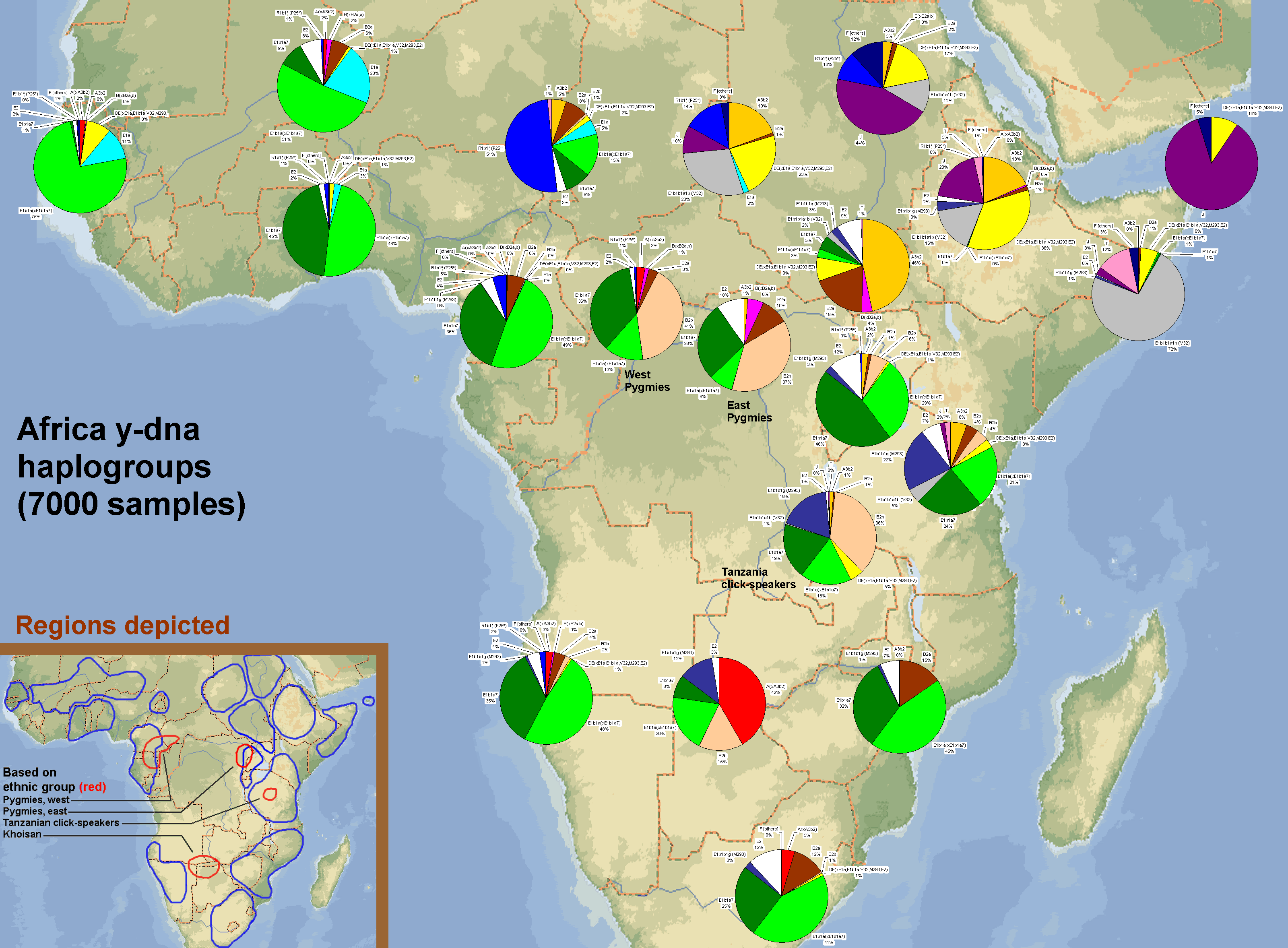
Nice Y-DNA map of Africa


Argiedude at Anthroforum has been making a huge effort compiling the available Y-DNA data for Africa south of the Sahara. The following map is the result:


(click to expand, large image)

A smaller version can be found HERE (useful for rapid comparisons but the legend is not readable and lacks the locator inset).

I think it is a most interesting piece of info and therefore I reproduce it here with permission.

Source: Anthroforum (you can find the raw data there as well). Author Argiedude.
.

Thursday, May 21, 2009

Haplogroup E1b1b1 and Afroasiatic languages


Originally found
at Dienekes.

Andrew Lancaster, Y Haplogroups, Archaeological Cultures and Language Families: A Review of the Possibility of Multidisciplinary Comparisons Using the Case of Haplogroup E-M35. Journal of Genetic Genealogy, 2009. (PDF).

The paper is a very nice and interesting meditation on the state of the art of our knowledge on the important haplogroup E1b1b or its main component E1b1b1, spread through North and NE Africa, West Asia and Europe. As a related issue, the extent and possible history of Afroasiatic languages is also explored in depth.

A must read for anyone interested in West Eurasian and African human genetics.
.

Sunday, April 12, 2009

Study suggests single origin for Pygmies.


·
E. Patin et al., Inferring the Demographic History of African Farmers and Pygmy Hunter–Gatherers Using a Multilocus Resequencing Data Set. PLoS Genetics, 2009.

The autors analyzed autosomal DNA samples from Western and Eastern Pygmies, as well as of a variety of agriculturalist peoples of Tropical Africa. They conclude that Pygmies separated from other Tropical Africans as a single population at the estimated time of some 60,000 BP and that they split into two groups, Eastern and Western, c. 20,000 BP.


Fig. 2. A is regular K-means clustering and B represents "filtered" populations after exclusion of individuals with more than 20% admixture at K=4.
.

Sunday, June 1, 2008

Out of Africa but when?


I had been driven by my own amateurish excercises on haploid genetic timing to begin pondering that the OOA epysode may need to be significatively older than the usual 70-60 milennia BP if we are to account for the the old ages that well studied Y-DNA clades like R1b or
O3 are yielding in MRCA estimates.

But I just found some scholarly support and precisely for about the same ages I was pondering:

A Bokyo et al, Assessing the Evolutionary Impact of Amino Acid Mutations in the Human Genome. PLOS Genetics, 2008.

The paper is wider in scope, as it tries to find out how much of autosomal SNP diversity is adaptative and how much is neutral, an important issue on its own. But the part that most got my attention is the section of the Discussion about Inference of Demography. The best fit demographic models (table S1) for Africans and Europeans suggest that the former have been expanding since some 170,000 years BP (6800 generations x 25 years) and that Europeans probably had two expansions with a bottleneck (in between?). The first expansion was c. 130,000 BP and the second c. 14,500 BP. The duration of the bottleneck was of only some 2100 years (84 generations).

There are other two models that are theoretically somewhat fit for Europeans but both are simpler and not as well fit as the one above. They are:

One states that there was just one expansion (no previous bottlenecks) since c. 6500 BP (I'm sure creationists would love this one! - but it can't account for much older Africans, so forget it). From a rationalist viewpoint anyhow it makes not much sense as 6500 BP would be post-Neolithic, suggesting a total replacement of farmers by what? Indo-European hordes? Sumerian erratics? Megalith builders? Hard to make sense of. The corrsponding 4500 BCE date actually doesn't relate with any exapansion: it's rather the end of Neolithic expansion in Europe, save for some marginal areas, that were still hunting and gathering.

The other one suggests a single expansion since c. 22,000 BP (just before the LGM) and a brutal bottleneck of c. 193,000 years. So with this model Europeans would have been in the hiding since the very beginning of Humankind and would have only began expanding precisely in the coldest period of the Ice Age. Again hard to make sense of.

But the complex model makes some sense: expansion since after the LGM, as most agree with and a bottleneck that would not be too long: about half the LGM span. The problem comes with the other expansion date: c. 130,000 BP. It should be an OOA or post OOA expansion, I understand but normally the OOA age is dated to about half that age.

Yet I already mentioned that such an old OOA event is not imposible at all: not just there is presence of modern humans in West Asia and Northern Africa since about that age but also Indian paleolithic shows continuity before and after the Toba event and MP artifacts might be work of H. sapiens in the subcontinent since before 100,000 BP.

The OOA migration could certainly be older and I was already thinking on several grounds of dates that approach that one of c. 130,000 BP (more like 100-110,000 BP?).

Note: thanks to Razib for suggesting that this paper might be important, what got me to read it with some more attention.

Friday, May 9, 2008

Revision of Aterian, U6 and North African prehistory in general


Yesterday I let myself be carried away by the apparent antiquity of Aterian in North Africa. I was already persuaded that Aterian and the arrival of mitochondrial DNA U6 to North Africa was the same thing. True that I had arrived to such conclussions when I thought Aterian had much more recent dates... enfin.

Something I should have re-read before posting that is: N. Maca-Meyer's paper on the philogeny and possible spread scenarios of U6 in North Africa. True that they conclude that the arrival of U6 to North Africa originated in West Asia... but they also notice that the nucleotide diversity of the haplogroup is higher in Iberia than in Africa. The problem? That U6 is seldom seen elsewhere in Europe, so she thinks that the clade arrived to Spain via North Africa and not vice versa. Maca-Meyer thinks that U6 arrived from West Asia via East Africa, based only in the greatest diversity of one subclade U6a in East Africa.

The estimated age of U6 is of c. 66,000 BP (+/- 25,000 years), what certainly could make it coincident with the arrival of Aterian via East Africa (The Horn). Aterian seems indeed most closely related to African Middle Stone Age, like Indian Middle Paleolithic, with dates c. 60-73,000 BP but some reaching as early as 90,000 BP. So yes, in principle, Aterian and U6 correlate well.

Another possibility could be that U6 arrived to North Africa from Iberia with the Oranian (Iberomaurusian) culture, that is believed to be an offshot of Mediterranean Iberian Gravettian or later Gravettizing cultures. Nevertheless Oranian correlates more clearly with haplogroups H and V. If that was the case, it would not be the only case of a U clade that is as old as Aurignacian but is found only rarely in Europe, due to drift. The case of U8a can serve maybe as counter-example. If U6 was accidentally concentrated in Mediterranean Iberia due to founder effect, it could well have expanded to North Africa from there along H, V and possibly other smaller clades without ever migrating to continental Europe, at least in significative ammounts.

This can only be understood if one knows reasonably well the peculiarities of Mediterranean Iberian UP, always reciever and almost never exporter of culture (with the possible exception of some facies of Solutrean, restricted anyhow to the Iberian peninsula). In Aurignacian, Gravettian, Magdalenian and the epi-Paleolithic, Mediterranean Iberia is always at the recieving end, at least in what regards to Europe.

So personally I would not exclude the model of a European (Med. Iberian) origin of U6. If we are not going to push back the ages of the OOA event too much, then it looks the more plausible explanation. Occam's razor seems to favor it, really.

Still the late Paleolithic of North Africa is intriguing. The older ages of Aterian have been reviewed to as early as c. 90,000 BP (Cremaschi et al, 1998) and the end of this culture is uncertain, with dates wildly varying between 65,000 BP (Cremaschi, who contests older C14 dates) to 25,000 or even 15,000 BP (Thillet).

Then you have the Oranian (Iberomaurusian) with an older datation of c. 22,000 BP (source: J. Escola Pujol, on Uadi Kenta - in Catalan), making it coincident with the complex Gravettian-Solutrean transition in Mediterranean Iberia (that culminates with a Gravettizing Solutrean that could well be called a Solutreanized epi-Gravettian as well). The most recent dates could be of c. 7000 BP.

And then you have the more famous Capsian cuture that is clearly epi-Paleolithic, coexisting with Oranian c.10,000-6000 BP, that is of quite clear East African origin (Sudan, The Horn) and that is with all likehood related to the spread of Y-DNA E3b and Afroasiatic languages (Berber).