New blogs

Leherensuge was replaced in October 2010 by two new blogs: For what they were... we are and For what we are... they will be. Check them out.
Showing posts with label Latin America. Show all posts

Thursday, September 30, 2010

Budget cuts cause revolt in Ecuador too


Update: Oct. 1: all this is nonsense. I was mislead by intoxications and lack of information. I can be a fool too at times and should be much more cautious, specially in a situation as confuse as this one. See my correction at my new blog For what we are... they will be. The only truth in all this is that there was a coup attempt, which failed, but everything else is wrong. 


President Rafael Correa was hurt by tear gas shot by mutinied police. Not only the police is mutinying but his own party has blocked Correa's attempts to cut spending by reducing the public sector. While the Army has sided with the president, there are reports of riots in Quito and the airport has been shut. 

Correa could technically rule up to two years without Parliament, assuming that this decision is approved by the Supreme Court, what is not likely.

Ecuador, like many European countries, has a budget problem (even after partial bankruptcy years ago) because it does not control the money it issues since the dollarization imposed by an unpopular right-wing government in the past. In order to take control of its own economy, it should be able to issue its own money, even if inflationarily. 

Correa and the parliamentary majority (59/100 seats) belong to Alianza PAIS (Patria AltIva y Soberana), a moderate left-wing political party, that sympathizes with the Bolivarian system of Venezuela. However it is surrounded by US allies with right-wing governments: Colombia and Peru, being maybe the weakest piece of the Bolivarian bloc, organized in the ALBA economic group. 

Sadly it is likely that the USA and its local puppets will try to take advantage of the situation, if they have not already helped to trigger it. A better solution is maybe that Correa is impeached or abdicates, as it is obvious that his new IMF-style policies have no support and governing by decree is not a viable solution anyhow (Ecuadoreans have already thrown away more than one such pretentious president)

Source for the main news item: Al Jazeera.

Thursday, September 9, 2010

Clinton wants to occupy Mexico


US Secretary of State, Hillary Clinton has declared that she wants the USA to intervene in Mexico "against drug gangs", the same it has been doing in Colombia and other countries. In fact she likened the decaying situation of Mexico to Colombia, however she claimed that the Plan Colombia, that has allowed the USA to establish an effective protectorate over the South American country, has been a success, what is plainly false - unless by success you mean taking over a whole country.


In this sense we must not forget that, on a similar pretext, the, until this year, famously demilitarized and rather prosperous, Republic of Costa Rica, allowed a few weeks ago the USA to take over it. Additionally the USA also controls Haiti, a major narcotrafficking hub (because of deep poverty and lack of democracy, thanks to Uncle Sam again). And we must not forget that, what used to be considered the main US base in Central America, Honduras, suffered a reactionary military coup last year, ousting the legitimate President and turning the country in a factual autocracy with US blessings.


Geopolitics of Middle America
Dark blue: USA and protectorates, light blue: US allies and their colonies
Red: Bolivarian bloc (ALBA), pink: other left-leaning governments
Green: Mexico

So now Hillary wants to add Mexico to the cyclops' menu. But this has rallied all Mexican politicians against. Even if this would not be the case, Mexico may indeed be a too big and too resentful piece of meat to swallowed by giant Uncle Sam. Mexico lists among the 20 largest economies of Earth, has a reasonably strong popular movement, and has many historical reasons to be wary of the USA, which took Texas, California and all what is between them and also partly invaded the Aztec country again during the Mexican Revolution.

There is already a lot of opposition in Mexico to the North American Free Trade Agreement (and the less known Security and Prosperity Partnership of North America) which is considered by many as the main culprit of the degeneration the country is suffering in the last decade or two.

The country's political system is however pretty much blocked by the fact that the PAN (conservatives) won the last elections by means of massive vote rigging. However the left is divided between those supporting AMLO and the PRD (social-democrats) and those who see no or little change possible with them. It is a clear case of "revolution needed urgently" and that is precisely why the USA wants to get greater direct control, probably. However it may well backfire, because a US invasion, even if sanctioned by Mexican institutions, would provide a rally point for all proud Mexicans who are never really happy about their beefy neighbor by the North.

News source: The Guardian.

Sunday, August 29, 2010

Latin American Left demands freedom for Arnaldo Otegi


The
Sao Paulo Forum, which gathers the Latin American left-wing parties, accepted to deal with the case of political repression against Basque nationalist leader Arnaldo Otegi, who is in prison for his ideas and proud rejection to bow to Spanish arbitrary impositions.

All parties present, as well as important personalities such as Nobel Peace Prize Adolfo Pérez Esquivel and Nora Cortiñas from the Madres de Plaza de Mayo human rights organization, signed the letter. This includes such important organizations as Brazilian Workers' Party (PT), Venezuelan Socialist Unified Party (PSUV), Mexico's Revolutionary Democratic Party (PRD), Uruguay's Broad Front (Frente Amplio), Cuba's Communist Party and Nicaraguan Sandinist Front of National Liberation (FSLN), as well as the Revolutionary Left Movement of Chile, the Communist parties of Venezuela and Brazil, etc.

The initiative, exposed by Doris Benegas, was promoted by Castilian Left (Izquierda Castellana, a small but veteran and very active Castilian nationalist party, solidarious with other stateless nations under the Spanish boot), which is observer at the Sao Paulo Forum.

A formal request by the Forum to ask the Spanish government for the release of Otegi was however shelved as the ruling parties of Brazil and Venezuela considered they would have to consult with their chancellors and there was no time for that.

Source: Gara[es]

Sunday, August 8, 2010

The killing fields of Colombia


As one fascist president takes over his equally fascist predecessor in Colombia, one of the largest mass burials known to exist in the country is being unearthed at
La Macarena, just 200 km south of Bogota. Some corpses are still fresh.


The Colombian paramilitary forces, promoted by the state in their fight not against the guerrilla but against the civilian dissidence (human rights' activists, leftist politicians, labor unionists...) and heavily involved in traffic of cocaine and its cheap derivative: crack, have murdered maybe 50,000 civilians, many of them social activists but many others mere random peasants used for training and then presented sometimes as guerrillas in the scandal of the false positives.

In many cases, the paramilitary forces used random peasants as victims for training their new recruits. The gangs' rookies had to disembowel and dismember these innocent people as means of initiation and training. They were also expected to do the same kind of hyper-violence when taking over a village, so peasants learned to fear them.

The new president, J.M. Santos, former minister of defense, is tainted with that blood and we can hardly expect any solution under his leadership, which represent only the continuity of mafias, death squads, generalized repression and the domination, under the shadowy protectorate of the USA, of the old oligarchic families, to which he belongs.

Source: La Haine.

See also this previous post.

Wednesday, July 28, 2010

Catalonia bans bullfights


The Catalan Parliament has approved a law that bans bullfights since January 2012. The decision was taken with 68 votes in favor, 55 against and nine abstaining. Catalonia is the second autonomous community of the Kingdom of Spain that bans bullfights, the first one being the Canary Islands, which forbade them in 1991. There is only one active bullfight plaza in all Catalonia.


While the vote was made on individual convictions, the vast majority of Catalan nationalist deputies voted for the ban while most Spanish nationalist ones voted against.

I am totally in favor of forbidding such cruel rituals and therefore I welcome the law and hope it's extended to other territories in Iberia and France, as well as America. However I disagree with those who oppose all kind of bull-themed fiestas such as encierros (running the bulls), recortes (dribbling the bull attacks much as in Knossos' frescoes) and vaquillas (similar with bullocks and open to public participation), which are essentially harmless to the animal (human participants know the risks they take). The important point is that the bulls are not tortured and also to prevent damage to horses, also suffering in the most cruel and well-known variants of bullfighting.

In my hometown there is a huge bullfight plaza that is almost unused except for the fiestas in late August. I have yet to meet a person who likes bullfights but there seem to be some in social strata I don't mix with. But I know a lot of people who enjoys vaquillas (or enjoyed them when younger). I would think that the plaza could have much better use as some sort of public venue, as for concerts (used on occasion) or massive popular assemblies - or just to gain a much needed new park after its demolition.

Source: Gara.

Friday, July 9, 2010

Puerto Rico: de facto coup by NPP?


What Puerto Rican dramatist
Roberto Ramos-Perea denounces[es] regarding the political situation in Puerto Rico sounds most worrisome.

He denounces that the pro-annexation New Progressive Party, which won the elections in 2008, lead by Senate President Thomas Rivera Schatz and Chief of Staff Marcos Rodríguez Ema, is making an institutional coup that has caused strikes and violent confrontations. The theoretical leader of the party and the country, Governor Luis Fortuño is claimed to be without will, without opinion and without public presence nor responsibility.

Ramos-Perea informs that the conflict began with the firing of more than 20,000 public servants with the pretext of solving public deficit along with strangling the budget of art institutions. Meanwhile the government hired at great cost many companies and advisors akin to the NPP.

The NPP also placed four party members in the Supreme Court, which totals seven members. Then it suppressed student participation in the University government causing a student strike that lasted 60 days, followed by a legal modification of the number of members of the University government (Junta de Síndicos), that again granted the NPP total control.

The NPP has also privatized a large fraction of the natural area known as "Karso del Noroeste", that gathers 1/3 of all water in the country. The new country's budget and associated laws will promote privatization and hand public funds to the private sector without surveillance. When approving these laws, the microphones of opposition representatives and senators were turned off.

Two weeks ago the FBI arrested Senator Héctor Martínez, right hand of Rivera Schatz, on corruption charges. Martínez was taped in his last instance of graft and is said to have links with narcotraffic. Rivera Schatz defense of the "innocence" of his friend caused even greater political upheaval.

In June 30, date in which the text seems to be written, student and citizen groups claimed their right to assist to the deliberations in the Puerto Rican Congress, being beaten and tortured by the police. The National Guard was mobilized and sent to the Capitol, causing more clashes and repression.

So far the synthesis of what Ramos-Perea denounces as happening these last months in Puerto Rico. I am somewhat surprised of not having known anything about this earlier, a clear sign of media disinterest or censorship.

If any reader can point me to more extensive information, I'd appreciate it.

Thursday, July 1, 2010

Honduras went to the streets to protest the coup in the dark anniversary


I remembered
three days ago the sad anniversary of the coup in Honduras. Today I come to know that in the Central American republic hundreds of thousands went (again) to the streets to protest against it.


It did not happen only in Tegucigalpa but across the country.

Carlos Reyes, speaker of the National Front of People's Resistance (FNRP) the coup has been tried to be made invisible, both inside and outside the country. Not just the coup but the crimes of the military and the resistance of the people.

Today we are certain that we have been doing the right thing, said Reyes. We have to install a Constituent National Assembly. This was the pretext on which the military-oligarchic alliance removed President Zelaya.

Source: La Haine[es] (includes photos and videos). More photos here.

Monday, June 28, 2010

Honduras: dark anniversary


Today one year ago, the Honduran oligarchy and military took over the country deporting the elected and popular President Manuel 'Mel' Zelaya and establishing a more than dubious regime of terror.


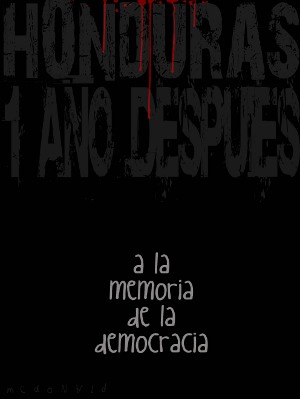
Honduras 1 year later. In memory of Democracy
(by Allan McDonald)

Manola Romalo interviews President Zelaya at Rebelión (Spanish language, there's also a German version) with some interesting comments by the ousted leader that I translate here:

They have now more problems than before: they made not just the Honduran People but also the peoples of America aware of the threat that represents economical greed for democracies, with this aggression they managed to speed up the process of transformation, generating new opposition forces.

The influence of large multinationals reaches to the foreign policy of the USA, evidence is in the fact that, in the period of President Obama's administration, just as in the past, it fell in the terrible error of supporting state terrorism, with the return to military coups, well known practice of the far right, obstinate in sowing barbarism.

(...)

In three years we achieved growth indexes of 6.5 and 6.7, the best ones in Honduran history, and also the reduction of poverty in more than 10% for the first time in thirty years.

Inversely, since the coup to date, the country has entered economic recession, poverty has increased and also the number of poor, same as the meaningful reduction of private and state investment. The damage that the coup has caused to the process of economical development is going to take at least ten years to recover.

(...)

My return is linked to the return of the state of law to Honduras. Even [acting] President Lobo declares to feel threatened himself and right away he says he guarantees my safety.

Evidently they are using Honduras as lab rat, as an experimental laboratory of violence, returning the military castes to repress the People and induce wreckage to keep control on society.

(...) they refounded a regime of terror and persecution and the USA lost a great deal of its prestige in Latin America.

Wednesday, June 9, 2010

Oaxaca caravan stopped


I reported yesterday on the solidarity caravan with the Triqui people of Oaxaca, that has constituted itself in autonomous municipality in order to confront the many abuses of the oligarchy, suffering since then the attacks and total siege of a paramilitary gang called UBISORT, which is supported by the authorities and oligarchs.

The caravan made most of its planned journey in spite of police harassment while solidarity demonstrations took place in Mexico City, Buenos Aires, Barcelona and Greece. However upon arrival to the Triqui district they decided to stop and go back to Huajanapan de León because it was very apparent that UBISORT militias were ready to ambush them, shooting at the distance in sign of warning.

The demonstration at Mexico DF was also attacked and the reports say that Oaxaca City is now full of policemen in plain clothes.

The caravan has yet to decide if they make a second attempt to breach the paramilitary siege of the indigenous community, which is in dire need of everything.

More information (in Spanish) at La Haine, Indymedia Chiapas and Radio Plantón (audio).

Tuesday, May 25, 2010

A critique of the Latin American "new left" governments from the left


The always interesting James Petras addresses
at Voltaire Net the issue of the limits and frustration of the "revolutionary" governments in Latin America. It is a very critical article that emphasizes how far from socialism these governments are and how this is triggering increasing protests by the grassroots that are accused of "trotskism" or even of helping the reaction.

It is a very long article that I can hardly synthesize here but basically he's saying that these governments, in their diversity, are mostly populist developmentalist (nationalist) soft capitalist systems under a red banner, much like China (red outside, white inside), which have not even realized the much needed agrarian reform, with the partial exception of Venezuela.

Petras also mentions how the strong revolutionary movement that existed a few years ago in Mexico has fragmented and looks powerless against the narco-feudalization of the country for that reason. In this context, he also makes the controversial claim that mafias offer a way out of poverty by means of "armed struggle", which has obviously no pretense to have political implications but may be true for the subjectivity of the individual slum-dweller and his/her survival and potential success immediate needs.

Possibly the conclusions can be those outlined in this paragraph:

The workers and peasants are increasingly recognizing that they are not the beneficiaries of the economic successes, growth and stability, celebrated by the leaders of the developmental regimes. The left must encourage, organize and capitalize on the masses’ rising expectations for higher living standards in the face of record high commodity prices. In recent years, too often, the left has fallen prey to the ‘theater’ of a self-described “new left” and its “anti-neo-liberal” rhetoric, even as it increases the presence of multi-national capital (MNC). The new “state-MNC” partnerships exclude the working class from the profits and revenue which, instead, are distributed between new rising middle professional and technocratic classes and foreign investors.
Criticism of the Left by the Left, as it should be. The Right is obviously not out of the process yet but it is just a dead weight, unable to produce any socially meaningful project, just more robbery and exploitation of people and Earth, something that has become simply unbearable. So, in a sense, we can say that the Right is out of the process and fatally damaged by its own incapability of generating happiness.

However the institutional Left is also limited by its own subservience to Capital and their own political liabilities, including personality cult and lack of revolutionary ambition. On the other hand it's difficult to imagine how such peripheral economies (though every day less peripheral probably) can lead the revolutionary process, that at this stage can only be global.

Though maybe I'm wrong in this.

Monday, April 19, 2010

Honduras: the struggle continues


Thousands of people gathered yesterday at Tegucigalpa demonstrating in solidarity with the peasants of Aguán valley, demanding the retreat of the Army from this area, the liberation of the arrested citizens and the implementation of a radical agrarian reform in the country.


In Honduras 300,000 families have no land whatsoever while other 200,000 have just small plots of 1-3.5 hectares (an hectare is 2.47 acres or 100 x 100 meters). This is one of the main causes of poverty in the largely rural country of 7-8 million people (est.) Almost half of the population lives on less than half a dollar per day and 25% on less than 25 cents. Meanwhile the wealthiest 20% has almost 30 times the wealth of the poorest 20%, a very sharp divide.

After the usual IMF-imposed criminal reforms and the also usual dumping of subsidized crops by affluent countries like the USA, Honduras has gone from being the greatest grain producer of grain of Central America to not being able to feed its own people, being forced to import 1 million tons of maize, 20 thousand tons of legumes and 50 thousand tons of rice. Instead Honduras now is producing mostly oil palm for export, what does not benefit the people, suffering from genuine food instability, but only the landowner minority, which has appropriated the vast majority of the land, and multinational corporations.

Source: UITA (found via La Haine). For more photos see here.

Saturday, April 17, 2010

Spanish energy corporation behind Guatemala murders


Eight Guatemalan activists who opposed the abuses of Spanish energy corporation
Unión Fenosa have been murdered in the Guatemalan department of San Marcos, near the Mexican border, in the last months, according to Spanish bi-weekly newspaper Diagonal[es].

The first victim was Víctor Gálvez, who was shot 32 times when he left an office where he attended neighbors affected by the activities of DEOCSA, one of the two affiliated companies that Unión Fenosa has in the Central American country, on October 24 2009. Gálvez was member of the Front for the Defense of Natural Resources and the Rights of the Peoples (FRENA).

In December 22nd, the right-wing government decreed the state of prevention (a variant of the state of exception), suppressing in practice civil rights in the department and attempted to criminalize the FRENA. Since then other seven activists have been murdered.

On January 13th Evelinda Ramírez, another activist of the FRENA who had been meeting with guvernamental officers to attempt to clarify the murder of her comrade was shot and killed while driving back home.

On January 29th Pedro García, member of the local workers' union and activist for the nationalization of energy services, was also shot dead a few days after he denounced irregularities in his municipal council of Malacatán.

On February 17th Octavio Roblero, grassroots Catholic, activist of the FRENA and of the National Front of Struggle for the Defense of Public Services and Natural Resources (FNL) and one of the main leaders in the struggle for the nationalization of the energy sector, was murdered as well.

On March 21st three other activists, Carlos Noel Maldonado, Leandro Maldonado y Ana María Lorezo, who fought for the expulsion of Unión Fenosa from the country and the right of the communities to access edible water, were murdered with guns and machetes.

The next day, Santiago Gamboa was killed Army shooting after the citizens had held workers of Unión Fenosa who had arrived to disconnect the electrical supply to the community.


Context of the struggle: mafioso extortion.

The struggle has an old background, dating to the 1990s, when the energy sector was "privatized" under IMF pressure and given in effective monopoly to the Spanish multinational, which, in order to pretend "free market", split its subsidiary in two, one taking charge of the East and the other of the West of the country. A similar procedure took place in Nicaragua, then ruled by the conservatives.

In July 2008, after Unión Fenosa was acquired by Gas Natural, another Spanish corporation, partly owned by La Caixa (a public non-profit Catalan savings bank) and partly by oil giant Repsol YPF (also Spanish), the activist organizations sent an open letter to Spanish NGOs, worker uions and political parties denouncing the abuses by the corporation, among them: illegal charges on electric bills, poor service and collective punishments against the communities that protested by cutting electrict supply.

After a year of payment strike, in December 15th the company cut electric supply to many communities of the department. After a week, water supply was also cut.

This action sparked anger and the communities took to blockade the roads linking to Mexico, as well as organizing demonstrations and assemblies. It was in this context that the government decreed the state of prevention, which has been prorrogated several times and is still in effect.

According to Rigoberto Madriz, member of the political committee of the FLN, since then the hitmen of narcotraffic mafias comb the department impunely blackmailing the people: "pay or we will kill you". The very next day to the declaration of the state of prevention, Unión Fenosa opened a new office just side by side to the home of the main capo of the department, in a building well known to be his property.

After the second murder a new denounciation letter was sent to the Spanish premier Rodríguez Zapatero and the Guatemalan president Álvaro Colom, as well as the directors of Unión Fenosa-Gas Natural and its main shareholders: La Caixa and Repsol YPF.

The only effect so far has been to increase the state terrorism against the people, demonstrating that the Spanish state is again accomplice with corporative crimes and terrorirsm in Latin America.

Tuesday, April 13, 2010

Troops seize community in Honduras: fear of massacre


More than three thousand troops and policemen have taken over the peasant communities of Bajo Aguan in the department of Colón.


Civic organizations have issued an alert that a massacre may be imminent. In spite of the attempts by the organized peasants to negotiate with the fascist government, this has only replied with repression and murders.

The peasant communities achieved agreements (agrarian reform) with the democratic government of ousted president Manuel Zelaya that allowed them to labor the lands without paying feudal tributes to the landowners. The current fascist government, supported by the USA, is trying to revert this situation returning the lands to rich and seem to have no problem in going into a murder rampage if they deem necessary.

Source: Tercera Información[es].

Sunday, March 7, 2010

Geopolitics of today (or "BRICs are heavy")


I finally made a satisfactory map that reflects as well as possible the imperfect multipolarity of today's geopolitics:

Click to expand

Legend:
  • Red shades: The Empire (dark red: USA and dependencies, bright red: other NATO members, other "central" US allies and their colonies, pink: other important US allies/EU members, stripes: under military occupation).
  • Turquoise: Russia (stripes: under military occupation), Cyan: main allies
  • Blue: China, lighter blue shades: under Chinese influence
  • Orange: India, lighter orange shades: under Indian influence
  • Green: Brazil, light green: other Mercosur countries, dark green: ALBA
  • Dark Grey: other regional powers
  • Regular Grey: other countries
Notice that I could not mark all US/NATO allies on risk of almost all the map becoming pink and that way maybe exaggerating the influence of The Empire even more. On the other hand I may have maxed the areas of influence of China (excepting Pakistan) and India. Many countries, of course, play multilateral diplomacy and try to keep a pretense of independence, what makes more difficult to decide what side are they in. The use of similar colors for Brazil/Mercosur and ALBA is somewhat justified but was mostly chosen to underline the differences between the USA/NATO bloc and the "Latin-Americanist" powers in the American continent. Anyhow, the latest developments in Honduras, Colombia and Haiti have clearly pushed Venezuela and Brazil closer in a joint bid to support the independence of Latin American and Caribbean nations, which obviously plays in their interest rather than in that of the USA, as imperialist power.


Overview:

There are two basic elements in the reality reflected in this map: The Empire and the BRIC.

The Empire is incredibly large (even if I tended to reflect only its strongest influence) and is clearly based on naval hegemony, which is supported by proportionally large navies, not just from the USA but also from France, UK, Italy, Spain, Australia and Japan in particular.

BRIC is an acronym that stands for Brazil, Russia, India and China. Even if it's an informal group, it has no other entity that reflect the four major powers that are still independent from The Empire. Each one of them has its own geostrategical interests and also different cultures and political systems. The only thing in common they may have is that they all are more or less confronted with The Empire... with one exception: India.


India:

It seems that India and China perceive each other as most direct rivals. Also India has a large maritime facade and hence clear naval interests in the Indian Ocean specially, which is also the ocean where The Empire has an arguably weaker presence. However India has with good reason distrusted The Empire in the past and instead kept stronger ties with the former USSR. The China-USA entente and the conflicts with Pakistan (an ally of both USA and China) on Kashmir, led the South Asian republic to act that way. However it has played both sides and has always kept major ties with Israel and other members of the Western bloc.

In the current circumstances, India still keeps good relations with Russia but the approach between Moscow and Beijing is pushing the old friend somewhat apart and throwing India in the arms of The Empire.


China and Russia:

But, of course, the most important power of all BRIC countries is nowadays China. And it is the growing conflict between China and the USA what really describes the scene. We can't still talk of a new Cold War, very specially because the Chinese take due care in no pushing the conflict to military but economic and diplomatic terms but, in any case, the conflict is clear and growing stronger, as knows anyone who reads the news.

China however is relatively weak in the military aspect, even if less so than in the past, and hence its growing alliance with the decadent but heavily armed Russia is of crucial importance. The "thirdworldized" Russia with loads of ICBM nukes, offers China an almost ideal ally: China does not dispute Russia its political and military clout on Central Asia but rips many of the economic benefits, not just of Central Asia but also of Siberia. It also offers China a military shield that prevents a direct conflict with The Empire.

On its side Russia also feels threatened by The Empire, which has been growing towards its borders and even threatens it with new missile deployments. The latest developments (defeat of Georgia, pro-Russian government in Ukraine, restive Turkey) may imply that Russia is scoring some goals but still it does feel threatened by NATO and siding with China is the best alternative it has (as together they control most of non-tropical Asia, while divided they would only play in the hands of their common rival).

China's worries are mostly a fear of being blockaded out of the oil supplies from the Middle East. Hence it's following two parallel strategies: on one side, cooperation with Russia to keep The Empire out of Central Asia (and as much as possible of The Middle East as well, for example protecting Iran) and, on the other side, securing as much as possible the shipping lines to West Asia (for which it has recently obtained bases in Bangladesh and Sri-Lanka).

In parallel, China is painfully working to weaken the imperial bloc in its immediate area of East Asia itself (seducing South Korea and even Japan and Taiwan as much as possible, supporting little Cambodia against Thailand, etc.), as well as gaining random friends in Polynesia and Africa and, specially, making business even where The Empire makes military alliances.


Brazil:

The other BRIC power is Brazil, whose confrontation with the USA has been growing hot in the last year. Brazil has been playing, even more than China, a soft diplomatic game, gradually strengthening its position both internally and internationally. While it has got its bad moments with the Bolivarian bloc led by Venezuela, the crisis of Honduras seems to have eventually opened its eyes. And if that did not, the growing US military presence in Colombia and the unbelievable massive invasion of Haiti have put things clear for Brazil: there's no room for two powers in America... unless they fight each other. Surely Brazil would like to grow in power more gradually and without conflicts but it seems that those days are now gone and The Empire is striking back. That situation obviously pushes the Bolivarian bloc (the ALBA) and the Brazilian-led bloc (Mercosur) into each other's arms.

The latest growing tensions around the Falklands/Malvinas disputed archipelago, as well as the repeated protests of Venezuela against the US-Colombia-Netherlands siege, show that the issue is serious.

However Brazil in comparison with the Asian BRIC countries has three disadvantages:
  • Like India, it is a naval oriented country with a large maritime facade. Hence it's potentially more exposed to the Imperial naval hegemony. But, unlike India it's much closer to the USA and its area of immediate interests.
  • It competes with the largest global power for Latin America, which the USA still considers its "backyard".
  • It is the only BRIC power that has no nuclear weapons. It might develop them (as did India not long ago) but that would mean breaching international agreements (NPT) and giving hence a pretext to the USA to behave even more aggressively.
On the other hand it has some major advantages:
  • Latin America in general is fed up with the USA and is clearly willing to try something new. Brazil has the potential of playing a leading role in this aspect and the recent formation of a distinct Latin American and Caribbean association without the USA nor Spain is a clear step in this direction.
  • Not only Latin America but eventually even large parts of Africa, very specially South Africa (particularly sympathetic to Brazil and India, and leader of a large bloc, not represented in the map) and the former Portuguese colonies, could be interested in some sort of cooperation with Brazil and other Latin American nations with common goals of emancipation and development.
  • The legitimacy of the people: unlike the other US rivals (China and Russia) and unlike most US allies (vassals) in the region, Brazil and its allies (excepting Cuba) are clear democracies, with more or less "progressive" leaning. Machiavelli himself would applaud that as a great asset.
  • Oil: Venezuela seems to have become the largest oil reserve in the World, replacing Saudi Arabia in this position. Brazil itself has discovered large deposits offshore and there are others in Cuba, Haiti and the Falklands, fueling the confrontation with the USA and Britain. But also allowing for some decent bargaining as well.

The Empire:

The Imperial bloc lead by the USA has clear advantages: the largest share by far of the global GDP, a huge military, presence almost anywhere on Earth, lots of nukes, total naval hegemony... But it has also some disadvantages, namely: overextension, huge debt (largely caused by military overexpending), being dominated by a small oligarchy with very peculiar interests, often conflicting with those of the people and even The Empire itself (particularly Zionism), and now a brutal overproduction crisis that might well seal its fate once for all.

Overgrowth crisis are not alien to large empires. Rome itself faced one after consolidation and languished for centuries in it, while the British Empire decayed largely because it was too large to be defended against its own peoples. But the closest parallel is surely the Habsburgian Empire of Charles V and Philip II, who similarly were forced to overexpend in military adventures, often ill fated, almost everywhere (Germany, the Mediterranean, Britain...). At the time there was no larger empire and the Habsburgs thought they had no rival... but soon they had to experience a harsh reality check and declare bankrupticy, as well as making huge concessions to their rivals.

This is in fact what The Empire is facing today: the crisis is, as we all know, far from over and it is affecting severely both major pillars of the bloc: the USA and EU. It is primarily an structural overproduction crisis but it's also a debt crisis (with China getting rid of less and less solid US bonds) and an overextension crisis as well.

Just count the unfinished major wars The Empire is involved in: Palestine, Iraq, Afghanistan, Colombia-plus, Yemen, Somalia. Not to mention the never accoplished threat of attacking Iran, the extreme instability of most US vassals in Latin America (Colombia, Mexico, Honduras and poor occupied Haiti at least), which can any day turn against their master by popular acclamation, and those of other regions (Egypt, Morocco, Pakistan, Thailand and even some European countries like Greece).

And then count the cost: the nominal US public debt is of almost 8 trillion USD but, in fact, more than 5 trillion are excluded from these accounts. Only counting the nominal fraction, the US public debt has never been so high since the late 1950s (as percentage of GDP, c. 70%) and, when we count all the real debt, it's as high as at the height of WWII (again as percentage of GDP, c. 115%). This kind of heavy indebtment, paid with the booty of conquest maybe but not without serious economic implications, is again another striking parallel with the Habsburgian Empire of Charles V and successors, very specially as most of it is wasted in both cases in military expenses.

But, of course, The Empire remains as of today as a mighty power, the only real superpower on Earth. Meanwhile, the Frances, Englands and Ottoman Empires of our day (the BRIC and particularly China) bid their time as much as they can avoiding direct confrontation as much as possible.

And this is the scenario we have now. Though admittedly it may well be obsolete in a decade or less.


Addendum: naval might:

Aircraft carriers may well reflect with some approximation the real naval might of each of the powers at play. They are as follows:

NATO and allies:
  • USA: 11 ships in use, 1 projected
  • Britain: 2 ships in use, 2 projected
  • Italy: 2 ships in use
  • Spain: 2 ships in use
  • France: 1 ship in use
  • Australia: 2 ships projected
  • Japan: 2 ships projected
  • Thailand: 1 ship projected
Total Empire: 18 aircraft carriers in use, 9 projected

BRIC:
  • India: 1 ship in use, 2 projected
  • Russia: 1 ship in use
  • Brazil: 1 ship in use
  • China: 1 ship projected
Total BRIC: 3 aircraft carriers in use, 4 projected


Sources: most data freely adapted from diverse Wikipedia articles and maps. See also this post on the China-US competition, this one on the latest US invasion of Haiti and its geostrategical implications and maybe this one on how Venezuela is being surrounded by US military deployment.

Note: of course, the secondary title is a silly wordplay with the superb record of L7, Bricks Are Heavy.

Saturday, March 6, 2010

Behind the "religious conflict" in Chiapas: a fundamentalist army


It has been presented by the Mexican government and some media as conflict between "Protestant" and "Catholic" natives but what is in fact going on?
According to La Jornada the real issue is the formation of paramilitary militia of Evangelical (fundamentalist Protestant) ideology self described as El Ejército de Dios (God's Army).

This "religious" death squad has already been involved in many violent actions, including the murder of a local politician. They are apparently in connivance with the police, both at state and federal levels, as well as to the Evangelical groups that perturb neighboring Guatemala (there as well in connivance with the army and the totalitarian and genocidal regime of Ríos Montt, who was preacher of these cults).


"Orangist" marches in Chiapas, what else?

This God's Army is not indigenous and has as program to de-indianize their adepts. Recently they marched through the city of San Cristóbal de las Casas with the music of the Imperial March of Star Wars (the music associated with Darth Vader, you get the point, right?) Their aggresive discourse is similar to that of the undemocratic Mexican government, opposed to the Zapatista bloc, against whom they act essentially.

Wednesday, February 24, 2010

Latin America buries OAE


33 Latin American and Caribbean countries have decided at Cancún, Mexico, to create a new continental
bloc without the USA and Canada, but with Cuba.

This is the first international organization including all or most of Latin America that is not overseen by the USA or Spain. It is continuation of the Rio Group but it aims to establish a real organization, which will be outlined at next year's meeting at Venezuela.

Full Declaration of Cancún at the Cuban Ministry of Foreign Affairs [es].

Saturday, February 6, 2010

Colombia: state terror


A group of seven MPs from the Kingdom of Spain (mostly Catalans, one Spaniard and one Basque too) traveled to Colombia recently to assess the situation there, invited by the Platform for Peace and Human Rights in Colombia in the context of the negotiations on a free trade treaty between the South American nation and the European Community.


One of the things that impressed me most was that even the Supreme Court itself admitted that the Executive Power does not allow the Judicial Power to work, there is no independent Justice, declared Francesc Canet.

60% of labor unionists murdered worldwide are Colombians. If a worker joins a union or tries to create a workers' committee, he is fired right away, declared senator Josep Nuet. Human Rights activists are similarly attacked: they are stigmatized and accused of belonging to armed groups.

14,700 people are accounted to have been murdered extra-judicially in Colombia. At least 2100 of them were killed arbitrarily only to pretend victories against the guerrilla and hence produce medals and honors for the commanders involved, these innocent victims of the army are called false positives.

Inés Sabanés tells of their painful experience with this issue: we were meeting with mothers of the false positives and that same day newspapers reported the liberation of several of the commanders who had commited such crimes. Worst of all was that the government organized a party to celebrate it, with spa, clowns and music. A shame.

Source: Tercera Información.

Mapuche nation creates Parliament


In January 29th, representatives of the Mapuche communities, accompanied by their lawyer, went to the presidential palace in Santiago de Chile to inform of this constituent action that they hope is not again accused of "illicit association".


The Parliament has as goals to be active participants of the constitutional recognition of the Mapuche nation and the implementation of convention 169 of the International Labour Organization.

For Jorge Huenchullan, Werken (president) of the new Parliament says that its creation means a new uprising of the Mapuche communities that are really in the struggle for land recuperation and reivindication and for regaining the civil rights that have been denied to the Mapuche in Chile. He states that the first goal of the Mapuche Parliament will be to expel the logging companies from the lands they have usurped, as well as the colonists in Mapuche territory. They plan to do so by legal means.

They also intend to work against the political repression they are suffering with indiscriminate arrests and even murders.

They are realist enough to acknowledge that the Chilean government has no intention of solving the conflict in any way that might favor the Mapuche nation. They denounce that the new Chilean president, Piñera, is a repressor who has direct interests with the logging companies and the death squads they maintain.

Source: Rebelión.

Thursday, February 4, 2010

Haití kidnapped (again)


A very complex subject but full of evil. That's surely why I haven't felt like writing much on it yet. But also felt I had to... so I'm finally on it.


A brief historical review

As A. Montero mentioned the other day at La otra economía, based on E. Galeano's historian work, the Western powers never forgave Haití that it dared to break its chains. Then France imposed a debt for such pride and Haití swallowed in exchange of recognition. The debt soon ended in US hands that used it to squeeze further the country that first abolished slavery. But the USA took 60 years to recognize the second independent country of America: slavery and racism were too high in its agenda, as well as its own form of imperialism.

It took Haití 124 years to pay off that debt that never contracted. By then the whole country belonged to the US banks.

But, even Simón Bolívar, who owed so much to the Caribbean nation, where he found refuge in the low times of his rebellion, where he was given weapons, ships and even soldiers, the very blood of the country. When he succeeded he didn't recognize Haití either. He formally abolished slavery as promised but no other sign of recognition to Haití.

Racism was incredibly powerful these days, it seems.


The last decades

But well, let's get to a more recent Haití. Some 20 years ago I was on holiday in New York and had the opportunity of taking part in a huge demonstration in support of democracy for Haití, which had been suppressed by a violent coup promoted by George Bush Sr. I still have over there a pin with the Haitian banner and the simple slogan: Free Haití.

Per the promise of Bill Clinton, Aristide went back to power... only to be forced to give the presidential band a few months later. But he was elected again four years later and George Bush Jr. meddled, in agreement with France, to cause a pretext of violence and propaganda of corruption, to invade the country with the UN blessings.

Aristide, the only popular president in a century or so, was kidnapped by the blue berets and sent to Central Africa. He's now in South Africa and has shown desire to return.

For many years now, Haití has been an odd international protectorate, as if the country could not rule itself. It could of course but not to the like of Washington nor Paris.


Earthquake and invasion

A few weeks ago we were all shaken by the tragic news of an earthquake in Haití. Not anywhere in Haití but right near the capital, destroying suddenly all the state's and UN's central infrastructure. Not the US embassy though: newly built with the most modern anti-sysmic technology.

But lucky Haitians... the US Southern Command was precisely at that moment making a drill on a hypothetical hurricane devastating Haití. The American friend was ready and in a few days they invaded the country again. All for the good of the Haitians, of course.

Since then everything is under control... or so we are told. We know little of what is really going on anymore, as journalists are not able to report properly. For security reasons, of course. Just like in Iraq... or in Gaza... The cold and totalitarian militarist logic has replaced the warm and frank logic of solidarity.

Just that nobody has reported feeling threatened... before the marines landed. So what the heck?!

Why is the USA invading Haití again? Guess that there are many reasons...


Economic reasons

Haití is practically owned by multinational corporations, mostly based on the USA, as well as by a tiny oligarchy that owns most of the land. The country has many mineral but ill-exploited resources and, crucially, there seems to be a huge oil reserve between Haití and Cuba, only recently discovered, and particularly extending under the soil of Port-au-Prince.

Hmmm... curious. How handy that the capital has been devastated providing an excuse to deport all or most of its inhabitants.

Maybe Thierry Meyssan is correct when claiming that the earthquake was not natural but the product of an ill-known but way too real type of weapons that cause earthquakes he may be onto something. Yah, "conspiration theories" sure... but you being paranoid doesn't mean that they are not after you anyhow. And such weapons do exist and the circumstances are too suggestive of criminal action.


Geostrategic reasons

It is well known that the Caribbean Sea is the gate of America. All European powers but Portugal accessed that way, the pirate wars, the US-Spain war of 1898 and the several military interventions of the USA in the area since then are clear signs of the importance of this sea and its islands. The largest of them, Cuba, has managed to stay independent, not without a fight that continues nowadays... but the rest barely so. Some are still in fact colonies of European powers or the USA.

And Haití is the most battered of all, maybe because it's just east of Cuba and the infamous Guantanamo base, too close to some key straits that have been central since the age of piracy. The infamous Tortuga island is of course in Haití, not far from the Windward Passage, which was one of the main sceneries of the piratical actions sponsored by France, Britain and the Netherlands against the Spanish Empire and particularly Cuba. Today the same cold strategic logic applies but the enemy is not a powerful colonial empire but some of its former colonies, Cuba of course but also Venezuela and others.

But there may be more. The only country that can dream of shadowing the USA some day in America is Brazil, a power of growing international importance, which has been playing very diplomatically but has been recently pushed to some confrontation by the US actions in Honduras and Colombia. Brazil was in charge of the UN force in Haití... until the earthquake.

And even more. Anybody who has been a minimally serious Diplomacy player can easily recognize that in the increasing global polarization centered in Washington and Beijing, Brazil is a natural ally of China, as it's not easy that the two will compete, while the competition between the USA and Brazil is almost a given. Of course diplomatists would contest that nothing is set on stone and that's why the game is called Diplomacy. But I'd say that the current scenery has been one of increased confrontation.

This is maybe because the Bush presidency was so extremely focused on the Middle East and Central Asia that ignored Latin America to some extent. Instead the Obama term seems to be more and more focused on a global aggressive policy in all fronts, with a clear focus on Latin America and also, it seems now, in increasing tensions with China.

As per above, the two things may not be really detached. But neither was the focus on Central and West Asia, though China has managed to land on its four on the very countries that the US aimed to control (see my previous post on this issue), while Bush was not too interested in directly increasing tensions with the Asian giant, that he perceived as too important for the US economy. Some say that the influece of Zbigniew Brzezinski's thought is too strong in the Democrat aparatchkik for anything else than pursuit of total global domination.

And Haití happens to be in the middle, to want to improve their situation democratically after many decades of brutal dictatorship by US-sponsored tyrants, to have oil, and to be so lucky, as to have the US Navy ready to invade it, for humanitarian reasons, of course, when the earthquake happened.

But there are other natural forces in Haiti, like the force of the water that in Creole is called Lavalas, avalanche.

Yankees, go home!


Further reading:
- Rebelión on Haití (in Spanish).
- Voltaire Net on Haití.
- Global Research on Haití.

Thursday, January 21, 2010

US military intervention effectively blocks aid in Haití


It was bad already and then the marines arrived.


They do not only do zero humanitarian work but severely hamper that of those who want and can help.

Yesterday I watched in TV returning Spanish rescue specialists that complained that they were forced by the invaders to stop their work at 5pm and severely restricted their activities on "security grounds", when they say that they never felt any threat at all.

Some propaganda images of the marines distributing aid have been spread by the media but RNE journalist Fran Sevilla absolutely denies that they are doing anything at all, not even patrolling much. They have taken indeed control of of the Port-au-Prince airport and give absolute priority to their own deployment and the evacuation of US nationals, in practice blockading the the aid distribution.

France and Brazil have joined the chore of complaints by many Latin American countries against the ugly reality of US unilateral intervention. Bolivian President Evo Morales is even organizing a UN meeting to demand the retreat of US troops on light of their harmful activity.

Physicians without Borders and Intermon OXFAM have complained that their aid is stuck at Santo Domingo unable to reach Port-au-Prince because the marines don't give them authorization. .

The maybe feeble but anyhow real, aid organizatiod by the Haitian government, that had moved its headquarters to a police station near the airport, has been totally overruled without legal authority by the disproportionate, meaningless and useless US military invasion, which seems more designed to promote obscure imperialist interests than to help in any meaningful way.

Source: Rebelión.