Tuesday, September 28, 2010
Several volcanoes may have severily damaged Neanderthals
Tuesday, September 21, 2010
Neolithic seal found near Izmir, Turkey
A seal (stamp) dating from 6200 BCE, roughly when most of Europe (except the Balcans) was still in the Epipaleolithic, and older than those from Mesopotamia as far as I can tell, has been unearthed at Yesilova Höyuk in West Turkey, in the Izmir metropolitan area.
The seal is shaped like a bull but the marking is a radial figure (8 radii, maybe representing the Sun or a star) and is speculated it belonged to an administrator of some sort.The site of Yelisova Höyuk looks interesting because not much was known until recently of the Neolithic of West Turkey, the missing link between West Asian and Balcanic Neolithic. However the oldest dates for this site so far are whole millenium more recent than those from Thessaly, Greece, so this particular site does not look like going to inform directly about the ultimate origins of Balcanic, and hence European, Neolithic.
Source for the seal discovery story: Hürriyet - Daily News (found at Archaeology in Europe).
Much more detailed information on the site overall at the dig's site.
Thursday, June 10, 2010
Jews are "Phoenicians", Palestinians are "Jews"
[Update: please read my 2012 independent analysis of Western Jews, Palestinians and other populations of West Asia, which adds some interesting nuances but in essence confirms what is said here].
This does not seem just another paper on Jewish genetics but more like The Paper. While it is pay per view and hence I haven't been able to read it in full , the material I could see at Dienekes' blog (same as in the supplementary material) is most revealing. I think this research will mark a before and after in Jewish genetics and also gives some interesting hints on other populations, specially in West Asia and North Africa.
Doron M. Behar, Bayazit Yunusbayev, Mait Metspalu et al. The genome-wide structure of the Jewish people. Nature, 2010. Pay per view but supplementary material freely accessible.
One of the good things is that finally comparison with Turks and other populations from that area where early Jewish Diaspora in the Hellenistic-Roman era is known to have lived, rather than in Palestine, in a time when Judaism (several sects including eventually Christianism) was still actively proselytizing.
Unlike what I used to think, Western Jews (Sephardi and Ashkenazi) do not cluster too well with the Turkish sample but they cluster almost perfectly with Cypriots and Lebanese. They seem to have no particular relation with Palestinians (nor Druze nor Negev Bedouins) but these also appear clearly different from other Arabs and in general any other sampled population.

This K-means analysis is for me the answer to all these endless discussions on the origin of Jews and Palestinians. Western Jews seem essentially to have coalesced in the Cypriot-Phoenician area probably by, essentially, conversion. Palestinians seem to be a uniquely distinct population, albeit somewhat admixed with their neighbors, which may well originate with the local Neolithic and certainly must have been there in early historical times.
In other words: Palestinians are most likely to be the true descendants from the Jews of the Biblical period, rather than modern Western Jews who seem more as originating from a Phoenician-Cypriot population which converted to Rabbinic Judaism for whichever reasons.
Other Jewish populations also seem to originate in conversion episodes but from different genetic pools. Hence Yemeni Jews appear as genetically Arab, Ethiopian Jews as Ethiopian, Indian Jews as Indian and Iraqi-Iranian Jews as Iranians. There may be some fine threading to enrich this overall picture but the essentials seem very clear in any case.
Anyhow, Moroccan Jews appear as just another branch of Western Jews (no particular relation with Moroccans is apparent) and I have not been able so far to identify the closest population to the small sample of Uzbek Jews. Also Turco-European Jews seem at least somewhat admixed with Europeans, something that was already well known.
As for other populations, I find interesting that an specific autosomal component of NW Africans has been detected (for the first time as far as I can tell). Many specific clusters have obviously not been detected because of the relative shallowness of the K-means analysis.
The supplementary materials have other interesting graphs, PC analysis of autosomal, Y-DNA and mtDNA genetics and a global K-means analysis of relevance when observing some peripheral Jewish populations specially but also providing some general hints on other populations (a very wide sample, specially in Eurasia).
I must cheer and congratulate the authors of this research for finally addressing the debate on Jewish (and Palestinian) origins with a worthy extended sample of many many populations, including key ones such as Turks, Cypriots and Lebanese (among others). The wording of the abstract doesn't say things as clearly as I do but their data speaks volumes.
Is it any miracle that in their days of overthrow and subjugation many Babylonians and Syrians and so forth, and later on many Phoenicians, speaking practically the same language and having endless customs, habits, tastes and traditions in common, should be attracted by this inspiring cult [Judaism] and should seek to share in its fellowship and its promise? After the fall of Tyre, Sidon, Carthage and the Spanish Phoenician cities, the Phoenicians suddenly vanish from history; and as suddenly, we find not simply in Jerusalem but in Spain, Africa, Egypt, the East, wherever the Phoenicians had set their feet, communities of Jews.
Update Nov 21: a free copy of the paper is available here (PDF).
Oldest "pampooty" shoe found in Armenia
Archaeologists working at Areni-1 cave in Armenia have found one of the earliest known shoes and the first one of a kind that was common in parts of Europe until recently. This type of rustic shoe made of a single piece of leather tied with leather strings (or cords) above the foot is known as pampooties in Ireland and as abarka in the Basque Country.

The shoe, dated to 3627–3377 cal. BC, in the Chalcolithic Age, is roughly contemporary with other oldest findings of shoes across the World: the footwear of Ötzi, made of two different leather pieces, a slip-on shoe from the USA and a sandal found in Palestine. However footwear is known to have been used since much eralier, with anatomical evidence strongly suggesting a Middle Paleolithic origin. Because of the perishable nature of the materials used, no older shoes are directly known to us though.
Ron Pinhasi et al. First Direct Evidence of Chalcolithic Footwear from the Near Eastern Highlands. PLoS ONE 2010. Open access.
See also the article at the PLoS ONE blog, EveryOne.
Above: modern pampooties. From A brief history of World Costume, which has an interesting, albeit old, article on prehistoric clothing and footwear, including a reconstruction of Ötzi's footwear, similar to low boots. Monday, June 7, 2010
Genetic comparisons of Basques and Jews
This past week I have been really oblivious to anything that was not directly related to the Zionist criminal assault of the Freedom Flotilla. I really did not feel that almost anything else mattered. Sometimes the tragedy of History just takes all the emotional and mental space and there is not really much room for anything else, I guess you can understand that.
However some more or less interesting stuff has been published in the meantime, in particular two papers on West Eurasian autosomal genetics which have been addressed at Dienekes' Anthropology Blog. So it's time to make a brief mention of them:
Basque genetics and other Europeans
Naiara Rodríguez Ezpeleta et al. High-density SNP genotyping detects homogeneity of Spanish and French Basques, and confirms their genomic distinctiveness from other European populations. Human Genetics. Pay per view.
See: Dienekes' relevant post for abstract, some details and his very questionable opinions, as well as for some discussion among readers.

Particularly questionable is his opinion that Basques should still be genetically identical to all other Iberians, based on one paper's Fst data but ignoring a whole array of other papers. These are (at least) Bauchet 2007 (discussed here), Achili 2007 (discussed here), Tian 2009 and Athaniasiadis 2010 (discussed here).
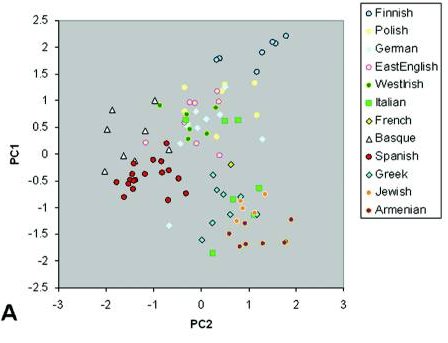
While Iberians are not sampled and plotted, based on the data of Tian 2009, they should show up very close to French and Italians (except the unique Sardinians), slightly above the (0,0) coordinates, in the graph above. Of course, it dependends on which Iberians but I'm talking about the main cluster, not Cantabrians nor Catalans.
Jewish genetics: yet another instance of truth avoidance
G. Atzmon et al. Abraham's Children in the Genome Era: Major Jewish Diaspora Populations Comprise Distinct Genetic Clusters with Shared Middle Eastern Ancestry. American Journal of Human Genetics, 2010. Pay per view (but should be freely accessible in six months).
See also Dienekes' relevant post.
Note: capitalized labels refer to Jewish subgroups. I strongly suspect, based on Fst distances (see second update below), that Palestinian and Bedouin labels are mistaken and should be the other way around.It really frustrated me once again that Turks (nor Greeks nor Syrians) had been compared with. [note: see update below, this is not true after all and is quite revealing] The most logical hypothesis, based both on historical and the available genetic data, suggests that modern Jews (or most of them) are not so much descendants of historical Jews from Palestine as from a hybrid population that coalesced mainly in Asia Minor in Hellenistic and Roman times.
The above graph does not contradict this hypothesis at all, at least for the main Jewish population of Europe, Turkey and Syria. Irano-Iraqi Jews instead probably had different origins, the same that Yemeni, North African and Ethiopian Jews do as well (not studied here).
The affinity to Adigey (a NW Caucasian people) strongly suggests this, as well as the fact that they seem less Levantine than such an outsider population as are the Druzes (with Anatolian and Egyptian origins, not Levantine). Anyone familiar with European genetics would expect Greeks and Turks to pop up almost exactly where most Jews do.
Comparing with Bauchet-2007
But if you doubt my words, I suggest that you look at Bauchet 2007, which is the only paper so fare that has compared Jews (Ashkenazi) with Greeks and Armenians, resulting in almost total identity in all comparisons (k-means, PC analysis), as well as with South Italians. None of these groups are present in this analysis but they should show up pretty much where the main Jewish cluster is.
PC analysis of West Eurasians (fig. 4-A)
K-means clustering (fig. 4-B)This paper remains to date one of the main and more clear references to understand European genetics at autosomal level and in particular to understand Basque and Jewish affinities or lack of them.
Together with other materials, some of them listed above, the case is clear:
- Basques are a distinct subgroup of Europeans, though probably akin to some North/NE Iberians and some South/SW French
- Iberians are also a distinct subgroup to the exclusion of Basques, even if they overlap at times (but not more than they overlap with Eastern Mediterraneans)
- Jews seem impossible to take apart from other Eastern Mediterraneans (Greeks, Armenians, South Italians, Adigey) but they seem somewhat distinct from Palestinians, meaning they probably coalesced in Anatolia. The fact that Zionist researchers systematically avoid comparing with Turks, Greeks, etc. probably means that they know this is true but want to hide it.
Someone has sent me a copy of Atzmon's paper and I must correct my previous statement that no Turks were sampled. In fact there is a small sample of Turks and Cypriots which cluster very closely with the main Jewish group (Euro-Turco-Syrian Jews):

I can't tell at the moment if the subgroup that clusters most closely are Turks or Cypriots or a bit of each but that is all what is in the ESE control group. There are also a couple of NW Europeans who also cluster very tightly and are most likely descendant of recently assimilated Jews (maybe in the time of the Holocaust, when some families found that such was their only hope of survival).Update: Fst distances
Table 1 is pretty interesting, even if it lacks the Turkish/Cypriot sample, in particular the Fst distances. In it, it seems quite obvious that Iranian and, to a lesser extent, Iraqi Jews are different populations from the main Jewish cluster of this study, that I will call hereafter Western Jews (incl. Turkish, Greek, Syrian, Italian and Ashkenazi subgroups). The most representative subgroup of this "Western Jewry" of Hellenistic-Roman origins are probably Turkish Jews (labeled TUR in the study), followed closely by Greek Jews (GRK) and then Syrian, Ashkenazi and Italian Jews.
In order to simplify, I averaged Fst distances within this group, resulting in the following pairwise comparisons with other populations (bold type):
North Italian - 0.006 (0.004) [0.010]
Palestinians - 0.008 (0.005)
French - 0.009 (0.007) [0.014]
Druze - 0.009 (0.007) [0.009]
Iraqi Jews (IRQ) - 0.010 (0.009) [0.010]
Adygei - 0.010 (0.008) [0.012]
Sardinian - 0.012 (0.010) [0.017]
Bedouin - 0.013 (0.010) [0.009]
Iranian Jews (IRN) - 0.016 (0.014) [0.017]
Basques - 0.016 (0.014) [0.021]
Russians - 0.016 (0.014) [0.021]
Figures in regular brackets (...) are Fst pairwise distances with Turkish Jews (TUR) only, while figures in square brackets [...] are distances with Palestinians.
For reference, the average Fst distance between Western Jewish populations with each other is 0.005 (0.004 of Turkish Jews with the other Western Jews on average).
Tuesday, May 18, 2010
New paper on Mediterranean genetics
We have a new free interesting paper by researchers of the Universitat de Barcelona on the issue of the Mediterranean partial barrier to genetic flow:
G. Athaniasadis et al., The Mediterranean Sea as a barrier to gene flow: evidence from variation in and around the F7 and F12 genomic regions. BMC Evolutionary Biology 2010. Open access.
The F7 and F12 genomic regions refer to a diverse set of neutral and functional polymorphisms located in and around the coagulation factor VII and XII genomic regions (F7 and F12).
Conclusions
As there is no consensus between the two genomic regions regarding gene flow through the Sahara, it is hard to reach a solid conclusion about its role in the differentiation between the two Mediterranean shores and more data are necessary to reach a definite conclusion. However our data suggest that the Mediterranean Sea was at least partially a barrier to gene flow between the two shores.
They compared a set of diverse populations from North West Africa, Iberia and Occitania (South France) and the Aegean area, using also samples from Ivory Coast and Bolivian natives as outgroups.
As the authors admit some uncertainty remains at not sampling some important Mediterranean regions. They mention Italy and the Adriatic but I'd say that a study like this would benefit from including mainland Greeks, other West Asians (Levant specially) and Egyptians, as well as some NW European outgroups (Scottish?).
I do welcome anyhow the sampling of Occitans, a much needed comparison from the viewpoint of Basque and Iberian genetics in particular.
From the study I have selected this PC graph (above) as most representative of their conclusions (fig. 3C). As I like to do, I have made some annotations in various colors: in red locations of the samples (so you don't have to check fig. 1 all the time), in gray the PC axes, in blue their possible meaning (my best hunch).
I have also marked two rather tight clusters (High Atlas and Pyrenees), both with a marked tendency to one pole of the PC2 axis, and two less clearly defined ones (Other North Africans and a mish-mash of Andalusians, Occitans and Cretans).
The High Atlas (or South-SE Moroccan) cluster is the most neatly distinct of all and shows very strong tendency in both PC axes. The African tendency (-PC1)>
The Pyrenean (or North-NE Iberian) cluster shares the same characteristics but with a clear European tendency instead of an African one.
The 'Other North African' cluster is really loose and is only defined because of the differences to the rest of groups, which should have been relativized if Egyptian and Levant samples would have been included most probably. Notice that the +PC2 pole, that I have dubbed 'Neolithic' just indicates an apparent more West Asian tendency, which might or not be Neolithic as such.
The Andalusia-Toulouse-Crete cluster is probably an artifact caused by their neutrality in the West Europe-West Asia (Paleo-Neolithic) axis rather than a true clustering. In any case, the clustering of the Cretan sample with SW Europeans is consistent in all three PC graphs what suggests that, at least in this aspect, Cretans are not so close to Anatolians as geography, history and haploid genetics suggests.
Also, the position of Asturians is very noticeable because they do not cluster at all with Pyrenean peoples but rather seem intermediate between the SW Europeans with a more Medeiterranean tendency (Andalusians, Occitans) and the Turkish sample. Knowing that in other markers, such as Y-DNA, Asturias tends to cluster with other West Iberian regions (Galicia, Leon, Portugal, Extremadura) one wonders if there was demic replacement in that country and, if so, when did it happen. Because it is something that is not obvious at all in the archaeological nor the historical records.
Tuesday, May 11, 2010
New analysis of African mtDNA
There is a new paper on 'African' mtDNA L(xM,N) with a focus on trans-Saharan flow:
Nourdin Harich et al., The trans-Saharan slave trade - clues from interpolation analyses and high-resolution characterization of mitochondrial DNA lineages. BMC-Evolutionary Biology 2010. Open access.
The authors conclude that all or most of this mtDNA flow happened in recent times within the trans-Saharan slave trade, mostly in the last few centuries of Arab domination. I think that this position is simply untenable (and I'd dare say falling into 'romantic' Orientalism per many of the reasonings like: some harems could be enormous, reaching even the extravagating number of 14,000 concubines) but there is interest anyhow in the data managed (from many other different studies mostly) and specially in the many nice distribution maps provided.
They do not only fall into pseudo-romantic visions of the slave trade and its importance but also fall in another pool of moving sands: excessive reliance on the molecular clock age estimation methods, when they draw their conclusions.
I really fail to see how MC age estimates of c. 10-15,000 years ago (L3) can justify a recent shared ancestry within the slave trade. They would actually point, if anything, to late Paleolithic or Epipaleolithic migrations (Capsian culture?) There is only one case with a more recent date in all the L3 comparisons but it's not between an Tropical and Mediterranean Africans but between one Jordanian and one North American (Afro-American?) Instead there are many L3 cases with older age estimates: up to 37,000 years ago.
They do not have age estimates for the other haplogroups, specially some L0 and L2 sublineages that also permeate the Sahara-Red Sea barrier.
As I have said before, some of these lineages look very old North of the Sahara (see here) and may have been pouring towards the North and NE since around the out-of-Africa migrational episode, which may be c. 120,000 BP, quite roughly.
They fail to analyze two particular haplogroups that are apparently more common North of the Sahara and East of the Red Sea: L3k and L3i respectively (L3i is plotted on a map but North African specific L3k is totally ignored).
As I said above, the best is the distribution maps, which allow for a quick visual impression of the distribution of the L(xM,N) lineages. Form these I think that:
- L0a shows a clear South-East Africa-West Asia distribution, with some very high concentrations in this last region. I previously mentioned that I think that L0a1b2 and L0a1c (?) are clear candidates for a Middle Paleolithic flow to West Asia related to the OOA migration.
- L1b surely had a Middle Sahelian origin but also clearly permeates across the Sahara. Within it, L1b1a2 is typical of the Red Sea area, while L1b1a5 is found in Mauritania and Cyprus (per Behar 2008). I think that its expansion happened some time after the L3 one (29 CR mutations to the root vs the 23 of L3) but may well belong to the late phase of the Abbassia Pluvial.
- L2a is so ubiquitous that cannot be analyzed as a whole. The timeline of its expansion is surely the same as that of L1b (again 29 CR mutations to the root) but it's much more impressive in its dimensions. Some of the high level sublineages (L2a1j) are exclusive of the Mediterranean, while some others are shared across the desert and surely deserve specific attention if we want to clarify anything.
- L2d. The map concentrates this lineage in West Sahara but (from Behar 2008) it's actually also present in Ethiopia, Algeria and Yemen. It's another candidate for an old lineage beyond the Sahara.
- L3b also looks pretty much North African/West Asian but has also presence in West and East Africa.
- L3d is an even more clear case of a North African/West Asian lineage: rare south of the Sahara and very common north of it.
- L3e looks by the map as split in a North African and a Bushman clades, however by Behar's data the situation is much more complex: scattered in many distinct African and West Asian populations, all very suggestive of an old spread within the L3 explosion (OOA related).
- L3f looks like spread from Sudan in all directions early on as well.
- L3i is shown as the Red Sea-South Arabia lineage it is and is a very strong candidate for OOA migration remnant in Southern Arabia. Can never be attributed to 'slave trade' but it's most probably the "little sister" (niece in fact) of M and N. It is actually closer to the L3 root than M and N by CR mutation count, so it's surely older, just that it did not reach South Asia.
- L3x is a very similar case, however it should be slightly more recent than L3i, with an age similar to that of the N and R explosions in further Asia.
- I'm wondering if L3w is just another name for L3k. It does not exist in PhyloTree but the distribution (Algeria, Ethiopia) is reminiscent of the one reported for L3k elsewhere.
In brief: it seems that the preconceptions of the authors are preventing them to reach to rational conclusions. The paper has some interest but this lays mostly on the illustrations (maps). Hopefully, as it happened with the similarly confused Balaresque paper, someone else (Morelli in this case) will take the bull by the horns and do something better with all that data.
Related posts:
- The early expansion of H. sapiens in Africa (mtDNA)
- Are we overlooking the signature of the Out of Africa?
- Reviewing the mtDNA lineages (notes): L0, L1, L2 and L5, L3'4'6
Monday, May 3, 2010
Finally some good research on R1b1b2!
Laura Morelli et al., A Comparison of Y-Chromosome Variation in Sardinia and Anatolia Is More Consistent with Cultural Rather than Demic Diffusion of Agriculture. PLoS ONE 2010. Open access.
An excellent critique of Balaresque 2009, totally in the line I was favoring myself.
Most important is maybe fig. 2A, where the use of (novel?) STR marker DYSA7.2, in addition to the usual ones, unveils a clear structure within R1b1b2-M269. I have annotated it for easier visualization:

Duality
The already quite obvious Europe-Anatolia (A-B) duality of this haplogroup becomes terribly apparent: two different star-like structures connected by a less clear group (C) centered at the Balcans.
I imagine that sooner than later, someone will come up with a defining SNP for the more than likely Anatolian haplogroup. If I'm correct, with the current nomenclature it should be something like R1b1b2a2. However the root of the whole R1b1b2 haplogroup might also be in that cluster (or is it in C?).
It is surely important to notice that this presumptive R1b1b2a2 haplogroup (at least a clear haplotype star-like structure) also experienced quite apparently a rapid expansion of its own, mostly in West Asia and the Balcans, which is in turn surely related to the expansion of R1b as such through the Mediterranean, Africa (R1b1a) and Central Asia (R1b1b1).
This third bout is actually two, as is evident in this paper (but was also evident before for those who can "read between lines" at least) but they may have happened in parallel (in which case my annotation above is more strictly correct) or they may have happened sequentially (in which case, lineage B would be R1b1b2a*, except for one of the branches that is actually the root: R1b1b2*).
Whatever the case, two things are clear:
1. There is a neat distinction between R1b1b2(xR1b1b2a1) and R1b1b2a1.
2. R1b1b2a1 had its own distinct and fundamentally unique expansion in West Europe, sensu lato.
Also notice that, as happens in previous versions, there are many branches hanging from the R1b1b2a1 central node (modal haplotype also), which appears to contradict the known subhaplogroup structure that only recognizes two branches and which seems to be quite imperfect as of now.
Tempo
As you know I am not any fan of the molecular clock but it's worth mentioning the estimates of this paper for they totally contradict the Neolithic model: the pool of Sardinian and Anatolian R1b1b2 gets an estimate age of 32.6 Ka, the Sardinian one has an age of 27.0 Ka and the Anatolian of 19.6. But the regional ages may be misleading because they include members of both clades, however the overall age should be roughly correct within the molecular clock paradigm.
This would fit with a Gravettian expansion but could also fit with an even older Aurignacian one. It makes some good sense, specially as we are talking of a single expansion that replaced all what was there before, which could only happen at very low population densities, and also because it is a single expansion and not two. It also makes good sense with the likely pattern of expansion of its likely mtDNA companion haplogroup H (also V probably).
As the authors admit, the Magdalenian late glacial recolonization (and noticeable demic expansion) is also within the scope. However I find difficult to explain R1b1b2a1 in Italy within this context, as Italy remained Epigravettian until the very Neolithic. It is also much easier to replace all when there's almost nothing to replace, as was surely the case after the Campanian Ignimbrite supervolcano eruption of c. 40 Ka ago.
Other lineages
The paper is also of interest for other haplogroups such as E, G and J. However I fail to see anything clear surely because of the excessive emphasis in exploring Sardinian-Anatolian connections without a wider scope.
See also: for a completely opposite editorial opinion and likely heated discussion at Dienekes'.
Saturday, March 13, 2010
Origin of small dogs in West Asia
New genetic research suggests that the alleles causing small size in certain dogs may have evolved early in the process of domestication and be derived from the wolf of West Asia (Canis lupus pallipes), of smaller size and tamer behavior than its more common relative Canis lupus lupus.
Melyssa M. Gray et al., The IGF1 small dog haplotype is derived from Middle Eastern grey wolves. BMC Biology, 2010.

See also the commentary by C.A. Driscoll and B. Macdonald: Top dogs: wolf domestication and wealth. Journal of Biology, 2010, arguing for a true origin of the dog in West Asian Mesolithic and later introgression of large size genes from the common wolf.
Monday, March 1, 2010
Are we overlooking the signature of the Out of Africa?
In my recent review of mtDNA L(xM,N), following mostly Behar 2008, I noticed that some of those lineages have distributions that either partly or totally do not seem to correspond with Africa South of the Sahara, but clearly penetrate since old times into West Asia, North Africa or both.
So I wonder: aren't some of them remnants of the migration Out of Africa, which never really made it to South Asia?
Let's see. The mutation count between "mitochondrial Eve" and the L3 node is of 23 (coding region only), to M is of 26 and to N of 28. This is roughly the "time frame" of the Out of Africa. By the "time" of 30 CR mutations the backflow of Eurasian mtDNA to West Asia was already beginning (mostly in form of R derivatives but also M1 and N1, and later some other N subclades too) and this became a clearly dominant flow. Also since M1 specially, scattered into East Africa, it's possible that there was a second flow from Africa in that period of colonization of West Asia that was, no doubt, coincident with the early Mousterian Puvial, when the region became less arid.
I find that the following lineages, normally tagged as "African", should have been involved in the Out of Africa episode:
L4b: at 24 mutations appears to have almost the same age as L3. It has two basal lineages: L4b1, which is only found in Yemen, and L4b2, typical of the Hadza and Sandawe, and found also among Ethiopians (with offshoots in Southern Africa and Arabia) and the Lisango of DR Congo and/or CAR.
L0f2: at 24 CR mutations looks only slightly younger than L3 and surely older than M. One of its sublineages (L0f2a) is only found at Oman, while the other is at Ethiopia (L0f2b).
L0a1b: at 26 CR mutations should have the same age as M. One of its sublineages is only found in Arabia Peninsula (L0a1b2), while the other is shared between Morocco and Southern Africa (L0a1b1).
L5c: at 28 CR mutations appears to be as old as N. One of its sublineages is found at Egypt (L5c2) and the other at Ethiopia (L5c1).
L3e2: at 29 CR mutations appears of the same age as R. L3e2a is shared by West and North Africa, while L3e2b has two lineages that are only found in Jordan (one of the L3e2b*) and Oman and Egypt (L3e2b2).
L6 shows 38 mutations, however the root of its very long stem is necessarily older than L3 (as it's the oldest branch of L3'4'6). Today it looks like Yemen harbors the highest diversity, with offshoots at Ethiopia and Egypt.
There are others but seem younger than the 30 mutations that I decided as limit and may represent other flows, maybe related to the arrival of M1 to East Africa.
It's quite striking, to say the least, that these lineages have been overlooked, they really appear to my eyes as participants of the OoA at a more modest scale, never reaching South Asia or beyond.
Also notice that Yemen and Oman appear insistently in this list. All mentioned lineages, except L5c and possibly L3e2 should represent local fixation processes when people took the coastal route via southern Arabia.
Update (Mar 14): corrected error re. L0f2 (nomenclature and mutation count).
I'd like also to add L3i to the list. It looks to me as centered at coastal Yemen and of similar age (slightly younger, 2 mutations downstream from L3, 25 from "Eve") as M.
Update (Mar 21): Browsing through the East Asian mtDNA data at Tanaka 2004, I just spotted 1/20 (5%) L2 among the Sakai (Semang Negritos) of southern Thailand (Trang province). Not sure what to think but it is odd indeed. Another unlikely survival?

Thursday, February 18, 2010
Phoenicians don't seem to have practiced ritual infanticide often
This research seems to largely contradict the propaganda by Jews and Romans, their historical enemies.
Jefferey H. Schwartz et al. Skeletal Remains from Punic Carthage Do Not Support Systematic Sacrifice of Infants. PLoS ONE 2010. Open access.
Abstract
Two types of cemeteries occur at Punic Carthage and other Carthaginian settlements: one centrally situated housing the remains of older children through adults, and another at the periphery of the settlement (the “Tophet”) yielding small urns containing the cremated skeletal remains of very young animals and humans, sometimes comingled. Although the absence of the youngest humans at the primary cemeteries is unusual and worthy of discussion, debate has focused on the significance of Tophets, especially at Carthage, as burial grounds for the young. One interpretation, based on two supposed eye-witness reports of large-scale Carthaginian infant sacrifice [Kleitarchos (3rd c. BCE) and Diodorus Siculus (1st c. BCE)], a particular translation of inscriptions on some burial monuments, and the argument that if the animals had been sacrificed so too were the humans, is that Tophets represent burial grounds reserved for sacrificial victims. An alternative hypothesis acknowledges that while the Carthaginians may have occasionally sacrificed humans, as did their contemporaries, the extreme youth of Tophet individuals suggests these cemeteries were not only for the sacrificed, but also for the very young, however they died. Here we present the first rigorous analysis of the largest sample of cremated human skeletal remains (348 burial urns, N = 540 individuals) from the Carthaginian Tophet based on tooth formation, enamel histology, cranial and postcranial metrics, and the potential effects of heat-induced bone shrinkage. Most of the sample fell within the period prenatal to 5-to-6 postnatal months, with a significant presence of prenates. Rather than indicating sacrifice as the agent of death, this age distribution is consistent with modern-day data on perinatal mortality, which at Carthage would also have been exacerbated by numerous diseases common in other major cities, such as Rome and Pompeii. Our diverse approaches to analyzing the cremated human remains from Carthage strongly support the conclusion that Tophets were cemeteries for those who died shortly before or after birth, regardless of the cause.
Tuesday, February 2, 2010
Bronze Age woman from Terqa was mtDNA K
Just a quick heads up (via Dienekes) on this aDNA finding, which being an isolated individual from a late period doesn't seem too informative. Terqa was an important Mesopotamian city (in modern NE Syria), north of the better known and also important city of Mari. The area was already Semitic by this time (2650-2450 BCE) and would be conquered by nearby Akkad in the centuries to come.
The burial in a two chambered structure with stone domes (probably tholos-like false domes, no evidence for true domes before Etruscans) included to human skeletons, a sheep skeleton (probably a sacrifice) and luxury goods. One of the skeletons belonged to an extremely strong and large man aged 45-50, showing sighns of healed injuries, the other is from a woman aged 40-44 (his wife, I presume) from which the aDNA was succesfully extracted (haplogroup K apparent from HVR 1 haplotype).
Ref.: J. Tomczyk et al. Anthropological analysis of the osteological material from an ancient tomb (Early Bronze Age) from the middle Euphrates valley, Terqa (Syria). International Journal of Osteoarchaeology, 2010. (Paywall).
Thursday, January 14, 2010
R1b1 origin: Italy or West Asia?
One thing I have been chewing on since I read the recent Cruciani paper on R1b1a-V88 is that, at least in that study, the region where R1b1-P25 has highest basal diversity (by haplogroups) are Italy and West Asia. Both regions have R1b1a, R1b1b and some other R1b1* (3/1173=0.25% in Italy and 1/328=0.3% in West Asia).
Another R1b1* was observed in the East Asian sample but this region lacks R1b1a.
The Italian R1b1* seems to belong (by haplotype) to two different subclades, what makes Italy provisionally a good candidate for the origin of R1b1. However notice that the Italian sample is much larger than the West Asian one, almost in direct proportion to the number of R1b1* individuals found.
Italy (incl. Corsica and Sardinia) also has high R1b1a diversity (by subhaplogroups: 2/4 basal sublineages, but lacks R1b1a*). This would suggest that the origin of R1b1a actually lays towards Africa, where basal diversity seems somewhat higher.
Of course it's a very tricky issue. Take with a grain of salt.
Wednesday, December 9, 2009
Yet another poor paper on Jewish ancestry
N.M. Koppelman et al., Genomic microsatellites identify shared Jewish ancestry intermediate between Middle Eastern and European populations. BMC genetics, 2009. Open access.
The first thing I looked at was whether they had sampled non-Jewish Turks as control group. They did not, hence, in my opinion, this is just another paper that totally misses the point of Jewish origins, which are probably more in ancient Anatolia than in Palestine.
However, my dad, who grew up under a fascist dictatorship where good information was scarce and camouflaged, taught me to read between lines: to go beyond what the authors are expressly saying and detect that way further implications. And there are some things we can learn from this paper too therefore.
They did not sample gentile Turks but they did sample Jewish Turks and Palestinians, as well as Tunisian and Moroccan Jews, Tuscan and Adygei gentiles, etc. Certainly Jews (who appear as a rather homogeneous cluster regardless of origin) do not cluster closely with Palestinians at K=6, which in itself suggests that they are not of Palestinian origin. Their Palestinian genetic levels are essentially the same as those of Europeans, or just slightly higher.
The "Jewish" (Anatolian?) cluster does appear instead to have some increased presence in some European populations: exactly those in which you would expect a greater Anatolian affinity: Sardinians, Tuscans and Adygeis.
This paper is essentially useless and is unable to question the Anatolian Diaspora hypothesis that I hold as the likely origin for Jews and very specially European Jews (Ashkenazim and many Sephardim).
Why do I hold this hypothesis? First, for historical reasons: the original Jewish community in Hellenistic and Roman times was the Anatolian diaspora (there were Jews in some other areas, notably Alexandria and Palestine but the vast majority lived in Asia Minor - and that's why Christianity began there). At that time Judaism (of which Christianity is just an offshoot) was proselytist (and that's why Christianity and Islam are proselytist) and logically absorbed many gentiles who found spiritual and/or materialist benefits in such conversion. There are clear medieval examples of full nations or at least their elites converted to Judaism: Yemen, Kurdistan, Berbers, Khazars... and nothing less than the whole Roman Empire (Christian subsect, then transformed in a separate religion). So this should not be surprising at all (but of course is taboo under the Zionist doctrine because it would imply that Judaism is just a religion, not a race or nation).
Secondly, Jews, specifically Ashkenazi Jews, have only clustered with someone else (as far as I know) when Greeks and Armenians were included in the sample (see Bauchet 2007). They are not Turks but close enough and anyhow these three peoples made up a unique cluster in this mostly European study.
So I am still waiting for the research paper that dares to deal with this issue from a honest perspective. Of course, I know that (sadly enough) one should not expect such honest approach from a Tel Aviv University researcher but I am always optimistic and truly believe in human good disposition and honesty. However I also know of cowardice and conformism.
I'm still waiting.
Monday, October 12, 2009
R1b1b2 tree revisited
A few days ago a reader made me notice a meaningful error in my previous version of the West Eurasian R1b structure. The tree was correct but I had an error in the DYS loci numbers that caused me some confusion when comparing with other data, like that at the valuable Ht35 project (FTDNA).
So I have been rethinking all the issue from scratch and have just finished producing a new version of the same tree, where haplogroup and haplotype structure are blended as far as my knowledge reaches.
As is mentioned in the picture, the haplotypes are taken from Alonso 2005, paper that may be somewhat limited in some aspects, like the restrictive choice of DYS markers but is anyhow the wider academic survey I know of R1b in West Eurasia. More specifically they are taken from his selection of the most common (above 2%) haplotypes, as shown in the distribution map (two were duplicated and hence irrelevant, and another one only frequent in Iceland has also been ignored for convenience). As R1b1b1 is only found in Central Asia, R1b* is extremely rare outside Africa (Egypt and south of the Sahara, where it surely makes up a distinct subhaplogroup, whose defining SNPs have not been found yet) and the minor haplogroups R1b1a and R1b1c are practically limited to Sardinia and Lebanon, not sampled by Alonso, this is in practical terms the same as talking of haplogroup R1b1b2.
In any case, I have been checking that the haplotypes correspond with haplogroup-described ones and I am quite sure that the above haplogroup sets (yellow boxes with orange legend) are very much correct. All haplotypes seem to correspond to only one of the R1b1b2 structural layers, excepting the modal (most common) 14-24-11-13-13, which in fact belongs to two of them: R1b1b2a1* and R1b1b2a1a. This and the haplotype tree structure imply that all SNPs at the root of R1b1b2a1a (only L11 is mentioned but there are three others known) happened within this haplotype, though there may be some differences in other loci, which I have not bothered researching yet. What is clear is that there are some mutations (haplogroup-defining SNPs at least) in this most common (modal) haplotype and hence I had to duplicate this haplotype to show it with and without the L11 (and the other three) SNP mutations that define haplogroup R1b1b2a1a (I did so anyhow with a colored line, so the difference is easy to spot).
The four most common haplotypes by local frequencies are shown in bold and larger type and with the same color as in Alonso's map, for easier identification. It is noticeable that all haplotypes have an either West Asian or European distribution (once we exclude the somewhat mixed Croatian pool and maybe minor erratics) excepting two: the "modal" 14-24-11-13-13 (in red) and what I call the "Anatolian modal" 14-24-11-13-12 (in cyan blue). However the latter is rare in Europe except maybe in Croatia and Italy and the former is much more common almost anywhere in Europe than in Asia. The dividing line between West Asia and Europe (mostly West Europe) is therefore around the R1b1b2a1 node.
Geographic structure
R1b1b2* - Its only major haplotype is found only in West Asia (rare) and among Berbers (more frequent).
R1b1b2a* - It is found almost only in West Asia, with some offshots into SE Europe and even at very low frequencies, Central Europe, Iberia and Ireland. Excepting Croatia all its presence in Europe seems to belong to the "Anatolian modal" clade. It is not found among Berbers though.
R1b1b2a1* - It is found almost exclusively in Europe. The only exception are some amounts of the modal haplotype, that is also found in West Asia and among Berbers, though I am not sure if this belongs to this haplogroup or the derived R1b1b2a1a. Apart of the modal haplotype (that is also the root), it has two branches, both rather widespread in their root haplotypes, however they seem more frequent towards Central/Northern Europe. The most common of the two (root at 14-23-11-13-13, color: purple) has highest frequencies in the Low Countries of all places, while the less important one seems to have its highest frequencies in Wales, with some Atlantic distribution if anything.
R1b1b2a1a - This is the most common R1b in Europe, being quite obviously rare elsewhere, except among Berbers. As such it shows a relatively wide array of more relevant (above 2% in Alonso's sample) haplotypes. Surely the most important haplotype is the "modal" one (I'd say from other data that about 80% or 90% of this haplotype belongs to this haplogroup), which is widely distributed. Besides, it has three branches, one of which is quite important too (root at 14-24-10-13-13, color: black) and is widely distributed as well, with a highest frequency in Scotland (though also common in other populations, including Berbers but not West Asians). The other two are less important and show certain Atlantic tendency maybe, with lower tier haplotypes being rather common among Berbers.
And this is what I can tell about this important haplogroup by the moment.
.

Thursday, July 23, 2009
Neanderthal killed by humans?
Was Shanidar 3 deadly injured by a projectile thrown from afar? Was this projectile the creation of Homo sapiens?
This is the fascinating criminological question that has been asked by Steven Churchill and colleagues (abstract) and that I have come to known by Mundo Neandertal (in Spanish, with interesting discussion in the comments section) and Science Daily.
Shanidar 3 is a Neanderthal male specimen from Iraqi Kurdistan, who died at the age of 40-50 after he suffered a puncturing wound in his chest, wound that was not immediately lethal (the injury had began to heal) but that surely caused his death in a matter of days or weeks. He is dated very loosely to 75-50,000 years ago.

Shanidar cave
According to the experiments realized by Churchill's team, the injury must have been caused by an object that hit in a descending 45 degrees angle, with low energy and momentum. This is inconsistent with a close fight injury, such as one caused by a knife or a spear at short range, instead it seems caused by a projectile thrown from a distance.
So far it seems convincing.
Was this caused by a modern human, a Homo sapiens individual, or was just domestic violence among Neanderthals? This is not so clear but there are indications that point in that direction: it has been argued that modern humans in Gravettian Europe had femur deformities consistent with a life of hurling spears or other weapons and, importantly, that Neanderthals did not show such traits.
Churchill showing the possible murderous weapons: a Neanderthal wooden spear and an atlatl used by modern humans (though not documented until later times)Also if Shanidar 3 lived in the latest dates of the estimated range, c. 50,000 year ago, that would be coincident with the probable dates of human migration from South Asia into the west, migration that would have got them into Neanderthal territory unavoidably, with possible clashes like the one suspected here.
And that is it. We cannot really reach to further solid conclusions on light of the available evidence. The suspicion stands anyhow: granpa did it. Did he?
.
Thursday, May 21, 2009
Haplogroup E1b1b1 and Afroasiatic languages
Originally found at Dienekes.
Andrew Lancaster, Y Haplogroups, Archaeological Cultures and Language Families: A Review of the Possibility of Multidisciplinary Comparisons Using the Case of Haplogroup E-M35. Journal of Genetic Genealogy, 2009. (PDF).
The paper is a very nice and interesting meditation on the state of the art of our knowledge on the important haplogroup E1b1b or its main component E1b1b1, spread through North and NE Africa, West Asia and Europe. As a related issue, the extent and possible history of Afroasiatic languages is also explored in depth.
A must read for anyone interested in West Eurasian and African human genetics.
.
Friday, April 3, 2009
Brief review of recent mtDNA H info
1. V. Alvarez-Iglesias, A. Mosquera-Miguel et al. New Population and Phylogenetic Features of the Internal Variation within Mitochondrial DNA Macro-Haplogroup R0. PLoS-ONE, 2009. (open access)
2. H. Ennafaa, V. M Cabrera et al. Mitochondrial DNA haplogroup H structure in North Africa. BioMed Central Genetics 2009. (open access)
3. L. Cherni et al. Post-last glacial maximum expansion from Iberia to North Africa revealed by fine characterization of mtDNA H haplogroup in Tunisia. American Journal of Physical Anthropology, 2008. (abstract only - full paper behind paywall)
4. D. Caramelli et al. A 28,000 Years Old Cro-Magnon mtDNA Sequence Differs from All Potentially Contaminating Modern Sequences. PLoS-ONE, 2008. (open access)
5. H. Chandler, B. Sykes and J. Zilhao. Using ancient DNA to examine genetic continuity at the Mesolithic-Neolithic transition in Portugal. Actas del III Congreso del Neolítico en la Península Ibérica, 2005. (PDF - freely accessible)
Fig. 3 from paper #1
H subclades' distribution in Europe, West and Central Asia
(1) and (2) are just out of the oven and it is really nice that such important papers are open access. (1) covers Europe, West Asia and Central Asia, while (2) focuses in North Africa (with context references for West Asia and Iberia), being the perfect complement of (1), illustrating how West European H1 and H3 comprise the largest part of North African H (which in turn is 25% of all regional mtDNA). (3) is sadly behind a paywall but the main conclusion visible in the abstract: Although no signs of local expansion were detected, which would allow a clear dating of their introduction, the younger and less diverse Tunisian H1 and H3 lineages indicate Iberia as the radiating centre.
(4) is a most important research that has found CRS haplotype in the HVR-I (most likely H) in a 28,000 years old individual from Paglicci Cave, Puglia, Italy. This discovery clashes directly with he usual MCH hunches that make this subclade much recent and document that haplogroup H and at least some of its subclades were already common in the early Gravettian and are no modern developement at all. (5) is an older yet relevant paper that shows that haplogroup H was strongly dominant in both Epipaleolithic and Neolithic Portuguese, along with some U and less important clades.
Overall it seems reasonably clear that H expansion dates at least from Gravettian times (no other cultural group has been so pan-European ever) and that its expansion into North Africa suggest that Iberomaurusian (Oranian) culture was with all likehood derived from Southern Iberian Gravetto-Solutrean. It also seems very clear that the DNA "molecular clock" does not seem to be ticking at the usually speculated rythms at all.
____________________
Update: Another paper on aDNA, including H, that I had forgotten is R. Kèfi et al. Diversité mitochondriale de la population de Taforalt (12.000 ans bp - maroc): une approche génétique a l’étude du peuplement de l’afrique du nord. Anthropologie 2005. Reviewed and translated in its essentials by Mathilda several months ago [note: previous link has gone broken but I found a Power Point direct download from Pasteur Institut]. The HVS-I haplotype sequencing of 23 bone remains from Taforalt cave, Morocco, yielded the following results:
· H or U (CRS, most likely all H): 11 (47.8%)
· H (not CRS): 4 (17.4%)
· JT: 3 (13%)
· U6: 2 (8.7%)
· V: 2 (8.7%)
· L3, M or N: 1 (4.3%)
JT means JT(xJ,xT), a very rare finding, exclusive nowadays of North Africa and Italy. The authors mention that this same mtDNA pool is the one found among modern Notheren Moroccan Berbers who live in that same area.
.
Friday, April 11, 2008
Aurignacian origins
The developement and arrival of Aurignacian culture to Europe was maybe a definitory moment. Most likely it was carried by the oldest Homo sapiens ever to step in the continent and these are our ancestors, at least our ancestors with the oldest roots here (others may have arrived later on).
Which are the exact origins of this culture seems to have arisen some scholarly disputes and the last word may not have been said yet. But the last years have provided some interesting papers that seem to be largely coincident. I'm mentioning three of them here:
1. M. Otte and J.K. Kozlowski, Constitution of the Aurignacian through Eurasia (2004): This is a brief paper that suggests that the Aurignacian evolves into its finished more characteristic European form as it marches into the West. Its origins could be somewhere in the Middle East or Central Asia, with related sites in Iraq, Iran, Uzbekistan, Afghanistan and even remote Altai. The Bacho-Kirian of Bulgaria is a precursor of finished European Aurignacian.
2. J.K. Kozlowski, A dynamic view of Aurignacian technology (2006): A larger and more technical paper. Kozlowski analyzes here the correlations between Bacho-Kirian (Bulgaria), Ahmarian and Emirian (Palestine and Lebanon) and well defined European Aurignacian, as well as transitional cultures (proto-Aurignacian). For him "Mediterranean" proto-Aurignacian is more directly connected to Ahmarian than to Bacho-Kiro but typical Aurignacian is rather a derivation of Bachokirian itself.
... the analysis of production techniques in regions remote from one another (Poland, France) indicates similarity of technology within the Typical Aurignacian. This technology derived from the Initial Upper Palaeolithic, known as the Bachokirian in southeastern Europe.3. P. Mellars: Archeology and the Dispersal of Modern Humans in Europe: Deconstructing the 'Aurignacian' (2006): For Mellars Aurignacian originates in Ahmarian (Near East), being Bachokirian an intermediate step. He also suggests two routes for the penetration of Aurignacian in Europe.
But more interestingly, Mellars reveals that recent studies allow for much more precise calibration of existing radiocarbon dates, pushing the arrival of Aurignacian to Europe back by some 5,000 years. Aurignacian colonists would therefore have arrived to most of Europe, roughly 42-41,000 years BP (calibrated) or, in other terms, some 40-39,000 years BCE.
He also provides a nice map: