New blogs

Leherensuge was replaced in October 2010 by two new blogs: For what they were... we are and For what we are... they will be. Check them out.
Showing posts with label Europe. Show all posts

Thursday, September 30, 2010

European protests, Spain's general strike


In a general strike that has been delayed for all the summer by the duopolistic unions UGT and CC.OO., finally Spaniards had yesterday occasion to vent their anger and frustration and go on strike.

It was, it seems, a massive success, considering the appeals to demobilization and police violence by the entrenched institutional actors. Unions estimated the impact in 71.7%, with some media reporting a rounded up figure of 75%. Even the minister of labor had to admit that the impact was of 100% in the automotive sector, with air carrier Ryanair also canceling all its flights and some key services such as trash collection generally paralyzed.
 

Southern Basque Country
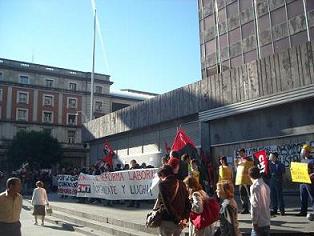
CNT picket in Bilbao
In the Southern Basque Country the impact was smaller, as the major unions did not join the strike, disgruntled by passive and manipulative attitude of the Spanish union duopoly. However in Navarre, the impact was similar to that of Spain with 74% of workers joining according to Gara and the airport completely paralyzed. Reports from industrial areas in the Western Basque Country, talk of some key industries paralyzed and industrial areas nearly stopped, as well as a total blockade of the harbors of Bilbao and Pasaia. Non-industrial sectors however were only mildly impacted.


Catalan Countries

Reports from the Catalan Countries tell of strong following in general and riots in Barcelona. With demonstrations in the thousands in many cities (Barcelona, Sabadell, Tarragona, Valencia, Lleida, etc.) and some arrests.
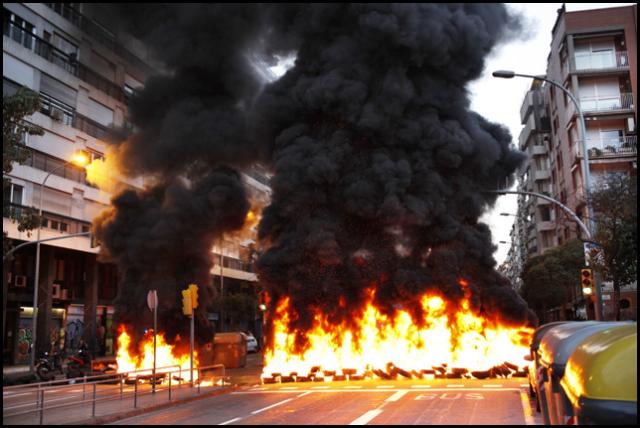
Fire barricade at Barcelona

Closing Mercavalencia at dawn


Asturias

In Xixon (Gijón) the walkout was generalized, with few incidents. The demo was called by Corriente Sindical de Izquierdas (CSI), SUATEA and CGT but was boycotted by institutionalist unions UGT, CC.OO. and USO, who were accused of making secret pacts with the patrons and government, trying to demobilize popular anger.


Aragon

The reports also talk of a general success, not just in Zaragoza but also in Teruel and other towns. They also talk very bad and  of the attitude of UGT-CC.OO, who posed for the photo and then left in most pickets. Combative unions in this country were CGT, Sindicato Obero Aragones (SOA) and CATA.

Closing El Corte Inglés, more images at NoblezaBaturra
There are also reports of police charges and arrests.


Andalusia

I could only find reports so far on Málaga, telling of irregular impact but stopping the key sectors. The demo was of several thousands.


Castile

The most important city by large is Madrid, which was strongly affected by the General Strike according to La Haine.

While the "official" UGT-CC.OO. demo gathered some 500 people, the alternative one called by other unions (CGT, Solidaridad Obrera, etc.) was massive (photos).

Very symbolically, regional public TV Telemadrid cut its emission, reminding somewhat of the impacting cut of TVE in the quasi-mythical general strike of 1988, which was a massive success.

While the unity and strength of genuine labor-unionism was an important element, the violence of police was another one. Police did not only charge against pickets, including the bycicle picket, but there are reports of seven live ammunition caskets being found after a specially violent charge in Airbus-EADS Getafe.
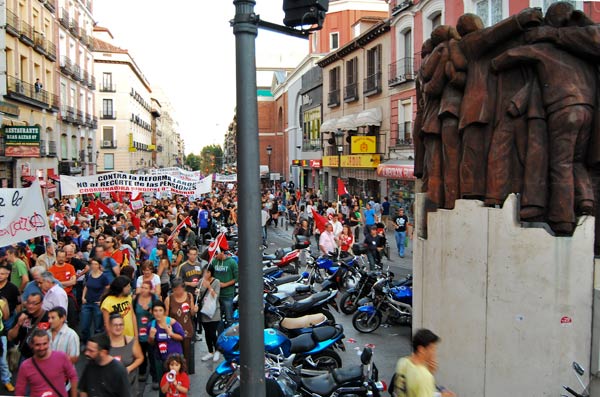
Madrid
Another city where the strike had major impact was Valladolid.

Valladolid

In Salamanca instead the reports tell of low following. 
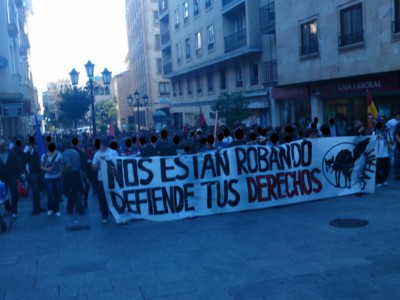
Salamanca
Elsewhere in Europe

There was a call for protests and demos to take place around Europe yesterday and I am aware of such protests in Ireland, Portugal, Italy and several Central European countries, however in the wealthy central bloc of the EU the impact of this call for mobilization seems to have been pretty low or nil, excepting the central demo at Brussels. 

Brussels
Dublin (Parliament gates)
Brief Analysis

Combative labor unions clearly made gains both in charisma and unity yesterday in the State of Spain, while traditional subsidized unions seem to have tried to make a posse strike instead to save their face before a growingly angry working class, which massively joined the strike in spite of all.

Much remains to be done at European level, which, in my understanding, is a key level of organization if we want to stop and reverse the offensive of Big Capital.


Some relevant links: CGT, CNT, Solidaridad Obrera, Rojo y Negro, La Haine.

Update: according to Cuestionatelotodo ("questioneverything") the sectorial impact was:
  • Metal 74%
  • Wood 59%
  • Construction 70%
  • Chemical 80%
  • Textile 77%
  • Mining 100%
  • Air transport 82%
  • Road transport 78%
  • Sea Transport 90%
  • Urban transport 85%
  • Markets 90%
  • Public education 60%
  • Private education 32%
By autonomous communities:
  • Andalusia 76.8%
  • Asturias 87%
  • Balearic Islands 72%
  • Canary Islands 70%
  • Cantabria 70%
  • Castile-Leon 72.3%
  • Castile-La Mancha 80.2%
  • Catalonia 80%
  • Valencian Country 78%
  • Extremadura 70%
  • Galicia 80%
  • Madrid 76%
  • Murcia 72%
  • Navarre 74 %
  • Western Basque Country 30%
  • La Rioja 71%

Wednesday, August 25, 2010

Cave bears extinct on human and climate pressure


That seems to be the conclusion of a mostly European research:


Mathias Stiller et al. Withering Away—25,000 Years of Genetic Decline Preceded Cave Bear Extinction. Molecular Biology and Evolution 2010. Pay per view.

Abstract

The causes of the late Pleistocene megafaunal extinctions are still enigmatic. Although the fossil record can provide approximations for when a species went extinct, the timing of its disappearance alone cannot resolve the causes and mode of the decline preceding its extinction. However, ancient DNA analyses can reveal population size changes over time and narrow down potential causes of extinction. Here, we present an ancient DNA study comparing late Pleistocene population dynamics of two closely related species, cave and brown bears. We found that the decline of cave bears started approximately 25,000 years before their extinction, whereas brown bear population size remained constant. We conclude that neither the effects of climate change nor human hunting alone can be responsible for the decline of the cave bear and suggest that a complex of factors including human competition for cave sites lead to the cave bear's extinction.

Cave bears went extinct roughly at the time of the Last Glacial Maximum, 25-18,000 years ago.

See also:
· Article at Science Daily
· Leherensuge: Mammoths died because of forest expansion.

Tuesday, July 6, 2010

Gulf oil disaster will reach the Atlantic


This is the estimate for the Gulf of Mexico oil spill in less than a year, according to simulations by US scientists:


The simulation is based on 5 typical years' climate and does not include any estimate of biological degradation or other accumulation processes such as the formation of tar balls. Whatever the case it is a most worrisome forecast for SE USA, parts of Mexico and even possibly Europe, where the Gulf Stream eventually ends.

The catastrophe, still mostly uncontrolled, has began to be dubbed "the American Chernobyl".

Source: Science Daily.

Saturday, July 3, 2010

Barroso saber-rattles to impose social degradation in Europe


The right-wing President of the European Comission, Joao Barroso, reportedly warned of military dictatorships coming to life in Europe if the so-called "austerity measures" (i.e. taxing the poor to give to the rich) find resistence.

This is reported by Heinz Dieterich[es] and the EU Observer[en].

According to the latter, the Secretary General of the European Trade Union Confederation (ETUC), John Monks, had the following exchange with Barroso:

The chief of Europe's trade union chiefs, John Monks, has warned that the austerity packages being imposed across the bloc will send the continent "back to the 1930s." He reported that European Commission President Jose Manuel Barroso also fears member states will turn their back on democracy - but for the opposite reason.

"This is extremely dangerous. This is 1931, we're heading back to the 1930s, with the Great Depression and we ended up with militarist dictatorship," the general secretary of the European Trades Union Congress (ETUC) said in an interview with EUobserver. "I'm not saying we're there yet, but it's potentially very serious, not just economically, but politically as well."

Mr Monks reported that Mr Barroso has similar concerns, but based on diametrically opposed reasoning. He said the commission chief believes the austerity packages will save Europe from returning to the darkest days of the last century rather than precipitating the fall.

"I had a discussion with Barroso last Friday about what can be done for Greece, Spain, Portugal and the rest and his message was blunt: 'Look, if they do not carry out these austerity packages, these countries could virtually disappear in the way that we know them as democracies. They've got no choice, this is it'."

"He's very, very worried. He shocked us with an apocalyptic vision of democracies in Europe collapsing because of the state of indebtedness."


For Dieterich, however this exchange is more than mere concern: it is a direct threat:

The European bourgeoisie states, in other words, an ultimatum to the worker and popular movement: pay submissively the costs of the crisis caused by Big Capital or we make you pay by means of the military boot. In political language: if you offer resistance to reduction of your life quality levels, we will move from the veiled bourgeois dictatorship (representative democracy) to open bourgeois dictatorship.

The level of the interlocutors is a clear sign of the seriousness of the threat: Barroso is the highest executive officer of EU and Monks the highest ranking officer of mainstream European labor unions. Dieterich also reminds that it was European bourgeoisie which invented fascism and its variants and which had no problem in 1968 to bring in the tanks to quell the revolt in Paris.

He also cites a report by Merryl Lynch-Capgemini that shows that while the World is immersed in the worst economic crisis since 1930, the number of hyper-rich and their profits keeps growing, a clear sing of who is paying for the crisis: not the oligarchs who caused it but the plain people who has no fault whatsoever (other maybe than being too naive about the real intentions of their rulers and elite class).

Dieterich however calls for a reaction more in the line of the 1840s: when it was becoming evident that revolution was at the gates, the International elaborated a program of action, which had a major impact in 1848 and set the basis for the Worker Movement as we know it. That program is now known as The Communist Manifesto.

Dieterich says that we now know better how Socialism must be (democratic planning, work value and principle of equivalence) as well as how its political structure needs to be (participative democracy) but that we lack, unlike in 1847, unions and intellectuals with class consciousness and critical theory, reason why the European people is "defenseless" in front of this kind of blunt threats.


-----------------------------------------------------

Update (July 4): On second thought, I'd say that the Spanish Armed Forces are so extremely lacking prestige and numbers that they could hardly serve as backbone of any authoritarian regime. The chance of effective military coup in Spain is nil. However in the particular case of the multiethnic realm, a situation somewhat similar to that of Yugoslavia in the 90s may be generated, that is: open war instead of the current low intensity conflict.

I was somewhat intensely involved in documenting and reporting on the West Balcans war in the 90s and I recall a potentially relevant conversation however. It happened in Skopje, Macedonia, in an interview with the leader of the small liberal party. I don't recall neither the name of the man nor that of his party but doesn't really matter.

He related an anecdote of a year or so before the war broke up, a conversation he had with a CIA agent he said. The Macedonian was telling the spy that he was confident in the future because, after all, Yugoslavia was finally, after the fall of the Soviet Bloc, "strategically irrelevant".

To this the North American agent replied mysteriously: "I would not be so happy if my country would become strategically irrelevant". Soon after the war broke up.

The case of Spain is very different: it is strategically most relevant, in particular because it is a platform to control the Gibraltar strait and potentially North Africa and because it hosts key US bases in that strategic area: the naval base of Rota and the air base of Morón de la Frontera. Also for several reasons France specially would not want Spain to break apart (fear of contagion, important neighboring ally, major investments).

So, for good or bad, open inter-ethnic war in Spain is not probably an option, unless powerful third parties would intervene, what does not seem likely at all.

So I would dare say that the threats are empty threats in this case. Greece instead still keeps a large conscription army which can effectively occupy the country, unlike the Spanish one, which can barely just reinforce the police force. However one of the dangers of a conscription army is that recruits can potentially take over it, if they are organized.

The real problem is overall lack of organization of the class forces and a self-defeating pactist dynamic of the mainstream unions. Without grassroots class organization the people is very weak and even police alone, with the help of the media, controlled by the same oligarchic forces, can keep high levels of repression.

But a coup? I don't think so: they'd lose all their remaining legitimacy and would disintegrate easily.

Wednesday, June 30, 2010

The financial coup and the end of Europe as we know it


Economist Michael Hudson has a new article at Counterpunch (Spanish language version at Sin Permiso) analyzing what he bluntly describes as financial coup.

Some key paragraphs:

A balanced budget in an economic downturn means shrinkage for the private sector. Coming as the Western economies move into a debt deflation, the policy means shrinking markets for goods and services – all to support banking claims on the “real” economy.

(...) The idea is to create an artificial financial crisis, to come in and “save” it by imposing on Europe and North America a “Greek-style” cutbacks in social security and pensions.

(...) It is diametrically opposed to the original liberalism of Adam Smith and his successors. The idea of a free market in the 19th century was one free from predatory rentier financial and property claims. Today, an Ayn-Rand-style “free market” is a market free for predators. The world is being treated to a travesty of liberalism and free markets.

(...) Latvia is the prime example. Despite a plunge of over 20 per cent in its GDP, its central bankers are running a budget surplus, in the hope of lowering wage rates.

(...) Beyond merely shrinking the economy, the neoliberal aim is to change the shape of the trajectory along which Western civilization has been moving for the past two centuries. It is nothing less than to roll back Social Security and pensions for labor, health care, education and other public spending, to dismantle the social welfare state, the Progressive Era and even classical liberalism.

(...) The problem is that there is not enough economic surplus available to pay the financial sector on its bad loans while also paying pensions and social security. Something has to give.

(...)

What really is causing the financial and fiscal squeeze, of course, is the fact that that government funding is now needed to compensate the financial sector for what promises to be year after year of losses as loans go bad in economies that are all loaned up and sinking into negative equity.

(...)

This is not the familiar old 19th-century class war of industrial employers against labor, although that is part of what is happening. It is above all a war of the financial sector against the “real” economy: industry as well as labor.

(...)

Latvia has been held out as the poster child for what the EU is recommending for Greece and the other southern EU countries in trouble: Slashing public spending on education and health has reduced public-sector wages by 30 per cent, and they are still falling. Property prices have fallen by 70 percent – and homeowners and their extended family of co-signers are liable for the negative equity, plunging them into a life of debt peonage if they do not take the hint and emigrate.

(...)

The explanation, of course, is that today’s economic planning is not being done by elected representatives. Planning authority has been relinquished to the hands of “independent” central banks, which in turn act as the lobbyists for commercial banks selling their product – debt. From the central bank’s vantage point, the “economic problem” is how to keep commercial banks and other financial institutions solvent in a post-bubble economy. How can they get paid for debts that are beyond the ability of many people to pay, in an environment of rising defaults?

(...)

This is why I say that Europe is dying. If its trajectory is not changed, the EU must succumb to a financial coup d’êtat rolling back the past three centuries of Enlightenment social philosophy. The question is whether a break-up is now the only way to recover its social democratic ideals from the banks that have taken over its central planning organs.


I could add many things but would be mere extensions on this analysis. Sadly enough, Hudson is right and, unless the People of Europe reacts very strongly, the continent will be plunged in a matter of years into the most dystopic scenario with the vast majority of citizens dumped into misery conditions, industries fleeing or dying out and mafias running the only remnants of the economy.

The corruption of the parliamentary representation system, with nearly all politicians being nothing but puppets of their financial patrons and with nearly no free media surviving, plus the destruction of effective state sovereignty is leaving Europe (and the World) on the hands of the big bankers, who have only one goal: to keep their profits high for as long as possible, concentrating all the wealth in their hands, without any real plan for the future other than that.

Capitalism has taken off its mask. It still tries to sell workers' austerity as something "good" but in fact they have no project whatsoever anymore. The Cold War illusion of welfare under capitalist conditions is all but dead now: class war has become very real.

But by the moment at least, the bad news is that the oligarchs are winning the war. For how long?

Friday, May 28, 2010

Eurozone's problem is Germany


Interesting review by Prof. Vincenç Navarro
at his blog[es] on how the real problem of the Eurozone is not really the rather normal finances of peripheral countries but in the lack of demand of the central countries, notably Germany.

Germany, supposedly the economic engine of the EU, has been pretty low in the last decade, with small GDP growth figures and high unemployment. What is worse: the domestic demand of Germany has been lower than the peripheral countries now being punished for precisely sustaining the economy of the Eurozone (and specially of Germany itself) with their demand.

This is because Germany, still with a social-democrat government then, chose not to use the huge surplus that conversion to the euro generated to increase its domestic economy by rising salaries (and hence demand) but to speculate in the peripheral countries feeding the housing bubble and the deficit escalation.

Germany is in fact the wealthy but savy cousin who wants to sell commodities to their less well off relatives. And oddly enough, it has worked for a while, thanks to German (and French) credit. But logically this was untenable in the long run and now the Germans (and the French) want their money back by any means, what implies the destruction of the demand for German products.

As I said before, Mr. Volkswagen: how do you expect us to buy your cars if we work for misery salaries and pensions?

Navarro mentions that Oskar Lafontaine, then minister of economy and now co-leader of the growing communist Die Linke party, left Schröeder's government and the SDP for that reason. Lafontaine proposed instead a more balanced approach, increasing the income of German workers and hence the internal demand, what would have created a much more balanced EU and not this neocolonial engender designed for Mr. Volkswagen exporting until the demand runs dry (what is happening right now).

So what really needs to be fixed is that historical error that highly imbalanced the demand in the Eurozone. The demand by Germany and other Eurozone countries need to rise, what probably means increasing local salaries.

That does not mean that other barbarities like the Spanish housing bubble do not need to be addressed, they do. In fact Spaniards could work for less or demand more commodities if housing prices were not so extremely high, and that's a good reason to explode this bubble. But that would cause serious trouble to banks, who have invested heavily in this worthless excercise of financial engineering.

That's after all the real problem we have in EU: if we do what is logical (explode bubbles, restore a healthy demand by rising income), then banks would sink. Nobody cares about that except banks themselves, because they can always be replaced by other more serious banks, private or public. Of course some private investors would suffer but most people would be unscathed.

But the interest of the people does not matter to policy-makers, specially as EU is anything but a democracy, so Brussels and the Eurozone oligarchs have decided that it's best to make people pay for the errors of the banks and re-level the Eurozone demand to misery levels by lowering income and making sure that the banks are paid back.

This is extremely short-sighted: it's bread for today and hunger for tomorrow. Even for the bankers. If there is only a very low demand in the Eurozone, then Mr. Volksvagen (my imaginary archetype of European capitalists) won't be able to sell nearly anything and the economy will become stagnant for a very very long time.

The problem is clear: who dares to hang the bell from the cat's (banks') neck? It's much needed if we want to avoid Europe from sinking into misery and self-destruction.

Nobody? Then I think I know where the first socialist revolution of the 21st century will happen.

Wednesday, May 5, 2010

Greece and Europe can only do one thing: a Revolution


As the pace of the Greek revolution speeds up, with the first casualties in a burned down bank office and the Greek Parliament besieged daily by the angry people, one may wonder why is people so angry. After all, according to the Imperial media, it's all their fault and the government is doing what it must do to save the nation.


The answer is logically that people is not so naive: they have barely, if at all, benefited from the bad practices that have triggered the crisis (rather the opposite) and they have yet to see any of those white collar criminals being brought to court and their properties seized to help pay the national debt.

The answer is that the whole nation is being held for ransom for the corruption of a handful of oligarchs and, what is maybe even more important, their international accomplices.

That's simply not acceptable.

And obviously this means a regime change in Greece: one that can effectively arrest the criminals and issue the appropriate international capture orders for their accomplices in Washington and Brussels.

One that has no problem in nationalizing the product of past years' robbery when possible.

One that dares to declare bankruptcy if need be.


So Greece is set for a revolutionary regime change and that is most unlikely to be prevented because there is no alternative. The only question is the pace and exact extension of this change.

But what about the rest or EU. EU can live without Greece but can it live without half of EU members? Because the speculators' aim is already set to other Eurozone states. It seems by the signals that the Iberian peninsula will be next but Italy, Ireland and the very UK (out of Eurozone but of great importance by its size) are clearly in the agenda.

The European Union today.
Eurozone in blue, comitted to join the Eurozone in green, special statuses in red, non-EU states using the euro in purple.
Stripes signify those states clearly targetted by the Transnational Capital to be ripped off in a "controlled demolition" (Latvia included because it's already suffering the IMF blackmail).
Original map from Wikipedia (modified).

The goal is to recycle these countries into cheap labor zones for the Euro-Global Capital without these vampires losing a cent in the process. The 'problem' is that the plan may go awry and trigger a pan-European revolutionary process.

Maybe the level of popular organization is not yet high enough but, even if the Transnational Capital achieves its goals it can only be a temporary situation as the rage they will leave behind in some of the more privatized and less well-off states of EU, where people do already struggle to make ends meet, cannot really be contained in the mid run.

While the Greek spending spree may have been going on before the advent of the Global Crisis, in the rest of countries public spending has actually been a reaction, a much needed one, to this disintegration of the Capitalist World Order. Claiming that states have to cut spending in the midst of a general crisis is totally absurd: states must increase their spending to put up for the inability of the so-called "market economy" to generate jobs and salaries, which are after all the only ones that will generate demand for the beleaguered private companies, at least for most of them.

Cutting public acquisitive power is not an option, not even for German capitalists: it's a suicide.

If the European Bank must print more euros, so be it. If the euro has to be devaluated, that is not a problem but in fact good news for European companies, which would see their international competitivity improved greatly by such measure.

But EU institutions are not working for the good of the European common citizen (or should I say denizen?), EU institutions are only working for the good of some privileged elites and they don't care at all about the common European, not even about the common European small company. Only huge multinationals matter for them.

This situation obviously demands a regime change at EU level. A regime change that redefines EU as a social federation and not as a capitalist one, a regime change that establishes EU finally as a representative democracy and not a mere bureaucracy at the service of the transnational mafias.

It may take some time but it will be done. The only alternative is for EU to disintegrate completely and its various states (or fragments of states in some cases, as Spain for example is not going to survive this one in a piece, nor will the UK) let to fend off alone in the vast ocean full of sharks. That's not a realistic or at least desirable goal and it's something that goes against the common feeling of nowadays Europeans, for which a European union, this or another better one, is a default.

So the only alternative is pan-European revolution.

Let's do it, do you have a better plan for today, my dear unemployed bored and desperate reader?

_________

Note: you can read the declaration of a colleague of the dead bank workers blaming the deaths on the bank owners at Occupied London (in English) and Indymedia (original in Greek). Triggered by this tragic incident, the Greek bank workers are going to strike tomorrow even if the corporative guild forbids them to do so.


Saturday, May 1, 2010

Switzerland: prison guards let a prisoner die laughing


From
Rebelión[es].

The guards of the Swiss prison of Bochuz, Vaud, Switzerland, let a prisoner die after he had set fire to his mattress. For hours they ignored him, making insulting commentaries and clear statements in favor of letting him die. They even prevented a rescue team from accessing arguing they were too few to control the prison.

Even more painfully, the prisoner, Skander Vogt, aged just 30, had been sentenced in 1999 to only 20 months of prison for minor crimes but had been kept arrested on a clause of the Swiss law that allows indefinite prison for those estimated to "compromise public security". Go figure: sentenced to 20 months (here you would not even go to prison at all) and jailed for 11 years!

Vogt had in the past climbed once to the prison roof demanding a dentist because he had a terrible tooth ache and the prison would not provide him one. He was held in isolation and would not be allowed to leave his cell unless fully chained. His only consolation a radio had been conficated by prison authorities the day before he set fire to the mattress in protest.

They let him die laughing.

What kind of democracy is this? What happened to this person's most basic human rights?

Wednesday, April 28, 2010

Should Greece declare bankruptcy?


It may be a realistic option considering the alternatives promoted by the FMI-EU tandem. Anyhow, after the BB+ rating by S&P it will not make much difference.


BBC reproduces a demonstrator's opinion, a bank worker's one to be more specific:

We should opt for bankruptcy. Goldman Sachs, Deutsche Bank, Wall Street, they lent us the money. (Far better) they lose their money and people don't lose their jobs.


But the case is: can small Greece, with only 10 million inhabitants and not so many natural resources other than sunny islands for turism survive alone? How?

I have little doubt that the Greek people have the organization to go in revolutionary spree. They may be the only ones in Europe in fact in such excellent revolutionary conditions. But, even if they succeed, what then?

A more realistic case may happen in Iberia, a far larger area and next on the list for catastrophic FMI-dictated austerity packages. Iberia does not have such a large well organized class struggle as of now but, in the case it would, it could indeed hold a very viable economically autonomous area (Spain alone is right now the 9th global economy by GNP, holding 2.5% of the World's GDP (nominal), almost half of Germany's). Even in the case of international ostracism it can find some economic space working with Latin America, largely a red zone already, for example. Geographically closer Arab countries such as Lybia and Syria are also potential partners for any ostracized Mediterranean power.

Of course, there are two problems:

One is the tight rope of the euro, which should be in fact the main problem to address at pan-European scale (from a liberal perspective), devaluating it significantly in order to boost exports, reduce imports and secure jobs and public services. The North European gang, lead by German Capital, is however getting too many benefits from this situation and unable to react fast enough to to protect the system they have created for their benefit. The fact that Germany exports mostly to EU countries says it all.

The other is military intervention. If anyone believes that the Empire is going to let countries leave without intervening, he/she is of course very wrong. The first line is indeed the local armies and police forces, normally with strong right wing, fascist-like tendencies. But they can succumb to popular pressure and nationalist feelings. They can indeed also be defeated by political ways or their intervention trigger organization of guerrillas and such. The second line is direct military intervention by NATO (with similar or even worse results).

Whatever the case, the foresight for the next years is drastic increase of class tensions and possibly revolutionary changes (or alternatively anachronistic, and hence doomed, fascist attempts) in Southern Europe (among other places: the oven is very hot everywhere).

This situation would be unthinkable just a couple of years ago but now it appears as almost unavoidable. Thank Goldman Sachs and the other global bankers for this.

Next the sight stops on other even more sizable countries: Italy, France, the UK... none of them too buoyant. A very bad scenario is also ripe for Eastern Europe (Latvia is the most outrageous case but the rest are not well off either) and even Northern Europe (Iceland could not scape the voragine either).

Sooner than later, Germany itself will have to face the consequences of this global disaster. Best would be to act at European level but the EU building is frail and patchy, undemocratic and controlled by the big corporations. It's not an instrument of change but of continuity.

However class organizations should coordinate and direct the fights at this level, as the state level is obviously too limited to produce results. So far workers in Greece, in Latvia, in the UK, in Italy... are fighting separate battles against the same enemy. This may help the collapse of EU but is not really an effective way of struggle. We should see masses of people striking at Madrid, Paris and Berlin in support of Greek workers... but it seems that this people's facet of Europe has yet to be created.

It will eventually because nowadays state governments are very much powerless and irrelevant, so the action has to be taken at pan-European levels, if not at global ones. But this stage has not yet arrived and hence it's easier to witness a collapse of EU than a pan-European revolution. Still I'd prefer the latter, strongly so, and I think it is the way to go.

Sunday, April 18, 2010

The volcano that collapsed all


I don't normally write on news that are on the main pages of all media, but the unpredictable consequences of the infamous volcano Eyjafjallajokull really deserve at least a few lines.


First of all, I admit I am guilty of copy-pasting the name of the volcano. Really it will take me more than just a few days to learn to spell that Icelandic word and therefore I have decided to call it simply Eyja, which I hope doesn't offend it.

And anyhow, it was just a matter of time before it was nicknamed somehow, yes or yes?


Impressive image of Eyja borrowed from Al Jazeera

Anyhow, Eyja's polluting power is such that in just a few days of eruption, otherwise not too destructive, it has created such an unprecedented chaos in modern globalized Europe that wealthy men are begging in Warsaw for a ride back home and airlines are rumored to be preparing to fire personnel. Meanwhile the roses from Kenya or the kiwis from Chile can't reach their European markets and the ash cloud has already reached East Asia causing widespread disruption there as well.

But this is probably only the beginning. Vulcanologists can't predict the duration of the eruption but, in any case, so far has only got stronger and stronger. It could be just two days more... or it could be two years. Nobody knows.

The closest precedent is that of Laki volcano, also in Iceland, in 1783, which lasted for eight months and historians link to crop failure and being one of the triggers of the French Revolution.

There are indeed no precedents for such a widespread closure of air space. The closest case experts can think of is the brief closure of US air space after 9/11. But even that is not comparable: now there's no way to predict how will be the situation just a few days ahead... though the most likely is that it will remain the same or even worsen.

And it is affecting the economy: businessmen can't fly to meetings and fairs (even presidents and prime ministers had to suspend their journeys), some imported food will soon become scarce in your local supermarket and some of the most profitable sectors, such as pharmaceutics, rely on air transport heavily. According to The Guardian, even if only 1% of the volume of British foreign trade is done by airplane, it is nothing less than 30% of its exporting value!

Add up all the many disruptions and their cumulative chain effects in the context of an already very severe economic crisis... and let your imagination fly - because there are no precedents, really.

Of course Eyja could stop tomorrow... but that's not very likely to happen.

Saturday, February 27, 2010

Raise salaries to tackle the crisis


Interesting quasi-Keynesian economical theory the one
explained by Alberto Garzón Espinosa at Altereconomía and developed originally by A. Badhuri and S. Marglin: European economies are in fact wage-led, not profit-led, hence destroying salaries will only sunk the economy further, what the system needs therefore is higher salaries.

The problem is that the Economic Doctrine, as in the seminaries... oops, I mean faculties of economics of virtually all universities ignores such fundamentals. The Doctrine says, erroneously, that economies are by definition profit-lead.

Demand is obviously driven mostly by the purchasing power of the people and if you destroy this purchasing power in order to minimize costs you destroy the demand and hence the economy. It doesn't matter how much the capitalist saves because he won't find a market for his super-cheap products if there is no demand.

This is, by the way, the fundamental contradiction of Capital as described by Marx more than a century ago. And that's why The Capital developed the now deprecated Keynesianism, as mechanism of defense when it faced its first structural crisis in the 1930s. But then came Thatcher and Reagan and their hordes of neoclassical priest-economists and decided that somehow the remedy was worse than the illness (was it?) and launched Reaganomics: plunder today that, in the immortal word of Keynes himself, "the future will take care of its own business".

Problem is that the future is today. Meh!

Meanwhile they created The Bubble, temporarily replacing the wage-based demand by a credit-based one. It could not last of course and millions of people and even whole nations were pushed into irrational indebtment in order to generate a spurious demand not sustained by the economy itself, i.e. by the salaries. It was nothing but a pyramid scam (Madoff? Thousands like him rule the world today!)

Whatever the case, the thesis defended by Garzón Espinosa is solid (not in vain it's consistent with the methodical analysis of the only economist worth that name ever: Karl Marx) and shows that the neoclassical remedies promoted by the FMI and acolytes, demanding salary reduction in order to reduce costs of a production that will nevertheless not find any significant demand, are fundamentally wrong. This is probably the case for any large economy anywhere but it's clearly true for Europe, which lives essentially on internal demand.

However, and this is my criticism, in order to make it work properly, a good deal of protectionism would be needed as well, at least while other countries/regions resort to the neoclassical recipes of the FMI. Otherwise the regional demand would be largely "wasted" in foreign products, not supporting the local economies. This is contrary to the interests of the Global Capital, particularly in the Toyotist paradigm, so the recipe cannot in fact be implemented within the system.

A change of system, a change of socio-economical paradigm is needed in order to save the economy, which is, let's not forget it, our very survival.

Tuesday, February 9, 2010

Zionists may be planning a new "9/11" in Europe


Several mainstream newspapers from West Asia have been speculating that the Zionist intelligence may be planning a new "9/11" massacre in order to relaunch the "clash of civilizations" war mentality. These media claim to have detected unusual activity by Zionist agents, not in the USA, but in Europe. They speculate that they might attempt a massacre at some notable religious such as St. Peter's Basilica or Notre Dame in order to re-stimulate the declining hatred between Christians and Muslims worldwide, that the Zionists exploit to their advantage.

In a related event, top US intelligence officials declared to Congress that Al Qaeda, that ghostly puppet organization, so convenient to some, plans to attack in the USA in three to six months, using improved methods to avoid detection. According to Voltaire Net, which is the source of this information, these declarations, accompanied by ruthless claims that US intelligence is authorized to murder anyone, including US citizens, and speculations about a massive global cyber-attack by China, are meant to counter the information already circulating in West Asia about a "9/11" in Europe orchestrated by the Zionists.

These people (sadly in power) are so absolutely crazy, murderous and powerful that I would not be too surprised if they did all at the same time: massacres in both Europe and the USA, blamed on Al Qaeda, along with an attack against the Internet, blamed on China, in order to reinforce (or try to reinforce) their crumbling imperialist "new world order".

In a separate, retrospective article also at Voltaire Net, research journalist Pino Cabras reports that an unusually high number of passengers of the flight that supposedly crashed against the Pentagon in September 2001, had top level military connections, some quite curious. Another research journalist, Thierry Meyssan, tells in an annex that, already in 2002, the Iranian spokesman for the Supreme Leader of Iran, Hussein Sariatmadari, told him that they had researched carefully in that same line and that they counted that 75% of all passengers of the ill-fated 9-11 flights had connections with the Pentagon.

This can't be a coincidence, can it?

Tuesday, January 26, 2010

Report on intolerance in Europe


I could only find the press release of this paper (should be somewhere in this site but I can't find it) but it's informative enough anyhow:

Andreas Zick et al. European Conditions. Findings of a study on Group-focused Enmity in Europe. Amadeu Antonio Stiftung, 2009. (PDF).

The report includes data for 8 EU states (the four largest ones plus Poland, Netherlands, Portugal and Hungary).

Immigration:
  • 50.4% think that "there are too many immigrants" in their countries. Oddly enough Portugal and Hungary are among the ones showing highest apportions of this xenophobic marker, only after Britain and Italy.
  • 33.5% think that "because of the number of immigrants, I sometimes feel like a stranger". Again Hungary is strangely high considering that immigrants are few there.
  • 48% think that "when jobs are scarce, [locals] should have more rights to a job than an immigrant". Again Eastern European countries are oddly high in this value.
  • 30.7% think that "immigrants enrich our culture". In this case East Europeans are the ones who seem to welcome more the cultural input by immigrants, what somehow seems to contradict other variables.
Anti-Jewish sentiment:
  • 24.6 % believe that "Jews have too much influence" in their country. Again East Europe is particularly high in this feeling (in spite of very few Jews living there).
  • 41.2% believe that "Jews try to take advantage of having been victims in the Nazi era".
  • 31% believe that "Jews in general do not care about anything but their own kind".
  • 38.1% disagree with the idea that "Jews enrich our culture"
Anti-Muslim sentiment:
  • 44.2% believe that "there are too many Muslims" in their country. Again Hungary is oddly high, while Portugal is low for this marker.
  • 55.4% think that "Muslims are too demanding".
  • 54.4% think that "Islam is a religion of intolerance".
Even if these figures seem high, there has been a clear drop in Islamophobia and an increase in Judeophobia in the last year, as Gilad Atzmon reports, probably triggered by the increased awareness of the macabre injustice that Israel is committed to.

Racism:
  • 13.1% think that "preferably Blacks and Whites should not get married"
  • 31.3% believe that "there is a natural hierarchy between Black and White people". Italy seems the country pushing down this racist belief, otherwise quite marked.
Sexism:
  • 17.6% consider that "when jobs are scarce, men should have more rights to a job than a woman"
  • 60.2% think that "women should take their roles as wives and mothers more seriously". This sentence is so ambiguous that can only indicate a relative trend in sexism, which is clearly stronger in the poorer countries of East and South Europe for both questions.
Homophobia:
  • 42.6% disagree with the statement "there is nothing immoral about homosexuality".
  • 52.9% disagree with the statement "it is agood thing to allow marriage between two men or two women".
The Netherlands is by far the most tolerant country in this aspect, while Poland is at the opposite extreme, followed by Hungary.

Overall there is a noticeable pattern of greater intolerance, sexism and xenophobia in Eastern European countries for nearly all values.


Sunday, January 24, 2010

European groups against the High Speed Train join forces in Hendaia


Thirteen organizations from the Italian, French and Spanish states joined forces yesterday at the Basque locality of Hendaia (Hendaye) before a demonstration against this kind of mega-infrastructure.


Snapshot of the demonstration held at Hendaia (Gara)

They reject the high speed train because it causes a ecological, socio-economic and human disaster, and because these projects disdain citizen participation. They denounce that in search of a justification for these kind of abusive transport structures the institutional promoters use many false hypothesis.

As alternative, the popular organisms demand improvement and optimization of the already existing railroads. In a further step of criticism they suggest that a reduction of transportation, along with a deep transformation of the economic model are much needed.

These points have been written down in a declaration known as the Hendaia Charter, which was signed by all present groups and ten other organizations across the continent. The Hendaia Charter has been translated to many languages already (so far I have only been able to locate the version in Basque).

Sources: Gara (sp), France24 (en).
Other references: AHT Gelditu! (eu - sp - fr)

Saturday, January 9, 2010

Snow on beaches: not seen since the 80s


Just a silly postcard post from "Ice Age Europe", so to say.


While forecasters have been warning that snow could reach the coast, their previous warning of this kind simply failed. So I suspected it would also be the case now, in spite of watching this impressive satellite image of frozen Britain, which is some many degrees further north anyhow, largely because it has not happened since more than 20 years ago.

But it did arrive in the end, just that not really here but further east. Some curious pics from Gara:


Donibane Lohitzune (St. Jean de Luz)


Donostia (San Sebastian)

Not here anyhow. Biscay is the only Basque region that seems largely unaffected by the storm, though it's damn cold anyhow.

Sunday, December 13, 2009

Informal referendum for independence in Catalonia


After the new statute has been challenged by the tories (fascists) at the Constitutional Court, Catalans are thinking that they are probably best on their own. An informal referendum is set up for today in 170 Catalan towns, including 700,000 voting citizens (Catalunya as a whole has more than 6 million inhabitants, many concentrated around Barcelona).


From BBC:

"More and more people think we have no room in the Spanish house, so we need a house of our own," organiser Alfons Lopez Tema says.

"[The Spanish] don't want us, they don't love us, they don't give us what we want. So the best thing is to vote and decide."

Joan Canela ponders at Rebelión:

If the Republic was formed after municipal elections, who knows what can bring independece.

The fact that this referendum acknowledges the right to vote to immigrants has brought their organizations to support Catalan independence. Diego Arcos, president of the Argentine House, says:

Catalonia acknowledges our citizenship while Spain does not.

Immigrants have already organized a political platform in favor of Catalan self-determination.

Anna Arqué, speaker of the organizing platform, hopes that the effect of these co-ordinated municipal referendums will be that the Catalan Parliament will call an official poll on the matter at national level.

Friday, December 4, 2009

The Great Western Imperial Firewall


Paul Marks writes at New Scientist:

"THIS is the kind of snooping you'd expect in China, not a modern western democracy. It raises huge questions over privacy invasion and freedom of expression." So says Andrew Heaney - who is not, as you might imagine, a civil liberties campaigner, but a senior executive at TalkTalk, one of the UK's largest internet service providers. Along with other ISPs, his company faces the prospect of being forced to spy on its customers' downloads for signs of potential copyright infringement.

>> Read more.

We supposedly enjoy the right to use our property the way we want, we supposedly enjoy the right not to be spied by the authorities without justified judicial intervention... but that does not apply to the Internet. While my phone or snail-mail conversations are protected by the right to privacy, whatever I do in the Internet is considered unprotected and open to be scrutinized by the police without any judicial supervision.

And if I happen to breach their corporativist laws, I won't even have a trial: I will be severely sentenced without any kind of guarantees.

And worst of all is that all their efforts to control intellectual property are futile. People will keep downloading and sharing one way or another, and they won't buy more because they just can't. Some will be punished but essentially piracy will just change its forms without any reduction. If anything people may feel even more justified to infringe copyright at any occasion because the mafioso style of this thought police is so annoying that you can't but choose to punish them whenever you can.

The whole project is going to fail (again). Their attempts to capitalize into even the most marginal sectors is essentially doomed. However it may have a good facet: that it will unavoidably open the debate on one of the central tenets of the late Toyotist capitalism: extremist intellectual property and how it makes impossible to do anything. And this kind of virtual property is the last hold of Capitalism: when we are done with it, this age will be over.

It is a fact that the labyrinth of patents and copyrights is hindering research, that fair use should be standard not any exception - even if just for the sake of science.

Tuesday, December 1, 2009

Scotland may have independence referendum next year


The ruling Scottish NationalParty has presented a plan to hold a referendum on independence in 2010. They need the support of the small Green Party to pass the law. There are also incognites on which options will the referendum ballot allow.


If successful, the Scottish process may herald the end of the United Kingdom as we know it. Together with other processes it may also signal the beginning of the "internal decolonization" in Western Europe, where many other nations are struggling for a long denied sovereignty.

Source: Gara.

Thursday, October 8, 2009

Istanbul IMF-WB summit protests: silenced?


I have been looking in several news sites and could find nothing. Only Basque left-wing newspaper Gara makes a meaningful mention of the protests and violent repression that have shaken
Istanbul as the yearly IMF and World Bank summit took place. Please, if you know anything more, let me know.

Per Gara, the city of the Bosporus has been virtually taken over by a huge police deployment, very specially at the centric area of Sisli, where the globalist financial meeting took place.

On Tuesday ago the main fights happened at the district of Beyoglu, beginning at Taksim Plaza and and continued for hours until the gases made the situation unbearable. The demonstration called there was mercilessly smashed by the police, what nevertheless did not avoid inccidents but in fact seems to be the main cause of them. A trader, Issac Kalvo, died of a heart attack in them.

Yesterday it was the centric district of Sisli the scene of the main struggles. In spite of the overwhelming police presence, demonstrators managed to block Pangalti Avenue for some time. There, a student identified as Mehmet, declared that the IMF and World Bank have sunk our country into misery, those who make deals to sell weapons that are used to kill Kurds, Alevis, Communists and that dissidence is smashed, want to come here to sell recipes to get out of the crisis.

Some masked street guerrilla groups managed to succesfully attack cash machines, bank offices and shops of multinational corporations. A different group managed to reach to the E5 highway and block it for some time.

Yesterday there were 34 people arrested, three of which in the mostly Alevi (a progressive Shia sect) and leftist neighbourhood of Gaziosmanpasa, who are being accused of membership in the illegal Revolutionary People's Liberation Party (DHKP-C) and of carrying more than twenty molotov cocktails.
.

Tuesday, August 11, 2009

Brittany's green toxic tide, the horses and the cart


An otherwise innocuous alga has become, thanks to the massive agricultural pollution, in a major threat to the ecosystem, tourism and even lives. The now widespread green toxic tide of sea lettuce remains forms a crust under which a deadly gas, hydrogen sulphide, forms, threatening the lives of those who may dare to walk on it.
A horse has already died and its human rider could only barely be saved from the same destiny.

The culprit? Pollution. Nitrogen pollution from the many farms throughout a country that is the major producer by far of pork (60%), poultry (45%) and dairies (30%) in the French Republic. The nitrogen high residues from these farms hyper-fertilize the coastal sea causing overgrowth of these weeds and the subsequent problems that threaten the tourism industry, as well as people's lives and cause a huge cost in the municipalities that desperately try to keep the tide away from their beaches.

More at BBC.

The real problem, I understand, is that these destructive "industries" are being allowed to pollute without paying for their damage. This makes their products "competitive" but the costs are only transferred to Nature and the public.

It is obvious that industrial or agricultural pollution should not be tolerated, certainly not beyond a minimal threshold, and that instead of investing so much public money in ecologically-friendly projects, authorities should be punishing destructive practices instead. This would result in healthier budgets and, of course, environments.

Some would argue that this would make industries less competitive, which only has an answer: eco-protectionism: forbid imports from polluting countries and/or make them pay high taxes. But first we have to clean our home, so we can ask the same from others.

But the opposite practice is what prevails.

Here for decades, we have been paying to electric companies an special "tax" just because they were forbidden to build new nuclear facilities. Logically, they should be the ones paying us for the facilities already built, which cause clear damage to the environment (either by leaks, the ever present danger of an accident and the totally unmanageable residues). Same for the conventional burner facilities.

That would make ecologically friendly electricity to be competitive. But the interest of the monopolistic industry remains, instead of that of the consumers, taxpayers and environment. And nope: electricity is anything but cheap.

What about water? In southern Spain for example, edible water is being misused brutally in golf courses and intensive industrial farming, causing, along with global warming, the rapid desertification of the area. Yet edible water is there a lot cheaper than here, where it rains every other day, and farmers and tourism entrepreneurs still demand more anti-natural water transfers from other hydrographical basins.

Again the interest of the industry and not that of the country (environment, people) is favored. The cart is once and again put before the horses in a never satiated capitalist accumulation process in which the wealth is extracted from Nature and the people into the pockets of a privileged class of vampires.

And I could continue but I have to stop at some point.
.