New blogs

Leherensuge was replaced in October 2010 by two new blogs: For what they were... we are and For what we are... they will be. Check them out.
Showing posts with label Jewish identity. Show all posts

Thursday, June 10, 2010

Jews are "Phoenicians", Palestinians are "Jews"


[Update: please read my 2012 independent analysis of Western Jews, Palestinians and other populations of West Asia, which adds some interesting nuances but in essence confirms what is said here].


This does not seem just another paper on Jewish genetics but more like The Paper. While it is pay per view and hence I haven't been able to read it in full , the material I could see at Dienekes' blog (same as in the supplementary material) is most revealing. I think this research will mark a before and after in Jewish genetics and also gives some interesting hints on other populations, specially in West Asia and North Africa.

Doron M. Behar, Bayazit Yunusbayev, Mait Metspalu et al. The genome-wide structure of the Jewish people. Nature, 2010. Pay per view but supplementary material freely accessible.

One of the good things is that finally comparison with Turks and other populations from that area where early Jewish Diaspora in the Hellenistic-Roman era is known to have lived, rather than in Palestine, in a time when Judaism (several sects including eventually Christianism) was still actively proselytizing.

Unlike what I used to think, Western Jews (Sephardi and Ashkenazi) do not cluster too well with the Turkish sample but they cluster almost perfectly with Cypriots and Lebanese. They seem to have no particular relation with Palestinians (nor Druze nor Negev Bedouins) but these also appear clearly different from other Arabs and in general any other sampled population.


This K-means analysis is for me the answer to all these endless discussions on the origin of Jews and Palestinians. Western Jews seem essentially to have coalesced in the Cypriot-Phoenician area probably by, essentially, conversion. Palestinians seem to be a uniquely distinct population, albeit somewhat admixed with their neighbors, which may well originate with the local Neolithic and certainly must have been there in early historical times.

In other words: Palestinians are most likely to be the true descendants from the Jews of the Biblical period, rather than modern Western Jews who seem more as originating from a Phoenician-Cypriot population which converted to Rabbinic Judaism for whichever reasons.

Other Jewish populations also seem to originate in conversion episodes but from different genetic pools. Hence Yemeni Jews appear as genetically Arab, Ethiopian Jews as Ethiopian, Indian Jews as Indian and Iraqi-Iranian Jews as Iranians. There may be some fine threading to enrich this overall picture but the essentials seem very clear in any case.

Anyhow, Moroccan Jews appear as just another branch of Western Jews (no particular relation with Moroccans is apparent) and I have not been able so far to identify the closest population to the small sample of Uzbek Jews. Also Turco-European Jews seem at least somewhat admixed with Europeans, something that was already well known.

As for other populations, I find interesting that an specific autosomal component of NW Africans has been detected (for the first time as far as I can tell). Many specific clusters have obviously not been detected because of the relative shallowness of the K-means analysis.

The supplementary materials have other interesting graphs, PC analysis of autosomal, Y-DNA and mtDNA genetics and a global K-means analysis of relevance when observing some peripheral Jewish populations specially but also providing some general hints on other populations (a very wide sample, specially in Eurasia).

I must cheer and congratulate the authors of this research for finally addressing the debate on Jewish (and Palestinian) origins with a worthy extended sample of many many populations, including key ones such as Turks, Cypriots and Lebanese (among others). The wording of the abstract doesn't say things as clearly as I do but their data speaks volumes.


Update: A reader, Joe, tells me that H.G. Wells already suggested this Phoenician true origin of Jews. In his book A Short History of the World, chapter XXII, he wrote, speaking of Semitic peoples, once all powerful but then defeated by the Indoeuropeans (Persians, Greeks, Romans):

Is it any miracle that in their days of overthrow and subjugation many Babylonians and Syrians and so forth, and later on many Phoenicians, speaking practically the same language and having endless customs, habits, tastes and traditions in common, should be attracted by this inspiring cult [Judaism] and should seek to share in its fellowship and its promise? After the fall of Tyre, Sidon, Carthage and the Spanish Phoenician cities, the Phoenicians suddenly vanish from history; and as suddenly, we find not simply in Jerusalem but in Spain, Africa, Egypt, the East, wherever the Phoenicians had set their feet, communities of Jews.


See also the discussion on Atzmon 2008.


Update Nov 21: a free copy of the paper is available here (PDF).

Monday, June 7, 2010

Genetic comparisons of Basques and Jews


This past week I have been really oblivious to anything that was not directly related to the Zionist criminal assault of the Freedom Flotilla. I really did not feel that almost anything else mattered. Sometimes the tragedy of History just takes all the emotional and mental space and there is not really much room for anything else, I guess you can understand that.

However some more or less interesting stuff has been published in the meantime, in particular two papers on West Eurasian autosomal genetics which have been addressed at Dienekes' Anthropology Blog. So it's time to make a brief mention of them:


Basque genetics and other Europeans

Naiara Rodríguez Ezpeleta et al. High-density SNP genotyping detects homogeneity of Spanish and French Basques, and confirms their genomic distinctiveness from other European populations. Human Genetics. Pay per view.

See: Dienekes' relevant post for abstract, some details and his very questionable opinions, as well as for some discussion among readers.


Particularly questionable is his opinion that Basques should still be genetically identical to all other Iberians, based on one paper's Fst data but ignoring a whole array of other papers. These are (at least) Bauchet 2007 (discussed here), Achili 2007 (discussed here), Tian 2009 and Athaniasiadis 2010 (discussed here).

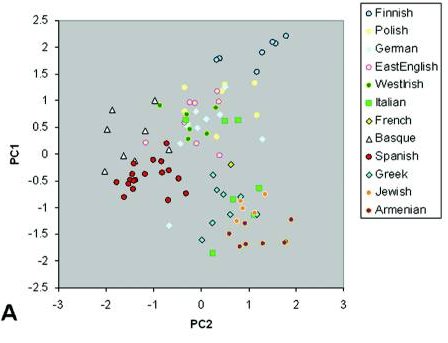
While Iberians are not sampled and plotted, based on the data of Tian 2009, they should show up very close to French and Italians (except the unique Sardinians), slightly above the (0,0) coordinates, in the graph above. Of course, it dependends on which Iberians but I'm talking about the main cluster, not Cantabrians nor Catalans.


Jewish genetics: yet another instance of truth avoidance

G. Atzmon et al. Abraham's Children in the Genome Era: Major Jewish Diaspora Populations Comprise Distinct Genetic Clusters with Shared Middle Eastern Ancestry. American Journal of Human Genetics, 2010. Pay per view (but should be freely accessible in six months).

See also Dienekes' relevant post.

Note: capitalized labels refer to Jewish subgroups. I strongly suspect, based on Fst distances (see second update below), that Palestinian and Bedouin labels are mistaken and should be the other way around.

It really frustrated me once again that Turks (nor Greeks nor Syrians) had been compared with. [note: see update below, this is not true after all and is quite revealing] The most logical hypothesis, based both on historical and the available genetic data, suggests that modern Jews (or most of them) are not so much descendants of historical Jews from Palestine as from a hybrid population that coalesced mainly in Asia Minor in Hellenistic and Roman times.

The above graph does not contradict this hypothesis at all, at least for the main Jewish population of Europe, Turkey and Syria. Irano-Iraqi Jews instead probably had different origins, the same that Yemeni, North African and Ethiopian Jews do as well (not studied here).

The affinity to Adigey (a NW Caucasian people) strongly suggests this, as well as the fact that they seem less Levantine than such an outsider population as are the Druzes (with Anatolian and Egyptian origins, not Levantine). Anyone familiar with European genetics would expect Greeks and Turks to pop up almost exactly where most Jews do.


Comparing with Bauchet-2007

But if you doubt my words, I suggest that you look at Bauchet 2007, which is the only paper so fare that has compared Jews (Ashkenazi) with Greeks and Armenians, resulting in almost total identity in all comparisons (k-means, PC analysis), as well as with South Italians. None of these groups are present in this analysis but they should show up pretty much where the main Jewish cluster is.


PC analysis of West Eurasians (fig. 4-A)

K-means clustering (fig. 4-B)

This paper remains to date one of the main and more clear references to understand European genetics at autosomal level and in particular to understand Basque and Jewish affinities or lack of them.

Together with other materials, some of them listed above, the case is clear:
  • Basques are a distinct subgroup of Europeans, though probably akin to some North/NE Iberians and some South/SW French
  • Iberians are also a distinct subgroup to the exclusion of Basques, even if they overlap at times (but not more than they overlap with Eastern Mediterraneans)
  • Jews seem impossible to take apart from other Eastern Mediterraneans (Greeks, Armenians, South Italians, Adigey) but they seem somewhat distinct from Palestinians, meaning they probably coalesced in Anatolia. The fact that Zionist researchers systematically avoid comparing with Turks, Greeks, etc. probably means that they know this is true but want to hide it.
If you still doubt of the distinctiveness of Basques in relation to Iberians, I would recommend to look at this other PC graph from Achilli 2007, even if it is about mtDNA, where the case is very clear even with a very small Basque sample in an ocean of other European and many different Iberian samples. Iberians do look quite diverse anyhow but none of them really clusters with Basques:


Update: Jewish genetic affinity with Turks and Cypriots revealed in the supplementary material.

Someone has sent me a copy of Atzmon's paper and I must correct my previous statement that no Turks were sampled. In fact there is a small sample of Turks and Cypriots which cluster very closely with the main Jewish group (Euro-Turco-Syrian Jews):


I can't tell at the moment if the subgroup that clusters most closely are Turks or Cypriots or a bit of each but that is all what is in the ESE control group. There are also a couple of NW Europeans who also cluster very tightly and are most likely descendant of recently assimilated Jews (maybe in the time of the Holocaust, when some families found that such was their only hope of survival).


Update: Fst distances

Table 1 is pretty interesting, even if it lacks the Turkish/Cypriot sample, in particular the Fst distances. In it, it seems quite obvious that Iranian and, to a lesser extent, Iraqi Jews are different populations from the main Jewish cluster of this study, that I will call hereafter Western Jews (incl. Turkish, Greek, Syrian, Italian and Ashkenazi subgroups). The most representative subgroup of this "Western Jewry" of Hellenistic-Roman origins are probably Turkish Jews (labeled TUR in the study), followed closely by Greek Jews (GRK) and then Syrian, Ashkenazi and Italian Jews.

In order to simplify, I averaged Fst distances within this group, resulting in the following pairwise comparisons with other populations (bold type):

North Italian - 0.006 (0.004) [0.010]
Palestinians - 0.008 (0.005)
French - 0.009 (0.007) [0.014]
Druze - 0.009 (0.007) [0.009]
Iraqi Jews (IRQ) - 0.010 (0.009) [0.010]
Adygei - 0.010 (0.008) [0.012]
Sardinian - 0.012 (0.010) [0.017]
Bedouin - 0.013 (0.010) [0.009]
Iranian Jews (IRN) - 0.016 (0.014) [0.017]
Basques - 0.016 (0.014) [0.021]
Russians - 0.016 (0.014) [0.021]

Figures in regular brackets (...) are Fst pairwise distances with Turkish Jews (TUR) only, while figures in square brackets [...] are distances with Palestinians.

For reference, the average Fst distance between Western Jewish populations with each other is 0.005 (0.004 of Turkish Jews with the other Western Jews on average).

Wednesday, December 9, 2009

Yet another poor paper on Jewish ancestry


N.M. Koppelman et al., Genomic microsatellites identify shared Jewish ancestry intermediate between Middle Eastern and European populations. BMC genetics, 2009. Open access.

The first thing I looked at was whether they had sampled non-Jewish Turks as control group. They did not, hence, in my opinion, this is just another paper that totally misses the point of Jewish origins, which are probably more in ancient Anatolia than in Palestine.

However, my dad, who grew up under a fascist dictatorship where good information was scarce and camouflaged, taught me to read between lines: to go beyond what the authors are expressly saying and detect that way further implications. And there are some things we can learn from this paper too therefore.

They did not sample gentile Turks but they did sample Jewish Turks and Palestinians, as well as Tunisian and Moroccan Jews, Tuscan and Adygei gentiles, etc. Certainly Jews (who appear as a rather homogeneous cluster regardless of origin) do not cluster closely with Palestinians at K=6, which in itself suggests that they are not of Palestinian origin. Their Palestinian genetic levels are essentially the same as those of Europeans, or just slightly higher.

The "Jewish" (Anatolian?) cluster does appear instead to have some increased presence in some European populations: exactly those in which you would expect a greater Anatolian affinity: Sardinians, Tuscans and Adygeis.

This paper is essentially useless and is unable to question the Anatolian Diaspora hypothesis that I hold as the likely origin for Jews and very specially European Jews (Ashkenazim and many Sephardim).

Why do I hold this hypothesis? First, for historical reasons: the original Jewish community in Hellenistic and Roman times was the Anatolian diaspora (there were Jews in some other areas, notably Alexandria and Palestine but the vast majority lived in Asia Minor - and that's why Christianity began there). At that time Judaism (of which Christianity is just an offshoot) was proselytist (and that's why Christianity and Islam are proselytist) and logically absorbed many gentiles who found spiritual and/or materialist benefits in such conversion. There are clear medieval examples of full nations or at least their elites converted to Judaism: Yemen, Kurdistan, Berbers, Khazars... and nothing less than the whole Roman Empire (Christian subsect, then transformed in a separate religion). So this should not be surprising at all (but of course is taboo under the Zionist doctrine because it would imply that Judaism is just a religion, not a race or nation).

Secondly, Jews, specifically Ashkenazi Jews, have only clustered with someone else (as far as I know) when Greeks and Armenians were included in the sample (see Bauchet 2007). They are not Turks but close enough and anyhow these three peoples made up a unique cluster in this mostly European study.

So I am still waiting for the research paper that dares to deal with this issue from a honest perspective. Of course, I know that (sadly enough) one should not expect such honest approach from a Tel Aviv University researcher but I am always optimistic and truly believe in human good disposition and honesty. However I also know of cowardice and conformism.

I'm still waiting.

Monday, April 20, 2009

Shlomo Sand on the invention of the Jewish People


Interesting interview with this Israeli historian that you can read at Rebelión (in Spanish) or at l'Humanité (in French). I know of no English version but I'll translate some excerpts here. He deals with his book When and How Was the Jewish People Invented?

I am very much Israeli, of Jewish origins. My cultural baggage is not European but especially Israeli. My first words of love were in Hebrew! It is very interesting to find out that Zionism does not acknowledge the Israeli people but still talks of "Jewish people", therefore neither Arab nationalism nor Zionism acknowledge the fact that in the Near East a society, a culture, even, it can be said, a new people that speaks a distinct language has arisen.

(...)

The exodus from Egypt never happened. (...) As historical document the Bible is not valid. I began researching when did the Bible became a historical book.

(...)

The first model [of Jewish nationalism] is the idea of the German nation. A national idea that is not republican, that is not civic, that relies on the notion of "where do we come from?" instead of using that of "where do we go from here", like the national ideas of France and the USA.

Therefore a lineal, totally imaginary, national history was created, beginning with the Bible.

(...)

I am not really sure that there was a Judaistic monotheism before the destruction of the Second Temple, before the destruction of the Kingdom of Judea. There are many archaeologists who think that there was never a large Kingdom of Israel. (...) The Bible is nothing but a mobilizing text to create a God-chosen people.

(...)

All children in Israel know that Tito exiled the Jews in the year 70 AD. (...) Can you believe that there is not a single book on the exile? Specialists know therefore that there was never any exile (...)

Ben Gurion, a great Zionist, believed until the late 1920s that the real descendants of the Judeans (term I use in my book) were the Palestinian peasants who never left the country. There were elites who migrated but, as always happens in history, the large masses of food producers never went anywhere.

(...)

So, if Jews were not really exiled, where did they live? I had not paid any attention to the fact that the Kingdom of Judea forced all its neighbours to convert. First by the sword, like any other religion, and then by persuassion too. Judaism proselytized until the triumph of Christianism. Then it became a religion enclosed in itself. (...) Jewishness is not any essence: it is a great religion. (...) I think that the origin of 80% of modern Jews is in Eastern Europe, notably Khazars and Slavs.

(...)

In Israel we have a regime that is deeply undemocratic, because it does not intend to serve the society but to the Jewish ethnicity throught the World.

(...)

It is the first time that a non-Zionist candidate to the post of Tel Aviv major gathers 34% of votes [communist Dov Khenin].
.

Friday, December 26, 2008

Can Jews be anti-Zionist?


Of course, there are many, even if most are rather the opposite and in the last decades Jewish identity has been dominated by criminal Zionism and hysterical
anti-anti-Semitism. But the issue has more ramifications and this interview, rather discussion, at Palestine Think Tank illustrates the matter pretty well. Gilad Atzmon argues in favor of dejudaization, in the line of Spinoza or Marx, while Sid Shniad argues that it is very necesary to stand up as Jewish against Zionism.

Take a look: Fighting Within.
.