
New blogs

Leherensuge was replaced in October 2010 by two new blogs: For what they were... we are and For what we are... they will be. Check them out.
Showing posts with label Paleolithic. Show all posts

Tuesday, September 14, 2010

Late human evolution maps


Kambiz Kamrani at Anthropology.net mentions
this site of a colleague and also his own dedicated page on human fossils. Both are very interesting and, using their data, I made some maps in order to better understand the chronology of recent human evolution in the range between 1.3 million years ago (oldest estimate for Neanderthal-Sapiens divergence, cf. Aida Gómez) and 60,000 years ago, when the expansion of these two species towards Asia was surely already in action.

As Asian fossils, excepted West Asia, are not relevant for my purpose (they are all Homo erectus senso lato with no transition happening there at all) I have used a base map that only includes the Western parts of the Old World.

Note: I used median ages but, when these overlapped too much with two of my arbitrary time frames, I placed them in the two relevant maps (check for safety but they are likely to be the same specimen.


1. 1.3 million years to 800,000 years ago:


While most of the findings are Homo erectus (purple dots), the likely first known individuals in the H. sapiens and H. neanderthalensis lines appear already, at the end of the period, at Atapuerca (H. antecessor) and Saldanha Bay (H. rhodesiensis).


2. 800-600,000 years ago:


We can appreciate in this period an expansion of H. rhodesiensis to the Horn of Africa and transition to H. heidelbergensis at Atapuerca (c. 600,000 years ago according to fossilized.org).


3. 600-400,000 years ago:

The expansion of Homo heidelbergensis becomes apparent in this period. Restricted to Europe however. Notice how in spite of these changes there are still many specimens categorized as H. erectus around the Mediterranean.


4. 400-200,000 years ago:


While it looks a dull map on first sight, most significant here is the existence of a fossil that may be transition between H. rhodesiensis and H. sapiens. This one is Lake Eyasi, in Tanzania (red-orange hue, not easy to appreciate possibly), dated to c. 240,000 years ago.


5. 200-60,000 years ago:


Whoa! Everything goes a lot faster now: Neanderthals and Sapiens everywhere! Well, each in their specialized area: Sapiens in and around the tropics, Neanderthals in the fresh regions of the North. Even the map caption becomes small as the earliest Neanderthal and Sapiens fossils (controversial chronology) show up in Central and East Asia respectively. I reflected this with a mere two color-coded arrows.

The oldest uncontroversial fossil of H. sapiens is Omo II (c. 195 Ka ago), followed by Herto (Idaltu) and Jebel Irhoud, in Morocco (both c. 160 Ka ago).

Thursday, September 9, 2010

More on megafauna and humans: Iberian peninsula


There is an interesting article
at Science Daily today that adds important information for one of the discussions that have arisen in Leherensuge recently: did humans caused megafauna extinctions?

The answer is clearly no. Not directly at least. Woolly mammoths are known to have existed in the Iberian peninsula, specially but not only in the North, not just in the Neanderthal (Middle Paleolithic) period but specially in the Upper Paleolithic period, when modern humans were already established and thriving in the region.

These species lived alongside different human cultures. There is evidence in some sites of the Basque country, Navarra and Catalonia that the Neanderthals coexisted with the mammoths and the reindeer at specific times. However, the majority of evidence of these faunae coincides with the periods of the Gravettian, Solutrean and Magdalenian cultures.

The most important detail for me is the word Magdalenian. We know with some certainty that population grew quickly in the Magdalenian period, after the Last Glacial Maximum, yet megafauna was still there and seems rather abundant.

The key element for the vanishing of these large herbivores in Iberia was the end of the Ice Age, when forests became the dominant feature of a warmed up landscape in which these animals, adapted to cold and steppe, could not survive.

There is however an ill-understood gap in the 31-26 Ka period (Aurignacian period, which in Iberia lasts from c. 30 Ka to c. 22 Ka. BP uncalibrated), when the megafauna findings are lacking.

Ref. Diego J. Álvarez-Lao and Nuria García, Chronological distribution of Pleistocene cold-adapted large mammal faunas in the Iberian Peninsula. Quaternary International, 2010. Pay per view.

Wednesday, September 8, 2010

Louse TMRCA provides estimate for human clothing


Research on age estimates for the evolutionary divergence of head and body lice suggest that clothing was already in use when humans left Africa.

Melissa A. Topus, Origin of clothing lice indicates early clothing use by anatomically modern humans in Africa. Molecular Biology and Evolution, 2010. Open access.

The following graphic synthesizes the paper very well:

However it must be said that there are other alternative dates jumping around in the paper. For example the 95% CI estimate for head/clothes louse divergence is 29-691 Ka ago, the mean is 229 Ka and the mode just 83 Ka. So 170 Ka is just a reasonable good hunch, considering always their methods.

Also a much older date is suggested by a single author for hair loss: 3 million years ago. This however would have forced Homo erectus in Asia to make their own clothing, of which we have no evidence so far. Interestingly, the 1.2 Ka figure would allow our Neanderthal cousins to be hairy, a rather convenient biological equipment in Ice Age Europe, provided that the long chronology for Neanderthal-Sapiens divergence is correct (Gómez defends 1.3 million years, a date with strong, and growing, archaeological support).

Saturday, August 28, 2010

More evidence for arrows 60,000 years ago


New findings at Sibudu cave (KwaZulu-Natal, South Africa), add evidence in favor of a very ancient use of bow and arrow by Homo sapiens. These findings are small stone points which keep traces of blood and bone from the impacts and also of the resin used to glue them to the shafts.


Forensic analysis of this evidence seems to discard that they were used as hand-held spear points but must have been shot with much greater energy. However I cannot find any reasoning that excludes their possible shooting with atlats.

The BBC article that is the source of this information claims that this finding pushes the use of bow and arrow back some 20,000 years, however bone points found at the same site two years ago, and also dated to c. 60 Ka, already suggested this.

Saturday, August 21, 2010

Who made the Chatelperronian? And the Uluzzian?


I want here to mention
a notable post by Julien-Riel Salvatore at his always interesting blog (A Very Remote Period Indeed), In it he reviews a recent paper:

Ofer Bar-Yosef and Jean-Guillaume Bordes, Who were the makers of the Châtelperronian culture? Journal of Human Evolution, 2010. Pay per view.

The authors cast doubt on the attribution to H. neanderthalensis of the early Upper Paleolithic (aka "transitional") techno-culture known as Chatelperronian, hinting at the possibility that the Neanderthal skull found at Grotte du Renne may have been dug up from earlier Mousterian deposits when setting up the cave for habitation and dumped near the cave mouth. However their argument for the one found buried at St. Cesáire in a late Chatelperronian context as unrelated to the tool findings in the same layer is more difficult to defend (but it is still the only known Neanderthal secondary burial).

The post has also further interest because it includes free links to two of the latest papers of Prof. Riel-Salvatore on the MP-UP transition in Italy, which are a most interesting read. Intriguingly, it seems that the transitional period in the peninsula was characterized by the presence of two early UP industries in the North (Proto-Aurignacian) and in the South (Uluzzian) buffered by a Mousterian zone at the center. Riel-Salvatore also argues in one of them that Uluzzian shows no signs of "transition" from Mousterian but that is a new introduction in South Italy, just falling short, for lack of direct evidence, of attributing it to H. sapiens.

Among the various references at the bottom of the article, there is one which is freely accessible: Mellars 2005. As you may know Prof. Mellars has repeatedly argued for the attribution to H. sapiens of all or most so-called "transitional" industries (earliest UP) in Europe and thinks that there was some sort of cognitive or otherwise wide cultural gap between the two human species that favored Neanderthal extinction and its replacement by our species. In any case also an interesting read.

Thursday, August 12, 2010

Lucy's knives


New evidence in form of unmistakable stone-tools' marks on bone, push back the earliest known systematic use of tools to an species that was surely not still "human" (in the sense of belonging to the genus Homo) but to Australopithecus afarensis or another similar (but unknown) species. This happened some 3.4 million years ago in the central-northern Ethiopian highlands.


Australopithecus afarensis, the species to which the famous fossil Lucy belonged to, is the only hominin species known to have lived in that space-time. However until now it was commonplace to think that they were vegetarians and did not use tools.

It seems now that such ideas were wrong and that Lucy's species, with a brain barely larger than that of a chimpanzee, was already using not just random rocks but sharp ones able to cut meat. Forensic analysis leaves no room to doubt the marks are product of cutting tools and not animal fangs or paws.

This has potentially interesting implications for the evolutionary history of human brain and intelligence, as well as our highly precise hand, both tightly associated to tool use.

More detailed news stories at Science Daily and BBC.

Ref. Shannon P. McPherron et al., Evidence for stone-tool-assisted consumption of animal tissues before 3.39 million years ago at Dikika, Ethiopia. Nature, 2010. Pay per view.

Sunday, July 25, 2010

Las Palmas woman and sloppy anthropometry


I read today that some authors are casting controversy on the origin of Native Americans on the grounds of a tentative reconstruction of the Las Palmas woman, a quite complete skeleton found in 2002 at Tulum (Quintana Roo, Mexico) dating to c. 12,000 years ago.


The woman, who died in her 40s, is said to be more related by phenotype to modern inhabitants of SE Asia than to those of NE Asia or Siberia. However some of the descriptions I read of the details appear totally meaningless, for instance (cited at The Guardian and Yahoo News from AP):

Her body structure, skin and eyes are similar to the population of Southeast Asia.

Hold on! Her skin?! How on earth can they know absolutely anything about her skin?! It's plainly impossible. And what about the eyes: the only thing they can know about the eyes refers to the eye sockets, nothing else: they can't know eye color, intensity of epicantic fold, etc.

So what do we have left? Body structure. And there is not even a single link to any paper dealing with the matter, so we can ponder how serious and well pondered is this claim (it doesn't look very serious considering context, right?)

Whatever the case, this is the reconstruction made in Paris following the patterns given by Mexican anthropogists of the Las Palmas woman:


And this is the original skull when it was still laying in the inundated cave of Las Palmas:


I'm not really sure if a woman in her 40s would look so elderly, with grayed eye and all, nor much less that her skin would be so white, considering what is common today among Native Americans but whatever.

One good point is made by Susan Gillespie (cited at Red Orbit):

You have to find skeletons of the same time period in Asia, or use genetic reconstructions, to make a strong connection, and cannot rely on modern populations. Do we have any empirical data on what Southeast Asian women looked like ... 10,000 years ago?

Anyhow, let's assume for a moment that the speculation is correct, cannot it be that the SE Asian phenotype range actually reflects an older type, let's call it proto-Mongoloid, once widespread in all Eastern Asia and only later evolved into/displaced by the modern Mongoloid archetype somewhat common now in NE Asia? I am pretty much for that explanation because in my humble opinion some Amerindians do resemble more some non-central East Asians than archetypal Mongoloids from around Beijing. Not only SE Asians (also) but sometimes peripheral Central Asian populations like Tibetans too.

Of course, the phenotype variability among Native Americans is so wide that it's not like we can consider any single unique phenotype. Some are big nosed with angular heads (typical of the Andes for instance) not reminding at all of the usual Mongoloid archetype, others instead are pretty close to the Mongoloid standard and many indeed give a SE Asian vibe while yet others are intermediate between these and other categories, even with some cases of extreme short size tendencies only comparable to Pygmies in this aspect (some Maya groups). There is not any unique Native American phenotype nor there is any unique East Asian phenotype either, even if there are often elements of convergence between the various groups and individuals.

And of course we have only a very limited sample of ancient individual phenotypes, which can at best give us with a most diffuse impression of how Paleolithic East Asian and Native Americans might have looked.

So please... let's be very cautious.

Tuesday, July 20, 2010

Some curiosities of the MP-UP transition in Europe: the Lincombian and a wooden spear point


I just want to mention that I have discovered today a couple of probably important elements I was unaware of earlier in regard to the Middle-Upper Paleolithic transition in Europe.


The Lincombian culture

The first one is dealt with in detail by Millán Mozota at his blog (in Spanish but all reference papers are in English) and is the Lincombian-Ranisian-Jerzmanowician (LRJ) culture. This techno-culture shares the general evolution towards characteristic Upper Paleolithic blade technology but is however quite different from others we know in the typological aspect, styling a distinctive double-faced retouch.

Extension and typical LRJ point (Semal 2009)

This culture is most probably the work of Homo neanderthalensis, as it was found along with Neanderthal remains in the cave of Spy in Belgium (however in flagrant case of bad archaeology where the archaeological context was totally destroyed and not documented). These remains have been recently carbon-dated and display a date of c. 36,000 years BP (very roughly c. 45,000 years ago after calibration), suggesting that both are related.


Wooden spear from Slovenia

The other item I stumbled upon today is the existence of a unique spear point made of yew wood. This point was discovered in 2009 at the Ljubljana Marshes near Sinja Gorica in Slovenia and is said to have Szeletian affinities (source: Ljubljana Municipality).


You tell me if this is not fascinating. There has been for long speculation on the existence of such wooden tools and weapons (for instance in SE Asia where bamboo might have been a material of choice) but so far no direct evidence.

The spear is believed to date to 38-45,000 years ago, though I am not aware that it has been dated by any method.

Tuesday, July 6, 2010

Homo ergaster had elephant in the menu


Mundo Neandertal
[es], citing newspaper Público[es], mentions today that Spanish researchers (a branch of the Atapuerca team) working in Olduvai gorge have found elephant bones with cut marks (sign of human meal) in association with bones of Homo ergaster, the ancestor of our species, dated some 1.3 million years ago.

Femur and radius of H. ergaster found at Olduvai

This quite clearly tells that, at least occasionally, our ancestors did feast on elephant meat. Whether they hunted the huge animal themselves or just found a recently dead one is another story.

Remains of Sivatherium, another large animal, a relative of modern giraffes, have also been found in the same circumstances.


Sivatherium reconstruction

The Homo ergaster bones are potentially very informative because, unlike what happens with Neanderthals and their ancestors (H. antecessor and H. heidelbergensis), very little is known of this human branch leading to us. Most of the information we have on how was H. ergaster is derived from a single individual, the 13 years old Turkana boy, who died by the infection caused by a rotten tooth, and who is believed would have reached 1.85 m. of height as adult, reaching 1.60 m. when he died.

However this extrapolation may perfectly be wrong. In my family at least, the height you have at 14 is almost the same you have for life (I have only grown 1 cm. or so since that age and is the same case with most of my relatives and probably many other people).

In any case these new findings should be of great help in understanding a little better the anatomy of the ancestral species.

Saturday, June 12, 2010

Humans in Philippines before 66,000 years ago


Julien Riel-Salvatore
at A Very Remote Period Indeed echoes the latest major discovery on ancient human (sensu lato) presence in Asia.

A metatarsal bone that has been found at Callao Cave in Northern Luzon island and has a minimal age of 66,700 years ago (± 1 Ka), calculated with an uranium-based methodology.

The foot bone compares well, albeit with some minor differences, with those of modern Negritos, believed to be descendants of the first colonization by Homo sapiens in the Middle Paleolithic. However the bone also compares well with other Homo species, such as Homo habilis and, more interestingly, Homo floresiensis, which is known to have lived in the not too distant island of Flores up to 12,000 years ago maybe.

The question on which species it actually belongs to may be solved in the near future as excavations progress in the Filipino cave but one thing is clear: it adds even further evidence in favor of a very early adoption of boating technology by hominins, with potential to cross sea bodies of small size.

Other such evidence is in the presence of Homo floresiensis in the remote island of Flores, never connected to the mainland and requiring in fact the crossing of several straits, the recent discovery of quartz handaxes in Crete dating apparently to as early as 130,000 years ago and the genetic reconstructions that seem to support a coastal route along southern Arabia into South Asia and beyond for the migration of Homo sapiens out of Africa.


Armand Salvador Mijares et al., New evidence for a 67,000-year-old human presence at Callao Cave, Luzon, Philippines. Journal of Human Evolution 2010. Pay per view.


Abstract

Documentation of early human migrations through Island Southeast Asia and Wallacea en route to Australia has always been problematic due to a lack of well-dated human skeletal remains. The best known modern humans are from Niah Cave in Borneo (40–42 ka), and from Tabon Cave on the island of Palawan, southwest Philippines (47 ± 11 ka). The discovery of Homo floresiensis on the island of Flores in eastern Indonesia has also highlighted the possibilities of identifying new hominin species on islands in the region. Here, we report the discovery of a human third metatarsal from Callao Cave in northern Luzon. Direct dating of the specimen using U-series ablation has provided a minimum age estimate of 66.7 ± 1 ka, making it the oldest known human fossil in the Philippines. Its morphological features, as well as size and shape characteristics, indicate that the Callao metatarsal definitely belongs to the genus Homo. Morphometric analysis of the Callao metatarsal indicates that it has a gracile structure, close to that observed in other small-bodied Homo sapiens. Interestingly, the Callao metatarsal also falls within the morphological and size ranges of Homo habilis and H. floresiensis. Identifying whether the metatarsal represents the earliest record of H. sapiens so far recorded anywhere east of Wallace’s Line requires further archaeological research, but its presence on the isolated island of Luzon over 65,000 years ago further demonstrates the abilities of humans to make open ocean crossings in the Late Pleistocene.

Wednesday, May 12, 2010

Neanderthal genome confirm very old divergence between both species


This is something that I had oversighted on my first reading of
Green-2010:

Assuming an average DNA divergence of 6.5 million years between the human and chimpanzee genomes, this results in a point estimate for the average divergence of Neandertal and modern human autosomal DNA sequences of 825,000 years. We caution that this is only a rough estimate because of the uncertainty about the time of divergence of humans and chimpanzees.
I must say that it is a pretty decent age that correlates well enough with the archaeological record. Acheulean technology, which surely reflects this divergent episode, spread from Africa to Eurasia c. 900,000 years ago or maybe even earlier (1.4 million years in Palestine).

I have mentioned in the past that the actual time of Pan-Homo divergence must be in fact somewhat older, at least 8 million years (ref. Caswell 2008), the difference with the date used by Green is enough to push the Neanderthal-Sapiens divergence to almost 1 million years, right in time to fit with the Acheulean expansion.

I have been advocating for this scenario for some time now and finally it seems that I was right in this. However I still see a lot of people happily talking of a mere 300 Ka, what is simply ridiculous.

This has of course implication for the mtDNA of the Denisova finger, which is doubly old and hence from c. 2 million years ago, from the very spread of H. erectus.

This is important because, against some speculations in the opposite direction, these ages match almost perfectly with the archaeological record: the puzzle fits well and that makes me happy.


The other age estimate is not Green's one

Contradictorily, in a later section they report, using a different method, a divergence age between 270 and 440,000 years. I can only shake my head before this apparent inconsistency. It's worth to read the confusing method they used to reach to this age at the Supporting Online Material (section 14, page 122) because the method produces very strange (and rather very short) age estimates for humans, such as 5000-60,000 for the divergence between Han and Yoruba. I think it's a rather suspicious method that is not better in anything to the point estimate above.

The fact that this procedure was made by co-author Heng Li (from MIT-Harvard, not the main Max Planck Institut team) and that the whole section seems strangely contradictory with the first one (whose SOM article is authored by Green himself - section 10, page 56) makes me think in possible disputes between the authors on which method and result is best, somehow resulting in this patchy double conclusion.

I understand that the estimate of 850 Ka is authored by Green and hence essentially the position of the European team and that the low estimate was introduced in the last minute to satisfy the Americans (after all Science is a US publication and its executive publisher has connections with the MIT).

I wonder which is the ideological or camarilla interest in promoting and even force-feed, as in this case, these low age estimates against all common sense, it is beginning to stink.

Wednesday, May 5, 2010

Origin of Aterian


Julien Riel-Salvatore
writes today on new research on the Moroccan site of Dar es-Soltan (near Rabat), which has yielded dates of c. 110,000 BP for one of the oldest cultures of our species: Aterian, defined by its characteristically tanged points and the clear evidence of symbolic behavior in form of perforated shells, extended through North Africa.

He mentions that the same Germano-Moroccan team has been working in other sites dated to as early as 175,000 BP, what is really bordering the very origins of our species as such (oldest skulls are dated to 190,000 BP in Ethiopia and 160,000 in both Ethiopia and Morocco).

He also points to a very promising site at Ifri n'Amar (at the Rif) with a depth of 6.3 meters which seems to include also recent layers of this culture. No final dates are given anywhere but the fact that the tanged peculiarity persisted through Upper Paleolithic (Oranian, Capsian) makes me think of some sort of continuity even through change.

Ref. Press release of the Moroccan Ministry of Culture (in French and Arabic).

Friday, April 16, 2010

Was Toba really so bad?


There's an interesting article
at New Scientist about what is possibly the most crucial issue of human prehistory: the Toba supervolcano explosion, which happened some 74,000 years ago.

There are two parallel debates: how catastrophic was Toba and were humans (H. sapiens) already in southern Asia then. They converge at the point on how could they survive the consequences of the supervolcano.

The debate seems to be quite hot and multifaceted: for some the catastrophe was really bad while for others only half that bad, for some humans were already in South Asia as evidenced by the toolkits so similar to African ones while others guided by the dubious molecular clock approaches prefer to consider a post-Toba out of Africa migration and yet others would push the dates of the migration back to c. 125,000 years ago, right at the Abbassia Pluvial, when there's abundant evidence also of H. sapiens in North Africa and Palestine.

A lot of information and synthesis of the various viewpoints can be found in the abstracts of the Oxford conference titled "The Toba Super-Eruption: A critical moment in human evolution?", which are freely downloadable as PDF.

Friday, March 26, 2010

Molecular clock and the Denisova hominin


Yesterday I echoed the sequencing of ancient mtDNA from a finger tip at Denisova cave in Altai, dated to c. 40,000 years ago, when the area was also populated by H. sapiens and H. neanderthalensis.

I thought that would be about enough but as I read more and more discussions there seems to be some major confusion sparked by the use of molecular clock estimates, which the paper estimates in only 300-700 Ka for Neanderthal most recent common ancestor, hence producing a 1300-900 Ka estimate for the MRCA of us and the Denisova hominin, aka "X Woman". This, some say, calls for a major revision of the history of hominin migrations out of Africa because we know of no such migration.

Nonsense!

The problem is caused by the use of a quick-ticking version of the molecular clock, because there's absolutely no archaeological reason to claim that Neanderthal and Sapiens MRCA is dated to only 700 Ka much less 300.

In fact the last migration out of Africa before H. sapiens we know of from the archaeological record is the Acheulean migration which is dated to c. 900,000 years ago. In my not so humble opinion, this is the real chronology of the divergence of Neanderthal and H. sapiens, a divergence that began most likely at the stage of H. ergaster.

Hence the Neanderthal-Sapiens MRCA must be an H. ergaster woman and should be dated to c. 900,000 or 1 million years ago.

That fixes all. Because, when we use this realistic reference, the MRCA of Denisova and the other hominins (Neanderthals and us) would have an age of 1.8 or 2 million years ago, which is precisely the time of the earliest H. erectus migration out of Africa.

So the Denisova hominin is, with all likelihood, an H. erectus or a descendant from this lineage (maybe by admixture with Neanderthals?) and everything fits nicely.

Everything but the short count molecular clock, which is obviously the one in need of a good fix, because it's demonstrating once and again that it only causes confusion and it always fails to fit well with the archaeological record.

Thursday, March 25, 2010

X Woman


Not any fictional character but the quite unoriginal name given to the former bearer of a finger found in Denisova Cave (Altai, Russia) whose mtDNA has been analyzed now by Krause et al. (Paabo's team).


The result known so far (via Mundo Neandertal and El Neandertal Tonto, Qué Timo!) is that she is almost twice more distant from us than H. neanderthalensis. The most logical conclusion is that, in spite of using Mousterian industry and being neighbor of both Neanderthals and H. sapiens, she belonged probably to a deeper branch of H. erectus.

However everybody seems to be asking for caution... and yet comparing with H. floresiensis.

J. Krause et al., The complete mitochondrial DNA genome of an unknown hominin from southern Siberia. Nature, 2010. Pay per view.

For the archaeological context, it's interesting to read: A.P. Derevianko and S.V. Markin, The Middle and Upper Paleolithic of the Altai. 1997 (PDF).

Other news articles and blog reviews:
- Science News
- BBC
- Anthropology.net
- Dienekes'

Sunday, March 7, 2010

Indonesian Y-DNA is mostly Paleolithic


Found
at Dienekes'.

Tatiana M. Karafet et al., Major East-West Division Underlies Y Chromosome Stratification Across Indonesia. MBE 2010. Pay per view.

While I don't have at the moment access to this surely interesting paper and hence to the likely substantial details, the abstract sounds highly interesting:

The early history of Island Southeast Asia is often characterized as the story of two major population dispersals: the initial Paleolithic colonization of Sahul ~45 thousand years ago and the much later Neolithic expansion of Austronesian-speaking farmers ~4,000 years ago. Here, in the largest survey of Indonesian Y chromosomes to date, we present evidence for multiple genetic strata that likely arose through a series of distinct migratory processes. We genotype an extensive battery of Y chromosome markers, including 85 SNPs/indels and 12 Y-STRs, in a sample of 1,917 men from 32 communities located across Indonesia. We find that the paternal gene pool is sharply subdivided between western and eastern locations, with a boundary running between the islands of Bali and Flores. Analysis of molecular variance reveals one of the highest levels of between-group variance yet reported for human Y chromosome data (e.g., ?ST = 0.47). Eastern Y chromosome haplogroups are closely related to Melanesian lineages (i.e., within the C, M and S subclades) and likely reflect the initial wave of colonization of the region, while the majority of western Y chromosomes (i.e., O-M119*, O-P203, and O-M95*) are related to haplogroups that may have entered Indonesia during the Paleolithic from mainland Asia. In addition, two novel markers (P201, P203) provide significantly enhanced phylogenetic resolution of two key haplogroups (O-M122, O-M119) that are often associated with the Austronesian expansion. This more refined picture leads us to put forward a four-phase colonization model in which Paleolithic migrations of hunter-gatherers shape the primary structure of current Indonesian Y chromosome diversity, and Neolithic incursions make only a minor impact on the paternal gene pool, despite the large cultural impact of the Austronesian expansion.

Bad news in any case for the Neolithicists, again confirmation for the Paleolithicists like myself. This in a context like SE Asia where it's been argued more than anywhere else in favor of a massive population replacement in Neolithic times (based on craniometric data mostly). It seems it was not the case after all.

I wonder how does Karafet and colleagues treat the issue of the proposed MNOPS macro-haplogroup downstream of K, or if just limit themselves to describe the sublineages (such as M, S and O) regardless of upstream affiliation.

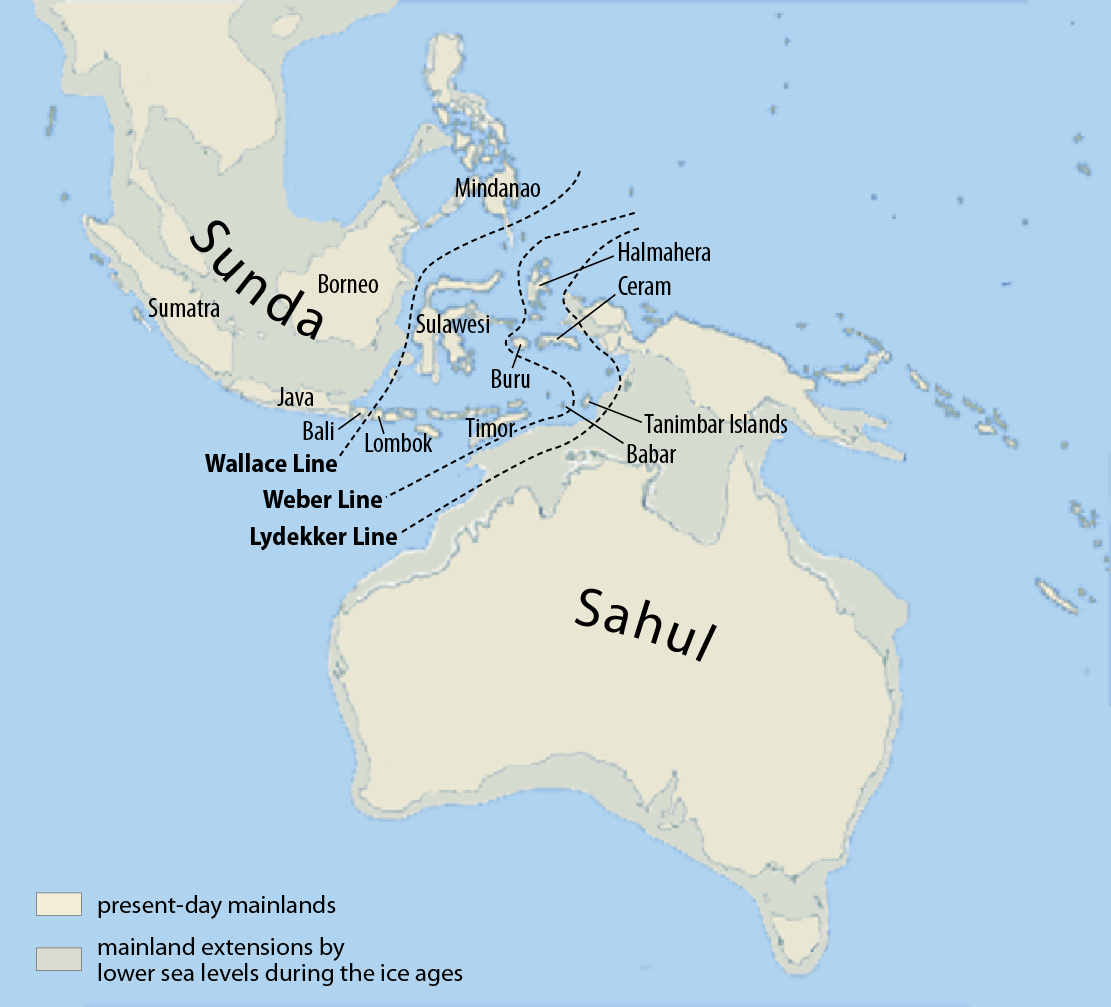
Notice that the discovered divide goes exactly along Wallace line, a major ecological divide, which exists because the continent reached in the Ice Age, when sea levels were much lower, as far East as Bali and Borneo, while the islands east of that line remained separated.


Understanding the ecological divide at Indonesia (from Wikipedia)

This divide only makes sense if navigation was limited at the time and makes no sense whatsoever if one wants to explain it within the context of Austronesian expansion, because for these formidable oceangoing sailors, who colonized as far as Hawaii, Easter Island and Madagascar, such barrier would have never been any obstacle at all.


Update (March 10):

I got a copy of the paper (thanks to Argiedude again) and the four phases proposed are as follows:
  1. Early colonization reaching to Sahul. Lineages: C*, K*, C2, M and S. Dated to c. 45 Ka ago.
  2. Second flow affecting only Sundaland. Lineages: O1a1, O2a, O3(xO3a3) and O1a. Dated to 30-15 Ka.
  3. Austronesian colonization. Lineages: O1a2 and O3a3(xO3a3b). Dated to 4-3 Ka.
  4. Late arrivals from India, West Asia and China. Lineages: H, L, J and O3a3b.

Of course, the dates attached to the two Paleolithic phases are to be taken with some caution.

Some F* (East Indonesia) and R (West Indonesia) were also detected and should be associated to phases 1 and 4 respectively.

The remnants of the first phase are found particularly in East Indonesia, Melanesia, Polynesia (as partial genetic extension of Melanesia) and Philippines, where K* still constitutes almost 50% of Y-DNA. There's also some C* and K* in West Indonesia (and notably, different source, some 25% K* among the Orang Asli of peninsular Malaysia) but it's much more patchy and diluted.

Of the second phase, I'd read that O2a and O3 are arrivals from mainland SE Asia but that O1 may have coalesced at Sundaland and flowed northwards to as far as Taiwan, where O1a2 constitutes some 90% of the Aboriginal Y-DNA, being the main haplogroup that can be directly linked to the Austronesian expansion in phase 3.

___________

Addendum (March 12): map by Argiedude showing the frequencies of the lineages belonging to the first colonization wave of Karafet, here described as "Australasian lineages" and also showing current distribution of Austronesian and Papuan languages (the latter a paraphyletic group):


_________________

Important update (Mar 14): rare H and J lineages:

Thanks to the keen eye of Ebizur and Argiedude (see the discussion here and at Dienekes' blog), two rare Y-DNA lineages have been spotted in the Karafet samples: these are H(xH1,H2) and J(xJ1,J2).

H(xH1,H2) is found in Bali (17/641 = 2.65%) along with some H1 and H2 (one case of each). This paragroup seems rare even in India.

J(xJ1,J2) is found in Bali too (2/641 = 0.3%) along with some J1 (6/641) and J2b (4/641). It is also found in Vietnam (1/70 = 1.4%), along with some J2(xJ2b) (1/70), this last one also found in Java, Sulawesi, Vanuatu and Han Chinese. J* is, according to Argiedude not really found anywhere else.

Someone by the name Finn uploaded the paper and supplements at Zoho Viewer and you can (at least by the moment), find them at these links: main, PDF supp, XLS supp.

_____________

Update July 3: Natsuya has got some further details via private communication with Tatiana Karafet. Specifically the distribution of haplogroups among the four different Han samples and STR haplotype sequences for O3b3b-M7. LINK.


Tuesday, March 2, 2010

Decorated ostrich eggshells from MSA South Africa


Mundo Neandertal
mentions today this paper by P.J. Texier et al., where it's revealed that people some 60,000 years ago at Howiensoon's Poort, South Africa, used decorated ostrich eggshells (possibly as containers, I guess). The decorations are often repeated in what seems to be a cultural expression.


This adds to other evidence of "advanced" culture in South African MSA, like the use of bow and arrow in the same site and that of Nassarius shell decorations at nearby Blombos.

Thursday, February 18, 2010

Paleolithic script?


Via
Pileta de Prehistoria I just came to read this more than curious article at New Scientist.

Genevieve von Pretzinger has cataloged the abstract signs found at caves and mural sites through the world and found that most are surprisingly similar. She thinks that they are a symbolic or pictographic language that must have existed since before the migration out of Africa. However, sadly enough, we can't yet understand it.


Paleolithic Europeans did not burn the vegetation as in SE Asia or Australia


While it seems that in SE Asia and Australia newly arrived H. sapiens extensively used fire to transform the landscape since 60-50,000 years ago, this was not the case in Europe, neither by Neanderthals nor our species.


Anne-Laure Daniau et al., Testing the Hypothesis of Fire Use for Ecosystem Management by Neanderthal and Upper Palaeolithic Modern Human Populations. PLoS ONE, 2010. Open access.

Conclusion

Extensive use of fire for ecosystem management was probably a component of the technical package of Modern Humans during their colonisation of Southeast Asia. Our study shows that fire regimes in Western Europe between 70 ka and 10 ka were mainly driven by the D-O millennial-scale climatic variability and its impacts on fuel load. At a macro level at least, the colonisation of Western Europe by Anatomically Modern Humans did not have a detectable impact on fire regimes. This, however, does not mean that Neanderthals and/or Modern Humans did not use fire for ecosystem management but rather that, if this were indeed the case, the impact on the environment of fire use is not detectable in our records, and was certainly not as pronounced as it was in the biomass burning history of Southeast Asia.

Thursday, February 11, 2010

Eurasian Y-DNA note


Just a brief working note on my current understanding of Eurasian Y-DNA diffusion and diversification patterns after the out of Africa migration.


I am assuming here that the newly proposed Y-DNA macro-haplogroup MNOPS (downstream of K) is for real and that it includes (for parsimony reasons) haplogroups K2, K3, K4, M, NO, P and S. This is not sure at all but is a quite reasonable possibility.


I used color codes for the main lineages (blue for DE, orange for C and red for F). The pink line represents the main route of the Eurasian migration, the red arrows represent the main flows of F and K derived lineages, which are the most complex ones. The light red dotted ellipse represents the most likely urheimat of F, IJK and K, as well as other derived lineages such as H and P. For simplicity reasons I have not depicted the expansions of C and D, nor of P and NO.

In order to infer the possible homelands of each of the lineages I used common sense, of course, but specially I used the following method: halfway point between the centroid of the lineage and the estimated homeland of upstream clades, when no centroid was available, midpoints between downstream centroids were used. It's notable that Northwest South Asia seems to be the homeland of the most important Eurasian Y-DNA lineages, not just of F but of several major nodes downstream of it (H, IJK, L, K, P, R), however the MNOPS "boomerang" migration, if confirmed, also has its own significance - and not just for Eastern Asia and Oceania. I wonder if this peculiar Y-DNA flow into SE Asia and back into South Asia is related with the flows of mtDNA N and R.