New blogs

Leherensuge was replaced in October 2010 by two new blogs: For what they were... we are and For what we are... they will be. Check them out.
Showing posts with label Aurignacian. Show all posts

Tuesday, September 28, 2010

Several volcanoes may have severily damaged Neanderthals


This is the hypothesis proposed by Liuvob Golovanova in the latest issue of Current Anthropology, according to Science News.

Golovanova's team has found two different volcanic ash layers in the Neanderthal  site of Mezmaiskaya, in the North Caucasus, the first one is dated to c. 45 Ka ago and the second one to c. 40 Ka ago. This one seems to have sealed the fate of Neanderthals in the Caucasus. 

Some time later, c. 38-37 Ka ago, items that are mostly associated with Homo sapiens, such as perforated shell ornaments, bone points and other items, appear at the site. 

A similar situation is found, as far as I know, in the not too distant site of Kostenki, in southern Russia. The 40 Ka eruption is also associated with the cold episode known as HE4 and has been related to the expansion of Aurignacian culture in SW Europe. 

However it must be noted that in the same issue, geologist Biagio Giacio, challenges Golovanova's account, mentioning the presence of artifacts under the ash layer in several Mediterranean locations. I presume that these are the same sites that Julien Riel-Salvatore has been digging in Southern Italy, of Uluzzian culture. 

Riel-Salvatore stands today at his blog by his published claims of Uluzzian being a Neanderthal industry, mostly because of the existence of a Mousterian (probably Neanderthal) buffer in Central Italy arguably preventing Sapiens influences from arriving,  but other researchers have already proposed that it is of H. sapiens manufacture because of it srather unmistakable Upper Paleolithic style, including bone tools (unknown to have been ever made by Neanderthals), and specially the presence of perforated decorations. 

The debate continues. 

Ref. L.V. Golovanova et al. Significance of ecological factors in the Middle to Upper Paleolithic transition. Current Anthropology. Vol. 51, October 2010, p. 655. doi:10.1086/656185.

Saturday, August 21, 2010

Who made the Chatelperronian? And the Uluzzian?


I want here to mention
a notable post by Julien-Riel Salvatore at his always interesting blog (A Very Remote Period Indeed), In it he reviews a recent paper:

Ofer Bar-Yosef and Jean-Guillaume Bordes, Who were the makers of the Châtelperronian culture? Journal of Human Evolution, 2010. Pay per view.

The authors cast doubt on the attribution to H. neanderthalensis of the early Upper Paleolithic (aka "transitional") techno-culture known as Chatelperronian, hinting at the possibility that the Neanderthal skull found at Grotte du Renne may have been dug up from earlier Mousterian deposits when setting up the cave for habitation and dumped near the cave mouth. However their argument for the one found buried at St. Cesáire in a late Chatelperronian context as unrelated to the tool findings in the same layer is more difficult to defend (but it is still the only known Neanderthal secondary burial).

The post has also further interest because it includes free links to two of the latest papers of Prof. Riel-Salvatore on the MP-UP transition in Italy, which are a most interesting read. Intriguingly, it seems that the transitional period in the peninsula was characterized by the presence of two early UP industries in the North (Proto-Aurignacian) and in the South (Uluzzian) buffered by a Mousterian zone at the center. Riel-Salvatore also argues in one of them that Uluzzian shows no signs of "transition" from Mousterian but that is a new introduction in South Italy, just falling short, for lack of direct evidence, of attributing it to H. sapiens.

Among the various references at the bottom of the article, there is one which is freely accessible: Mellars 2005. As you may know Prof. Mellars has repeatedly argued for the attribution to H. sapiens of all or most so-called "transitional" industries (earliest UP) in Europe and thinks that there was some sort of cognitive or otherwise wide cultural gap between the two human species that favored Neanderthal extinction and its replacement by our species. In any case also an interesting read.

Tuesday, June 15, 2010

Paleolithic rock art discovered in Romania


Stone Pages' Archaeonews reports in this issue, among other interesting archaeological news, that mural art has been found in Coliboaia cave, at Bihor County, northwest Romania, by local speleologists.

The findings have been confirmed by an specialist team, lead by Jean Clottes, dating them provisionally between 23,000 and 35,000 years ago, in the Aurignacian or Gravettian periods.

The art depicts several animals in black paint, including a bison, a horse, a possible feline, two bear heads and two rhinoceroses. There are several engravings as well

Head of rhinoceros (from Bradshaw Foundation)

As far as I know, it is the easternmost case of Paleolithic mural art in Europe.

Sources: Bradshaw Foundation (includes two more images), PHYSORG

Tuesday, March 16, 2010

The Neanderthal-Sapiens transition at Cova Gran (Catalonia)


Found at Pileta de Prehistoria.


J.M. Moreno et al., The Middle-to-Upper Palaeolithic transition in Cova Gran (Catalunya, Spain) and the extinction of Neanderthals in the Iberian Peninsula. Science Direct, 2010. Pay per view.

A good article can be found at El País in both Spanish and English.

Most relevant seems to be that the transition between the occupations by the two species is separated by a thick sterile layer, meaning that there was no sudden replacement but maybe just the colonization of an empty land.

Cova Gran is located at the Catalan Pyrenees in the province of Lleida.

Tuesday, August 4, 2009

Dog origin anywhere in Eurasia


It was claimed some years ago (Savolainen et al., 2002) that dog domestication had happened apparently in East Asia, reasoning based on the genetic diversity of the animals sampled in that region. But now new research by Adam Boyko and colleagues challenges this after having sampled numerous dogs through Africa, while in honeymoon, Boyko has found that the diversity there is comparable to that found in East Asia.

But the study does not challenge the fundamental notion that the domestic dog descends from the Eurasian grey wolf (Canis lupus), so Africa cannot be the place where it was first domesticated. Where then? The question remains unanswered by the moment and East Asia could still be the place but the evidence is inconclusive.

The highest diversity found in Africa and East Asia so far doesn't seem to correspond to anything but the fact that village dogs, in contrast to purebreeds and mixes from these breeds, are intrinsecally much more diverse genetically. It is rural disinterest for dog breeding what has preserved that higher diversity, not any aboriginal pervivence.

It may be worth remembering here too that the oldest dogs found in the archaeological record belong to the Aurignacian culture of Europe, specifically in modern Belgium. It is also interesting to mention in this regard that this dog is apparently not the direct ancestor of modern dogs, at least matrilineally. (Note: I found another media article claiming that there are dog remains from Britain from before 100,000 BP, what would make the domestication a Neanderthal achievement - I cannot confirm this claim though).

Source: BBC.
.

Tuesday, July 21, 2009

The AMH colonization of Europe


The colonization of Europe by anatomically modern humans (AMH, technically Homo sapiens) is generally accepted to be clear with the rapid Aurignacian expansion, c. 41-40 millennia ago (kya). But the real implications of the MP-UP transition are often controversial.


In this sense, John F. Hoffecker has made a nice review of the matter, to which I've been directed twice in the last weeks by Dienekes and Tim respectively, and that I feel it's about time to comment on here as well.

John F. Hoffecker, The spread of modern humans in Europe. PNAS, 2009.

The author reviews in few pages the available data on the MP-UP transition in Europe and their possible relations with each of the human species extant at the time.

In the conclusion, he argues for two waves of AMH colonization of Europe: first, beginning c. 48 kya, the Bohunician (that for him includes Bachokirian), that would originate in the Emirian culture of Levant, extending into the East Balcans, parts of Central Europe and even Eastern Europe. Second would be the proto-Aurignacian, originating in the Ahmarian culture (derived from Emirian) and extending specially southern European areas, like Italy and the Pyrenees. The Aurignacian proper would be a European culture, possibly originated in the Balcans (though others have argued Central Europe).

Let's review the sequence and groups in more detail:

Group A: would include the Szletian (Central Europe) and Chatelperronian (Western Europe) cultures. At least the later is clearly associated with Neanderthal remains and, by extension, many believe that Szletian would be too.

Group B: would include the Bohunician (SE, Central and Eastern Europe) and its possible ancestor the Emirian of the Near East (specially the sites of Bocher Tachtit in Palestine, Ksar Akil in Lebanon and Üçagizli in southern Turkey). The Bohunician dates to c. 48 kya (Bacho Kiro, Bulgaria) and the latest dates are of c. 40 kya. There are no clear forsenic remains associated to it but some indications of it being of AMH creation are the presence of ornaments in some sites and the relation between Emirian and Ahmarian, this one clearly product of H. sapiens.

Group C: would include the proto-Aurignacian of Bulgaria (Temnata) Italy, Pyrenees and other southern European sites (and even Kostenki 14 in Eastern Europe) and the Ahmarian of the Near East. This one is clearly the product of AMH and Hoffecker argues that some of the oldest H. sapiens remains of Europe (Pestera cu Oase and others in Rumania) could belong to this techno-cultural group, even if they are devoid of any direct artifactual associations. Some Italian proto-Aurignacian also shows personal ornaments and bone industry, which again suggest AMH manufacture. The proto-Aurignacian dates to c. 45-40 kya.

Other:

The Uluzzian of Italy (since c. 48 kya) again is not directly associated to any particular human species. For this reason many think it could be a Neanderthal creation. But Uluzzian shows again personal ornaments and bone industry and could therefore be associated to H. sapiens on mere cultural grounds.

The Kostenki culture of Eastern Europe (since c. 44 kya) is clearly of AMH creation and, while original, shows occasional similitudes with Italian proto-Aurignacian (Kostenki 14) and the later Aurignacian. It is rich in bone industry and includes the first eyed needles known.

The Aurignacian. Hoffecker suggests a Balcanic origin for this culture though it's best documented first in Central Europe (c. 40-38 kya), overlying the transitional industries. It is possible that its expansion was favored by the Campanian Ignimbrite eruption, the most catastrophic volcanic event in the area in some 200 milennia, which is dated to c. 40 kya. Guess it could be included in group C.
.

Neanderthals extinct by competition, not climate


Tim (
remote central) points me to a study by Banks, d'Errico and colleagues that reviews the hypothesis suggesting that Neanderthals went extinct due to climatic constrain:

William E. Banks et al. Neanderthal Extinction by Competitive Exclusion. PLoS ONE, 2008.

Background

Despite a long history of investigation, considerable debate revolves around whether Neanderthals became extinct because of climate change or competition with anatomically modern humans (AMH).

Methodology/Principal Findings

We apply a new methodology integrating archaeological and chronological data with high-resolution paleoclimatic simulations to define eco-cultural niches associated with Neanderthal and AMH adaptive systems during alternating cold and mild phases of Marine Isotope Stage 3. Our results indicate that Neanderthals and AMH exploited similar niches, and may have continued to do so in the absence of contact.

Conclusions/Significance

The southerly contraction of Neanderthal range in southwestern Europe during Greenland Interstadial 8 was not due to climate change or a change in adaptation, but rather concurrent AMH geographic expansion appears to have produced competition that led to Neanderthal extinction.


Their modelling shows that in the warm and wet GI8 climatic period (c. 38-35,000 BP) Neanderthals could exploit nearly all Europe but in fact were restricted to parts of Iberia, as shown in this map:


Red: surely apt, Pink: probably apt, Grey: possibly apt, Dots: actual Neanderthal sites
.

Wednesday, December 31, 2008

Neanderthal extinction: driven by ecology?


This is the conclusion of
a new paper published at PLoS ONE and authored by Willian E. Banks et al.

I have not yet but browsed it but guess that it adds to the rather intense discussion on why did our ancestors replace Neanderthals in West Eurasia and specially Europe, a good review of which can be found at Dienekes.

By the moment just a note. I may write more later on when I read it properly.
.

Monday, October 20, 2008

Around the Web: European UP people and dogs


Magdalenian Faces.-
Tim at remote central, makes a nice review of the Magdalenian portraits of La Marche and other sites, their history and their striking modernity.

Aurignacian dogs.- Several blogs touch this issue recently: I found it first at Anthropology.net but Dienekes and John Hawks also adress the matter of ancient domestic dogs. It seems that Aurignacian people already had dogs and that these were alredy somewhat different from their wild ancestors (wolves).

In relation with these issues, I'd thank if anybody could provide some nice info on the forgotten issue of Magdalenian domestic (?) horses. Anticipated thanks.

Saturday, April 19, 2008

European Paleolithic geography


So where is Isturitz, what is Magdalenian, what the heck are you talking about?

Ok, let's recapitulate:

1. A week ago, I commented on Aurignacian origins. Aurignacian culture is believed to be the first manifestation of Homo sapiens (we and our ancestors) and it's known to have penetrated pretty fast in most of Europe, displacing the former inhabitants, the Neanderthals. I also posted a map by A. Mellars:


Aurignacians began experimenting with rudimentary art and eventually also colonized, even if sparsely, the Mediterranean shores of the Iberian peninsula.

2. Haven't yet posted on it, I think, but the next thing to happen, many thousand years later was the developement or arrival of Gravettian culture. Gravettian technology shows some correlation with Neanderthal-made Chatelperronian but it's also true that similar technologies were in use among West Asians and possibly other peoples. Earlier, when Paleolithic research was concentrated in France, it was thought that Chatelperronian and Gravettian were two phases of the same cuture (Perigordian) but this is not sustained anymore and now it's believed that Gravettian culture evolved in Central-Eastern Europe or even arrived from outside the continent (though there's lack of evidence for this yet). It is likely that the Crô-Magnon type, strictu sensu, is associated with this culture.

Gravettian is also a pan-European culture and replaced Aurignacian everywhere, even if in many places it looks intrusive (older techniques remain). In fact it reached further than Aurignacian, incorportaing Eastern Europe and even penetrating into the Caucasus and Zagros areas (West Asia) and with connections as far east as the Altai. With Gravettian art became something much more common. Some of the most fascinating examples are the venus figurines, like the one of Lespuges:


3. In Western Europe, Gravettian didn't last long alone. A new techno-culture appeared locally, the Solutrean and replaced Gravettian rather fast, specially in the Franco-Cantabrian region. Instead, in Mediterranean Iberia, Gravettian showed to be strong enough and survived in a hybrid form with Solutrean (Iberian Gravetto-Solutrean), that is probably at the origin of North-African Ibero-Maurusian culture later on.

Solutrean was therefore primarily a culture of the Franco-Cantabrian region:


The Franco-Cantabrian region
(red dots are main sites of Paleolithic art, light green are areas that were over sea level in the past, white shows glacial areas).


Gravettian also survived in Italy and Eastern Europe. Central Europe is believed by many to have been too cold to be inhabited, at least densely, in this time, as the Solutrean phase is coincident with the Last Glacial Maximum, some 20,000 years ago. Another area that was affected by this episode was the Zagros region of West Asia, where human inhabitation probably became impossible or very hazardous then.

Solutrean peoples were very advanced for their time, knowing the needle, the fishing hook and maybe even the bow and arrow. They also advanced quite a bit in art expression.

4. After some milennia, Solutrean evolved into Magdalenian locally in the Franco-Cantabrian region. While many sites with transitional industries are known, there are some questions still to answer because the Magdalenian is surprisingly similar to old Aurignacian, even if much more refined. Since c. 13,000 BP, as the greatest cold went away, Magdalenian expanded into Central Europe. It also shows signs of late expansion into Mediterranean Iberia but with a very marked Gravetization anyhow (Parpalloan) and lacking the characteristic bone tools of this industry elsewhere.

Magdalenian is, of course, best known for its magnificient mural art, though these peoples also made potable art, like their predecessors.


Horse from Lascaux cave (Franco-Cantabrian region)

And here is where the Isturitz findings fit in: Magdalenian, Franco-Cantabrian, bone tools... whale bone tools! Makes sense, right?

Where is Isturitz? Quick graphic answer:


Is that better? Hope so.

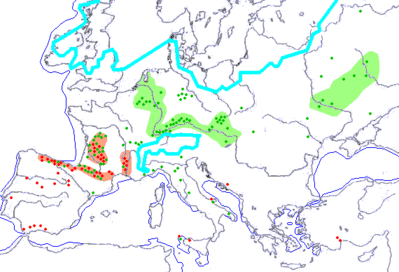
Another interesting map is this one of European Paleolithic art:


Red: mural art. Green: portable art.
Cyan thick lines: glacial maximum: areas under ice. Blue lines: ancient coastline.

It helps getting an idea of where did humans dwelt in the Upper Paleolithic. Yet the Mediterranean, even if not so dedicated to art as other areas, also had some population density probably.

Friday, April 11, 2008

Aurignacian origins


The developement and arrival of Aurignacian culture to Europe was maybe a definitory moment. Most likely it was carried by the oldest Homo sapiens ever to step in the continent and these are our ancestors, at least our ancestors with the oldest roots here (others may have arrived later on).

Which are the exact origins of this culture seems to have arisen some scholarly disputes and the last word may not have been said yet. But the last years have provided some interesting papers that seem to be largely coincident. I'm mentioning three of them here:

1. M. Otte and J.K. Kozlowski, Constitution of the Aurignacian through Eurasia (2004): This is a brief paper that suggests that the Aurignacian evolves into its finished more characteristic European form as it marches into the West. Its origins could be somewhere in the Middle East or Central Asia, with related sites in Iraq, Iran, Uzbekistan, Afghanistan and even remote Altai. The Bacho-Kirian of Bulgaria is a precursor of finished European Aurignacian.

2. J.K. Kozlowski, A dynamic view of Aurignacian technology (2006): A larger and more technical paper. Kozlowski analyzes here the correlations between Bacho-Kirian (Bulgaria), Ahmarian and Emirian (Palestine and Lebanon) and well defined European Aurignacian, as well as transitional cultures (proto-Aurignacian). For him "Mediterranean" proto-Aurignacian is more directly connected to Ahmarian than to Bacho-Kiro but typical Aurignacian is rather a derivation of Bachokirian itself.

... the analysis of production techniques in regions remote from one another (Poland, France) indicates similarity of technology within the Typical Aurignacian. This technology derived from the Initial Upper Palaeolithic, known as the Bachokirian in southeastern Europe.
3. P. Mellars: Archeology and the Dispersal of Modern Humans in Europe: Deconstructing the 'Aurignacian' (2006): For Mellars Aurignacian originates in Ahmarian (Near East), being Bachokirian an intermediate step. He also suggests two routes for the penetration of Aurignacian in Europe.

But more interestingly, Mellars reveals that recent studies allow for much more precise calibration of existing radiocarbon dates, pushing the arrival of Aurignacian to Europe back by some 5,000 years. Aurignacian colonists would therefore have arrived to most of Europe, roughly 42-41,000 years BP (calibrated) or, in other terms, some 40-39,000 years BCE.

He also provides a nice map: