New blogs

Leherensuge was replaced in October 2010 by two new blogs: For what they were... we are and For what we are... they will be. Check them out.
Showing posts with label mtDNA. Show all posts

Tuesday, August 24, 2010

Megalithic aDNA from Charente Maritime


The paper requires payment and the abstract is not too informative but John Hawks mentions
in his blog the essential findings and Jean Manco has already added its results to her exhaustive aDNA list.

Testing only for HVS-1 (hyper-variable control region 1) haplotypes, they found that three individuals buried in Megalithic context at Prissé-la-Charrière, near La Rochelle (Charente Maritime, France), dating to c. 4200 BCE, have the following mtDNA haplogroups: X2, U5a and N1a.

Notice that HVS-1 sequencing is subject to potential criticism because, sometimes, different haplogroups may share the same or very similar signature. Generally aDNA studies are considered more reliable when they go to great lengths to make sure that there is no contamination or sequencing error (they seem to have accounted for that in this case) and when they can confirm haplogroup adscription by testing for SNPs in the control region of the mitochondrial genome.

In any case, this is more data to add to the list of European aDNA, on which I may work out an actualized synthesis soon. It is also intriguing data.


N1a

The authors, as Hawk and others, focus specially on the presence of N1a and with good reason: this haplogroup, now residual among Europeans, has been showing up, sometimes at high apportions, in aDNA from Central European Neolithic sites belonging to the Linear Pottery culture (Danubian Neolithic, LBK by its German acronym): 1/1 in Hungary, 4/11 in East Germany and 1/10 in West Rhenania. The haplogroup nowadays is most common in West Asia and had not been found before in any European aDNA other than Danubian Neolithic and some later Hungarian ones.

It is also noticeable because its relative haplogroup I (also part of haplogroup N1) has been shown to be relatively common among ancient and medieval Danes but is now quite rare.

While other haplogroups like K or various subclades of U also seem to have experienced some contraction, their decline is nothing compared with that of N1 sublineages.


X2

Haplogroup X2 is also somewhat noticeable in my opinion. The lineage is not that common either in Europe (excepting to some extent Orkney islands and some Mediterranean scatter) and can easily be speculated of as a Neolithic arrival. However the antiquity and wide spread of this lineage (from Europe to Native Americans via Altai) does not allow us to reach to conclusions easily.

In any case this is the oldest individual known to have carried this haplogroup. Excepting some unclear cases from the Southern Basque Neolithic (T or X), the next case are two siblings from a Corded Ware culture burial in Eulau, East Germany, c. 2600 BCE, and then some scattered findings from historical times.

This haplogroup, unlike N1 (N1a and I), does not pose any real issue because it is not really being found at high frequencies at all, just like today.


U5a

There seems to be some confusion about which haplogroup is this one: while Hawks reports it as U5a, Jean Manco does as U5b. However searching for the sequence provided by Jean herself at PhyloTree, I can only find a close match in U5a, probably a variant of U5a2a1.

This is where the sequence 16270T, 16271C leads me to. However there is another marker not defining this U5a2a1 haplogroup, 16189C, but this seems extremely variable, with matches in every other haplogroup in the mtDNA tree of humankind, so it is very possible that it only responds to individual or microlineage variance in this case.

U variants including U5 (and U2, U4, U*, etc.) have been reported in the most ancient DNA sequenced anywhere in Europe: Kostenki culture in Russia (1/1 U2), Gravetto-Solutrean in Andalusia (1/2 U*), Magdalenian in Swabia (2/2 U*) and the Epipaleolithic of Portugal (1/9 U5, 1/9 U*), the Don Basin (2/2 U5a), Swabia (2/4 U5b2, 1/4 U5a, 1/4 U4), England (1/1 U5) and Lithuania (3/4 U5b2, 1/4 U4). Additionally they have been reported as dominant in subneolithic or regressive neolithic peoples in the island of Götland and related cultures in Baltic Poland and Germany (Pitted Ware senso lato).

Later the presence of haplogroup U and specifically U5 becomes less common, although it keeps showing up until present, being nowadays a most important haplogroup in all Europe, specially towards the NE. In that part of Europe we do find not just U5a but also U5b and U4 at relatively high frequencies. This is largely coincident with what we do find in aDNA, with the caveat that everywhere but Iberia, the haplogroups seem to have shrunk somewhat since Neolithic arrival (what is easily explained in terms of partial population replacement).

However there is much more than that to haplogroup U: U2 for instance has a more Asian distribution, U6 is typically North African and Iberian, being extremely rare elsewhere, U3 is typical of the Black Sea area and the most common subclade of U8, K, is very much widespread nowadays but only shows up in aDNA since the Neolithic (Alps, Central Europe, Pyrenees). Haplogroup U after all is a very old macro-lineage, by all accounts dispersed at the very colonization of West Eurasia some 40-50,000 years ago.


In context

Neolithic mtDNA in West Eurasia (updated)
Each dot represents one individual
High U Baltic area sites are subneolithic or regressive Neolithic (Pitted Ware)

Hawks, following Dienekes, argues that:
If N1a were present somewhere in pre-Neolithic Europe, it would require some kind of "partition" of the pre-Neolithic population, along with its propagation -- presumably southeastward -- into the LBK of central Europe. Seems doubtful.
I fail to see the point, sincerely. It does not require anything of that, I don't see why. We must remember that Neolithic diffusion, following the archaeological record, is a complex process in many cases showing clear signs of cultural (and hence demographic) continuity at least in the Mediterranean (Cardium pottery and related remains are often found along locally rooted Epipaleolithic tools and only in specific sites colonization seems the most likely explanation for its expansion). Even if population replacement may be a more likely case for Central Europe, there is still the unsolved problem of where did the core immigrant population originated: West Asia, Greece, Hungary or a mix of all three? The lack of aDNA for the Balcans and Turkey does not really help, the only reference remaining being the PPNB site of Tell Halula, at the Upper Euphrates.

This site does show abundance of mtDNA K and T (specifically T2b) and some presence of the ubiquitous H too, together with L2, R* and C1. The K+T combo shows up also in Central European Neolithic but the explanation for the origin of other associated haplogroups (J and N1a specially) is not clear on light of the present data. It can be argued for them having a West Asian origin certainly but the case is far from settled. The other LBK haplogroups, found in Paleolithic individuals from Europe and Morocco, can hardly be argued to have spread with Neolithic (the problem of the expansion of H to Northern Europe remains murky however with my favorite explanatory vectors being either the late Bronze Age Urnfield culture or Megalithism but notice also low Paleolithic/Neolithic sampling in the North Sea area, still allowing for UP presence for this lineage). The causes of the apparent decline of N1 (N1a and I) in Europe remain equally confusing as well.

The particular case of Prissé-la-Charrière also requires an explanation but I can only give a negative one: it cannot be attributed to LBK in any case because Danubian Neolithic never reached so far south. But it actually contrasts more with the samples related to Cardium Pottery (Mediterranean Neolithic) and Megalithism (largely "Atlantic Neolithic") in Iberia and Italy, which display a very different array of haplogroups (H, U*, U5, K, J, etc.) This in turn makes more difficult to argue for a Mediterranean or Atlantic Neolithic origin of this localized aDNA sample.

The case remains open in my opinion.


References:

Marie-France Deguilloux et al., News from the West: Ancient DNA from a French Megalithic burial chamber. American Journal of Physical Anthropology, 2010. Pay per view.

Building History: Ancient Eurasian DNA.

Leherensuge: European ancient DNA in sequential maps (not updated in almost a year).


Update: Link to the whole paper (PDF), courtesy of Natsuya. They report the U5 individual as U5b, by the way.


Wednesday, August 18, 2010

Mitochondrial Eve lived some 200,000 years ago


Just for the record.


Contrasting several simpler and more complex models of mtDNA molecular clock evaluation seem to show coincidence at least in this aspect our shared oldest grandma (by purely matrilineal ancestry) lived some 200,000 years ago.

Krzysztof A. Cyrana and Marek Kimmel, Alternatives to the Wright–Fisher model: The robustness of mitochondrial Eve dating. Theoretical Population Biology, 2010. Pay per view.

According to the news article at Science Daily:

Each model has its own assumptions, and each assumption has mathematical implications. To further complicate matters, some of the assumptions are not valid for human populations. For example, some models assume that population size never changes. That is not true for humans, whose population has grown exponentially for at least several thousand generations. Other models assume perfect mixing of genes, meaning that any two humans anywhere in the world have an equal chance of producing offspring.

Cyran said human genetic models have become more complex over the past couple of decades as theorists have tried to correct for invalid assumptions. But some of the corrections -- like adding branching processes that attempt to capture the dynamics of population growth in early human migrations -- are extremely complex. Which raises the question of whether less complex models might do equally well in capturing what's occurring.

"We wanted to see how sensitive the estimates were to the assumptions of the models," Kimmel said. "We found that all of the models that accounted for random population size -- such as different branching processes -- gave similar estimates. This is reassuring, because it shows that refining the assumptions of the model, beyond a certain point, may not be that important in the big picture."


Sunday, August 1, 2010

Ancient Danish mtDNA


There is a new paper with some potentially interesting information about hypothetical demographic changes in Northern Europe in recent prehistory.


Linea Melchior et al., Genetic Diversity among Ancient Nordic Populations. PLoS ONE 2010. Open access.

Most of the recovered data is from the last 2000 years and only three sequences are from earlier periods (two from Neolithic and one from Early Bronze). This limits somewhat the conclusions that can be reached from this paper alone but will be useful to complement the previous data and gradually draw a clearer picture of ancient genetics in Europe. Still they make some meaningful findings that I comment below.


Demographic replacement with Urnfield culture in Northern Europe?

The finding of haplogroup U4 and U5a among Neolithic Danes and yet another case of mtDNA U4 in the single Bronze Age successful sample, essentially discards the hypothesis of Neolithic replacement so far north (Bramanti 2009). It still remains as a possibility for Central Europe but this hypothesis is largely reliant on Epipaleolithic and Neolithic Era foragers' data from the Baltic area (essentially U5 and U4 as well) and a limited sample from Paleolithic Swabia.

The haplogroup frequencies for antique and historical Danes are very similar to present. What says that, if there was any replacement, this happened after the Early Bronze Age.

In this sense, I am considering more and more the possibility of a demic replacement in Northern Europe with the Urnfield culture expansion, because a similar situation is apparent in the Elbe basin, where the Corded Ware site of Eulau and previous Neolithic samples show mtDNA apportions quite different from modern (high K in Eulau, high N1a in Danubian Neolithic of East Germany, low H in all), while the nearby site of Liechtenstein, belonging to Urnfield culture (Late Bronze Age), already displays a very modern mtDNA pool, high in H and U.

Notice please that while this may apply to Northern Europe, it is certainly not the case in the South, specially in the Southwest, as well as in Morocco, where mtDNA H is found at modern frequencies more or less at all temporal layers since Late Upper Paleolithic. Sometimes partial data for Northern or Central Europe is happily extrapolated to the whole continent and this is very much incorrect.


The vanishing of haplogroup I

This is even more intriguing, specially because this paper findings (12.5% of haplogroup I) are highly consistent with previous data showing high apportions of mtDNA I in Denmark (all for the last two millennia), when now this haplogroup only amounts to 2.5%.

As I say, the rest of the samples for this period are totally modern but this identity is strangely broken when we consider haplogroup I, which has shrunk dramatically and nobody seems to understand why.

The authors notice that haplogroup diversity appears to have been higher in the past than today, which is surely related, but they are not able to propose a cause for this phenomenon other than drift.

Wednesday, June 30, 2010

Mitochondrial lineage C1d in South America questions the two migrations hypothesis


An interesting new paper for those interested in the process of colonization of America.


Hugo A. Perego et al. The initial peopling of the Americas: A growing number of founding mitochondrial genomes from Beringia. Genomic Research, 2010. Open access.


Abstract

Pan-American mitochondrial DNA (mtDNA) haplogroup C1 has been recently subdivided into three branches, two of which (C1b and C1c) are characterized by ages and geographical distributions that are indicative of an early arrival from Beringia with Paleo-Indians. In contrast, the estimated ages of C1d—the third subset of C1—looked too young to fit the above scenario. To define the origin of this enigmatic C1 branch, we completely sequenced 63 C1d mitochondrial genomes from a wide range of geographically diverse, mixed, and indigenous American populations. The revised phylogeny not only brings the age of C1d within the range of that of its two sister clades, but reveals that there were two C1d founder genomes for Paleo-Indians. Thus, the recognized maternal founding lineages of Native Americans are at least 15, indicating that the overall number of Beringian or Asian founder mitochondrial genomes will probably increase extensively when all Native American haplogroups reach the same level of phylogenetic and genomic resolution as obtained here for C1d.


Fig. 2
In parenthesis percentage of sequences at SMGF database,
from which the regional apportions are deduced


Update: Speaking to La Voz de Galicia[es], one of the co-researchers, Antonio Salas, claims that the molecular clock estimates they got imply not only that the Paleolithic colonization of America happened between 15 and 18 thousand years ago but also that the colonists spread extremely rapidly across the double continent: in less than one thousand years (found at Pileta de Prehistoria).


Tuesday, May 11, 2010

New analysis of African mtDNA


There is a new paper on 'African' mtDNA L(xM,N) with a focus on trans-Saharan flow:


Nourdin Harich et al., The trans-Saharan slave trade - clues from interpolation analyses and high-resolution characterization of mitochondrial DNA lineages. BMC-Evolutionary Biology 2010. Open access.

The authors conclude that all or most of this mtDNA flow happened in recent times within the trans-Saharan slave trade, mostly in the last few centuries of Arab domination. I think that this position is simply untenable (and I'd dare say falling into 'romantic' Orientalism per many of the reasonings like: some harems could be enormous, reaching even the extravagating number of 14,000 concubines) but there is interest anyhow in the data managed (from many other different studies mostly) and specially in the many nice distribution maps provided.

They do not only fall into pseudo-romantic visions of the slave trade and its importance but also fall in another pool of moving sands: excessive reliance on the molecular clock age estimation methods, when they draw their conclusions.

I really fail to see how MC age estimates of c. 10-15,000 years ago (L3) can justify a recent shared ancestry within the slave trade. They would actually point, if anything, to late Paleolithic or Epipaleolithic migrations (Capsian culture?) There is only one case with a more recent date in all the L3 comparisons but it's not between an Tropical and Mediterranean Africans but between one Jordanian and one North American (Afro-American?) Instead there are many L3 cases with older age estimates: up to 37,000 years ago.

They do not have age estimates for the other haplogroups, specially some L0 and L2 sublineages that also permeate the Sahara-Red Sea barrier.

As I have said before, some of these lineages look very old North of the Sahara (see here) and may have been pouring towards the North and NE since around the out-of-Africa migrational episode, which may be c. 120,000 BP, quite roughly.

They fail to analyze two particular haplogroups that are apparently more common North of the Sahara and East of the Red Sea: L3k and L3i respectively (L3i is plotted on a map but North African specific L3k is totally ignored).

As I said above, the best is the distribution maps, which allow for a quick visual impression of the distribution of the L(xM,N) lineages. Form these I think that:

  • L0a shows a clear South-East Africa-West Asia distribution, with some very high concentrations in this last region. I previously mentioned that I think that L0a1b2 and L0a1c (?) are clear candidates for a Middle Paleolithic flow to West Asia related to the OOA migration.
  • L1b surely had a Middle Sahelian origin but also clearly permeates across the Sahara. Within it, L1b1a2 is typical of the Red Sea area, while L1b1a5 is found in Mauritania and Cyprus (per Behar 2008). I think that its expansion happened some time after the L3 one (29 CR mutations to the root vs the 23 of L3) but may well belong to the late phase of the Abbassia Pluvial.
  • L2a is so ubiquitous that cannot be analyzed as a whole. The timeline of its expansion is surely the same as that of L1b (again 29 CR mutations to the root) but it's much more impressive in its dimensions. Some of the high level sublineages (L2a1j) are exclusive of the Mediterranean, while some others are shared across the desert and surely deserve specific attention if we want to clarify anything.
  • L2d. The map concentrates this lineage in West Sahara but (from Behar 2008) it's actually also present in Ethiopia, Algeria and Yemen. It's another candidate for an old lineage beyond the Sahara.
  • L3b also looks pretty much North African/West Asian but has also presence in West and East Africa.
  • L3d is an even more clear case of a North African/West Asian lineage: rare south of the Sahara and very common north of it.
  • L3e looks by the map as split in a North African and a Bushman clades, however by Behar's data the situation is much more complex: scattered in many distinct African and West Asian populations, all very suggestive of an old spread within the L3 explosion (OOA related).
  • L3f looks like spread from Sudan in all directions early on as well.
  • L3i is shown as the Red Sea-South Arabia lineage it is and is a very strong candidate for OOA migration remnant in Southern Arabia. Can never be attributed to 'slave trade' but it's most probably the "little sister" (niece in fact) of M and N. It is actually closer to the L3 root than M and N by CR mutation count, so it's surely older, just that it did not reach South Asia.
  • L3x is a very similar case, however it should be slightly more recent than L3i, with an age similar to that of the N and R explosions in further Asia.
  • I'm wondering if L3w is just another name for L3k. It does not exist in PhyloTree but the distribution (Algeria, Ethiopia) is reminiscent of the one reported for L3k elsewhere.
There's no mention to L6 and L4b, both of which are also candidates for participation in the OOA flow to South Arabia.

In brief: it seems that the preconceptions of the authors are preventing them to reach to rational conclusions. The paper has some interest but this lays mostly on the illustrations (maps). Hopefully, as it happened with the similarly confused Balaresque paper, someone else (Morelli in this case) will take the bull by the horns and do something better with all that data.

Related posts:

Sunday, March 28, 2010

Macro-haplogroup N in East Asia, Chen 2009


A reader has been so kind to send me a copy of this Chinese paper, which I have hanged at ZohoViewer:


Chen Zhiyong, Migration and Diversification of Mitochondrial Haplogroup N in EastAsians. Communication on Contemporary Anthropology 2009.

The paper is in Chinese (and can't find any English version) but has loads of nice and informative graphs and maps with legend in both languages about macro-haplogroup N and some of its derivatives, specially A and N9 (incl. Y).

As the saying goes: an image is worth more than a thousand words... specially if these are in a language you can't understand. Still, if any of you can read some Chinese and give some feedback, I'm of course interested.

Most importantly the paper seems to confirm a SE Asian origin for macro-haplogroup N. Specifically it suggests a SE Asia as probable origin:

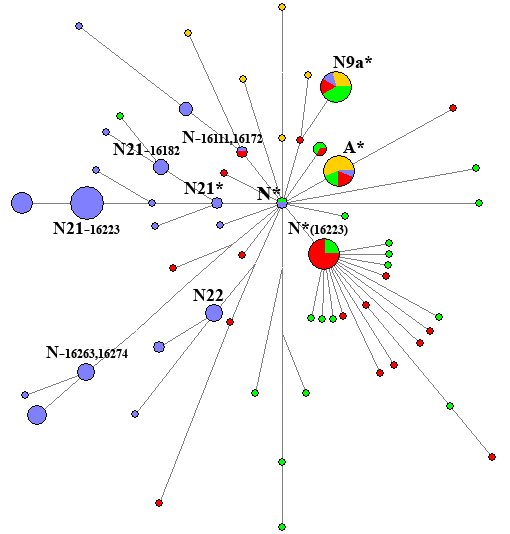
Fig.2 A simplified Median-joining Network of haplogroup N based on mitochondrial HVS-1 Keys for the colors: Red for the Tonkin Bay area, Green for South China, Orange for North China, and Blue for Southeast Asia.


Fig. 4 The frequency distributions of unclassified N [top] and N*(16223) [bottom]

Another relevant finding is that haplogroup A seems to be also original (like nearly everything) from South China/SE Asia:

Fig.10 Diffusion of the mitochondrial proto-A haplogroup. Blue clines stand for the total frequency, and red clines stand for the mutation rate within the population.

Notice that "proto-A" seems to mean A* rather than some pre-A standing between the N and A nodes. That's what I gather from the phylogenetic context in other figures but if anyone can clarify further, I'll be thankful.

Finally as the genetics of SE Asia and in particular Island SE Asia have been recently matter of lengthy discussions in this blog, I think that this map on ISEA N9 (N9a and Y2) may be interesting:

Fig.28 Distributions of the mitochondrial haplogroups Y2 and N9a in Southeast Asia. Blue stands for Y2, and red for N9a6.

But anyhow, take a look at the paper even if you can't speak Chinese because there are a lot of maps and phylogenetic graphs, all of them of interest.

One thing they have in common though: the spread of all lineages seems to begin in South China/SE Asia.

Friday, March 26, 2010

Molecular clock and the Denisova hominin


Yesterday I echoed the sequencing of ancient mtDNA from a finger tip at Denisova cave in Altai, dated to c. 40,000 years ago, when the area was also populated by H. sapiens and H. neanderthalensis.

I thought that would be about enough but as I read more and more discussions there seems to be some major confusion sparked by the use of molecular clock estimates, which the paper estimates in only 300-700 Ka for Neanderthal most recent common ancestor, hence producing a 1300-900 Ka estimate for the MRCA of us and the Denisova hominin, aka "X Woman". This, some say, calls for a major revision of the history of hominin migrations out of Africa because we know of no such migration.

Nonsense!

The problem is caused by the use of a quick-ticking version of the molecular clock, because there's absolutely no archaeological reason to claim that Neanderthal and Sapiens MRCA is dated to only 700 Ka much less 300.

In fact the last migration out of Africa before H. sapiens we know of from the archaeological record is the Acheulean migration which is dated to c. 900,000 years ago. In my not so humble opinion, this is the real chronology of the divergence of Neanderthal and H. sapiens, a divergence that began most likely at the stage of H. ergaster.

Hence the Neanderthal-Sapiens MRCA must be an H. ergaster woman and should be dated to c. 900,000 or 1 million years ago.

That fixes all. Because, when we use this realistic reference, the MRCA of Denisova and the other hominins (Neanderthals and us) would have an age of 1.8 or 2 million years ago, which is precisely the time of the earliest H. erectus migration out of Africa.

So the Denisova hominin is, with all likelihood, an H. erectus or a descendant from this lineage (maybe by admixture with Neanderthals?) and everything fits nicely.

Everything but the short count molecular clock, which is obviously the one in need of a good fix, because it's demonstrating once and again that it only causes confusion and it always fails to fit well with the archaeological record.

Thursday, March 25, 2010

X Woman


Not any fictional character but the quite unoriginal name given to the former bearer of a finger found in Denisova Cave (Altai, Russia) whose mtDNA has been analyzed now by Krause et al. (Paabo's team).


The result known so far (via Mundo Neandertal and El Neandertal Tonto, Qué Timo!) is that she is almost twice more distant from us than H. neanderthalensis. The most logical conclusion is that, in spite of using Mousterian industry and being neighbor of both Neanderthals and H. sapiens, she belonged probably to a deeper branch of H. erectus.

However everybody seems to be asking for caution... and yet comparing with H. floresiensis.

J. Krause et al., The complete mitochondrial DNA genome of an unknown hominin from southern Siberia. Nature, 2010. Pay per view.

For the archaeological context, it's interesting to read: A.P. Derevianko and S.V. Markin, The Middle and Upper Paleolithic of the Altai. 1997 (PDF).

Other news articles and blog reviews:
- Science News
- BBC
- Anthropology.net
- Dienekes'

Thursday, March 18, 2010

Another tentative mtDNA chronology


[Updated Aug 6 2010: there was a key error in the steps between L3'4'6 and L4 and L3. In other words: I totally forgot about the L4'3 node and the three CR mutations defining it, pushing L(xL4'3) ahead in time some est. 9000 years. Corrected the main est. chronology now but left the text untouched otherwise]


Take what follows with the proverbial pinch of salt please. It's nothing but a working note.


Method:

The first West Eurasian lineages that show up in the downstream CR mutation count are R0 and M1, at 30 CR mutations counting from "Eve" (7 downstream of L3).

The first European-specific lineages are H and V at 33 CR mutations (10 from L3).

These facts may serve to generate a tentative chronology using the simplest molecular clock methodology: 1 CR mutation = 1 time unit.

A further control may be the place of K1 at 48 CRM (21 from L3), the most recent important clade showing signs of expansion in Europe/WEA, which should not be more recent than Neolithic.

The safest date for the colonization of Europe, which surely included an starlike expansion like the one we see at H, is that of Aurignacian expansion c. 40 Ka ago. A reasonable (but speculative) date for the arrival of H. sapiens to West Asia is c. 50 Ka ago.

This makes CRM=10/3=3.33 Ka.

To make calculations simpler I will round down this rate to CRM=3 Ka and take age(H,V)=40 Ka. as main reference.

Control: K1: 40-(3x11)=7 Ka ago. Fits perfectly: 7 Ka ago is roughly when Neolithic arrived to Central Europe, where K has been detected aboundantly in aDNA from the period and may be coincident with the expansion of K1.


Results:

  • 148 Ka - Root ('Eve')
  • ...
  • 133 Ka - L1''6
  • ...
  • 121 Ka - L0, L1, L2"6 --- Beginning of Abbassia Pluvial
  • ...
  • 115 Ka - L0a'b'f'k
  • ...
  • 109 Ka - L5
  • ...
  • 100 Ka - L2'3'4'6, L0a'b'f
  • ...
  • 91 Ka - L0a'b, L0d, L1c --- End of Abbassia Pluvial
  • 88 Ka - L0f
  • 85 Ka - L3'4'6, L0d1'2
  • ...
  • 79 Ka - L2, L0a
  • 76 Ka - L2a'd, L3'4
  • 73 Ka - L4
  • 70 Ka - L3 --- Out of Africa migration?
  • 67 Ka - L4b, L3a, L3b'f, L3c'd'j, L3e'i'k'x
  • 64 Ka - L3i, L3h
  • 61 Ka - M, L1b, L3e ---- Beginning of Eurasian Expansion
  • 58 Ka - L2b'c, L3f, M1'51, M3a, M3c, M4"64, M5, M9, M12'G, M13'46'61, M25, M29'Q, M32'56, M33, M34'57, M35, M40'62, M44, M49 ---- Arrival to East Asia and Melanesia
  • 55 Ka - L1b1a, L2a, N, M30, M37, M7, M9a'b'c'd, M14, M17, M56, M36, M42, M52'58, M60, D --- Arrival to Australia
  • 52 Ka - R, L0d3, L3d, M3b, M4a, M4b1, M4b2, M45, M13, M21, M27, M39, M71, N1'5, N9, S --- Final pan-Eurasian wave
  • 49 Ka - R0, L4a, L3k, L3x, M2, M38, M43, M6, M8, G, M31, M54, O (N12), R2'JT, R6, R11'B7, B4'5, R30, R31, P ---- Colonization of West Asia
  • 46 Ka - D4, L3e1, M1, M4c, M5a, E, Q, M32a'b, M53, N1, HV, R9, R12'21,
  • 43 Ka - M63, M11, M29, M41, M73, D1, N2, N9a, N22, HV0a, JT, R5, R9b, U
  • 40 Ka - H and V, L0k, L2a1, L3b, M1a, M64, M8a, Z, M12, Y, A, X, R0a, F, U6, U2'3'4'7'8'9 ---- Colonization of Europe, North Africa and NE Asia
  • 37 Ka - M10, N5, N9b, X2, H1, H2, H3, H6a, H6b, H7, H9, H10, H13, H14, H15, H16, H17, R8, U6b, U4'9, U8
  • 34 Ka - C, D4a1, A2, R0a2, H2a, H8, H11, H12, H18, H19, J, U3, U5, U6a --- Beginning of coldest conditions
  • 31 Ka - L6, L3c, L3j, H4, J1, U5a, U6d ---- Gravettian
  • 28 Ka - L2d, M7a1a, M23, R2, J1c, J2, R7, R11, U1, U5b
  • 25 Ka - L2e, N1a, I, U6c, U2b, U5b3, U9
  • 22 Ka - W, J2b, U4 --- Solutrean
  • 19 Ka - K, D4h3a
  • 16 Ka - M51, T, K2 --- Magdalenian, end of coldest period
  • 13 Ka - T1
  • 10 Ka - T2, K2a --- End of Ice Age, earliest Neolithic, Epipaleolithic
  • 7 Ka - K1 --- European Neolithic
  • 4 Ka - K1a1, T2b

Note: bold type is arbitrary for perceived "most important haplogroups", however font size reflects the presence of star-like nodes: large size for 5-12 branches, largest size for >15 branches. Clades are listed in logical phylogenetic order with a few exceptions when a single node seems to define a whole phase, in which case they have been listed first. All suggested dates are in thousand years (Ka) ago.


Comments:

Of course there's no way I know of properly estimating the effective mutation rate at each space-time, which should be affected by issues as population size and, with low population levels specially, purely random accidents (drift). Still, I would prefer a logarithmic approach, with longer times/mutation towards the past and smaller ones towards the present.

That would probably be better because it would allow to push the L2 and L3'4'6 expansion towards a more realistic date at the beginning of the Abbassia Pluvial, when we see clear signs of expansion in North Africa and Palestine and also would push the root of the tree (the earliest genetic signal of expansion of H. sapiens) closer to the oldest known fossils c. 160 Ka.

Another issue is the known length of downstream branches, even in some well studied lineages, which appear almost "frozen" since their expansion. This seems to happen in particular to large star-like lineages like M and H (not sure why) but, in any case, the high variability in the length of the lineages towards the present is an anomaly that I would rather not have to face.

In this regard, notice the star-like expansions within the K and T haplogroups by the end of the (always tentative) chronology, wouldn't they be better some 3,000 years earlier? That way T2 and K2a could take part in the Magdalenian expansion, while K1a1 and T2b would belong to the Neolithic expansion. But maybe they fit well with Epipaleolithic and what I imagine as some phase of the Indoeuropean expansion... somehow.

A corrected 2.7 Ka/CRM ratio would fix that.

But it would also push the oldest dates forward quite a bit (for instance the root would be at just 129 Ka), so I feel I need a more refined approach: which should probably be a logarithmic or quasi-logarithmic equation that could account for estimated population sizes. However my maths skills are terribly rusty...


See also PhyloTree for a whole comprehensive mtDNA phylogeny.

Thursday, March 11, 2010

The early expansion of H. sapiens in Africa (mtDNA)


As you probably know, I have been working as of late on the puzzle of the early human mtDNA, in the context of Africa, using particularly
Behar 2008 as reference.

I published some stuff previously (L0, L1, L2 & L5, L3'4'6 and considerations on Arabian L(xM,N)) and went into a lengthy discussion with Terry about where exactly did the various L lineages coalesce and, of course, human prehistoric boating abilities (an impossible for him before the arrival to almost mythical archipelago of Wallacea, aka Eastern Indonesia).

So I took my time to estimate the composite centroids of each lineage, at every level, from bottom up. Some centroids are plainly valid as likely origins for the major clades, while a few others are more questionable (see below). After a subjective but common-sensical revision of these I came up with the following maps that reconstruct early human expansion:


First expansion:

There seem to be basically two moments of demographic expansion, the first one happened at about 9 (coding region) mutations downstream of the most recent common ancestor (mitochondrial Eve), where the nodes of L0, L1 and L2"6 are in the phylogenetic tree, maybe corresponding with some favorable conditions, which are hard to unravel.


This map shows the earliest expansion at the very phylogenetic origin of the species (purple arrow) and the subsequent three populations generated, defined by the mtDNA lineages L0, L1 and L2"6, all three showing some sign of expansion around the 9th CR mutation (i.e. approximately at the same time, if the molecular clock makes any sense whatsoever).

Of course, L1 and L2"6 shared phylogeny for 5 CR mutations (L1"6), what seems to mean that they had reached Central Africa by that time.

The location that may cause more controversy is that of L0 around Lake Tanganyika, because this lineage is most commonly associated with Khoisan people. However only the L0d1'2 subslineage is totally exclusive of this macro-ethnicity and other L0 lineages are scattered towards the Nile and even as far as Kuwait. The overall centroid, as well as those of L0d and L0a'b'f'k, showed up around there, so I decided that it stands that way, even if admittedly origins around Ethiopia-Sudan or Southern Africa can also be argued for (as did Doron Behar).


Second expansion:

The second major expansion is located at around the 20th CR mutation downstream from "Eve" and in my opinion may be correlated with the Abbassia Pluvial, some 120-90,000 years ago, which probably improved living conditions allowing for significative demographic growth.

It is also the prelude of the migration out of Africa into Asia.


At this moment we see L0 finally splitting up clearly between a northern and a southern group, the latter leading to the Khoisan peoples.

We also see signal of expansion of L1c (but not yet L1b), which correlates best with Pygmies (and also some other peoples of the jungle belt essentially).

And we see the split of L2'3'4'6 (the branching of L5 is earlier, just marked it for the record), first between Western (L2) and Eastern (L3'4'6) populations, centered at Central Africa and what seems to be Eritrea respectively. Then L3'4 split up, with L3 expanding rapidly in Ethiopia, Sudan and towards Lake Chad and L4 scattering along the Rift Valley down to Tanzania, where it is still the most important lineage among the Hadza and Sandawe. L3, of course, also expanded eastward towards Asia where its sublineages M and N would find enormous opportunities.

The minor lineage L6 would not expand till a later moment, so at this time it was yet some "private" L3'4'6*. I suspect that it also benefited from the Out of Africa migration, along with L4b and some L0 subclades, because it's highest basal diversity is in Yemen, suggesting it coalesced there.

A word of caution must be said about the area of origin of L2. The actual composite centroid happens to be at the Niger but this location is the product of basal sublineage L2e, which is only represented by one individual in Behar's data, who happens to live at Guinea Bissau. But the major subclade, only diverged from L2 by a single CR mutation (unlike L2e, which has a very long stem), is L2a"d and this one has a clear center at Chad and, secondarily, the CAR.

Similarly, I ended up with a composite centroid at Yemen for L3 after considering M and N. But I can't ignore the absence of basal L3 sublineages in South Arabia, so I decided that the result without M and N is much more likely to reflect the reality.


The actual centroids:

Prior to the above maps, and after hard work, I came up with this preliminary map. The composite centroids here are the "raw" ones, without further consideration:


But, as said above, I have serious caveats about L2, L3 and L6 specially. I think that the areas depicted in the other maps reflect better the likely reality, with L2 coalescing at Chad, L3 at Sudan and L6 most probably at Yemen after the out-of-Africa episode.

As said before, I also have some caveats about the coalescence area of L0 but I can't come up with a clear alternative (it'd be either Ethiopia or Southern Africa but both weight about the same), so I left it that way.

Of course, the ultimate place of origin of Humankind (Homo sapiens), or at least of the most recent common ancestor (mtDNA Eve), remains a mystery. But guess that somewhere in the vast geography of Eastern Africa is a quite reasonable conjecture (Southern and Central Africa are also possibilities).

_______________

Erratum: there is an error with minor lineage L5 (thanks to Terry for noticing) but luckily doesn't affect much the overall picture. I made a meaningful error when calculating the centroid of L5a, what, in the maps here pushes the centroid of L5 significantly but not dramatically to the south, to South Sudan at the border with SW Ethiopia to be precise. In turn this affects the centroid of L2"6, L1"6 and "Eve", pushing them also proportionately southwards (not too much but something anyhow). The rest of the nodes are not affected, as they depend only of the downstream geography.

I think it's no big deal but I might correct the maps later on... if my perfectionist side prevails over my lazy one.

Monday, March 1, 2010

Are we overlooking the signature of the Out of Africa?


In my recent review of mtDNA L(xM,N), following mostly
Behar 2008, I noticed that some of those lineages have distributions that either partly or totally do not seem to correspond with Africa South of the Sahara, but clearly penetrate since old times into West Asia, North Africa or both.

So I wonder: aren't some of them remnants of the migration Out of Africa, which never really made it to South Asia?

Let's see. The mutation count between "mitochondrial Eve" and the L3 node is of 23 (coding region only), to M is of 26 and to N of 28. This is roughly the "time frame" of the Out of Africa. By the "time" of 30 CR mutations the backflow of Eurasian mtDNA to West Asia was already beginning (mostly in form of R derivatives but also M1 and N1, and later some other N subclades too) and this became a clearly dominant flow. Also since M1 specially, scattered into East Africa, it's possible that there was a second flow from Africa in that period of colonization of West Asia that was, no doubt, coincident with the early Mousterian Puvial, when the region became less arid.

I find that the following lineages, normally tagged as "African", should have been involved in the Out of Africa episode:

L4b: at 24 mutations appears to have almost the same age as L3. It has two basal lineages: L4b1, which is only found in Yemen, and L4b2, typical of the Hadza and Sandawe, and found also among Ethiopians (with offshoots in Southern Africa and Arabia) and the Lisango of DR Congo and/or CAR.

L0f2: at 24 CR mutations looks only slightly younger than L3 and surely older than M. One of its sublineages (L0f2a) is only found at Oman, while the other is at Ethiopia (L0f2b).

L0a1b: at 26 CR mutations should have the same age as M. One of its sublineages is only found in Arabia Peninsula (L0a1b2), while the other is shared between Morocco and Southern Africa (L0a1b1).

L5c: at 28 CR mutations appears to be as old as N. One of its sublineages is found at Egypt (L5c2) and the other at Ethiopia (L5c1).

L3e2: at 29 CR mutations appears of the same age as R. L3e2a is shared by West and North Africa, while L3e2b has two lineages that are only found in Jordan (one of the L3e2b*) and Oman and Egypt (L3e2b2).

L6 shows 38 mutations, however the root of its very long stem is necessarily older than L3 (as it's the oldest branch of L3'4'6). Today it looks like Yemen harbors the highest diversity, with offshoots at Ethiopia and Egypt.

There are others but seem younger than the 30 mutations that I decided as limit and may represent other flows, maybe related to the arrival of M1 to East Africa.

It's quite striking, to say the least, that these lineages have been overlooked, they really appear to my eyes as participants of the OoA at a more modest scale, never reaching South Asia or beyond.

Also notice that Yemen and Oman appear insistently in this list. All mentioned lineages, except L5c and possibly L3e2 should represent local fixation processes when people took the coastal route via southern Arabia.


Update (Mar 14): corrected error re. L0f2 (nomenclature and mutation count).

I'd like also to add L3i to the list. It looks to me as centered at coastal Yemen and of similar age (slightly younger, 2 mutations downstream from L3, 25 from "Eve") as M.


Update (Mar 21): Browsing through the East Asian mtDNA data at Tanaka 2004, I just spotted 1/20 (5%) L2 among the Sakai (Semang Negritos) of southern Thailand (Trang province). Not sure what to think but it is odd indeed. Another unlikely survival?


Update (May 5): Map of a plausible Abbassia Pluvial (120-90,000 years ago) Out of Africa migration with the candidate mtDNA lineages to have participated in it (red: L3, purple: other):


Reviewing the mtDNA L lineages (notes): L3, L4 and L6


And here it goes the last note of the series. See previous posts for
L0, L1, L2 and L5.

Again based on PhyloTree and Behar 2008. However I have also considered Tishkoff 2007 for the case of the Hadza and Sandawe within L4b2 (formerly L4g or L3g).

As in previous posts, only coding region mutations were considered and labelled as ">". Here it goes the reference for L3, L4 and L6:

>>>>>L1''6
_____>>>>L1
_____>>>>L2''6
_________>>>>L5
_________>>>>>>>L2'3'4'6
________________>>>>>L2
________________>>L3'4'6
__________________>>>>>>>>>>>>>>>>>>>>L6 [L6a: Yemen, Egypt]
______________________________________>L6b [Ethiopia, Yemen]
__________________>>>L3'4
_____________________>L4
______________________>>>>>>>>L4a
______________________________>>>>>L4a1 [Ethiopia, Arabia]
______________________________>L4a2 [Ethiopia, Yemen]
______________________>>L4b
________________________>>>>>>>>>>>>>>>>>>>>>>>L4b1 [Yemen]
________________________>>>>>>L4b2 [unspecified clade: Hadza, Sandawe]
______________________________>>L4b2a
________________________________>>>>L4b2a1 [Ethiopia]
________________________________>>>L4b2a2 [Ethiopia, Arabia, Khoisan]
______________________________>>>>>>>>>>>>>L4b2b [CAR]
_____________________>>L3
_______________________>L3a [Ethiopia]
_______________________>L3b'f
________________________>>>>>>>>>L3b [L3b*: Chad, Kenya]
_________________________________>L3b1
__________________________________>L3b1a [West Africa, NA, SA, Chad, Ethiopia, Arabia, Makran]
__________________________________>>L3b1b [Burkina, NA]
_________________________________>L3b2 [West Africa]
________________________>>>L3f
___________________________>>L3f1
_____________________________>>>>>L3f1a [Chad, Ethiopia]
_____________________________>>>>>>L3f1b [L3f1b*: West Africa, Levant, Ethiopia, Egypt]
___________________________________>>L3f1b1 [SA, Khoisan]
___________________________________>L3f1b2 [Yemen, Jordan]
___________________________________>>>L3f1b3 [Chad]
___________________________________>L3f1b4 [SA, Kenya, Oman]
___________________________>L3f2 [L3f2*: Ethiopia]
____________________________>>>>>>L3f2b [Chad, Egypt]
___________________________>>>>>>>>>>L3f3 [Ethiopia, Chad]
_______________________>L3c'd'j
________________________>>>>>>>>>>>>L3c [Ethiopia, Yemen]
________________________>>>>>L3d
_____________________________>L3d1-5 [L3d1-5*: Kenya, Chad, Syria]
______________________________>L3d1
_______________________________>>>L3d1a [L3d1a*: Yemen]
__________________________________>L3d1a1 [West Africa, Chad, Kenya, SA, Yemen, Brahui]
_______________________________>L3d1b [West Africa, Chad, Ethiopia]
_______________________________>>>>>L3d1c [North Africa]
_______________________________>>L3d1d [SA]
______________________________>>L3d2 [Burkina]
______________________________>>>L3d3 [L3d3*: Jordan]
_________________________________>>>>L3d3a [SA]
________________________>>>>>>>>>>>>L3j [Sudan]
_______________________>L3e'i'k'x
________________________>>L3e [L3e*: Chad, Tunisia, Levant]
__________________________>>>>>L3e1
_______________________________>L3e1a1 [Arabia]
_______________________________>>>>L3e1a2 [SA, Khoisan]
_______________________________>L3e1a3 [SA, Oman]
_______________________________>L3e1b [SA, Palestine]
_______________________________>>>>>L3e1c [Chad, Syria]
_______________________________>>>L3e1d [SA]
_______________________________>L3e1e [Kenya, Cameroon]
__________________________>L3e2 [L3e2b*: Ethiopia, Zaire, G. Bissau, Jordan]
___________________________>>>L3e2a [West Africa, NA]
___________________________>L3e2b1 [Burkina]
___________________________>L3e2b2 [Oman, Egypt]
__________________________>L3e3'4'5
___________________________>L3e3'4
____________________________>>>>>>L3e3
__________________________________>>L3e3a [SA, Kenya, Arabia]
__________________________________>>>>>L3e3b [Cameroon, Burkina, Chad]
____________________________>>>>L3e4 [G. Bissau, SA, Lebanon]
___________________________>>L3e5 [Ethiopia, Burkina, NA]
________________________>L3i
_________________________>>>L3i1
____________________________>>>L3i1a [Sudan]
____________________________>>L3i1b [Ethiopia, Yemen]
_________________________>>>>>>L3ei2 [Ethiopia, Oman]
________________________>>>>>>L3k [NA]
________________________>>>>>>L3x
______________________________>L3x1 [Ethiopia, Yemen]
______________________________>L3x2
_______________________________>L3x2a [Ethiopia, Arabia]
_______________________________>>>>>>>L3x2b [Algeria]
_______________________>>L3h
_________________________>>>>>L3h1
______________________________>L3h1a
_______________________________>>>>>>>>>>L3h1a1 [Sudan]
_______________________________>L3h1a2 [L3h1a2*: Egypt, Lebanon]
________________________________>>>>>>>>>L3h1a2a [Tanzania, Ethiopia, Yemen]
______________________________>>L3h1b [L3h1b*: G. Bissau, Tunisia]
________________________________>L3h1b1a [Ethiopia, Chad]
_________________________>>>>>>>>>>>>>>>>>L3h2 [Ethiopia]
_______________________>>>M [Eurasia, Oceania, America]
_______________________>>>>>N [Eurasia, Oceania, America]


Notes: "SA" means non-Khoisan Southern Africans (often Mozambicans), "NA" means North Africa (several locations), "Arabia" means Arabian Peninsula and Levant (several locations).

Considerations:

L6 is either Ethiopian or Yemeni by origin. Probably Yemeni.

L4 looks Ethiopian by origin or at least East African.

L3 is, naturally, a more complex clade. It has 7 basal sublineages, most subdivided in many further branches. Let's see:

L3a is clearly Ethiopian again.

L3b'f has two subclades: One is L3b, whose main sublineage, L3b1 looks West African but whose upstream "asterisk" diversity appears more easterner (Chad, Kenya). L3f has three subclades: L3f2 and L3f3 look original from somewhere between Chad and Ethiopia, L3f1 is more scattered but should also have that same area of origin overall. So I guess that L3b'f as a whole originated around the Upper Nile, with only L3b1 being clearly a West African offshoot.

Of L3c'd'j three subclades, two are small and concentrated again around the Upper Nile: L3c in Ethiopia/Yemen and L3j in Sudan. The other lineage, L3d, is widely scattered but, considering all the details in Behar's data, I'd say that it also expanded from that Upper Nile area.

Of L3e'i'k'x, two of its four sublineages (L3i and L3x) appear again to be original from the Upper Nile area, L3k seems restricted to North Africa (with an age estimate by Behar of almost 40 Ka), while L3e is again the largest and most complicated sublineage. I'll make some risky bets here and suggest that L3e1 originated in East Africa, L3e2 somewhere in the Central-West African Savanna, L3e3'4 around Southern Chad or the CAR and L3e5 in Egypt. Overall the Nile looks like the most likely origin for L3e'i'k'x.

L3h looks Ethiopian by origin.

M has an obvious South Asian origin, while N may have spread from SE Asia.

Overall L3 looks like having coalesced at the Upper Nile: maybe in Ethiopia or not too far away in any case.

And that's all folks.

Reviewing the mtDNA L lineages (notes): L2 and L5


Third and penultimate release of these notes, following
PhyloTree and Behar 2008 (fig. S1), now with L2 and L5, the oldest branches of L1''6.

L0 was dealt with here and L1 was dealt with here. L3'4'6 is dealt with here.

>>>>>L1''6
_____>>>>L2''6
_________>>>>L5
_____________>>>>>>>>>>>>>>>>>>>>>>>>>L5a
______________________________________>>>L5a1
_________________________________________>>L5a1a [Ethiopia, Kuwait]
_________________________________________>>L5a1b [Ethiopia, Chad]
_________________________________________>>>L5a1c [Pygmy]
______________________________________>>>>>>>>L5a2 [SA]
_____________>>>>>>>>>>>>>>>L5c
____________________________>>>>L5c1 [Ethiopia]
____________________________>>>>L5c2 [Egypt]
_________>>>>>>>L2'3'4'6
________________>>>>>L2
_____________________>L2a-d
______________________>>>>>>>L2a
_____________________________>>L2a1 [L2a1*: G. Bissau, NA, , Ethiopia]
_______________________________>>>>L2a1a [SA, Chad, Kenya, Nigeria, NA, Yemen, Makran]
_______________________________>L2a1b [SA, Khoisan, Kenya]
_______________________________>L2a1f [SA, Oman]
_______________________________>>L2a1c [West Africa, Ethiopia, Chad, Palestine]
_________________________________>>L2a1c2 [Burkina]
_________________________________>L2a1c3 [G. Bissau, Negev]
_______________________________>>>>>>>L2a1d [Ethiopia, Egypt]
_______________________________>>>L2a1e [?]
_______________________________>>>L2a1h [Kenya, Palestine]
_______________________________>L2a1i [West Africa]
_______________________________>>L2a1j [Morocco, Jordan]
_____________________________>>>>L2a2
_________________________________>>>L2a2a [Chad, Sudan, Pygmy]
_________________________________>>L2a2b [Pygmy, Khoisan]
_______________________>>>>>>L2b'c
_____________________________>>>>>>>>>>>>>L2b
__________________________________________>>>L2b1 [Khoisan, SA, Egypt, Arabia]
__________________________________________>>>L2b2 [SA]
__________________________________________>L2b3 [Ethiopia, G. Bissau]
_____________________________>>>>>>L2c [L2c*: West Africa, SA, Morocco]
___________________________________>L2c2 [SA, Lebanon]
_______________________>>>>>>>>>>>>>L2d [Ethiopia, Algeria, Yemen]
______________________>>>>>>>>>>>>>>>>L2e [G. Bissau]
________________>>L3'4'6 [to be dealt with later]

Notes: SA means Southern Africa (non-Khoisan), NA means North Africa, Arabia means Asian Arabs (from Arabia Peninsula or Palestine), "?" means found only in the USA.

Considerations:

L5 is easy to describe: it's essentially an Ethiopian lineage with some offshoots.

L2 instead is a total mess, with representatives scattered all around. Let's go by parts: L2 has two basal sublineages: gigantic L2a-b and tiny L2e. The latter has only been found among Mandinka of Guinea-Bissau. This may be an important clue because some other L2 lineages are also in Guinea Bissau and often among the Mandinka.

But let's still check the parts by the moment:

L2a is pretty large and scattered, even north of the Sahara and east of the Red Sea (and not always one can claim the slave trade routes as explanation of such distribution). In many cases one can think of a West African urheimat but not at all in others. One of the two basal lineages, L2a2, seems easier to read: Pygmy-related, with branches in Sudan, Chad and among the Khoisan. L2a1 instead is still a mess. I'd guess that "around Sudan or Chad or Kenya" could be a reasonable hunch for its origin.

L2b is not much clearer: South Africa, Red Sea area and again Guinea-Bissau show up. The Horn/Nile area again looks as a reasonable suspect for its origin. It's sister L2c could be more like West African originated.

L2d instead looks like from the Red Sea area again.

So I'm guessing that, with due caution, L2 might have spread from that "knot" around the Upper Nile OR West Africa - open to discussion, really.

Reviewing the mtDNA L lineages (notes): L1


Here I continue the task initiated in
my previous post of detailing the African mtDNA lineages as per PhyloTree and Behar 2008 (fig S1) with haplogroup L1:

>>>>>L1''6
_____>>>>L1
_________>>>>>>>>>>>>>>>>>>>>L1b [L1b-other: Fula]
_____________________________>>L1b1a [L1b1a*: West Africa]
_______________________________>L1b1a1 [?]
_______________________________>>L1b1a4 [Khoisan, Fula]
_______________________________>L1b1a2 [Ethiopia, Egypt, Negev]
_______________________________>L1b1a3 [Igbo]
_______________________________>L1b1a5 [Mauritania, Cyprus]
_________>>>>>>>>>>L1c
___________________>L1c1'2'4'6
___________________>>>>L1c1
_______________________>>>L1c1a
__________________________>>L1c1a1 [L1c1a1-other: Pygmy, Khoisan, Gabon]
____________________________>L1c1a1a [L1c1a1a*: Bakola Pygmy]
_____________________________>>>>L1c1a1
_________________________________>>>>L1c1a1a [Pygmy, Gabon]
__________________________>>>>>>>>L1c1a2
__________________________________>>>L1c1a2a [Pygmy, Gabon]
__________________________________>>>L1c1a2b [Pygmy, Gabon]
_______________________>>>>>>>>>>L1c1b [Gabon]
_______________________>L1c1c'd
________________________>>>>>>>>>>>>>>>>>L1c1c [Fula]
________________________>>>>L1c1d [Igbo, Gabon, Khoisan]
____________________>>>L1c2'4
_______________________>>>>>>>>>L1c2
________________________________>>>>L1c2a [SA, Baka Pygmies, Kenya]
________________________________>L1c2b [L1c2b*: Syria]
_________________________________>L1c2b1 [Ethiopia, SA]
_______________________>>>>>>>>L1c4 [Biaka Pygmies, Gabon, CAR]
____________________>>>>>>>>>>>>>>>>L1c6 [Gabon]
___________________>>>>>>>L1c3
__________________________>>>>>>L1c3a [West Africa, SA]
__________________________>L1c3b'c
___________________________>>>L1c3b
______________________________>>>>>>>>L1c3b1 [?]
______________________________>>>>>>>>>>>>L1c3b2 [SA, Gabon, Morocco]
___________________________>>>>>>>>>L1c3c [Gabon]
______>>>>L2''6 [to be dealt with later]


Notes: Pygmies and Khoisan are always mentioned as such, geographical locations like "Gabon" hence refer to Bantus. Fulbe and Fula are treated as single group ("Fula"). "SA" means Southern Africa, "CAR" means Central African Republic (specifically refers to a Lissongo person), "?" means only typed in the USA (no African specific locations known). L1 and its basal sublineages (L1b and L1c) are in bold type, as well as sister lineage L2''6 and the common ancestor L1''6 (for clarity).

Considerations:

L1b is widespread but clearly non-Pygmy and non-Khoisan. Instead it might have a special affinity with the Fula people, that were recently shown to be a quite peculiar group also by autsomal DNA. However it is not really clear where it's urheimat might have been (I'd say West Africa baed on where most basal lineages are found today).

L1c instead can be considered to be an essentially Pygmy lineage, with some penetration among Bantus (in Gabon particularly), this is particularly true of L1c1a but less clearly so of the other lineages probably. Still an ancestral homeland in or near Gabon is likely for the whole lineage. Notice that L1 spread could be older than that of L0, depending who you read (and in any case not too distant in time).

Hence, with the branching and scatter of L0 and L1 we are probably "witnessing" the first expansion of humankind, with one branch heading south (L0d), another heading west into the jungle (L1c), another heading towards the Ethiopian highlands (L0a'b'f'k or at least L0a'b'f) and yet another heading maybe towards West Africa (L1b). The remaining macro-lineage (L2''6), which is the major one by raw numbers today, probably represents a second expansion.

Other lineages are dealt at:
· L0
· L2 and L5
· L3'4'6