New blogs

Leherensuge was replaced in October 2010 by two new blogs: For what they were... we are and For what we are... they will be. Check them out.
Showing posts with label Turkey. Show all posts

Tuesday, September 21, 2010

Neolithic seal found near Izmir, Turkey


A seal (stamp) dating from 6200 BCE, roughly when most of Europe (except the Balcans) was still in the Epipaleolithic, and older than those from Mesopotamia as far as I can tell, has been unearthed at
Yesilova Höyuk in West Turkey, in the Izmir metropolitan area.

The seal is shaped like a bull but the marking is a radial figure (8 radii, maybe representing the Sun or a star) and is speculated it belonged to an administrator of some sort.

The site of Yelisova Höyuk looks interesting because not much was known until recently of the Neolithic of West Turkey, the missing link between West Asian and Balcanic Neolithic. However the oldest dates for this site so far are whole millenium more recent than those from Thessaly, Greece, so this particular site does not look like going to inform directly about the ultimate origins of Balcanic, and hence European, Neolithic.

Source for the seal discovery story: Hürriyet - Daily News (found at Archaeology in Europe).

Much more detailed information on the site overall at the dig's site.

Pottery from layer III

Wednesday, June 30, 2010

Some Archaeo News


The compilation of
archaeological news by the team of the reference site Stone Pages strikes with a new update, some of whose snippets I found of some significance:

  • Çatalhöyuk team to announce new findings this summer (more at Hürriyet)
  • Guernsey's only gallery grave (passage dolmen) dug by archaeologists (more at BBC)
  • Possible indications of Neolithic at Andrah Pradesh discovered by freelance archaeologist (more at The Hindu - not a very clear story)
  • Neanderthals and Sapiens probably diverged long ago because of teeth morphology (more at Science Daily).
I already mentioned this last story earlier in relation to the latest Neanderthal Genome controversial molecular clock guesstimates, which caused palaeoanthropologist Aida Gómez, of the Atapuerca team, pointing to her older works on the matter saying: no way, it's more like one million years. It seems that the story is still bouncing around, now in English.

Thursday, June 3, 2010

Freedom Flotilla (7): some of those who Israel murdered at sea


The names, and in most cases the photos, of the nine people murdered by Israel have finally been known but only upon their arrival to Turkey. They are all Turkish nationals but one, a 19 years old boy, is also US citizen.

However there are more deadly victims, as the Zionist commandos threw many corpses overboard (organizers keep the figure of 16-20 killed). That is what Manuel Tapial, who was aboard the Mavi Marmara, said in Spanish to SER radio. He also said that there were executions after the Zionist commandos had total control of the ship and that they were shot from the zodiacs that surrounded the ship (from Un té por Palestina, podcast included).

The same story is confirmed by Bulent Yildirim, president of IHH (source):

They gave us nine bodies. Relatives are going to identify them. But the list of martyrs is larger.

There are missing people. Our doctors handed them 38 injured but they now say that there are only 21 injured.


What follows is an incomplete list: those whose bodies Israel has returned:

Furkan Dogan, 19. Born in the USA with dual Turkish-US citizenship. Student at Kayseri High School, planning to study medicine. Two siblings.


Necdet Yildirim, 32. From Malatya. IHH aid worker. Married with a three-year-old daughter.


Cevdet Kiliçlar, 38. From Kayseri. IHH aid worker, former journalist. Married with two children. You can see some of his photos at Flickr.


Ali Haydar Bengi, 39. From Diyarbakir. Graduate in Arabic Literature by Al-Azhar University, Cairo. Married with 4 children.


Cengiz Akyüz, 41. From Iskenderun. Married with three children.


Fahri Yaldiz, 43. From Adiyaman. Firefighter. Married with four children.


Cengiz Songür, 47. From Izmir. Married with seven children.


Çetin Topçuoglu, 54. From Adana. Former taekwondo champion, coach of Turkey's national taekwondo team. Married with one son. (Link to his Facebook page)


Ibrahim Bilgen, 61. From Siirt. Electrical engineer. Member of the Chamber of Electrical Engineers of Turkey. Married with 6 children.


Source: Lawrence of Cyberia.

Some of them were shot at close range, repeatedly so. Executions by a unit created by the Italian fascists.

In other developments:

Friday, May 21, 2010

USA seems set to attack Iran


The last few days have left us with a spat of contradictory news on the conflict around Iran and its nuclear ambitions. First Brazil and Turkey managed to strike a deal that was tailored to US demands so far on this matter and which counted with the support of Russia, a key UN security council veto-holding power and a major nuclear power itself. The US reaction however has been very hostile, claiming that they had already reached an agreement with Russia and China on further sanctions, including intercepting ships sailing to/from Iran in search of nuclear fuel or components.


They pretext that the agreement comes six months late and that Iran does not renounce to regular uranium enriching, which it is entitled to by the NPT, but the obvious reasons are that the USA wants to increase and not decrease the tension with Iran, in line with what their Zionist masters (the only nuclear power of the region) demand and, also, that it wants to trample the diplomatic movements of Brazil (already under US factual siege in Latin America), Turkey (becoming too independent for Washington's and Tel Aviv's likes) and Russia.

This new block of sanctions proposed by the USA are all but an open declaration of war, because the bulk of the naval intervention would fall to US/NATO hands, who are the interested party and who have a whole fleet in the area.

If Washington's position prevails (and so far it usually does), we should expect rapid escalation towards open war. While the USA is unlikely to occupy Iran right away (too costly and too likely to backfire), a terrible protracted unequal conflict, similar to the situation that Iraq was subjected to in the 1990s and early 2000s of total blockade, takeover of airspace and calculated bombings, is the most likely outcome. If the fundamentalist regime does not fall to that, then outright war is also within the possibilities but probably at a later moment, just like happened in Iraq under Bush Jr.

At the moment the UN security council is made up mostly of US satellites (UK, France, Austria, Japan, Mexico, Gabon, Nigeria, Uganda, Bosnia-Herzegovina), what makes the possibility of defeating US proposals by regular vote something almost unthinkable. This leaves Russia and China, who have the right of veto, as the key players.

China, maybe more concerned right now on what is happening at its own borders (Kyrgyzstan, Nepal, Thailand, Korea), has not yet said a word. So Russia seems the most crucial player in this standoff. It's not a comfortable position considering how strong are Zionist interests in Russia too but, as of late, Russia has acted with determination and success against Zionist plans in Georgia, is gaining influence in West Asia (Syria, Turkey and of course cornered Iran).

Clinton has said that they had already persuaded Russia and China to back up their new sanctions package but Russia has spoken with ambiguous words backing the Brazil-Turkey bartered deal.

It's difficult to understand all clues in this complex multilateral situation but I'd say that Russia needs to back up Turkey specially, which is clearly sliding away from US influence, and does not want in any case yet another US engineered war in its West Asian backyard. Afghanistan, Iraq and Georgia are already more than enough. I imagine that, unless the USA offers a lot (something like Taiwan), the interest of China is also to back Russia, Iran, Turkey and Brazil in the UN. China, deeply concerned about its own access to West Asian oil resources, does not want more US military buildup in the Persian Gulf.

On the other hand, US attitude is clearly set up for a remake of the Iraq blockade, eventually leading to an outright invasion. This is totally consistent with the invasions of Afghanistan and Iraq, the rallying of friendly Arab dictatorships into its military alliance system and the government change and potential disintegration of Pakistan. Ideally, for the Pentagon and the White House (and of course for AIPAC, J-street and all the Zionist International), all the area should become submissive to the USA (and Israel), furthering the grip not just in Arab/Muslim nationalist ambitions but also on the access to resources of rising star China and setting advanced positions closer to the soft belly of Russia: Central Asia.

Of course, neutralizing the initiative of free-thinker powers such as Brazil and Turkey is also part of the plan. So, in the best case, expect the new deal to be boycotted by the USA and never gain the seal of approval of the UN Security Council, keeping the situation as it is: an active siege of Iran.

References:
· Thierry Meissan, Strategy Shift in the Middle East (Voltaire Net)
· BBC: Iran hit by fresh UN nuclear sanctions threat
· Al Jazeera: Brazil criticises USA over Iran

Thursday, February 11, 2010

Kurdish journalist jailed


A Turkish tribunal has sentenced Ozan Kilinc, editor of Kurdish-language newspaper Azadiya Welat, to 21 years for "support of the PKK". His actual "crime" seems to be to have dared to mention or allow to mention the illegal (but highly popular) party's name in the newspaper, allowed mentions to Abdullah Ocalan as "leader of the Kurdish people" and not licking the boots of the Turkish conscription Army by calling its casualties "martyrs" as seems to be standard among Turkish media.


Ozan Kilinc (image from Azadiya Welat)

As BBC reports, this kind of brutal repression seems way too common: a 15 year old girl sentenced to 8 years for hurling stones to the police, a journalist asked 32 years for writing a book critical of the police investigation in the murder of another journalist...

In other words: more or less like in Spain. They should definitively allow them into EU, but first let Basques and Kurds get out of it.

Wednesday, December 16, 2009

Two Kurds killed in protests


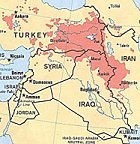
The ban of the Democratic Society Party (DTP) has only brought more confrontation in Turkey: Kurds, who are 15-20% of Turkish citizens but whose homeland is in the southwest, crossing also into Syria, Iraq and Iran, have reacted angrily at this decision, taking to the streets.

The protests ended in violent repression at Bulanik, where two people were killed apparently by a shopkeeper with an AK-47, reports Al Jazeera.

As Zeina Khodr reports at The Europe Blog of Al Jazeera, the banishment of the DTP has only caused further legitimacy for the Communist Party of Kurdistan (PKK), which has led armed struggle against Turkey for decades now:

I met a group of old men drinking tea at one of Diyarbakir's cafes. They seemed to have the answer to that question.

"Now that they banned the DTP … our real representative is the PKK. The PKK is our party and our leader is Abdullah Ocalan. He was the person who woke up Kurds to their rights," Hajj Moustapha Alay told me.


See also my previous entry on the latest developments at Kurdistan.

Update (Dec 19): a reader has corrected me, mentioning that the two victims in this particular case appear to have been shot by a civilian, a shopkeeper armed with battlefield weapons. I have corrected the corresponding sentences - and my apologies for the confusion.

Sunday, December 13, 2009

Increase in repression of Kurds leads to street fighting


After commenting on Catalonia and Greece (I did not mention Greek financial troubles though, but it is the next "Dubai" or "Iceland" quite obviously), and in what seems to be the aggravation of the existing class and ethnic conflicts in Europe, it's indeed obliged to mention also the difficult situation that Kurds under Turkish occupation are going through again.


Never mind that sectors of the PKK have actively expressed their will for a peaceful solution, even turning themselves to Turkish authorities as a sign of such a determination. Turkey is a hyper-nationalist country with a weak identity that only seems to be able to exist as opposition to some "enemy", preferably weak and within its borders, just like its Western counterpart: Spain.

It seems that instead of looking for a solution, the Turkish Republic is again attacking its own citizens, just because they reject to be forced into the uniform corset of Turkishness. They have banned a major Kurdish party, the Democratic Society Party (DTP).

It is the 10th major Kurdish party to be banned by the Constitutional Court, what strongly suggests that it is the high tribunal and the restrictive constitution the ones that needs to be banned instead.

The announcement has caused the 21 MPs of this formation to abandon all parliamentary activity without renouncing to their seats. It has also caused major protests and clashes in North Kurdistan.

Kurds make up between 20% and 25% of the population of the Turkish Republic but their language and culture have been essentially forbidden, though with some shy tolerance measures in the last decades, mostly makeup to show up at Brussels. Kurds demand recognition of their culture and identity and the eshtabilishment of a Kurdish autonomous regions where they are majority. Historically Turkey, based on an extreme version of the French Jacobine model of nation-state, instead has rejected any compromise with the minorities, causing the genocide of Armenians and the ethnic cleansing of Greeks. The approach to Kurds, mostly Sunni Muslims like Turks, were to call them "mountain Turks" and get their language and identity banned. This "solution" did not last for long and eventually Kurds took up arms against the invader state.

The conflict looks far from being solved because that won't happen while the Turkish state keeps its arrogant imperialist attitude.

Thursday, October 8, 2009

Istanbul IMF-WB summit protests: silenced?


I have been looking in several news sites and could find nothing. Only Basque left-wing newspaper Gara makes a meaningful mention of the protests and violent repression that have shaken
Istanbul as the yearly IMF and World Bank summit took place. Please, if you know anything more, let me know.

Per Gara, the city of the Bosporus has been virtually taken over by a huge police deployment, very specially at the centric area of Sisli, where the globalist financial meeting took place.

On Tuesday ago the main fights happened at the district of Beyoglu, beginning at Taksim Plaza and and continued for hours until the gases made the situation unbearable. The demonstration called there was mercilessly smashed by the police, what nevertheless did not avoid inccidents but in fact seems to be the main cause of them. A trader, Issac Kalvo, died of a heart attack in them.

Yesterday it was the centric district of Sisli the scene of the main struggles. In spite of the overwhelming police presence, demonstrators managed to block Pangalti Avenue for some time. There, a student identified as Mehmet, declared that the IMF and World Bank have sunk our country into misery, those who make deals to sell weapons that are used to kill Kurds, Alevis, Communists and that dissidence is smashed, want to come here to sell recipes to get out of the crisis.

Some masked street guerrilla groups managed to succesfully attack cash machines, bank offices and shops of multinational corporations. A different group managed to reach to the E5 highway and block it for some time.

Yesterday there were 34 people arrested, three of which in the mostly Alevi (a progressive Shia sect) and leftist neighbourhood of Gaziosmanpasa, who are being accused of membership in the illegal Revolutionary People's Liberation Party (DHKP-C) and of carrying more than twenty molotov cocktails.
.

Thursday, September 25, 2008

Turkey: trial for standing against military service


I know well that total resistence to the military, and particularly conscription, is a virus (a benefic one though) that is not going to stop at the borders of EU. And the cultural relationship of Turkey with the rest of Europe is way too strong to change that, as it's probably the case of Russia, though it may take some more time in this latter case because of their grandeur dreams.


The case is anyhow that a famous Turkish singer, Bulent Ersoy, has been brought to court for suggesting that the Kurdish conflict needs a solution and that, would she have a son, she would not send him to war.

She is being accused under article 318 that forbids dissuading people from miltary service. But she is standing defiant: even if they hang me, I will keep talking.

She could face more than four years in prision if convicted.


The transexual singer stood defiant.
Some people deployed banners in her support.


I still recall when a Turkish resister to the army visited us maybe some 20 years ago (this issue is not new at all) , his main worry was legal matters: his organization was about to be declared illegal and, to my incrdulity, he said that, if illegalized they would not be able to work anymore because the full wight of repression would fall upon them. I was flippant as our own organizaton had never bothered to get legalized at all (better outside the law) but guess circumstances are somewhat different. I am not sure of their current situation but I bet it is most delicate. I'll see what can I find on war resisters in Turkey.

In any case, the attitude of Bulent Ersoy is most brave and an example for people, not just in Turkey, but around the World.

Monday, September 1, 2008

Dark hands of the East


A couple of news items from Al Jazeera:


1.
Kremlin critic 'shot in custody': Magomed Yevloyev, director of ingushetiya.ru, a major indepenent news source on the Caucasus was shot dead after being arrested by police.

2. Uncovering Turkey's dark past: article on the judicial research of Turkish terror gang Ergenkon, that has been behind many state crimes in this country. A major issue is that while the judiciary is researching this death squad's crimes in Turkey proper, it seems that most of its crimes happened in Kurdistan, and these are not looked upon with the same interest. Also it would seem like the research is intended to prevent that Ergenekon could be involved in triggering a military coup against the Islamist government.

Sunday, April 13, 2008

Tukey's taboos


Interesting BBC article on how difficult is to write openly on certain taboo subjects in hyper-nationalistic Turkey. Specially the Armenian genocide issue, certainly, but not only. Even writing about the Comunist Party of Turkey is taboo there, and certainly dealing critically with the issue of Kurdistan.

Ragip Zarakolu puts it clear:
If you believe you are great, clean, and honest it is hard to face something like 1915. Our society has traumas that we are avoiding.Really, we should see a therapist!


Thursday, March 20, 2008

On the Turkish "parade" in Southern Kurdistan


Again La Haine has quite interesting article recopilating different views on what the heck was the Turkish army launching a massive operation against the PKK in the midst of winter. The article by K. Zurutza is in Spanish and, while it's all very interesting, I will not attempt to translate it but some quotes can still be very illustrative.

To begin with, Hassan a former PKK guerrilla says:
No one can believe the figures of Ankara: they are unbelievable. A guerrilla is like a rabbit running through the mountains (...)
I remember one day in 1996 when we surrounded some fifty soldiers. They had no chance and we killed all them and only four of our men died. Two days after, Turkish TV announced that they had "eliminated 70 terrorists" and lost four soldiers.
Abdullah, an elderly man from Dohuk believes that:
An operation into the mountains in full winter is a nonsense.
Haci, a mobile telephone worker makes a suggestive analysis:
It's all because of Kirkuk, it has nothing to do with the PKK. The Turks have been nervous since some time ago, as the referendum about the integration of Kirkuk into Southern Kurdistan approahches. They don't want to even hear of a Kurdish neighbour controlling one of the largest oil reserves of the Middle East.
In the final (appendix-like) part of the article, originally from the Basque newspaper Gara, Khider Domle, journalist and professor at the University of Dohuk, suggests that the Western powers, do not have a real plan for the region, that Turkey is oil hungry and that fears that what has happened in Kosovo might happen in Northern Kurdistan as well.

Sunday, March 2, 2008

Kurds claim victory against Turkey.


Kurdish Media reports that the PKK claims victory against Turkey in the recent combats in Southern Kurdistan (Iraq). While the Turkish figures talk of 23 soldiers
(27 according to BBC) 237 peshmergas (more that 240 for the BBC) killed in the fight, the PKK claims that 130 Turkish soldiers were killed along with a downed Black Hawk helicopter, while giving no figure of their own casualties.

It is still not clear why the Turkish army retreated just after the visit of US secreatry of defense, R. Gates. My own hunches go in three possible directions:
1. That the offensive was being a disaster, as the PKK claims.
2. That the Southern Kurdish autonomous government blackmailed the USA in one way or another, maybe threatening to attack Turkish troops along with the PKK.
3. That it is related somehow to the developements in Lebanon (danger of Hezbollah takeover) and Palestine (Israeli genocidal impunity).

In any case it seems that the Middle East is becoming something too hot for the USA to handle properly.

Monday, February 25, 2008

Turkish army in Southern Kurdistan (1)


I've been following as much as possible the latest Turkish invasion of Southern Kurdistan (Iraq). I say "as much as possible" because there seems to be a blanking of information not just by Turkey but also by the Kurdish autonomous government in Kirkuk. Journalists have been forbidden to head to the border to report on the invasion. That doesn't mean that Southern Kurdistan is happy about the Turkish intervention and in fact there was a standoff when Turkish troops stationed in Iraq (since 1991) attempted to leave their bases to join the operations: the Kurdish peshmergas surrounded them and eventually they had to turn back.

One thing that makes little sense to me is why these operations are being carried out in the midst of Winter. The PKK militias are deep in the mountains and these are true ice cubes in this time of the year, not the best scenario for the Turkish army to make fast gains, right?

It is worth mentioning that the Kurdish authorities at Kirkuk and the PKK do not really get along: historically regional and global powers have played the Kurds selectively against their rivals and the parties in power in Southern Kurdistan, supported by Turkey and the USA historically are not sympathetic of USSR and Syria backed PKK (PKK stands for Kurdistan Workers Party, though nowadays they are less Communist than they used to). Nevertheless the sister organization PJAK, that acts in Iran (Eastern Kurdistan) has support from the USA and is not listed by them as "terrorist organization".

Right now, the situation seems to be as follows: the PKK has shooted down a Turkish helicopter, while the Turks have destroyed 5 bridges in northern Iraq. Casualties' figures are confuse: the Turkish soldiers killed by the PKK may be between 15 and 47, depending who you believe; Turkey claims 112 PKK casualties but I suspect many are actually civilians (if the figure is not inflated).


One of the five bridges bombed by Turkey and map of Kurdistan (Kurdish ethnic majority).

Ref: Al Jazeera: 'Turkey ignores Iraq pull-out plea'.