New blogs

Leherensuge was replaced in October 2010 by two new blogs: For what they were... we are and For what we are... they will be. Check them out.
Showing posts with label EU. Show all posts

Thursday, September 30, 2010

Ireland to waste 30 billion euros in bailing out pointless bank


As a commenter explains under the extremely brief BBC news note, that is the cost of two years of public healthcare. All commenters agree: let it fall, use public money in public investment to generate much needed jobs instead. 


You are probably familiar with this image already: in yesterday's class war pan-European protests a demonstrator crashed this truck, representing the burden of Anglo Irish Bank to the Republic of Ireland, against the Parliament's gates. The incident has become known as cementgate, and is generating a number of silly jokes involving the words concrete and gate, as well as others such as constructive protest, crash, foundations, etc.

But the issue is much more serious: why should a state bail out a private bank? If anything it should nationalize it or, alternatively, just let it fall. Most business do not have the heavy state protection some banks do, nor see even a fraction of the absurdly high profits and disparate salaries for their managers. And most business, unlike banks, contribute to the real and not just the speculative economy.

Ireland is one of the European countries worst affected by the budget crisis, along Greece, Latvia and Hungary, all which are under IMF intervention (with the only result that their recession has aggravated many levels since then). I imagine that the least they can do is to waste 30 billion in a useless bank.

Can anyone tell me what do banks contribute to the real economy? I can't find a single idea, specially since they do not even issue loans anymore. 

Let them fall, all the banks except the public ones (which are the ones issuing money and which can lend directly to the public and even make a benefit from that).

European HR Court condemns Spain for not investigating tortures


It refers to the case of Basque citizen Mikel San Argimiro who was arrested, held incommunicado and (allegedly, most likely) tortured for five days by the Guardia Civil (militarized police corps) in 2002. The sentence condemns Spain to pay 23,000 euros for the fault of investigating the denounces of torture. The sentence is likely to establish a precedent in the matter because Spain almost systematically does not investigate torture while in detention.

The forensic report in San Argimiro's torture case established the first day that he had many lesions, which were dismissed as they could be "compatible with the development of the arrest and the maneuvers of immobilization". This same argument was held by the state attorney in the case of Igor Portu and Mattin Sarasola, which, in an exceptional development, resulted in the accusation of several policemen (Guardia Civil again) which will be judged in a month. 

In the second day of arrest the forensic physician reported new lesions without attributing them to any particular cause. Four days later, after being sent to prison, another physician found a broken rib.

The European tribunal cannot judge the existence of not of torture, because there is no investigation but can judge that not investigating it is a serious fault, a breach of article 3 of the European Covenant on Human Rights forbidding torture.

There is a long list of similar cases involving Basques as victims; next in line are the well known cases of Unai Romano, whose photos with the face totally deformed by the beatings caused a tremendous impact, and Martxelo Otamendi, director of Basque language newspaper Egunkaria, which is one of the most aggravating cases of persecution against freedom of speech and linguistic diversity. 

 Unai Romano before and after his arrest

In the past the European tribunal has only ruled against Spain in few occasions, one involving Catalan nationalists, tortured in the context of the Olympic Games of 1992, the other two affect Basque victims: nationalist MP Miguel Castells, who was deprived of parliamentary immunity, judged and sent to prison for a crime of opinion (denouncing that the death squads of the 1980s were not being investigated) and the other happened last year, when Strasbourg condemned Spain to pay 170,000 euros to Mikel Iribarren, who was almost killed by a rubber bullet shot at short distance against his face. 

Hopefully this sentence will help to at least contain a bit the systematic impunity of police torture.

Source: Gara.

Wednesday, September 29, 2010

Monday, August 16, 2010

Zaragoza-Brussels march for social rights


It began last Saturday and it's expected to reach Brussels on September 27 after many journeys varying from 17 to more than 50 kilometers, mostly through France.


People who wish to join for whatever length is asked to write to marchaabruselas@gmail.com, including name, mail address, telephone and journeys planned to take part in, or calling to telephone +34-679213259. Marchers are expected to bring their luggage, shoes, basic aid kit and sleeping utilities (sleeping bag, tent). A van accompanies the march to take care of luggages and people who need to rest.

The slogan is "March to Brussels. Against labor reform, for social rights" and one for the callers is anarcho-syndicalist union CGT, a splinter of the historical CNT (they mention other organizations but I have not been able to find out yet).


More photos and info (in Spanish) at CGT (includes detailed schedule and other info) and Rojo y Negro (photos).

From the second site:

We march against the spoliation of working classes and the destruction and privatization of the public sector in all Europe.

We march against Labor Reform and social cuts in the State of Spain.

We march against the Spanish government and the rest of European governments, who reduce salaries to public employees, freeze salaries, freeze pensions, increase VAT equally for the rich and the poor.

AND ABOVE EVERYTHING ELSE, we march because taxes are not being raised for the rich, fiscal paradises are not being destroyed, submerged economy is not being persecuted, tax fraud is not being attacked, no responsibilities are demanded to those who have caused the crisis, no embargoes nor prison are being applied against bankers, speculators and billionaires who are taking the public money.

Tuesday, July 13, 2010

Sovereign credit ratings... according to non-Anglosaxons


Specifically, according to Chinese company Dagong Global Credit Rating.

It is not trivial, considering that Anglosaxon companies may have a bias and that China, along with other East Asian countries like Japan, is a major investor in foreign debt.

Definitively the USA, Britain and other major Western countries like France, or even Germany, are not AAA for the Chinese financial watchdog. Notably the USA is rated as merely AA in both local and foreign currency with a negative outlook.

For reference, I must remind that the rating of AAA- of Spain by Standard and Poor caused hysterical reactions from the corporations and the politicians, both locally and at EU level.

Let's see the detail (major powers in bold type)

States that get AAA rating are Norway, Denmark, Luxemburg, Switzerland and Singapore. Australia and New Zealand also get this rating in their local currencies but only AA+ in foreign denominations.

AA+ is achieved by Canada, Netherlands, Germany and China. China also gets AAA in foreign denominations.

AA rating is given to Saudi Arabia and the USA, however the superpower gets a "negative" remark on its outlook.

AA- is obtained by South Korea, Japan, Great Britain and France. Japan however gets a full AA, without the minus, for credit denominated in foreign currencies. Japan, Britain and France get a "negative outlook" remark as well.

A+ is reserved for Belgium and Chile.

A is given to South Africa, Malaysia, Russia, Estonia, Poland and Spain. Poland gets an A- in foreign currency rating. Spain is the only in this bloc with the "negative outlook" remark.

A- includes important countries like Brazil and Italy, as well as Israel and Portugal. Israel credit looks weak but as long as it can get its yearly tribute from Washington guess it'll survive. Italy and Portugal however get the "negative outlook" remark.

BBB includes India, Thailand, Mexico, UAE, Kazakhstan and Hungary. The last two with BBB- in foreign currencies. Hungary and UAE get a "negative outlook" remark.

The category BBB- for both types of bonds is reserved to Indonesia.

BB+ includes Egypt, Venezuela, Nigeria and Romania, this last with a "negative outlook" remark.

A BB ranking is obtained by Greece, Turkey and Iceland. Iceland being the only one with the "negative outlook" remark in this group.

Vietnam gets a BB-, Mongolia and Philippines a B+, Argentine and Ukraine a B, Pakistan B- with "negative outlook" and Ecuador is ranked as CCC, the lowest of all surveyed countries.

The ratings are based on a number of factors, which are fulfilled only by the AAA rated countries:

... political institutions are mature and well-functioning; national development strategies are clear and implemented vigorously with obvious effect; the national security situation is stable; economic strength is strong, and they have powerful global competitive advantage; as the world economic recovery, their growth prospects are assured; they have well-developed financial systems and strong resistance to impacts; the Government maintains a stable fiscal records in long term; although the economic crisis yields the government deficit and debt increasing, the fiscal sustainability are maintained; the internal value of currency is stable; their debts are mainly denominated in local currency, or they have good external liquidity and ample foreign exchanges; the external value of the currency is stable.
Countries rated AA are considered less stable lacking one or two of these ideal components, what makes their solvency somewhat less guaranteed. States ranked A are only strong in two or three of these elements, etc.

The report also includes a comparison with Western rating agencies that makes evident that the Chinese agency is more demanding in order to give an AAA rating but compensate that by giving more AA and A ratings. B and lower segment ratings are similar.

Dagong rates several developing countries higher than its Western equivalents. Of course, one of them is China but also includes Saudi Arabia, Russia, Brazil, India, Indonesia, Nigeria, Venezuela and Argentina. Go BRIC, go! or are the Chinese more objective when rating the developing world?

They argue that:

Dagong holds that the national management capacity of these countries continues to improve, the economic growth potential is stable in the long term, fiscal stability and the resistance capacity against external shocks are getting better increasingly. Especially after the global financial crisis, the performance of these countries prove that they are more likely to turn the disadvantage into advantage in a short time, which could ensure the increase of national credit level.
What seems to make some good sense on light of what we have seen in the news in the last years.

In turn there are 18 countries getting lower ratings by Dagong than the usual NYC-based watchdogs. Of these, more than half are developed Western countries: Canada, the USA, a large list of European states and Israel. There's also a meaningful group of developing countries (UAE, Thailand, Mexico, Romania, Philippines and Ecuador) but these only rank one level lower, while the developed countries of Europe and North America see often their credit rankings reduced by several levels.

Chinese or Western bias? Considering the panic that they are inducing through the media over here about credit issues, I'd say that Western bias looks more likely. However can you trust the media these days?

The Chinese raters argue that:

As a result of the discordance among the growth rate of government debt, the growth rate of the economic output, and that of the fiscal revenue, this group of countries can only maintain their sovereign credit level on the basis of external financing. Since the beginning of 2010, fiscal risks in these countries have not only become the biggest source of systemic risk domestically, but also possibly the main source of the risk of a double dip for the world economy.

There's also a long list of 23 states that get similar ratings by all four companies.


Sources:

Saturday, July 3, 2010

Barroso saber-rattles to impose social degradation in Europe


The right-wing President of the European Comission, Joao Barroso, reportedly warned of military dictatorships coming to life in Europe if the so-called "austerity measures" (i.e. taxing the poor to give to the rich) find resistence.

This is reported by Heinz Dieterich[es] and the EU Observer[en].

According to the latter, the Secretary General of the European Trade Union Confederation (ETUC), John Monks, had the following exchange with Barroso:

The chief of Europe's trade union chiefs, John Monks, has warned that the austerity packages being imposed across the bloc will send the continent "back to the 1930s." He reported that European Commission President Jose Manuel Barroso also fears member states will turn their back on democracy - but for the opposite reason.

"This is extremely dangerous. This is 1931, we're heading back to the 1930s, with the Great Depression and we ended up with militarist dictatorship," the general secretary of the European Trades Union Congress (ETUC) said in an interview with EUobserver. "I'm not saying we're there yet, but it's potentially very serious, not just economically, but politically as well."

Mr Monks reported that Mr Barroso has similar concerns, but based on diametrically opposed reasoning. He said the commission chief believes the austerity packages will save Europe from returning to the darkest days of the last century rather than precipitating the fall.

"I had a discussion with Barroso last Friday about what can be done for Greece, Spain, Portugal and the rest and his message was blunt: 'Look, if they do not carry out these austerity packages, these countries could virtually disappear in the way that we know them as democracies. They've got no choice, this is it'."

"He's very, very worried. He shocked us with an apocalyptic vision of democracies in Europe collapsing because of the state of indebtedness."


For Dieterich, however this exchange is more than mere concern: it is a direct threat:

The European bourgeoisie states, in other words, an ultimatum to the worker and popular movement: pay submissively the costs of the crisis caused by Big Capital or we make you pay by means of the military boot. In political language: if you offer resistance to reduction of your life quality levels, we will move from the veiled bourgeois dictatorship (representative democracy) to open bourgeois dictatorship.

The level of the interlocutors is a clear sign of the seriousness of the threat: Barroso is the highest executive officer of EU and Monks the highest ranking officer of mainstream European labor unions. Dieterich also reminds that it was European bourgeoisie which invented fascism and its variants and which had no problem in 1968 to bring in the tanks to quell the revolt in Paris.

He also cites a report by Merryl Lynch-Capgemini that shows that while the World is immersed in the worst economic crisis since 1930, the number of hyper-rich and their profits keeps growing, a clear sing of who is paying for the crisis: not the oligarchs who caused it but the plain people who has no fault whatsoever (other maybe than being too naive about the real intentions of their rulers and elite class).

Dieterich however calls for a reaction more in the line of the 1840s: when it was becoming evident that revolution was at the gates, the International elaborated a program of action, which had a major impact in 1848 and set the basis for the Worker Movement as we know it. That program is now known as The Communist Manifesto.

Dieterich says that we now know better how Socialism must be (democratic planning, work value and principle of equivalence) as well as how its political structure needs to be (participative democracy) but that we lack, unlike in 1847, unions and intellectuals with class consciousness and critical theory, reason why the European people is "defenseless" in front of this kind of blunt threats.


-----------------------------------------------------

Update (July 4): On second thought, I'd say that the Spanish Armed Forces are so extremely lacking prestige and numbers that they could hardly serve as backbone of any authoritarian regime. The chance of effective military coup in Spain is nil. However in the particular case of the multiethnic realm, a situation somewhat similar to that of Yugoslavia in the 90s may be generated, that is: open war instead of the current low intensity conflict.

I was somewhat intensely involved in documenting and reporting on the West Balcans war in the 90s and I recall a potentially relevant conversation however. It happened in Skopje, Macedonia, in an interview with the leader of the small liberal party. I don't recall neither the name of the man nor that of his party but doesn't really matter.

He related an anecdote of a year or so before the war broke up, a conversation he had with a CIA agent he said. The Macedonian was telling the spy that he was confident in the future because, after all, Yugoslavia was finally, after the fall of the Soviet Bloc, "strategically irrelevant".

To this the North American agent replied mysteriously: "I would not be so happy if my country would become strategically irrelevant". Soon after the war broke up.

The case of Spain is very different: it is strategically most relevant, in particular because it is a platform to control the Gibraltar strait and potentially North Africa and because it hosts key US bases in that strategic area: the naval base of Rota and the air base of Morón de la Frontera. Also for several reasons France specially would not want Spain to break apart (fear of contagion, important neighboring ally, major investments).

So, for good or bad, open inter-ethnic war in Spain is not probably an option, unless powerful third parties would intervene, what does not seem likely at all.

So I would dare say that the threats are empty threats in this case. Greece instead still keeps a large conscription army which can effectively occupy the country, unlike the Spanish one, which can barely just reinforce the police force. However one of the dangers of a conscription army is that recruits can potentially take over it, if they are organized.

The real problem is overall lack of organization of the class forces and a self-defeating pactist dynamic of the mainstream unions. Without grassroots class organization the people is very weak and even police alone, with the help of the media, controlled by the same oligarchic forces, can keep high levels of repression.

But a coup? I don't think so: they'd lose all their remaining legitimacy and would disintegrate easily.

Wednesday, June 30, 2010

The financial coup and the end of Europe as we know it


Economist Michael Hudson has a new article at Counterpunch (Spanish language version at Sin Permiso) analyzing what he bluntly describes as financial coup.

Some key paragraphs:

A balanced budget in an economic downturn means shrinkage for the private sector. Coming as the Western economies move into a debt deflation, the policy means shrinking markets for goods and services – all to support banking claims on the “real” economy.

(...) The idea is to create an artificial financial crisis, to come in and “save” it by imposing on Europe and North America a “Greek-style” cutbacks in social security and pensions.

(...) It is diametrically opposed to the original liberalism of Adam Smith and his successors. The idea of a free market in the 19th century was one free from predatory rentier financial and property claims. Today, an Ayn-Rand-style “free market” is a market free for predators. The world is being treated to a travesty of liberalism and free markets.

(...) Latvia is the prime example. Despite a plunge of over 20 per cent in its GDP, its central bankers are running a budget surplus, in the hope of lowering wage rates.

(...) Beyond merely shrinking the economy, the neoliberal aim is to change the shape of the trajectory along which Western civilization has been moving for the past two centuries. It is nothing less than to roll back Social Security and pensions for labor, health care, education and other public spending, to dismantle the social welfare state, the Progressive Era and even classical liberalism.

(...) The problem is that there is not enough economic surplus available to pay the financial sector on its bad loans while also paying pensions and social security. Something has to give.

(...)

What really is causing the financial and fiscal squeeze, of course, is the fact that that government funding is now needed to compensate the financial sector for what promises to be year after year of losses as loans go bad in economies that are all loaned up and sinking into negative equity.

(...)

This is not the familiar old 19th-century class war of industrial employers against labor, although that is part of what is happening. It is above all a war of the financial sector against the “real” economy: industry as well as labor.

(...)

Latvia has been held out as the poster child for what the EU is recommending for Greece and the other southern EU countries in trouble: Slashing public spending on education and health has reduced public-sector wages by 30 per cent, and they are still falling. Property prices have fallen by 70 percent – and homeowners and their extended family of co-signers are liable for the negative equity, plunging them into a life of debt peonage if they do not take the hint and emigrate.

(...)

The explanation, of course, is that today’s economic planning is not being done by elected representatives. Planning authority has been relinquished to the hands of “independent” central banks, which in turn act as the lobbyists for commercial banks selling their product – debt. From the central bank’s vantage point, the “economic problem” is how to keep commercial banks and other financial institutions solvent in a post-bubble economy. How can they get paid for debts that are beyond the ability of many people to pay, in an environment of rising defaults?

(...)

This is why I say that Europe is dying. If its trajectory is not changed, the EU must succumb to a financial coup d’êtat rolling back the past three centuries of Enlightenment social philosophy. The question is whether a break-up is now the only way to recover its social democratic ideals from the banks that have taken over its central planning organs.


I could add many things but would be mere extensions on this analysis. Sadly enough, Hudson is right and, unless the People of Europe reacts very strongly, the continent will be plunged in a matter of years into the most dystopic scenario with the vast majority of citizens dumped into misery conditions, industries fleeing or dying out and mafias running the only remnants of the economy.

The corruption of the parliamentary representation system, with nearly all politicians being nothing but puppets of their financial patrons and with nearly no free media surviving, plus the destruction of effective state sovereignty is leaving Europe (and the World) on the hands of the big bankers, who have only one goal: to keep their profits high for as long as possible, concentrating all the wealth in their hands, without any real plan for the future other than that.

Capitalism has taken off its mask. It still tries to sell workers' austerity as something "good" but in fact they have no project whatsoever anymore. The Cold War illusion of welfare under capitalist conditions is all but dead now: class war has become very real.

But by the moment at least, the bad news is that the oligarchs are winning the war. For how long?

Thursday, June 17, 2010

Genetically modified corn causes infertility


New research by the Austrian government confirms that a Monsanto-patented genetically modified maize causes infertility in mice (and probably in humans too). The variety, known as NK 603 x MON 810, is by the moment forbidden in the European Union but it is being grown experimentally in 30 municipalities of Spain.


Sources: Greenpeace, G&C and La Haine (all three in Spanish)

Research paper should be found here (in German) but at the moment the PDF link is broken, giving a "500 Internal Server Error" page.

Sunday, May 30, 2010

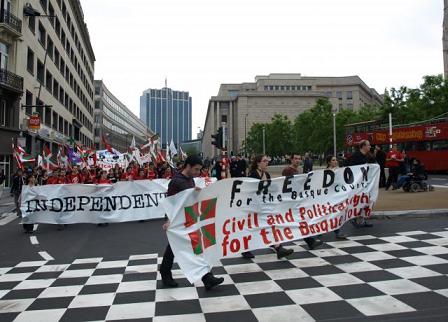
Thousands of Basques demonstrate at Brussels


Thousands of Basque youths reached out to the capital of the European Union to demonstrate in demand of sovereignty and civil rights.


As you can see in the photo above, the central slogan of the demo was "Freedom for the Basque Country - Civil and Political Rights for the Basque Youth".

This was surely the only banner in English, others read in Basque and French: "Independence", "Committee 'Liberez-les' of Support for Political Refugees and Prisoners" and "International Solidarity - Without Rest Until Victory".

The demonstration had been called by GaztEHerria (Young People, with a letter play of EH meaning Euskal Herria: the Basque Nation or People), a plural platform of Basque organizations.

Additionally, the march had support of other European nationalist movements such as Sinn Féin and the Flemish Nieuw-Vlaamse Alliantie.

The buses departing from the Basque Country suffered from police hostigation and delaying tactics but all arrived to Brussels in time for the demo to take place.

Sources:
· Boltxe Kolektiboa[es], with many more photos
· Gara[es]

Danish pharmaceutical giant retrieves insulin drug from Greece


Throwing salt on the Greek injury, Danish pharmaceutic corporation Novo Nordisk has retrieved a key insulin drug from the Greek market after the government decreed that all medicine prices had to be cut by 25% (source).

It is the right and the duty of any government to guarantee as much as possible the the health and well being of its citizens, particularly those with special needs, in this case diabetics. Hence I understand that the Greek government and the European Commission (as EU government, even if unelected) have the right and the duty to guarantee that this medicine is delivered to European citizens in Greek as in Denmark, be it by grade or force, with or without the trademark and with or without the agreement of that stupid WTO mass-scam ring. No copyright, trademark, patent or whatever fancy pretext can justify the manslaughter of people by denying them readily available medicines.

Mr. Barroso: as President of the Government of the European Union, you have the duty to secure that these medicines are delivered to diabetic citizens at a reasonable price.

Friday, May 28, 2010

Eurozone's problem is Germany


Interesting review by Prof. Vincenç Navarro
at his blog[es] on how the real problem of the Eurozone is not really the rather normal finances of peripheral countries but in the lack of demand of the central countries, notably Germany.

Germany, supposedly the economic engine of the EU, has been pretty low in the last decade, with small GDP growth figures and high unemployment. What is worse: the domestic demand of Germany has been lower than the peripheral countries now being punished for precisely sustaining the economy of the Eurozone (and specially of Germany itself) with their demand.

This is because Germany, still with a social-democrat government then, chose not to use the huge surplus that conversion to the euro generated to increase its domestic economy by rising salaries (and hence demand) but to speculate in the peripheral countries feeding the housing bubble and the deficit escalation.

Germany is in fact the wealthy but savy cousin who wants to sell commodities to their less well off relatives. And oddly enough, it has worked for a while, thanks to German (and French) credit. But logically this was untenable in the long run and now the Germans (and the French) want their money back by any means, what implies the destruction of the demand for German products.

As I said before, Mr. Volkswagen: how do you expect us to buy your cars if we work for misery salaries and pensions?

Navarro mentions that Oskar Lafontaine, then minister of economy and now co-leader of the growing communist Die Linke party, left Schröeder's government and the SDP for that reason. Lafontaine proposed instead a more balanced approach, increasing the income of German workers and hence the internal demand, what would have created a much more balanced EU and not this neocolonial engender designed for Mr. Volkswagen exporting until the demand runs dry (what is happening right now).

So what really needs to be fixed is that historical error that highly imbalanced the demand in the Eurozone. The demand by Germany and other Eurozone countries need to rise, what probably means increasing local salaries.

That does not mean that other barbarities like the Spanish housing bubble do not need to be addressed, they do. In fact Spaniards could work for less or demand more commodities if housing prices were not so extremely high, and that's a good reason to explode this bubble. But that would cause serious trouble to banks, who have invested heavily in this worthless excercise of financial engineering.

That's after all the real problem we have in EU: if we do what is logical (explode bubbles, restore a healthy demand by rising income), then banks would sink. Nobody cares about that except banks themselves, because they can always be replaced by other more serious banks, private or public. Of course some private investors would suffer but most people would be unscathed.

But the interest of the people does not matter to policy-makers, specially as EU is anything but a democracy, so Brussels and the Eurozone oligarchs have decided that it's best to make people pay for the errors of the banks and re-level the Eurozone demand to misery levels by lowering income and making sure that the banks are paid back.

This is extremely short-sighted: it's bread for today and hunger for tomorrow. Even for the bankers. If there is only a very low demand in the Eurozone, then Mr. Volksvagen (my imaginary archetype of European capitalists) won't be able to sell nearly anything and the economy will become stagnant for a very very long time.

The problem is clear: who dares to hang the bell from the cat's (banks') neck? It's much needed if we want to avoid Europe from sinking into misery and self-destruction.

Nobody? Then I think I know where the first socialist revolution of the 21st century will happen.

Thursday, May 6, 2010

"Those lazy Greeks!"


The Imperial media is spreading the lie that Greek workers are lazy and overpaid. The reality is, of course, very far from that insulting propaganda:


Greeks work on average 42 hours per week, while the EU average is 40.3 and the Eurozone one is just 40 hours.

Private sector workers are also extremely underpaid in Greece: 803 euros per month, including taxes and social security payments. You get more than that in many EU countries for picking your nose! The lowest wages in the Eurozone are well ahead of those figures, at least 1400 euros in the Netherlands for example.

Pensioners only become such at ages slightly above the EU average, 61.4 vs. 61.1 years, but do so with pensions that, before the current draconian measures, were already insultingly low: 750 euros/month, while in the Netherlands is 3200 euros instead.

At least 30% of Greek workers are totally outside of the social security system anyhow, in a black market area that certainly does damage to the ability of the government to meet its social obligations and can only be harmful to workers themselves. In comparison the EU average is of 5-10%.

Greece public service (22.5% of workforce) is large in comparison with Germany (14%) but rather modest in comparison with other EU countries: 30% in France, 27% in the Netherlands, 20% in the UK.

The 13th and 14th month salaries are not any "extras" but just a method of dividing the yearly salary to stimulate consumerism in the holiday seasons. A similar method is common in Spain. The salary is anyhow defined in yearly terms and the only difference is that it is divided in 14 units instead of 12.

While the wages and working conditions in Greece are extremely low for EU standards, price have not stopped rising. Greek workers have to buy at German prices while having half the salary of Germans. A somewhat similar situation happens in Spain and other low wages Eurozone countries: it is the euro-prices which won't allow ever to lower salaries because after all, you want a salary to pay for your living, so it has to be big enough for that.

In Greece a packet of cereals costs on average 2.86 euros, while the same packet costs 1.89 euros in the UK (51% cheaper than in Greece) and in France 2.25 euros (27% cheaper). Greeks buy a toothbrush for 3.74 euros while in the UK the same toothbrush is sold for 2.46 euros (52% cheaper). A pack of soft drinks that costs 3.1 euros in Greece, costs 2.76 in Belgium, 2.3 in France and 2.68 in UK. The most prominent examples are a cup of coffee or tea: in Greece the average price is between 3 and 3.5 euros, more than twice the average in most European countries.

Greece does not need lower salaries, quite obviously. It needs cheaper prices if anything. You just can't lower salaries under the cost of living.

More at Marxist.com

Wednesday, May 5, 2010

Greece and Europe can only do one thing: a Revolution


As the pace of the Greek revolution speeds up, with the first casualties in a burned down bank office and the Greek Parliament besieged daily by the angry people, one may wonder why is people so angry. After all, according to the Imperial media, it's all their fault and the government is doing what it must do to save the nation.


The answer is logically that people is not so naive: they have barely, if at all, benefited from the bad practices that have triggered the crisis (rather the opposite) and they have yet to see any of those white collar criminals being brought to court and their properties seized to help pay the national debt.

The answer is that the whole nation is being held for ransom for the corruption of a handful of oligarchs and, what is maybe even more important, their international accomplices.

That's simply not acceptable.

And obviously this means a regime change in Greece: one that can effectively arrest the criminals and issue the appropriate international capture orders for their accomplices in Washington and Brussels.

One that has no problem in nationalizing the product of past years' robbery when possible.

One that dares to declare bankruptcy if need be.


So Greece is set for a revolutionary regime change and that is most unlikely to be prevented because there is no alternative. The only question is the pace and exact extension of this change.

But what about the rest or EU. EU can live without Greece but can it live without half of EU members? Because the speculators' aim is already set to other Eurozone states. It seems by the signals that the Iberian peninsula will be next but Italy, Ireland and the very UK (out of Eurozone but of great importance by its size) are clearly in the agenda.

The European Union today.
Eurozone in blue, comitted to join the Eurozone in green, special statuses in red, non-EU states using the euro in purple.
Stripes signify those states clearly targetted by the Transnational Capital to be ripped off in a "controlled demolition" (Latvia included because it's already suffering the IMF blackmail).
Original map from Wikipedia (modified).

The goal is to recycle these countries into cheap labor zones for the Euro-Global Capital without these vampires losing a cent in the process. The 'problem' is that the plan may go awry and trigger a pan-European revolutionary process.

Maybe the level of popular organization is not yet high enough but, even if the Transnational Capital achieves its goals it can only be a temporary situation as the rage they will leave behind in some of the more privatized and less well-off states of EU, where people do already struggle to make ends meet, cannot really be contained in the mid run.

While the Greek spending spree may have been going on before the advent of the Global Crisis, in the rest of countries public spending has actually been a reaction, a much needed one, to this disintegration of the Capitalist World Order. Claiming that states have to cut spending in the midst of a general crisis is totally absurd: states must increase their spending to put up for the inability of the so-called "market economy" to generate jobs and salaries, which are after all the only ones that will generate demand for the beleaguered private companies, at least for most of them.

Cutting public acquisitive power is not an option, not even for German capitalists: it's a suicide.

If the European Bank must print more euros, so be it. If the euro has to be devaluated, that is not a problem but in fact good news for European companies, which would see their international competitivity improved greatly by such measure.

But EU institutions are not working for the good of the European common citizen (or should I say denizen?), EU institutions are only working for the good of some privileged elites and they don't care at all about the common European, not even about the common European small company. Only huge multinationals matter for them.

This situation obviously demands a regime change at EU level. A regime change that redefines EU as a social federation and not as a capitalist one, a regime change that establishes EU finally as a representative democracy and not a mere bureaucracy at the service of the transnational mafias.

It may take some time but it will be done. The only alternative is for EU to disintegrate completely and its various states (or fragments of states in some cases, as Spain for example is not going to survive this one in a piece, nor will the UK) let to fend off alone in the vast ocean full of sharks. That's not a realistic or at least desirable goal and it's something that goes against the common feeling of nowadays Europeans, for which a European union, this or another better one, is a default.

So the only alternative is pan-European revolution.

Let's do it, do you have a better plan for today, my dear unemployed bored and desperate reader?

_________

Note: you can read the declaration of a colleague of the dead bank workers blaming the deaths on the bank owners at Occupied London (in English) and Indymedia (original in Greek). Triggered by this tragic incident, the Greek bank workers are going to strike tomorrow even if the corporative guild forbids them to do so.


Monday, May 3, 2010

Greece and Spain like Latvia, Portugal to tax the rich instead.


There's a nice article of economist I. Esnaola at Gara today, illustrating how the "rescue plan" of the IMF-EU tandem is a recipe for disaster. It is exactly the same "medicine" Latvia got in 2008 and things have only got worse for them since then: growing unemployment (even higher than Spain!), "growth" of -18% in a single year, and all without being able to stop public deficit from running wild at all.


That's exactly what they want to impose to Greece, just that the Greek people seem much less sheeply than Latvians and may just send IMF, EU and everything of the like to the trash bin in the process.

Spain does not seem to need an IMF package: it is already applying one: on its own will nearly all state income is reliant on a growing VAT (consume tax, now to be raised to 18%) and from tobbacco, alcohol and gasoline special taxes. Meanwhile the wealthy enjoy the best deals, what makes Spain unable to collect enough money for its expenses.

Instead, the only conservative government of the three South European countries, that of Portugal, has decided to tackle the tax crisis by raising taxes to the wealthy segment, up to 45%. It's clear that they are the only ones who know how to deal with the budget crisis: redistributing and not just loading the scales against the working class even more.

Saturday, May 1, 2010

Greece: why are not the thieves behind bars?, their properties confiscated?


Day after day we read about the Greek crisis and its ramifications. We know by now that a good deal of the responsability behind this case was that of a corrupt government and companies.


But we know little more about that. Some anecdotal details but not a word about any of the culprits being brought to trial or his/her property expropriated to pay for some of the national debt they used for their own benefit.

This is the most outrageous element of all the process: some oligarchs have brought a whole nation to heavy indebtedness and they are not even charged?! Their names are almost not mentioned, their practices nearly not inspected, their wealth (obviously the product of such anti-patriotic larceny) not even considered.

What's wrong?

It's as simple as this: some people and companies scammed a whole nation, they must be held responsible for it and their assets must be returned to the nation so it can face this challenge form a better position.

Yes or yes?

Tuesday, March 30, 2010

Four Peace Nobels press for peace negotiations in the Basque conflict


The Mandela Foundation and four Peace Nobel price winners from South Africa and Ireland are pushing for peace negotiations in the conflict that confronts Basque militants and the Spanish state.


The group, coordinated by Brian Currin, includes Desmond Tutu, Frederick de Clerk, John Hume, Albert Reynolds, Betty Williams and Jonathan Powell, among others, including the Mandela Foundation. Currin presented yesterday at the European Parliament a proposal signed by 21 personalities, asking ETA to declare a cease-fire and the Spanish government to respond in accordance.

The declaration is available as video HERE (in English with Spanish subtitles) and as PDF text HERE.

Currin's presentation was backed by Flemish MEP Frieda Brepoels, who underlined that the Basque Nationalist Left has recently advocated in exclusive for non-violent peaceful means to achieve their goals. This was in turn emphasized by the South African facilitator, who declared that a document like Zutik Euskal Herria (Stand Basque Nation), recently backed by 270 grassroots assemblies of the Nationalist Left, is a clear message that they want a process that is irreversible.

Speaking as personal opinion, Currin answered journalists' questions, saying that Spain should guarantee that the Nationalist Left could run to elections and develop its activities normally and should also repatriate the Basque political prisoners. This would help a lot, he said.

Brepoels emphasized that the large group of personalities backing this document is a really impressive group and a demonstration that there is a lot of people who believes that this opportunity should not be missed.

Source: Gara.


My two cents: the Spanish conservatives prefer the war to continue.

This is of course an important advance and something that would not have surely happened unless there is already some sort of preliminary negotiations going on. The fact that, barring the inccident at Paris, ETA has not carried any attacks since summer 2009 and that the Basque Nationalist Left has carried on a participative process to approve a declaration seeking political means, declaration that was backed by ETA in a recent communication, indicate that there is clear political will in this camp.

What is less clear is what happens in the other camp: among the Spanish nationalist ranks, which has not made any conciliatory movement of any sort, rather the opposite.

And what is even more worrisome is that the Spanish conservatives (recycled fascists) are accusing the social-democrats of "connivence" with ETA in what is an obvious electoralist maneuver of the kind they style all the time. Even if the ruling PSOE would want (which is not clear at all) to get into some sort of negotiations, a petty division of this kind in the Spanish nationalist camp would probably ruin any chance of these advancing at all.

So if I'd have to bet, I'd bet for another failure, sincerely. However it's always worth a try.

See also: label: Basque politics.

Monday, March 8, 2010

Iceland massively rejects to pay private debt


93% of voters chose NO in the referendum to validate or reject the bill that approved massive payments to foreign investors for debts acquired by a private bank, Icesavings, now nationalized after going bankrupt.


The Parliament had approved the bill agreeing to pay 5 billion dollars in exchange for a loan of 10 billions and support for an entrance into EU that Icelanders do not seem to desire anymore. However the President of the small republic, in a rare show of politic honesty of the kind you seldom see anymore in this rotten old Europe, vetoed the bill and demanded a referendum that has finally ended in a total defeat for the government. I commented on this neocolonialist abuse in a previous post.

Source: Rebelión, BBC, etc.

Sunday, March 7, 2010

Geopolitics of today (or "BRICs are heavy")


I finally made a satisfactory map that reflects as well as possible the imperfect multipolarity of today's geopolitics:

Click to expand

Legend:
  • Red shades: The Empire (dark red: USA and dependencies, bright red: other NATO members, other "central" US allies and their colonies, pink: other important US allies/EU members, stripes: under military occupation).
  • Turquoise: Russia (stripes: under military occupation), Cyan: main allies
  • Blue: China, lighter blue shades: under Chinese influence
  • Orange: India, lighter orange shades: under Indian influence
  • Green: Brazil, light green: other Mercosur countries, dark green: ALBA
  • Dark Grey: other regional powers
  • Regular Grey: other countries
Notice that I could not mark all US/NATO allies on risk of almost all the map becoming pink and that way maybe exaggerating the influence of The Empire even more. On the other hand I may have maxed the areas of influence of China (excepting Pakistan) and India. Many countries, of course, play multilateral diplomacy and try to keep a pretense of independence, what makes more difficult to decide what side are they in. The use of similar colors for Brazil/Mercosur and ALBA is somewhat justified but was mostly chosen to underline the differences between the USA/NATO bloc and the "Latin-Americanist" powers in the American continent. Anyhow, the latest developments in Honduras, Colombia and Haiti have clearly pushed Venezuela and Brazil closer in a joint bid to support the independence of Latin American and Caribbean nations, which obviously plays in their interest rather than in that of the USA, as imperialist power.


Overview:

There are two basic elements in the reality reflected in this map: The Empire and the BRIC.

The Empire is incredibly large (even if I tended to reflect only its strongest influence) and is clearly based on naval hegemony, which is supported by proportionally large navies, not just from the USA but also from France, UK, Italy, Spain, Australia and Japan in particular.

BRIC is an acronym that stands for Brazil, Russia, India and China. Even if it's an informal group, it has no other entity that reflect the four major powers that are still independent from The Empire. Each one of them has its own geostrategical interests and also different cultures and political systems. The only thing in common they may have is that they all are more or less confronted with The Empire... with one exception: India.


India:

It seems that India and China perceive each other as most direct rivals. Also India has a large maritime facade and hence clear naval interests in the Indian Ocean specially, which is also the ocean where The Empire has an arguably weaker presence. However India has with good reason distrusted The Empire in the past and instead kept stronger ties with the former USSR. The China-USA entente and the conflicts with Pakistan (an ally of both USA and China) on Kashmir, led the South Asian republic to act that way. However it has played both sides and has always kept major ties with Israel and other members of the Western bloc.

In the current circumstances, India still keeps good relations with Russia but the approach between Moscow and Beijing is pushing the old friend somewhat apart and throwing India in the arms of The Empire.


China and Russia:

But, of course, the most important power of all BRIC countries is nowadays China. And it is the growing conflict between China and the USA what really describes the scene. We can't still talk of a new Cold War, very specially because the Chinese take due care in no pushing the conflict to military but economic and diplomatic terms but, in any case, the conflict is clear and growing stronger, as knows anyone who reads the news.

China however is relatively weak in the military aspect, even if less so than in the past, and hence its growing alliance with the decadent but heavily armed Russia is of crucial importance. The "thirdworldized" Russia with loads of ICBM nukes, offers China an almost ideal ally: China does not dispute Russia its political and military clout on Central Asia but rips many of the economic benefits, not just of Central Asia but also of Siberia. It also offers China a military shield that prevents a direct conflict with The Empire.

On its side Russia also feels threatened by The Empire, which has been growing towards its borders and even threatens it with new missile deployments. The latest developments (defeat of Georgia, pro-Russian government in Ukraine, restive Turkey) may imply that Russia is scoring some goals but still it does feel threatened by NATO and siding with China is the best alternative it has (as together they control most of non-tropical Asia, while divided they would only play in the hands of their common rival).

China's worries are mostly a fear of being blockaded out of the oil supplies from the Middle East. Hence it's following two parallel strategies: on one side, cooperation with Russia to keep The Empire out of Central Asia (and as much as possible of The Middle East as well, for example protecting Iran) and, on the other side, securing as much as possible the shipping lines to West Asia (for which it has recently obtained bases in Bangladesh and Sri-Lanka).

In parallel, China is painfully working to weaken the imperial bloc in its immediate area of East Asia itself (seducing South Korea and even Japan and Taiwan as much as possible, supporting little Cambodia against Thailand, etc.), as well as gaining random friends in Polynesia and Africa and, specially, making business even where The Empire makes military alliances.


Brazil:

The other BRIC power is Brazil, whose confrontation with the USA has been growing hot in the last year. Brazil has been playing, even more than China, a soft diplomatic game, gradually strengthening its position both internally and internationally. While it has got its bad moments with the Bolivarian bloc led by Venezuela, the crisis of Honduras seems to have eventually opened its eyes. And if that did not, the growing US military presence in Colombia and the unbelievable massive invasion of Haiti have put things clear for Brazil: there's no room for two powers in America... unless they fight each other. Surely Brazil would like to grow in power more gradually and without conflicts but it seems that those days are now gone and The Empire is striking back. That situation obviously pushes the Bolivarian bloc (the ALBA) and the Brazilian-led bloc (Mercosur) into each other's arms.

The latest growing tensions around the Falklands/Malvinas disputed archipelago, as well as the repeated protests of Venezuela against the US-Colombia-Netherlands siege, show that the issue is serious.

However Brazil in comparison with the Asian BRIC countries has three disadvantages:
  • Like India, it is a naval oriented country with a large maritime facade. Hence it's potentially more exposed to the Imperial naval hegemony. But, unlike India it's much closer to the USA and its area of immediate interests.
  • It competes with the largest global power for Latin America, which the USA still considers its "backyard".
  • It is the only BRIC power that has no nuclear weapons. It might develop them (as did India not long ago) but that would mean breaching international agreements (NPT) and giving hence a pretext to the USA to behave even more aggressively.
On the other hand it has some major advantages:
  • Latin America in general is fed up with the USA and is clearly willing to try something new. Brazil has the potential of playing a leading role in this aspect and the recent formation of a distinct Latin American and Caribbean association without the USA nor Spain is a clear step in this direction.
  • Not only Latin America but eventually even large parts of Africa, very specially South Africa (particularly sympathetic to Brazil and India, and leader of a large bloc, not represented in the map) and the former Portuguese colonies, could be interested in some sort of cooperation with Brazil and other Latin American nations with common goals of emancipation and development.
  • The legitimacy of the people: unlike the other US rivals (China and Russia) and unlike most US allies (vassals) in the region, Brazil and its allies (excepting Cuba) are clear democracies, with more or less "progressive" leaning. Machiavelli himself would applaud that as a great asset.
  • Oil: Venezuela seems to have become the largest oil reserve in the World, replacing Saudi Arabia in this position. Brazil itself has discovered large deposits offshore and there are others in Cuba, Haiti and the Falklands, fueling the confrontation with the USA and Britain. But also allowing for some decent bargaining as well.

The Empire:

The Imperial bloc lead by the USA has clear advantages: the largest share by far of the global GDP, a huge military, presence almost anywhere on Earth, lots of nukes, total naval hegemony... But it has also some disadvantages, namely: overextension, huge debt (largely caused by military overexpending), being dominated by a small oligarchy with very peculiar interests, often conflicting with those of the people and even The Empire itself (particularly Zionism), and now a brutal overproduction crisis that might well seal its fate once for all.

Overgrowth crisis are not alien to large empires. Rome itself faced one after consolidation and languished for centuries in it, while the British Empire decayed largely because it was too large to be defended against its own peoples. But the closest parallel is surely the Habsburgian Empire of Charles V and Philip II, who similarly were forced to overexpend in military adventures, often ill fated, almost everywhere (Germany, the Mediterranean, Britain...). At the time there was no larger empire and the Habsburgs thought they had no rival... but soon they had to experience a harsh reality check and declare bankrupticy, as well as making huge concessions to their rivals.

This is in fact what The Empire is facing today: the crisis is, as we all know, far from over and it is affecting severely both major pillars of the bloc: the USA and EU. It is primarily an structural overproduction crisis but it's also a debt crisis (with China getting rid of less and less solid US bonds) and an overextension crisis as well.

Just count the unfinished major wars The Empire is involved in: Palestine, Iraq, Afghanistan, Colombia-plus, Yemen, Somalia. Not to mention the never accoplished threat of attacking Iran, the extreme instability of most US vassals in Latin America (Colombia, Mexico, Honduras and poor occupied Haiti at least), which can any day turn against their master by popular acclamation, and those of other regions (Egypt, Morocco, Pakistan, Thailand and even some European countries like Greece).

And then count the cost: the nominal US public debt is of almost 8 trillion USD but, in fact, more than 5 trillion are excluded from these accounts. Only counting the nominal fraction, the US public debt has never been so high since the late 1950s (as percentage of GDP, c. 70%) and, when we count all the real debt, it's as high as at the height of WWII (again as percentage of GDP, c. 115%). This kind of heavy indebtment, paid with the booty of conquest maybe but not without serious economic implications, is again another striking parallel with the Habsburgian Empire of Charles V and successors, very specially as most of it is wasted in both cases in military expenses.

But, of course, The Empire remains as of today as a mighty power, the only real superpower on Earth. Meanwhile, the Frances, Englands and Ottoman Empires of our day (the BRIC and particularly China) bid their time as much as they can avoiding direct confrontation as much as possible.

And this is the scenario we have now. Though admittedly it may well be obsolete in a decade or less.


Addendum: naval might:

Aircraft carriers may well reflect with some approximation the real naval might of each of the powers at play. They are as follows:

NATO and allies:
  • USA: 11 ships in use, 1 projected
  • Britain: 2 ships in use, 2 projected
  • Italy: 2 ships in use
  • Spain: 2 ships in use
  • France: 1 ship in use
  • Australia: 2 ships projected
  • Japan: 2 ships projected
  • Thailand: 1 ship projected
Total Empire: 18 aircraft carriers in use, 9 projected

BRIC:
  • India: 1 ship in use, 2 projected
  • Russia: 1 ship in use
  • Brazil: 1 ship in use
  • China: 1 ship projected
Total BRIC: 3 aircraft carriers in use, 4 projected


Sources: most data freely adapted from diverse Wikipedia articles and maps. See also this post on the China-US competition, this one on the latest US invasion of Haiti and its geostrategical implications and maybe this one on how Venezuela is being surrounded by US military deployment.

Note: of course, the secondary title is a silly wordplay with the superb record of L7, Bricks Are Heavy.

Saturday, March 6, 2010

Greece becomes a colony... in exchange of nothing


Greece has got just "good words" (and "not a cent" as the German economy minister put it) in exchange of ceding the control of its whole economy to the IMF and Brussels. The, ahem, "socialdemocratic" government is now approving the so-called "austerity measures" which include massive cut of social spending and high tax raises.

Naturally, this has caused some serious street warfare between police and revolutionaries, reminding of the serious conflict that took place last winter, still under conservative rule. Though divided, Greece has one of the strongest revolutionary traditions in modern Europe, so I still have hope that the people will overturn these abusive ultra-capitalist and colonialist measures for which, in the very words of PM Papandreou, they did not vote the socialdemocrats to power.

James Petras, whom I just now realize is Greek by ancestry, declared to Uruguayan Radio Centenari that "the worst in Greece is what the imperialist European countries like Germany, and also the USA, demand: that the control of the economy is transfered to the IMF, Germany and France. This is the colonization of the economy".

Source: Gara.

Wednesday, February 24, 2010

Navarro on how to solve the Eurocrisis.


Economist Vicenç Navarro deals
at Rebelión[es] with the difficult economical and political situation of EU under the euro.

He first considers how the implementation of the single coin with its draconian budgetary demands, was meant to damage the popular classes, which are almost invariably those who benefit from public expenditure, perpetuating, in the case of Spain, the inequalities established by the fascist dictatorship.

Then he travels to other EU states such as Letonia (GDP down 25%, unemployment up to 22%) or France (69% against the euro), while despising IMF's and Krugman's suggestions of reduction of salaries (how do you expect people to pay for the cost of life, if they can't already?)

Then it goes to offer a constructive alternative, that I detail here:

1. Creation of a true European federation, really democratic and participative, including a real instance of economic and monetary coordination at EU level, which does not exist now.

2. A EU budget that, as suggested by the "founding fathers", should be at least 7-9% of the GDP.

3. A Central Bank that is dependent of political institutions: European government and parliament.

4. A pan-European Social Pact, producing pan-European workers' statutes with legal weight.

5. A radical change of the criteria of Maastrich and the Stability Pact, emphasizing the Development component and prioritizing economic growth and employment creation.

6. Alter the draconian limits on deficit, allowing for more deficit than just 3% of GDP and for more debt than just 60% of the state's budget.

7. Instruct the Central Bank to have a role in the generation of European bonds that would help states to solve their punctual budgetary crisis in harsh times like these.

8. Do not allow that any state can be brought to the limit of not being able to pay its debt: creating a EU common front against such eventualities.

9. Establish a EU tax that would feed a common fund with purposes such as redistribution policies that stimulate economic growth, employment generation, etc.


My opinion:

However, I'd say this is not enough. This would have worked if implemented in the 90s or early 2000s but now it is already too late: the only solution for EU (and all capitalist regimes throughout the world) is true socialism. European federation? Sure but under a red banner (and of course with a real red policy).

Of course in the meanwhile, we will witness some of this, with a likely devaluation of the euro in order to allow some competition. Getting out of the common coin is not any realistic option (people would continue using, or at least treasuring, the euro while it exists, because it's stronger and would not get devaluated every other day: think Milosevic's Serbia, where salaries used to be named in German marks) and kicking a country out of it is not either (same reasons, plus political tensions).

This context really only allows for one exit: the creation of a European super-state that rules the economy somehow. But liberals (capitalists) don't want that: their whole (misguided) goal was to create a common market without efficient, much less democratic, federal institutions. This is a total nonsense proper of that engender known as Reaganomics (less state, more "market"). No "market" solutions, of the likes of the IMF, are really possible in this context. Blowing up the euro is not an option either (if it ever happens it will cause much more grief and problems than anything else, not just locally but at the whole EU level).

However a social-democrat federal EU as Navarro suggests is totally inviable, first of all because there are not anymore any social-democrats around. Sure there are a lot that call themselves that way but the only thing they do is to bow their heads to the IMF and the liberal policies of Brussels. And they don't have anymore any project of their own. In the past even the right used to be somewhat social-democrat, now it's the opposite and it doesn't look like the minds involved would ever be able to challenge their "market" fetishes, much less the mega-corporations that rule them, in order to achieve a viable Europe for the people.

That is not their goal anymore: they are all too corrupt, too involved with the global capitalism to dare think in terms of Europe.

Hence the only alternative is to break the molds and forge a new Europe of the people. But this, admittedly will not happen in the next few years, so I foresee a steep path of decline and further chaos, not only affecting EU but all Earth (after all EU is a major market and supplier for nearly everybody else). Eventually the European working class will realize their situation, get organized and take over. But it will take some time for the whole process to complete, sadly.