New blogs

Leherensuge was replaced in October 2010 by two new blogs: For what they were... we are and For what we are... they will be. Check them out.
Showing posts with label Greece. Show all posts

Tuesday, July 20, 2010

Greek blogger shot down in Athens


Sokratis Giolias, 37, was shot down before his home in Athens after men possibly dressed in police uniforms rang his bell and said his car had been robbed. They shot 16 bullets of the 19 mm caliber at him.

Giolias run the most popular blog and one of the most visited websites of Greece, Troktiko, which mixed frivolity with wide spectrum journalism, including, it seems, investigative journalism. He may have stepped on the wrong toe of someone with very bad temper and enough power. Who exactly? That I don't know yet.

While the police accuses the mysterious leftist armed group "The Revolutionary Sect" (variously called in the media "Sect of Revolutionaries" or "Rebel Sect"), which possibly means Revolutionary Struggle, which sent a parcel-bomb to the Greek Minister of Interior recently, killing one of his aides. I find this association strange to say the least, as the modus operandi is clearly different, there are reports that the men were dressed in police uniforms and, after hours of reading an automatically translated version of the blog, I get the conclusion the main targets of his reports seem to be the establishment, including the police, wealthy tax evaders, fire arsonists and EU dictator Joao Barroso, as well as fascist Turkish groups like the Grey Wolves.

[Update: a frequent poster at the blog, Anagnostis, says that while "the Sect" had threatened certain journalists, Giolias' name was not in their list. He/she adds other reasons not to believe in the official version].

I suspect that the Greek police is trying to cover up the institutional murder of a free reporter who had become a problem for them. But we'll see because it's not like we can be deceived forever, right?

Most intriguing is this announcement repeatedly placed in the blog yesterday which reads (according to Google translator):

Do not miss tomorrow troktiko


Tomorrow we will see how the state of the relationship between security forces and entrepreneur! With photos and documents


From what I could gather from the media, he was about to publish an investigative report on corruption, possibly those links between the police forces and the capitalists that we can understand from the babbling translation provided by Google.

Mainstream media references: Al Jazeera, BBC, Reuters, New Europe.


________________________

Update (Jul 23): Antimperialista blog[es] reports that all documents and personal objects of Sokratis Giolias have been confiscated by police on the pretext of doing a throughout investigation. That way the investigation on police corruption he was about to publish will never see the light.

It also clarifies that the mysterious "Revolutionary Sect" is believed to be different from other armed groups and a cover up for police and fascist murderous activities.

The blog also links to Il Manifesto newspaper[it], which wonders if Greece is falling again into the Lead Years, name by which are known the period of the 1970s and 1980s that, specially in Italy but also in other areas of Europe, characterized by state terrorism against revolutionaries and complex manipulations leading to farce-trials.

Sunday, May 30, 2010

Danish pharmaceutical giant retrieves insulin drug from Greece


Throwing salt on the Greek injury, Danish pharmaceutic corporation Novo Nordisk has retrieved a key insulin drug from the Greek market after the government decreed that all medicine prices had to be cut by 25% (source).

It is the right and the duty of any government to guarantee as much as possible the the health and well being of its citizens, particularly those with special needs, in this case diabetics. Hence I understand that the Greek government and the European Commission (as EU government, even if unelected) have the right and the duty to guarantee that this medicine is delivered to European citizens in Greek as in Denmark, be it by grade or force, with or without the trademark and with or without the agreement of that stupid WTO mass-scam ring. No copyright, trademark, patent or whatever fancy pretext can justify the manslaughter of people by denying them readily available medicines.

Mr. Barroso: as President of the Government of the European Union, you have the duty to secure that these medicines are delivered to diabetic citizens at a reasonable price.

Monday, May 17, 2010

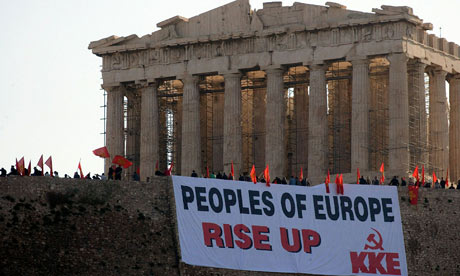
Red is the color of the decade


A beautiful picture I just found at Ciudad Futura. From Athens, last Saturday.


Thursday, May 6, 2010

"Those lazy Greeks!"


The Imperial media is spreading the lie that Greek workers are lazy and overpaid. The reality is, of course, very far from that insulting propaganda:


Greeks work on average 42 hours per week, while the EU average is 40.3 and the Eurozone one is just 40 hours.

Private sector workers are also extremely underpaid in Greece: 803 euros per month, including taxes and social security payments. You get more than that in many EU countries for picking your nose! The lowest wages in the Eurozone are well ahead of those figures, at least 1400 euros in the Netherlands for example.

Pensioners only become such at ages slightly above the EU average, 61.4 vs. 61.1 years, but do so with pensions that, before the current draconian measures, were already insultingly low: 750 euros/month, while in the Netherlands is 3200 euros instead.

At least 30% of Greek workers are totally outside of the social security system anyhow, in a black market area that certainly does damage to the ability of the government to meet its social obligations and can only be harmful to workers themselves. In comparison the EU average is of 5-10%.

Greece public service (22.5% of workforce) is large in comparison with Germany (14%) but rather modest in comparison with other EU countries: 30% in France, 27% in the Netherlands, 20% in the UK.

The 13th and 14th month salaries are not any "extras" but just a method of dividing the yearly salary to stimulate consumerism in the holiday seasons. A similar method is common in Spain. The salary is anyhow defined in yearly terms and the only difference is that it is divided in 14 units instead of 12.

While the wages and working conditions in Greece are extremely low for EU standards, price have not stopped rising. Greek workers have to buy at German prices while having half the salary of Germans. A somewhat similar situation happens in Spain and other low wages Eurozone countries: it is the euro-prices which won't allow ever to lower salaries because after all, you want a salary to pay for your living, so it has to be big enough for that.

In Greece a packet of cereals costs on average 2.86 euros, while the same packet costs 1.89 euros in the UK (51% cheaper than in Greece) and in France 2.25 euros (27% cheaper). Greeks buy a toothbrush for 3.74 euros while in the UK the same toothbrush is sold for 2.46 euros (52% cheaper). A pack of soft drinks that costs 3.1 euros in Greece, costs 2.76 in Belgium, 2.3 in France and 2.68 in UK. The most prominent examples are a cup of coffee or tea: in Greece the average price is between 3 and 3.5 euros, more than twice the average in most European countries.

Greece does not need lower salaries, quite obviously. It needs cheaper prices if anything. You just can't lower salaries under the cost of living.

More at Marxist.com

Wednesday, May 5, 2010

Greece and Europe can only do one thing: a Revolution


As the pace of the Greek revolution speeds up, with the first casualties in a burned down bank office and the Greek Parliament besieged daily by the angry people, one may wonder why is people so angry. After all, according to the Imperial media, it's all their fault and the government is doing what it must do to save the nation.


The answer is logically that people is not so naive: they have barely, if at all, benefited from the bad practices that have triggered the crisis (rather the opposite) and they have yet to see any of those white collar criminals being brought to court and their properties seized to help pay the national debt.

The answer is that the whole nation is being held for ransom for the corruption of a handful of oligarchs and, what is maybe even more important, their international accomplices.

That's simply not acceptable.

And obviously this means a regime change in Greece: one that can effectively arrest the criminals and issue the appropriate international capture orders for their accomplices in Washington and Brussels.

One that has no problem in nationalizing the product of past years' robbery when possible.

One that dares to declare bankruptcy if need be.


So Greece is set for a revolutionary regime change and that is most unlikely to be prevented because there is no alternative. The only question is the pace and exact extension of this change.

But what about the rest or EU. EU can live without Greece but can it live without half of EU members? Because the speculators' aim is already set to other Eurozone states. It seems by the signals that the Iberian peninsula will be next but Italy, Ireland and the very UK (out of Eurozone but of great importance by its size) are clearly in the agenda.

The European Union today.
Eurozone in blue, comitted to join the Eurozone in green, special statuses in red, non-EU states using the euro in purple.
Stripes signify those states clearly targetted by the Transnational Capital to be ripped off in a "controlled demolition" (Latvia included because it's already suffering the IMF blackmail).
Original map from Wikipedia (modified).

The goal is to recycle these countries into cheap labor zones for the Euro-Global Capital without these vampires losing a cent in the process. The 'problem' is that the plan may go awry and trigger a pan-European revolutionary process.

Maybe the level of popular organization is not yet high enough but, even if the Transnational Capital achieves its goals it can only be a temporary situation as the rage they will leave behind in some of the more privatized and less well-off states of EU, where people do already struggle to make ends meet, cannot really be contained in the mid run.

While the Greek spending spree may have been going on before the advent of the Global Crisis, in the rest of countries public spending has actually been a reaction, a much needed one, to this disintegration of the Capitalist World Order. Claiming that states have to cut spending in the midst of a general crisis is totally absurd: states must increase their spending to put up for the inability of the so-called "market economy" to generate jobs and salaries, which are after all the only ones that will generate demand for the beleaguered private companies, at least for most of them.

Cutting public acquisitive power is not an option, not even for German capitalists: it's a suicide.

If the European Bank must print more euros, so be it. If the euro has to be devaluated, that is not a problem but in fact good news for European companies, which would see their international competitivity improved greatly by such measure.

But EU institutions are not working for the good of the European common citizen (or should I say denizen?), EU institutions are only working for the good of some privileged elites and they don't care at all about the common European, not even about the common European small company. Only huge multinationals matter for them.

This situation obviously demands a regime change at EU level. A regime change that redefines EU as a social federation and not as a capitalist one, a regime change that establishes EU finally as a representative democracy and not a mere bureaucracy at the service of the transnational mafias.

It may take some time but it will be done. The only alternative is for EU to disintegrate completely and its various states (or fragments of states in some cases, as Spain for example is not going to survive this one in a piece, nor will the UK) let to fend off alone in the vast ocean full of sharks. That's not a realistic or at least desirable goal and it's something that goes against the common feeling of nowadays Europeans, for which a European union, this or another better one, is a default.

So the only alternative is pan-European revolution.

Let's do it, do you have a better plan for today, my dear unemployed bored and desperate reader?

_________

Note: you can read the declaration of a colleague of the dead bank workers blaming the deaths on the bank owners at Occupied London (in English) and Indymedia (original in Greek). Triggered by this tragic incident, the Greek bank workers are going to strike tomorrow even if the corporative guild forbids them to do so.


Monday, May 3, 2010

Greece and Spain like Latvia, Portugal to tax the rich instead.


There's a nice article of economist I. Esnaola at Gara today, illustrating how the "rescue plan" of the IMF-EU tandem is a recipe for disaster. It is exactly the same "medicine" Latvia got in 2008 and things have only got worse for them since then: growing unemployment (even higher than Spain!), "growth" of -18% in a single year, and all without being able to stop public deficit from running wild at all.


That's exactly what they want to impose to Greece, just that the Greek people seem much less sheeply than Latvians and may just send IMF, EU and everything of the like to the trash bin in the process.

Spain does not seem to need an IMF package: it is already applying one: on its own will nearly all state income is reliant on a growing VAT (consume tax, now to be raised to 18%) and from tobbacco, alcohol and gasoline special taxes. Meanwhile the wealthy enjoy the best deals, what makes Spain unable to collect enough money for its expenses.

Instead, the only conservative government of the three South European countries, that of Portugal, has decided to tackle the tax crisis by raising taxes to the wealthy segment, up to 45%. It's clear that they are the only ones who know how to deal with the budget crisis: redistributing and not just loading the scales against the working class even more.

Saturday, May 1, 2010

Postcards: May 1


Oddly enough I won't begin with a demo but with a tradition kept in some Navarrese mountain areas: Raft Day.


The activity re-enacts the hard job of the lumberjacks of the past and how they brought their produce downstream to the mills.

Of course the hot spot of the day was Athens, where demonstrators threatened to take a Parliament that has lost all legitimity:


But everywhere, from Macau to Gasteiz, from Kathmandu to Moscow, the leit motiv was the same: not to austerity measures, workers don't have to pay for the Capitalist crisis.

Photos from Gara.

60% of Greeks wish for 'a genuine left-wing party'


Interesting review of the situation in Greece
by Fred Weston at Rebelión[es].

One one side he makes an analysis of the positions: the working class, the majority of the people wants some sort of radical change and is not willing to put up with the IMF-EU impositions that would cut pensions by even as much as 50%, among other Capitalist measures of the like of those imposed by Pinochet in Chile. The tamed labor unions and established "left" parties such as the Communist Party are just letting pressure go with limited demonstrations but don't seem willing to corner the "socialist" government and rather prefer to just pose the anger in the vague hope that the government will step back.

The problem is that the government cannot step back. After all social-democratic parties such as the PASOK are nothing but violin ones: supported by the left but played by the right. And making genuine left measures such as embargoing the debt and nationalizing companies and banks is well beyond their imagination and their real positioning.

Then Weston analyzes the opinion polls, which show that the PASOK is sinking but to the benefit of absolutely no other party: both the right (culprits of the ripoff and accomplices of the IMF-EU neocolonization) and the established left (the communist KKE and the 'new left' Syriza) remain static in vote intention. Here is where we come to know that 60% of voters would want 'a genuine left party' to vote for.

Easier say than done I guess but it's clear that there is popular demand, that the people is ready for such thing as a true socialist party that can face globalized Capitalism with some dignity for the good of the people.

The conditions are there: revolution is awaiting in Greece. How will it manifest.

PS- keep also an eye in neighboring Albania, where the right has rigged the elections bringing multitudes to protest in the streets of Tirana. We are now standing on a moment of uncertainty when everything becomes possible, except the old regime. It is impossible to predict how the situation will evolve locally and globally but we should expect many surprises and sudden twists. But of course expect growing discontent everywhere coalescing more or less rapidly into revolutionary options, which may eventually come to power.

Greece: why are not the thieves behind bars?, their properties confiscated?


Day after day we read about the Greek crisis and its ramifications. We know by now that a good deal of the responsability behind this case was that of a corrupt government and companies.


But we know little more about that. Some anecdotal details but not a word about any of the culprits being brought to trial or his/her property expropriated to pay for some of the national debt they used for their own benefit.

This is the most outrageous element of all the process: some oligarchs have brought a whole nation to heavy indebtedness and they are not even charged?! Their names are almost not mentioned, their practices nearly not inspected, their wealth (obviously the product of such anti-patriotic larceny) not even considered.

What's wrong?

It's as simple as this: some people and companies scammed a whole nation, they must be held responsible for it and their assets must be returned to the nation so it can face this challenge form a better position.

Yes or yes?

Wednesday, April 28, 2010

Should Greece declare bankruptcy?


It may be a realistic option considering the alternatives promoted by the FMI-EU tandem. Anyhow, after the BB+ rating by S&P it will not make much difference.


BBC reproduces a demonstrator's opinion, a bank worker's one to be more specific:

We should opt for bankruptcy. Goldman Sachs, Deutsche Bank, Wall Street, they lent us the money. (Far better) they lose their money and people don't lose their jobs.


But the case is: can small Greece, with only 10 million inhabitants and not so many natural resources other than sunny islands for turism survive alone? How?

I have little doubt that the Greek people have the organization to go in revolutionary spree. They may be the only ones in Europe in fact in such excellent revolutionary conditions. But, even if they succeed, what then?

A more realistic case may happen in Iberia, a far larger area and next on the list for catastrophic FMI-dictated austerity packages. Iberia does not have such a large well organized class struggle as of now but, in the case it would, it could indeed hold a very viable economically autonomous area (Spain alone is right now the 9th global economy by GNP, holding 2.5% of the World's GDP (nominal), almost half of Germany's). Even in the case of international ostracism it can find some economic space working with Latin America, largely a red zone already, for example. Geographically closer Arab countries such as Lybia and Syria are also potential partners for any ostracized Mediterranean power.

Of course, there are two problems:

One is the tight rope of the euro, which should be in fact the main problem to address at pan-European scale (from a liberal perspective), devaluating it significantly in order to boost exports, reduce imports and secure jobs and public services. The North European gang, lead by German Capital, is however getting too many benefits from this situation and unable to react fast enough to to protect the system they have created for their benefit. The fact that Germany exports mostly to EU countries says it all.

The other is military intervention. If anyone believes that the Empire is going to let countries leave without intervening, he/she is of course very wrong. The first line is indeed the local armies and police forces, normally with strong right wing, fascist-like tendencies. But they can succumb to popular pressure and nationalist feelings. They can indeed also be defeated by political ways or their intervention trigger organization of guerrillas and such. The second line is direct military intervention by NATO (with similar or even worse results).

Whatever the case, the foresight for the next years is drastic increase of class tensions and possibly revolutionary changes (or alternatively anachronistic, and hence doomed, fascist attempts) in Southern Europe (among other places: the oven is very hot everywhere).

This situation would be unthinkable just a couple of years ago but now it appears as almost unavoidable. Thank Goldman Sachs and the other global bankers for this.

Next the sight stops on other even more sizable countries: Italy, France, the UK... none of them too buoyant. A very bad scenario is also ripe for Eastern Europe (Latvia is the most outrageous case but the rest are not well off either) and even Northern Europe (Iceland could not scape the voragine either).

Sooner than later, Germany itself will have to face the consequences of this global disaster. Best would be to act at European level but the EU building is frail and patchy, undemocratic and controlled by the big corporations. It's not an instrument of change but of continuity.

However class organizations should coordinate and direct the fights at this level, as the state level is obviously too limited to produce results. So far workers in Greece, in Latvia, in the UK, in Italy... are fighting separate battles against the same enemy. This may help the collapse of EU but is not really an effective way of struggle. We should see masses of people striking at Madrid, Paris and Berlin in support of Greek workers... but it seems that this people's facet of Europe has yet to be created.

It will eventually because nowadays state governments are very much powerless and irrelevant, so the action has to be taken at pan-European levels, if not at global ones. But this stage has not yet arrived and hence it's easier to witness a collapse of EU than a pan-European revolution. Still I'd prefer the latter, strongly so, and I think it is the way to go.

Thursday, March 25, 2010

Upper Paleolithic 'Greeks' built walls against cold


Some 23,000 years ago Europe was plunging into the
Last Glacial Maximum and, of course, it was cold, very cold. Even in sunny Greece, it seems.

So the inhabitants of a Thessalian cave, near the town of Kalambaka, invented masonry and built the first wall ever, not to protect them from any fleshed threat but from a much more insidious enemy: cold.

From Yahoo News, via Archaeology in Europe.

Saturday, March 6, 2010

Greece becomes a colony... in exchange of nothing


Greece has got just "good words" (and "not a cent" as the German economy minister put it) in exchange of ceding the control of its whole economy to the IMF and Brussels. The, ahem, "socialdemocratic" government is now approving the so-called "austerity measures" which include massive cut of social spending and high tax raises.

Naturally, this has caused some serious street warfare between police and revolutionaries, reminding of the serious conflict that took place last winter, still under conservative rule. Though divided, Greece has one of the strongest revolutionary traditions in modern Europe, so I still have hope that the people will overturn these abusive ultra-capitalist and colonialist measures for which, in the very words of PM Papandreou, they did not vote the socialdemocrats to power.

James Petras, whom I just now realize is Greek by ancestry, declared to Uruguayan Radio Centenari that "the worst in Greece is what the imperialist European countries like Germany, and also the USA, demand: that the control of the economy is transfered to the IMF, Germany and France. This is the colonization of the economy".

Source: Gara.

Saturday, February 20, 2010

Greece accuses US and British speculators, Greenspan involved


It has been known yesterday that the Greek intelligence services have discovered that four multinational corporations based in the USA and UK were behind the artificial devaluation of its bonds, selling them "massively" and "buying them again at reduced prices at the end of the day". This information was published yesterday by To Vima newspaper (though I gather it from Gara).

The financial corporations accused are: Moore Capital, Fidelity International, Paulson & Co (these three from the USA) as well as Brevan Howard from the UK. All them are described in Wikipedia as "hedge funds", so it seems just another case of speculative attack by the usual financial criminals against the real economy. It is noticeable that former Fed chairman Alan Greenspan is nowadays "adviser on economic issues and monetary policy" for Paulson & Co.

So guess I would not be too wrong if I'd directly blamed Greenspan for the financial attack against Greece and more in general for the speculative attacks against the periphery of the Eurozone. However blaming the speculators alone would be naive, as it's obvious that EU played it wrong when it did not provide the euro with the appropriate political resorts and is playing it wrong now when it does not allow for a devaluation of the european currency, which would only help the continental economy, favoring much needed exports.

Prime Minister Giorgos Papandreu explained that these attacks are not directed against just Greece but that have a further goal: the euro.

Meanwhile the class conflict in Greece, sparked by the FMI-style draconian measures, is reaching extremes that will probably force a rethink of the policy because the strike public workers of the customs sector is leaving Greece without gasoline and other first need products. This upcoming wednesday a general strike has been called.

Monday, January 11, 2010

African-style quartz tools in Crete from 130,000 BP


From Science News (found via Archaeology in Europe).

Archaeologists have found quartz tools in the Mediterranean island of Crete, dated to c. 130,000 BP, that resemble the type of tools used in Africa c. 800,000 BP (Acheulean I presume). For that reason they speculate, in spite of the late date, that the makers could have been part of the Homo erectus para-species, rather than H. sapiens or H. neanderthalensis, who lived nearby anyhow.

Whatever the species, what this finding makes clear is that ancient members of our genus were able to navigate, as Crete has never been connected to the mainland, since the Mediterranean Sea exists.

However, and very cautiously, I'd consider the possibility that they could be Homo sapiens, who are known to have lived in Palestine and North Africa not much later than this date.

__________________

Update (Aug 19): Julien Riel-Salvatore mentions in his blog that the paper on this matter has finally appeared (LINK, pay per view). Importantly, he quotes:

The dating of the Palaeolithic in the Plakias region presents a considerable challenge, not least because of the long period of time that may have elapsed since the occupation of the earliest sites, during which postdepositional natural processes may have obscured the archaeological record. Additionally complicating the issue are the small number of sites, the lack of excavation, and the impact of modern development on the area, which has destroyed many sites.

Several approaches to dating were attempted, and our research on this topic continues. At Preveli 2, east of the Preveli Gorge, Palaeolithic artifacts are associated with a flight of marine terraces resulting from relatively high sea levels in the Pleistocene that were preserved by subsequent rock uplift. The lowest late Pleistocene marine terraces resulting from high stands of the sea at Preveli (14 ± 1 masl) and Schinaria (21 ± 1 masl) have 2-sigma calibrated radiocarbon ages of 45,400 ± 1,600 and 49,120 ± 2,890 years b.p., respectively, and are correlated with Marine Isotope Stages 3.3 and 3.4, both eustatic high stands. The higher terraces, at 59 and 96 masl, are unquestionably older. How much older? Assuming similar rates of rock uplift (1.4 ± 0.1 m/kyr) determined from the age-elevation relationships of the dated terraces at 14 and 21 masl, it is possible to estimate the approximate ages of the terraces associated with artifacts. This correlation provides an approximate age for the lithic artifacts. The higher terrace, at 96 masl, may belong to Marine Isotope Stage 5, possibly early 5e, ca. 110,000 b.p. Artifacts associated with the terrace at 59 masl could correlate with Marine Isotope Stage 5a, ca. 70,000 b.p. It should be stressed that these are rough approximations and these ages are probably minima that represent a terminus ante quem. If the uplift rate is changed, the terraces and the artifacts associated with them could be much older.

At Preveli 3, Preveli 7, Timeos Stavros 1, and Schinaria 5, Palaeolithic artifacts were found in outcrops of paleosols that exhibit the characteristics of the oldest maturity stage for such features, that is, Maturity Stage 6, or in geological terms, Marine Isotope Stage 6. Together these observations suggest an age of ca. 190,000–130,000 b.p. and serve as a terminus ante quem for the artifacts embedded within them. The stone tools were incorporated in the paleosols as part of a process described by Runnels and van Andel in Epirus: “the top of the Bt horizon itself would move gradually upward as a result of slow deposition, so engulfing any artifacts laid down on former land surfaces above it.” In other words, the Bt horizon, especially as much of the clay comes from eolian sources, will increase in thickness through time, slowly engulfing clasts, such as stone tools, that were formerly in the A horizon.

In sum, the dating of the Palaeolithic sites is based on geological data derived from the study of marine terraces on the southwestern coast of Crete and our identification of paleosols, and these data place the Palaeolithic lithic artifacts firmly in the Pleistocene, ca. 130,000 b.p. or earlier. The chronology can be further refined, however, and a dating program currently in progress may provide data for doing so.

Sunday, December 13, 2009

Greek Anarchists warn of the return of the Junta


While I think this is naively ignoring that the same fascist trend is way too apparent in all Europe (just ponder
the violent repression at "Hopenhagen" against peaceful environmentalists as example), it's still very worth mentioning, none the less because there seems to be already missing people, which is one of the most worrisome indications of Pinochetism.

The last days have witnessed unbelievable orgies of the Greek Military Junta.

Examples:

1) Officials with fire weapons in demonstrations

2) Police agents in motorbikes making raids against demonstrators

3) Police deployed behind peaceful demonstrators, indiscriminate and wild arrests

4) Made-up accusations, as the supposed murder attempt against the president of the Pritanea

5) Lots of vague accusations in order to dissuade youths and adults

6) Closure of schools with the pretext of swine flu and beatings of students who tried to arrive to them

7) Masked secret police kidnapping demonstrators

8) Increased level of collaboration between the Golden Dawn neonazis and police

9) Secret meetings between Chrysohoides [minister of "citizen protection"] and directors of TV channels and journalists to determine how to show the information in the media

10) Secret cameras, helicopters flying all the time

11) Zero tolerance: a rotten orange or a stone on a bank have become a serious crime and a pretext for a police attack

12) Prohibition of demonstrations and meetings in the most dynamic areas, with major police intimidation and scandalous investigation lines

13) Hacker attacks against Indymedia, squatter pages and TVXS (television without borders), suppression of comments.

14) Invasion and preventive arrests in many self-managed spaces

15) In an Orwellian style, anarchists and rebels are called "fascists and nazis"

16) Suppression of the academic asylum, as in the military dictatorship

And much more.

Some of these things only happened before in rare cases, while others happened during the military junta (1967-74), while yet others had never happened before, only now. Never before all this had happened together in such a short space of time!

It seems that the confrontation happening here, that they try to hide, the Indomitable December, has the power to activate a new emergency decree, a new "Plaster Model" [the pronouncement of the Junta in 1967].

These moments are more than historical. We are witnessing for the first time an attempt to impose a coup by the fascist Police. If they are able to commit all these crimes in a "parliamentary democracy", this Junta is not different and we all have to realize that. The Anarchist slogans on the streets are beginning to say that without twists: "Down with the Junta!"

There is complicity of attorneys, deans, upper classes, bourgeois media and the police, and we yet do not know what other local and foreign forces have been enlisted. We are beginning to hear of missing people, the climate is as tough as under the Junta.

This is not the time to remain silent! This is not the moment to relax!

Everybody to the streets! Sittings everywhere!

Please, help to bring down the Greek Military Junta!

The regime goes straight back to 1967!

Wake up!

Source: Alasbarricadas.org

Saturday, October 17, 2009

Bronze Age Greek city surveyed underwater


Just a heads up. The city of
Pavlopetri, now sunk off the coast of Laconia, southern Greece, has been surveyed by submarine archaeologists, revealing a long history dating to c. 2800 BCE, long before the Mycenaean period. It was probably a major trading hub and the analysis of the many discovered artifacts (pottery, etc.) is now being take care of.

The earliest dates may be the most interesting ones, in my opinion, because they correspond chronologically with the pre-Indoeuropean Cycladic and Minoan cultures, of which only so much is known. However we will have to wait until the archaeological work is finished.

More at Science Daily, including a video and a podcast.
.

Monday, December 8, 2008

Greece burns in hope


Watching the news (
example) and all seems eclipsed by the events in Greece: after three days, riots persist with full force. And are not anymore limited to the largest cities.

I can't but express my admiration for the Greek people and the antiauthoritarian faction within it, surely one of the strongest and best organized in all Europe. It brings me memories of the riots of 1991, that happened when I was visiting Thessalonikí (though the action was then all in Athens), but what really encourages me of all this is to see that after 17 years the capability of Greek antiauthritarians to challenge the system has not diminished at all. While it's probably not probably the moment yet, I must say that this is the substance of which revolutions are made and that I am really glad that somewhere in Europe there seems still to be such a strong class conscience and people power to resist Liberalism.

__________________________________________________

Expansion: what do Spanish-language antiauthoritarian media think?

Based on the following news and opinion media: Eutsi, Nodo50, Kaosenlared...

Maybe the most interesting stuff is on why these riots: obviously the trigger was the murder of a student by the police (not the first one certainly) but, as they mention at Nodo50, this is not something that 100 anarchists can set up, it implies widespread anger and frustration among huge sectors of the population. There's a major general strike called for next Wesdnesday and the speculation is that the riots won't settle before that day in the best case; the strike itself is an outburst of massive discontent, specially on light of new Liberal measures imposed by Brussels, like allowing private universities or privatizing certain airlines. Also another element appears to be the rise of the far right, whose combat squads recently killed a Pakistani bringing anarchists to clash with them in the streets of Athens. One of the triggers was precisely solidarity with 15 immigrants who are on advanced hunger strike demanding civil rights.

And certainly one of the most direct triggers was the policial challenge, who took up the Athenian neighbourhood of Eskarja, context in which the cold blood murder of a young anarchist happened.

There's also an interesting meditation by Kilnamen in Nodo50, where s/he compares the somewhat pitiful situation of Iberian anarchism, almost unable to react to a similar cold blood murder some months ago, and the admirable health of Greek antiauthoritarians or even the recent Italian uprising in a similar context. The author calls for a more direct approach of confrontation on daily basis and less factionalism to feed up again the Iberian libertarian movement and the much needed hope of revolution.

Thursday, May 22, 2008

Greek Y-DNA review at Dienekes


Source:
Dienekes: Exploring Y chromosome frequencies in Greece.

This is my cartographic visualization of his data:


And my opinion is that:
  • J21a is basically Cretan. Also at Larissa that seems to have the same clade distribution than overall Crete (and reminds me of Homeric mentions of Pelasgians in both lands)
  • E3b is dominant in mainland Greece (exception made of Agrinion, in the west, and already mentioned Larsissa), with some less important decrease in Macedonia.
  • R1a is most important in the central North (west Macedonia and Kardhitsa) and also in two spots of Crete that were demographically disturbed by the Venetians historically.
  • R1b and I seem to show no or very little structure.

Dienekes mentions a J2a1 vs J2(xJ2a1) negative correlation that may be real but in any case seems pretty secondary overall.

Anyhow, read the original post. I just wanted to post the map.

Thursday, May 1, 2008

Lesbians, lesbians, the Greek island and Sappho.


Ridiculously enough the Lesbian authorities, those of the Greek island of Lesbos, near the Turkish coast, have begun a crusade against lesbians in Greece and around the World. They want to banish the use of the term lesbian, to refer to female homosexuals.

But the fact is that the term is much older than modern homosexual liberation movement: it dates from antiquity, because of the quite apparent bisexual tendencies of the island most famous poet ever: Sappho. Ironically, Sappho herself also suffered from that Lesbian (that not lesbian) intolerance in her life, as she was exiled to Syracuse c. 600 BCE.


Sappho as imagined by Charles Mengin

Her romantic poetry (preserved only fragmentarily) makes allusions to male and female lovers and crunches indistinctly. For that reason, since classical times, the terms sapphic and lesbian became synonim with female homosexuality, meaning that is still in use in many languages.

Well, considering all the trouble Greeks are making on terminology (see the absurd dispute on the name of Macedonia), any day the very use of the nouns pitagorean, Alexandria, aphrodisiac, olympic and even strategy will be challenged on grounds that they are "historical Greek terms that nobody else has the right to use". Are you unlucky enough as to have a Greek name like Alexander or Hercules? Maybe you will be prompted to change it. Do you follow some approximation of an ancient Greek philosophy like Epicureism, Stoicism or Platonism? Maybe you have to redefine your ideology in non-Greek terms. What about telephone and all other common neologisms construed on Greek words? Maybe an acronym for long-distance-talk-device, like LDTD, will have to be used instead...

Pathetic. Instead of being proud of their most famous citizen, Lesbians, or at least some of them, are making a fool of themselves.