New blogs

Leherensuge was replaced in October 2010 by two new blogs: For what they were... we are and For what we are... they will be. Check them out.
Showing posts with label stateless nations. Show all posts

Monday, September 27, 2010

Mapuches take UN see in Chile


This happens after two days ago they briefly took other UN offices in Santiago (International Work Organization and Economic Committee for Latin America and the Caribbean). 

As the hunger strike of Mapuche prisoners goes beyond the 70 days and government and prisoners failed to reach an agreement last Friday, native organization Maulen Huanchu took yesterday the offices of the United Nations in Santiago de Chile with intent of remaining there indefinitely.

Source: Gara.

Thursday, September 2, 2010

Mapuche prisoners: 52 days in hunger strike


The hunger strike of Mapuche prisoners in Chile reaches today the 52nd day. In practical terms this means that they are beginning to notice the hard effects of the fast, losing muscle tissue and beginning to affect major organs as the liver, kidneys and heart. Their life is at risk.


The strikers demand the abolition of the anti-terrorist law by which they are being judged, under accusations of attacks and road blockades demanding that their ancestral lands be returned to the Mapuche communities.

The government is showing signs of weakness in this nonviolent struggle, and is asking, since tuesday, that the prisoners stop their hunger strike on promises of law reform. This announcement was welcomed by Mapuche organizations that demand hurrying up the procedure.

The strike began on July 12 in the prisons of Concepción and Temuco and has been joined by other prisoners gradually. The anti-terrorist law is a fascist law passed by Pinochet dictatorship and allows the imprisonment of suspects without charges for unlimited periods. If found guilty, the penalty is multiplied by three automatically.

The law is seldom applied to white Chileans but is systematically used against Mapuches, who are fighting for the return of their communal lands and their right to self-rule. The independent Mapuche polity was invaded by Chile in the 19th century and has no recognized autonomy.

The Appeal Court authorized prison guards to use forced feeding on striking prisoners.

Source: Gara.

This fight has, as so many other important news, got no room in mainstream media, either in Spanish or English. Many wonder if this happened in Cuba or Venezuela, what kind of media reaction would it trigger. This in turn causes deep concern for the situation of freedom of speech and journalism in general in the so called Western World. And this is not the only case: what do you know of the real situation Louisiana oil spill and its real effects on the people living at the Gulf of Mexico? If you are only following mainstream media: nothing at all! A very bad situation for information freedom the one we have.


Tuesday, August 3, 2010

How West Sahara was given to Morocco


There is a rather interesting historical review
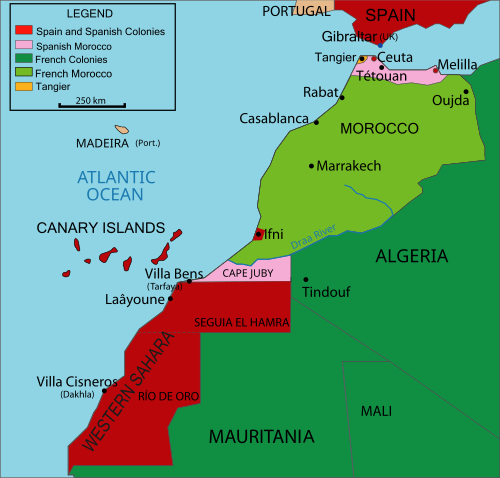
at Le Monde Diplomatique (in English) on how the then Spanish provinces of Saguía el Hamra and Río de Oro (then legally as much part of Spain as Madrid, by the way - so good for the unalienable unity of the fatherland) ended up in Moroccan hands with the blessings of the USA and France.

Map of the colonial West Sahara and Morocco in the mid 20th century (from Wikipedia).

Apparently the USA saw Algerian interest in supporting the Sahrawis as part of the Cold War geopolitics, so, by default, it supported Morocco discretely. Spain was reluctant to yield the territory and specially if it appeared they had been kicked out, however it eventually yielded to pressure in the context of an uncertain regime change.

The appointed Sahrawi council (Yemaa or D'jemaa) however declined to play the rubber-stamping role that the USA, France, Morocco and Mauritania had devised for them and instead declared its own dissolution and transfered its power to the recently created POLISARIO Front, which proclaimed the Sahrawi Arab Democratic Republic.

To Moroccan disillusionment the African Union Organization, as well as most African states, also recognized the rebel republic and the weakest part, Mauritania, soon yielded to Polisario attacks and recognized the country's independence in 1979. Morocco became isolated in Africa. However, later on, the Moroccan tyranny (it's a police state where people fear speaking freely, I can tell you), with massive support from Saudi Arabia, the USA and France, managed to build their version of the Great Wall, forcing the Polisario out of most of the country and preventing them from attacking the much coveted phosphate mines and foreign fishing ships that had no authorization from the Republic.

All this only barely dealt with in the Le Monde Diplomatique article but it is still interesting to read to understand how the imperialist interests of the USA and France played in favor of the last absolute monarchy of Africa... and to read how Kissinger view the issue on his own words.

However, in spite of a two decades long cease fire, the wound is still open and the war might start again at any moment. Moroccan official maps, of the kind you find only there, have no borders south of Oujda, as the fascist monarchy claims all the desert for them: a good bunch of Algeria, all Mauritania and, who knows, maybe even Mali.

Further reading (in Spanish) at Sahara Libre, where you can find news of the ongoing conflict such as the violent repression of striking workers yesterday, the long hunger strike of Dr. Abbas Mohammed Chej Sebaj or how lobbyists in the USA are trying to bring the now unemployed Louisiana fishermen to the rich Sahrawi banks.

Thursday, February 11, 2010

Kurdish journalist jailed


A Turkish tribunal has sentenced Ozan Kilinc, editor of Kurdish-language newspaper Azadiya Welat, to 21 years for "support of the PKK". His actual "crime" seems to be to have dared to mention or allow to mention the illegal (but highly popular) party's name in the newspaper, allowed mentions to Abdullah Ocalan as "leader of the Kurdish people" and not licking the boots of the Turkish conscription Army by calling its casualties "martyrs" as seems to be standard among Turkish media.


Ozan Kilinc (image from Azadiya Welat)

As BBC reports, this kind of brutal repression seems way too common: a 15 year old girl sentenced to 8 years for hurling stones to the police, a journalist asked 32 years for writing a book critical of the police investigation in the murder of another journalist...

In other words: more or less like in Spain. They should definitively allow them into EU, but first let Basques and Kurds get out of it.

Saturday, February 6, 2010

Mapuche nation creates Parliament


In January 29th, representatives of the Mapuche communities, accompanied by their lawyer, went to the presidential palace in Santiago de Chile to inform of this constituent action that they hope is not again accused of "illicit association".


The Parliament has as goals to be active participants of the constitutional recognition of the Mapuche nation and the implementation of convention 169 of the International Labour Organization.

For Jorge Huenchullan, Werken (president) of the new Parliament says that its creation means a new uprising of the Mapuche communities that are really in the struggle for land recuperation and reivindication and for regaining the civil rights that have been denied to the Mapuche in Chile. He states that the first goal of the Mapuche Parliament will be to expel the logging companies from the lands they have usurped, as well as the colonists in Mapuche territory. They plan to do so by legal means.

They also intend to work against the political repression they are suffering with indiscriminate arrests and even murders.

They are realist enough to acknowledge that the Chilean government has no intention of solving the conflict in any way that might favor the Mapuche nation. They denounce that the new Chilean president, Piñera, is a repressor who has direct interests with the logging companies and the death squads they maintain.

Source: Rebelión.

Thursday, January 7, 2010

National identity in 21st century France


Maite Ubiria reviews today at Gara about the many unsolved problems of Jacobin French identity with motive of the half centenary of the death of Albert Camus (author of The Stranger, among other titles) and the failure of the institutionalized debate that President Sarkozy has tried to propel personally on French identity.

Sarkozy pretended to offer some sort of state funeral to the illustrious writer and philosopher but the Camus family fought against this and hence the Algerian-French author will remain buried at his modest but cosy tomb at Lourmarin, Provence.

The figure of Camus is arguably relevant to this absurd debate on French and European identity that some percieve as threatened by the every day more visible Muslim community, turning to an obsolete Christian faith that anyhow nearly nobody professes anymore. The stubborn atheism of his character Mersault even in the death row impressed me in my youth as did his strange honesty.

While Sarkozy insists to empty halls about the Catholic identity of France, the very French identity of the hexagon is at the stake. A plurality of opressed nations within the French Republic declined to participate in this absurd scenification of a debate: Caribbean creoles, Corsicans and others expressed their disdain.

From the French Caribbean colonies (Guadaloupe, Martinique, etc.) the mayor of Le Prechêur (Martinique), Marcelin Nadeau, complained that we have our language but the territorial collectivities we have cannot define its development in our schools nor have competences to determine what our children learn. The unemployment in these islands is of some 30% and every year a thousand of arable lands are lost largely because of tourism and real state speculation. For Nadeau another important pending issue is the recovery of the memory and historical reparation (for colonialism and slavery). As illustrative example, the case of acclamated Martinican director Guy Deslauriers, whose latest film The Aliker Case, on the execution of a Martinican militant of the 1930s, was rejected any subsidies by the Frech ministry of culture (that is much more generous to metropolitan authors) and could only be produced thanks to popular subscription.

This issue of memory is also central to Corsican grievances. While France claims to be the motherland of Human Rights, the fact is that it was in Corsica where such ethical construct was first written and promulgated in Corsica by national hero Pasquale Paoli, almost totally ignored in French versions of history books. This is also the case of the many Corsican resistents to fascism and the ill-known fact that they managed on their own to liberate the island from Italian occupation already in 1943. But their hero and martyr Jean Nicoli is nowhere to be found in French history books used in schools compulsorily.

Brittany is another of the aggraviated nations within the Republic. The list of offenses is similar but in the Breton case there is not even a minimal autonomy. Emile Granville speaker of the Breton Party and liutenant mayor of Redon states that in view of the French denial, Bretons can only try to bypass the state and attempt to be acknowledged as what they are at European level.

For the smaller nations (Basque, Catalan), whose nationalist forces are gathered in the Federation of Regions and Peoples, the problem is about the same. Its speaker Peire Costa denounces that this pseudo-debate is only a propaganda attempt in favor of cultural uniformity and centralism, which are in fact the problems that hide behind it. For Costa, it is just nothing but a Jacobin assault, orchestrated by the summit of the state, that has as main target the diversity generated by immigration but that is also an assault against the so-called regional languages and cultures.

Apart of the dominant French ethnicity, the French Republic includes the following distinct nations or ethnically distinct territories (more or less):

In Europe:
Non-european colonies with some population:
Corsica and the other overseas colonies have some minimal and variable autonomy. West Flanders and the Northern Basque Country have no recognition at all, not even at department level.

France, Spain and Italy epitomize the urgency for self-determination of the the peoples of Western Europe, much as Kabylia, Kurdistan and Palestina do for the so-called Middle East. While so many nations have achieved self-rule in the last century in Central and Eastern Europe (from Poland to Kosovo), the problem of decolonization in West Europe remains much of an open wound.

Wednesday, December 16, 2009

Two Kurds killed in protests


The ban of the Democratic Society Party (DTP) has only brought more confrontation in Turkey: Kurds, who are 15-20% of Turkish citizens but whose homeland is in the southwest, crossing also into Syria, Iraq and Iran, have reacted angrily at this decision, taking to the streets.

The protests ended in violent repression at Bulanik, where two people were killed apparently by a shopkeeper with an AK-47, reports Al Jazeera.

As Zeina Khodr reports at The Europe Blog of Al Jazeera, the banishment of the DTP has only caused further legitimacy for the Communist Party of Kurdistan (PKK), which has led armed struggle against Turkey for decades now:

I met a group of old men drinking tea at one of Diyarbakir's cafes. They seemed to have the answer to that question.

"Now that they banned the DTP … our real representative is the PKK. The PKK is our party and our leader is Abdullah Ocalan. He was the person who woke up Kurds to their rights," Hajj Moustapha Alay told me.


See also my previous entry on the latest developments at Kurdistan.

Update (Dec 19): a reader has corrected me, mentioning that the two victims in this particular case appear to have been shot by a civilian, a shopkeeper armed with battlefield weapons. I have corrected the corresponding sentences - and my apologies for the confusion.

Sunday, December 13, 2009

Informal referendum for independence in Catalonia


After the new statute has been challenged by the tories (fascists) at the Constitutional Court, Catalans are thinking that they are probably best on their own. An informal referendum is set up for today in 170 Catalan towns, including 700,000 voting citizens (Catalunya as a whole has more than 6 million inhabitants, many concentrated around Barcelona).


From BBC:

"More and more people think we have no room in the Spanish house, so we need a house of our own," organiser Alfons Lopez Tema says.

"[The Spanish] don't want us, they don't love us, they don't give us what we want. So the best thing is to vote and decide."

Joan Canela ponders at Rebelión:

If the Republic was formed after municipal elections, who knows what can bring independece.

The fact that this referendum acknowledges the right to vote to immigrants has brought their organizations to support Catalan independence. Diego Arcos, president of the Argentine House, says:

Catalonia acknowledges our citizenship while Spain does not.

Immigrants have already organized a political platform in favor of Catalan self-determination.

Anna Arqué, speaker of the organizing platform, hopes that the effect of these co-ordinated municipal referendums will be that the Catalan Parliament will call an official poll on the matter at national level.

Wednesday, December 9, 2009

POLISARIO Front warns that if Aminatu Haidar dies, the truce is over


Aminatu Haidar is a Sahrawi citizen and human rights activist who was expelled from the territory occupied by Morocco to Canary Islands (Spain) after she wrote down in her police file that her country of residence is Sahara (meaning West Sahara or the Sahrawi Arab Democratic Republic, as is officially recognized by many countries).

Since then she has mantained a hunger strike for more than 20 days and her life now is at increased risk. However she refuses to be hospitalized on fear of Spanish manipulations or forced feeding. She has also rejected the offer of political assylum by Spain and demands to be returned to Moroccan-administered territory.

I have several times thought of covering the matter but, with so many things going on, I have failed to do it until now.


Aminatu Haidar is known as the Sahrawi Gandhi

Anyhow, the case is that the POLISARIO Front (acronym of Frente POpular para la LIberación de SAguía el Hamra y RÍO de Oro, names of the former Spanish provinces in West Sahara) has declared that if Aminatu Haidar dies, they will abandon their long standing UN-sponsored truce, that has given no results besides diplomatic blah-blah, and return to armed struggle. It was none less that Taleb Omar, leader of the Front and Prime Minister of the disputed Republic who made this warning to the Spanish state news station RNE, so it is something that must be taken very very seriously.

Oddly enough, Taleb Omar demands that the Law of Foreigners is strictly applied in this case, which would result in Haidar being expelled to Morocco immediatly (and Morocco would have to accept her because of the bilateral treaties on this matter). He had very rough words for Spain, which is accused again of being accomplice of the Moroccan tyranny (also a privileged ally of the USA and France) and compared disfavorably the role of Spain in the Sahrawi case with that of Portugal in the similar case of East Timor, where the former metropolis had a proactive commitment to the independence of its ex-colony.

Source: Rebelión.

Tuesday, December 1, 2009

Scotland may have independence referendum next year


The ruling Scottish NationalParty has presented a plan to hold a referendum on independence in 2010. They need the support of the small Green Party to pass the law. There are also incognites on which options will the referendum ballot allow.


If successful, the Scottish process may herald the end of the United Kingdom as we know it. Together with other processes it may also signal the beginning of the "internal decolonization" in Western Europe, where many other nations are struggling for a long denied sovereignty.

Source: Gara.

Monday, May 18, 2009

Tamil Tigers lay down arms "to stop the slaughter".


The struggle has reached its bitter end. Against all odds we have contained the Sinhalese army without any help, except the endless support of our people. It is our people who is dying under the bombs and missiles, of starvation and illnesses. We have only one option left to remove the last weak pretext of our enemy to exterminate our people. We have decided to silence our weapons. We only lament the loss of lives, that we cannot sustain for longer. We won't bear anymore watching how the blood of our people is spilled.

We need to do everything on our hands to stop this slaughter. If this implies laying down our arms and get into a peace process, that is something we already said were willing to do. We are living in an unprecedented historical moment that requires unprecedented prudent historical decisions. If that saves the lives of thousands, it must be done.


This is the excerpt published by Gara of the communication of the Liberation Tigers of Tamil Elam, signed by Selvarasa Pathmanathan.

An interview with this leader of the Tamil guerrilla can be watched at Channel 4 as well. He denies surrender but insists in using the expression "laying down arms" instead. He also rejects they have used civilians as human shields claiming instead that the people went with them because they distrust the Sinhalese army.
.

Sunday, July 27, 2008

Mapuche resistents attack logging camp


Some 40 people with their faces hidden behind masks attacked with fire weapons the machines at an illegal logging camp of the company Minico in Mapuche territory. Later they were involved a shooting with police forces in charge of the protection of the camp. The inccident ended, like in previous occasions, without any arrests.


In spite of the growing activism of the Mapuche people for the recovery of their lands and dignity, the pseudo-leftist government of Bachelet has not just ignored their demands but persisted with the same arrogant attitude of aggresion as before, accusing the activists of "terrorism" and applying against them laws issued under the fascist regime of Pinochet.

Source: La Haine (in Spanish).

Sunday, July 6, 2008

Kabylia demands autonomy


Kabylia is maybe the more self-conscious
Berber region of Algeria and one that has suffered much, specially since Algerian independence, though its historical autonomy was supressed initially by the French. Now the Movement for the Autonomy of Kabylia (MAK) is officially calling for autonomy taking the opportunity of a period of relative calm.

The text of the declaration is too long to transcribe here but you can read it either at North of Africa or at Kabylia Info. It is an interesting read as it makes in relatively few lines a good abstract of the long troubled history of this country.

I really hope they get their political and cultural autonomy as soon as possible. It is time of decolonization in Western Europe as in North Africa. Berbers, as Basques, have been around since Prehistory but the cultural and political imperialism of other nations have put both on the verge of survival. It's time to change that. It is time for the rights of the native peoples of the Old World to be finally respected.


Kabyle-speaking area

Saturday, June 28, 2008

The referendum that won't be


The Basque autonomous Parliament has approved to call for a consultative referendum to Western Basque society (not Navarrese, not Northern Basques) with the following (rather tricky) questions:


1. Do you agree to support a process of dialogated end to violence if previously ETA declares unequivocally its intention to abandon violence forever?

2. Do you agree that the Basque political parties, without exclussions, begin a process of negotiation to reach a democratic agreement on the excercise of the right to decide of Basque people and that such agreement is submitted to referendum before the end of 2010?

Tricky certainly, they are so misleading that I'm tempted to vote against both. But worry not: the Spanish political and judicial institutions will curtail the right of Basques to vote on their own destiny before it happens. It has happened before and will happen again: Spanish politicians seem to need the Basque conflict exactly as Bush seems to need Al Qaeda.

In fact the Nationalist Left bloc has supported this law reluctantly (only one representative voted for it, the rest abstaining, so it would be approved by a single vote) on the certainty that Spain will simply forbid the referendum.

On the first question I have the following caveats: why would anyone renounce "definitively" to violence while the right of self-determination of the Basque People is not guaranteed, why isn't this demand posited to Spain and its armed forces?

On the second question I have even more doubts: I don't want the political parties to agree to anything, I want the right of self-determination to be acknowledged, full stop. Once it's acknowledged, then they will probably have to discuss and vote on how it's implemented. If Spain doesn't recognize the right of self-determination, our only realistic path is to begin with self-determination now and break apart unilaterally, like Kosova.

Tuesday, June 17, 2008

L'Académie opposes any mention to "regional languages" in the French constitution.


Source: Gara: DEBATE SOBRE LA REFORMA INSTITUCIONAL FRANCESA: La mera mención a las lenguas minorizadas indigna a la Academia.


Déclaration de l´Académie française

Depuis plus de cinq siècles, la langue française a forgé la France. Par un juste retour, notre Constitution a, dans son article 2, reconnu cette évidence : "La langue de la République est le français".

Or, le 22 mai dernier, les députés ont voté un texte dont les conséquences portent atteinte à l'identité nationale. Ils ont souhaité que soit ajoutée dans la Constitution, à l'article 1er, dont la première phrase commence par les mots : "La France est une République indivisible, laïque, démocratique et sociale", une phrase terminale : "Les langues régionales appartiennent à son patrimoine".

Les langues régionales appartiennent à notre patrimoine culturel et social. Qui en doute? Elles expriment des réalités et des sensibilités qui participent à la richesse de notre Nation. Mais pourquoi cette apparition soudaine dans la Constitution ?

Le droit ne décrit pas, il engage. Surtout lorsqu'il s'agit du droit des droits, la Constitution.

Au surplus, il nous paraît que placer les langues régionales de France avant la langue de la République est un défi à la simple logique, un déni de la République, une confusion du principe constitutif de la Nation et de l'objet d'une politique.

Les conséquences du texte voté par l'Assemblée sont graves. Elles mettent en cause, notamment, l'accès égal de tous à l'Administration et à la Justice. L'Académie française, qui a reçu le mandat de veiller à la langue française dans son usage et son rayonnement, en appelle à la Représentation nationale. Elle demande le retrait de ce texte dont les excellentes intentions peuvent et doivent s'exprimer ailleurs, mais qui n'a pas sa place dans la Constitution.

12 juin 2008

(Cette déclaration a été votée à l'unanimité par les membres de l'Académie française dans sa séance du 12 juin 2008).

Aren't Basque, Gascon, Occitan, Breton, Flemish, Catalan, Corse or Alsatian German worth even a petty mention in the French constitution? Guess not and that's just another reason to split France, that gothic monster of the imperialist past in smaller pieces. It's time for the decolonization of Western Europe, it's time for the states born in the 15th century at the expense of the peoples to cease to exist.

Tuesday, March 18, 2008

The mask of the Dalai Lama falls.


He's appealing to the Tibetan people to stop their protests and violence, he asks to keep good relations with China and claims that indepence is out of the question.

But he also admits that the situation is beyond his control and has threatened to resign if the protests continue.

Read more at Al Jazeera: Dalai Lama threatens to resign. (Curious: I didn't read this at BBC).

He's playing the Chinese card against his own people, against their hopes of sovereignity, dignity and freedom. In a sense it's probably good because the Tibetan people cannot remain subject to the feudal lamaist aristocracy. On the other side it could be demoralizing.


The Tibetan revolt has extended beyond the autonomous region into other provinces of Tibetan majority. As you may know Tibetans extend by much of the Southwest of the People's Republic of China, well beyond the borders of autonomous Tibet:


I wonder if this nationalist revolt could spark the eventually unavoidable burgueoise "revolution" in all China. Maybe not yet... but as the global economic crisis deepens and as the contradictions of totalitarianism and corruption become more patent, China will have no choice but to change: you can't be burgueoise under the red banner forever.

Kosovo revolts also disintegrated Yugoslavia. Nothing remains, change happens.

Saturday, February 16, 2008

Tomorrow Kosova will be free


That's what some media claim. If accurate, the Yugoslavian troubles will have passed page on the core issue that caused them: Serbian imperialism, specially against Albanians, but also against anybody else: Croats, Bosniaks, Hungarians...

Almost two deacdes ago, Serbian intervention in Kosova was one of the main triggers of the disintegration of Yugoslavia: fearing the new imperialist Serbian leadership of Milosevic & co., the non-Serbian components of the federation broke apart one after the other, some in more bloody circumstances, others less so. The worst fell upon Bosnia, where roughly 1/3 of the population claimed Serbian ethnicity (i.e. Orthodox religious cultural frame: otherwise it's impossible to take apart a Serbian, a Croat or a Bosniak) and 2/3 of the territory (compromise: what's that?) beginning the bloodiest genocide of Europe since Hitler.

Meanwhile, in Kosova, the situation remained tense under Serbian occupation, all autonomy wiped out and Albanians being discriminated and often killed by paramilitars under the leadership of Arkan. I saw the pics of the bodies myself. In Prishtina, indeed. We had to follow our guide at some distance by the streets so he would not arise suspicions because of being with foreigners.

The Kosovar strategy was then of nonviolent resistence but it seemed like little couldbe done against such aggressive masters. Eventually, in 1998, the Kosova Liberation Army (UÇK) took the lead, maybe in connivence with some Western powers, including the USA, Turkey and others, who erventually intervened to prevent the announced genocide of Albanians and Roma by the Serbian troops several months later, forcing the surrender of Serbia and the capture of Milosevic.

Since then Kosova has been a NATO protectorate (even if formally under the flag of the Uinted Nations). Yet, what was a very welcomed protection in 1999 became eventually an obstacle for Kosovar goal: independence. The situation was stalled with no chance of agreement with Serbia after so many decades of opression and after the whole Yugoslavia had broken apart. It seems that some more pragmatic western powers realized this and are now willing to support Kosovar independence. Nevertheless many others, including Spain, strongly oppose it, fearing it may set an example for their own opressed stateless nations.

In the 70s Krutwig wrote that, after the decolonization of Africa and Asia in the 50s and 60s, it was time for the internal decolonization of Europe itself. He's proven to be right in many cases: all Eastern Eruope has followed such process and many new (yet old) nations have risen their banners along the rest at the UN. Yet Western Europe still remains reluctant to proceed with it: only Northern Ireland seems to have seen a reasonable settlement by the moment.

But it will happen evenetually: the same that countries like Estonia, Slovakia or Armenia have broken free from their former opressors, the same that Kosova is now standing sovereign and equal among European nations, soon the now stateless western nations like the Basque Country, Catalonia, Corsica, Flanders, Scotland, etc. will do the same.

The decolonization of Eastern Europe happened in the midst of a deep crisis, now we are entering a major crisis also in the West. Maybe the time has arrived.

In any case, congratulations Kosova!