New blogs

Leherensuge was replaced in October 2010 by two new blogs: For what they were... we are and For what we are... they will be. Check them out.
Showing posts with label self-determination. Show all posts

Sunday, September 19, 2010

Latest developments in the fragile Basque process


I'm not even going to call it "peace process" jet, just "process". Because the news are not really hopeful in general.


After rumors on the bilateralness of the truce, the Spanish government decided to dismiss these by the path of action and jailed a number of Basque politicians diffusely accused of belonging to the "all is ETA" conspiracy theory that prevails in Madrid since some 12 years ago. In effect they are accused to belonging to Ekin, a ghostly political avant-guard organization that would lead the similarly ghostly KAS bloc, including the Basque Nationalist Left, ETA and a host of other organizations. The KAS (Patriotic Socialist Coordination) bloc did exist in the 80s and 70s but it's not clear it does exist anymore nor that it ever included ETA at all and, in any case, it should be the same as the Basque Nationalist Left political movement (now illegal but still very real). No evidence of the existence of Ekin now or in the past exists (just police reports).

All the arrested denounced tortures, triggering some protests and, rather unusually, a pre-trial. All them been jailed "preventively".

But the most important meaning is to say, not just to ETA, but to all those hopeful of some kind of solution in the short run, who are most in the Basque Country (not so many in Spain it seems), that the State of Spain is not accepting the good will signals from the armed group.

It is also and foremost a message to the Spanish Right that the government is not renouncing to the repressive road to peace, a road that most here would consider impossible or even undesirable.

We are therefore witnessing, I understand, a sign of weakness of the Spanish socialdemocrats, who, the same as other "liberal left" parties elsewhere appear only to be able to govern under the ominous shadow of the right, specially the belligerant Reganist quasi-fascist far-right. This phenomenon is known as "violin government": supported by the left but effectively played by the right.

In this sense, ETA has now issued a new communication, which is published by Gara today but only in the print edition it seems.

The armed group responds in this communication to the Brussels Declaration issued by a number of senior public figures from South Africa, Ireland and Britain and declares to assume its part of responsability in this. The Brussels Declaration reads:

Statement by International Leaders in Conflict Resolution and Peace Processes

We, the undersigned, welcome and commend the proposed steps and new public commitment of the Basque Pro-independence [Movement] (Abertzale Left) to "exclusively political and democratic" means and a "total absence of violence" to attain its political goals. Fully carried out, this commitment can be a major step in ending the last remaining conflict in Europe. We note the expectation that the coming months may present a situation where the commitment to peaceful, democratic and no-violent means becomes an irreversible reality. To that end, we appeal to ETA to support this commitment by declaring a permanent, fully verified ceasefire. Such a declaration appropriately responded to by [Spanish] Government would permit new political and democratic efforts to advance, differences to be resolved and lasting peace attained.

Signatories:

-Nelson Mandela Foundation
-Archbishop Desmond Tutu (Peace Nobel Prize. South Africa).
-Frederik Willem de Klerk (Peace Nobel Prize. Former South African President).
-Mary Robinson (Former Irish President).
-John Hume (Peace Nobel Prize. Took part in the Good Friday Accord for Ireland).
-Albert Reynolds (Former Irish Prime Minister).
-Jonathan Powell (Chief of Cabinet form Tony Blair).
-Nuala 0'Loan (First Police Ombud in North Ireland).


The wording chosen by ETA seems subtle but I am not in condition to judge it until I buy the newspaper (if I do), as it doesn't seem that Gara is publishing it integrally online this time. The online article quotes the sentence: disposition to study jointly the steps needed by the democratic process, included the compromises to be adopted by ETA.

ETA hence seems to emphasize the democratic process of resolution (i.e. eventual self-determination) and seems to condition any permanent demilitarization steps to advance in the negotiation process. Nothing new really but I would not have expected anything else either. Meh, it's been more than 40 years now! And the last time they already issued a "permanent" declaration of ceasefire, what in the end lasted "only" one year. So issuing another would be futile rhetoric.

You may agree or not with what ETA says or does, but that is exactly what has been going on for the last 40-plus years. All my life. On one side there is a Spanish nationalist (Jacobin/Post-Fascist) state that has as principle the territorial integrity of the remaining state (after losing the Netherlands, Portugal, Belgium and most of Italy, most of America, Philippines, Cuba, Equatorial Guinea, West Sahara, etc.) as "sacred" and on the other there is this armed group and akin political movement saying that they do not settle for anything but the right of self-determination and sovereignty of the Basque People. They have been bumping heads forever (ETA is just the latest symptom, we can easily go back through the centuries to the Bagaudae with almost no stop in the struggle) and it does not seem likely they will suddenly find any kind of agreement possible.

The case of Ireland shows us that other possibilities do exist but a very different thing is to actually implement them, specially as the approach of Britain is generally less dogmatic than those of Jacobin Latin European states, derived ultimately from French Absolutism.

ETA says: if there is democratic will, it is possible to solve the conflict now and here.

It also attributes itself, with mariner language, the bravery of relaunching the opportunity for peace:

Before the close-mindedness of Spain and France, ETA has launched again the ship of opportunity for the democratic solution of the conflict. And it has taken the first decision without throwing the anchor, ready to sail into deeper waters.

They look as reference anyhow not only to Ireland but also to Central and Eastern Europe, where many new states have formed recently, as well as to Greenland and Scotland, where self-determination processes are ongoing with full normality.

They also make an appeal to international institutions and agents to impel the peace process: a democratic process that provides a permanent, just and democratic solution to a centuries old political conflict.

ETA confirms that it has been willingly for six full months without committing any attack. And complains that the various Spanish governments have wasted all opportunities for peace so far.

Source: Gara[es]. More briefly also at BBC[en].

Sunday, August 29, 2010

Basque author on trial in Chile for supporting Mapuche struggle


Basque writer Asel Luzarraga
was arrested in December 31 2009 while making a graffiti in solidarity with the Mapuche struggle for land and self-rule. He was accused of "terrorism", specifically of planting two bombs in Temuko in December 2009, one of them when he was not in Chile and the other (not exploded) the very same day of his arrest.

In spite of the severity of the accusations he has been under home arrest (while simultaneously an order of expulsion has been issued as well).

There seems to no grounds whatsoever for the accusation other than being anarchist, solidarious with the Mapuche cause and possibly being Basque. There was a newspaper cartoon the other day that read: "everybody is innocent until proven Basque", funny maybe but way too real.

However the trial begins today.

Meanwhile the Mapuche struggle continues. Prisoners have been in hunger strike for many weeks already and are being force-fed by the authorities. Some may die soon. Mostly this struggle has gone unnoticed in the media, even in Chile itself. And that may be because, as Atilio Boron said, the Mapuches are not Cubans. Can you imagine anything like this happening in Cuba and not being first page in all the international media?

Well, if it happens in Chile, Mexico, Colombia, Morocco or Spain... it seems it is not news-worthy.

Canarians get involved in West Sahara while the Moroccan tyrant choses repression again


Tenerife con el Sahara
reports[es] that a number of Canarian citizens have taken part in a protest for the rights of the Arab Democratic Sahrawi Republic at El Aaiun. The reaction of the Moroccan autocracy has been brutal, as usual.


Carmen Roger one of the Canarian victims

After being beaten by the Moroccan occupation forces, the Canarians have been arrested at the "House of Spain". Two international observers, Mexican Antonio Velázquez Díaz and Catalan Isabel Terraza, are being besieged by the occupation forces at the homes of their Sahrawi host family. Tenerife con el Sahara claims that they are at serious risk, as well as the Sahrawi families besieged at their homes by the invader troops.

The international protests are organized by Saharaacciones which is promoting nonviolent protest in order to make the occupation and repression of the West Sahara more visible and hopefully push towards a democratic solution through the right of self-determination of the Sahrawi people:

We are demonstrating to make visible a vetoed territory, where we are unwelcome by the occupation forces, following the example set by the admirable peaceful resistance that the Sahrawi people are doing once and again since the beginning of the Intifada in May 2005.

Morocco may be pushing for greater involvement of Spain

This is what Pedro Canales argues at El Imparcial newspaper (found at Sahara Libre). According to him, Morocco wants Spain to take a more clear pro-Moroccan stand in regards to the West Sahara, a former Spanish province. As Spain cannot really control the high level of popular support for the Sahrawi cause, which is generally perceived as a treason to the formerly "Spanish" people of the Sahara by Madrid, nor can reign on the local and regional administrations in this matter, Morocco seems to have opted to do the same: leave the Moroccan popular discontent with Spain on matters such as the colonial outposts of Ceuta and Melilla or the treatment of immigrants, break loose.

However Canales seems to be writing for the Moroccan viewpoint and seems to think that greater Spanish involvement alone could change things. This is not possible because Spain already has a very shameful role by mere inhibition and cannot really take any stronger political stand against the Arab Democratic Sahrawi Republic. So if Spain would get involved, it could only do with a stand at least moderately opposed to Morocco's aspirations, so really Morocco is doing it wrong if Canales is right. After all some border riots at the Melilla fence won't get anyone worried this side of the Strait.

On the other hand, I guess it is always positive when the people, in this case the Moroccan people can express their discontent. It is a positive development that may be in the future will turn against the autocrat of Rabat. If the people can really express their anger and gets organized maybe in the near future we can hope to see a simultaneous solution to both colonial problems: Moroccan occupation of the Sahara and Spanish control of Ceuta and Melilla.

In any case, I don't think that Morocco really wants to press Spain to get itself "more involved" in the conflict of West Sahara because it can only backfire. For Moroccan imperialist interests the best situation is the status quo, with Spain inhibiting itself, what is as pro-Moroccan as it can get.

But that the people organizes itself and gets to speak out loud in any conflict is as such a good development. In an ideal democracy situation all these conflicts would not exist because it'd be up to each local people to self-determine their status and their future.

Saturday, August 28, 2010

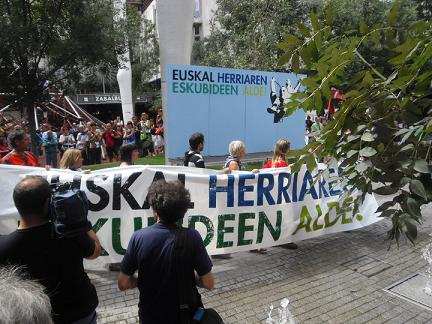
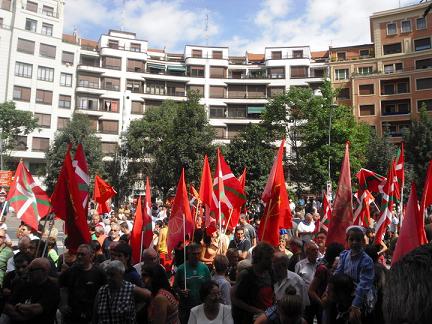
Thousands demonstrate in Bilbao 'for the rights of the Basque Country'


Plaza Zabalburu in Bilbao became yesterday the scenario of another demonstration for the rights of the Basque Country.


This was in fact their motto: Euskal Herriaren eskubideen alde - for the rights of the Basque Country.


Leaders of the 'illegal' Nationalist Left, Kiko Moreno, Miren Legorburu, Tasio Erkizia and Jone Goirizelaia, spoke to the crowd in the current line of trying to build a scenario of democratic solution to the Basque-Spanish conflict.

The official acknowledgement or the legality of Kosovar independence was also cheered in the demo, as it clears the way, in the international legal frame, for Basque self-determination as well.

The demonstration as such was initially banned by the current undemocratic 'Basque government' but was eventually authorized as mere meeting by the judiciary. Still the people were forbidden from demonstrating through the streets of the city and closely watched by the police.

Sources: Boltxe (photos) and Gara [both in Spanish].

Saturday, July 10, 2010

Catalans take Barcelona by millions!


We are a nation - Self-determination!


More than one million people, according to the city police, took to the streets in Barcelona today in defense of their Statute as the people and democratic institutions designed it, and not the mutilated remnant that the Spanish Constitutional Court would allow.

Catalonia has 6 million inhabitants, so these figures mean that practically every Catalan is supportive of the Statute. It also meant that the demo had major difficulties proceeding as planned because the people itself prevented it from advancing unwillingly, which happened at the rate of very few meters per minute, with streets and streets cramped with people and republican Catalan banners.

Sources: VilaWeb, Gara

This situation really pits Catalans and the Spanish institutions into a confrontational dead-end that can only be resolved with a radical change of the Spanish Constitution, something that the Spanish parties are not for.

Unlike the small Basque Country, Catalonia is a major demographic (and even greater economic) component of the State of Spain and it is very difficult to see how can it be ignored for long.


Basques demonstrate for independence and solidarity with Catalonia


The demo, under the main slogan of "We are a nation - Self-determination", was called by the Basque Nationalist Left and Basque Solidarity (EA) and Alternative (Alternatiba), in solidarity with Catalonia, which has seen how the statute democratically designed by Catalans was wildly mutilated by the Spanish Constitutional Court.


Basque parties feel that this attack on Catalan self-rule has also grave implications for the Basque Country, making virtually impossible to work for self-determination within an institutional frame that does not acknowledge that right.

Source: Gara


Monday, March 15, 2010

Most Northern Basque voters in favor of self-rule and against the high speed train


The referendum organized by Batera with the help of most municipalities in the Northern Basque Country on whether the region must be a distinct territorial collectivity 78% of votes in favor and 19% against and 3% issued blank votes.


However, being an unofficial poll, the participation was relatively low, fluctuating between 10 and 48% of citizens, depending on the canton. The results by canton are:

  • Baiona: 81.7% in favor, 15.7% against (participation: 10%)
  • Garazi: 75.6% in favor, 19.5% against (participation: 28.4%)
  • Iholdi: 85.1% in favor, 10% against (participation: 47.9%)
  • Hazparne: 89% in favor, 10% against (participation: 16.6%)
  • Beskoitze: 79% in favor, 17.7% against (participation: 29.6%)
Source: Kazeta.


The eight communes affected by the high speed train will have this ballot, disdained by Paris, next Sunday because yesterday they voted on this environmental issue, with all villages voting massively against (between 86 and 96%).


Democracy in the Basque Country: people votes, the government ignores.

Source: Kazeta.


In the (almost meaningless but official) regional elections for the artificial Aquitaine region, the participation was of 48% (low but above the French average), with the Socialist (PSF), Gaullist (UMP) and Christian-Democrats (Forces Aquitaine) being first, second and third force. The Basque nationalist list Euskadi Europan, with 6.7% of votes, was fifth, after Europe Ecologie (also participated by Basque nationalists) which got 11.85% of the vote. Overall the vote to Basque nationalist lists keeps growing, reaching now almost 18%. The communes affected by the high speed train punished severely the large officialist lists.

Source: Kazeta.

Wednesday, March 10, 2010

Northern Basques will vote on "territorial collectivity"


The referendum is not backed, and even doubtfully claimed to be "anti-constitutional" by the French Republic but has the support of 90 majors and many other people.


Making it coincident with the upcoming regional elections in March 14 and 21, 91.5% of Northern Basques will finally be able to express their opinion on whether the country should become a territorial collectivity within the French Republic or not.

At the moment and since two centuries ago, when the historical provinces were abolished and replaced by a centralized and arbitrary administrative structure imposed by Paris, Northern Basques have enjoyed no self-rule whatsoever (other than municipalities), what has severely damaged the economy and the culture of the country.

The recent creation of a distinct Chamber of Commerce, out of private initiative, also seeks to revert this awful situation.

Source: Gara.


Sunday, December 13, 2009

Informal referendum for independence in Catalonia


After the new statute has been challenged by the tories (fascists) at the Constitutional Court, Catalans are thinking that they are probably best on their own. An informal referendum is set up for today in 170 Catalan towns, including 700,000 voting citizens (Catalunya as a whole has more than 6 million inhabitants, many concentrated around Barcelona).


From BBC:

"More and more people think we have no room in the Spanish house, so we need a house of our own," organiser Alfons Lopez Tema says.

"[The Spanish] don't want us, they don't love us, they don't give us what we want. So the best thing is to vote and decide."

Joan Canela ponders at Rebelión:

If the Republic was formed after municipal elections, who knows what can bring independece.

The fact that this referendum acknowledges the right to vote to immigrants has brought their organizations to support Catalan independence. Diego Arcos, president of the Argentine House, says:

Catalonia acknowledges our citizenship while Spain does not.

Immigrants have already organized a political platform in favor of Catalan self-determination.

Anna Arqué, speaker of the organizing platform, hopes that the effect of these co-ordinated municipal referendums will be that the Catalan Parliament will call an official poll on the matter at national level.

Sunday, October 25, 2009

30 years of Western Basque "autonomy": empty celebrations and demands of self-determination


The statute of autonomy that grants to the Western Basque regions certain self-rule within Spain, is now 30 years old. After more than a decade of such "birthdays" not being celebrated at all, the new undemocratic government of López has resuscitated the day but getting nearly no audience.


The pro-Spanish parties, that rule without popular support, thanks to judicial manipulation of the electoral scenery, have been the only ones to join the official events. Even the "open doors" day at Ajuria Enea, the residence of the Lehendakari (President), has only raised the interest of a few hundred individuals.

The largest Basque political formation, the conservative Basque Nationalist Party, declined again to participate in the calculated choreographies of the unionists and has instead asked again for the fulfillment of the statute in its integrity, something they have been demanding since the 1980s. The extremely "moderate" (pro-Spanish) speaker of this party, I. Urkullu, called instead for "a pact built on a new model of relationship, as is defined by the New Political Statute [Ibarretxe Plan] approved by the [Western] Basque Parliament", law that included the right of self-determination for Basques and that was blocked at the Spanish parliament without any second thoughts.

The PM by Eusko Alkartasuna (Basque Solidarity, center-left), J.M. Larrazabal, stated that the statute is impossible to recycle, as it is such a "disfigurated and deteriorated" legal frame cannot be revived. He asked for a wholly new legal and political structure that includes the right to self-determination.

The so-called Gernika Statute was approved in 1978-79 and was only half-way to the huge self-rule that Basque provinces enjoyed before the Carlist Wars and id not acknowledge the right of Basques to self-determination. For these reasons, more than 40% of Western Basques chose abstention in the referendum of 1979. Additionally many of its capacities have never been fully implemented, as the Spanish government has made an issue of retaining such competences. In many cases the Basque Government had to act unilaterally in order to partially transfer such attributions.

Nowadays only the unionists support it, as even the most moderate of Basque nationalist formations is demanding to move over into a new more democratic frame, truly representative of Basque collective will. The more or less legal fraud in the latest elections, putting a unionist proconsul in Ajuria Enea, clearly against popular will, has only aggravated the "constituional crisis" that the Basque Country is going through.

Source: Gara.
.

Tuesday, August 25, 2009

History of solidarity with Basques marks Uruguay elections


Fifteen years ago the Uruguayan left went to the streets massively against the extradition of three Basque refugees. These mobilizations were supported by the
Frente Amplio (Ample Front), today in power, and were brutally quelled by the right-wing President Luis Alberto Lacalle, killing one, Fernando Morroni, and injuring dozens.

This institutional murderer is still at large and running again for President. For that reason today a demonstration has been called in Montevideo, demanding that Lacalle is judged for his crimes, that history is not whitewashed and ratifying the solidarity with the struggle of the Basque Country for independence and that of all peoples for self-determination.

Because self-determination is democracy and democracy is self-determination.

Source: Gara.
.

Saturday, June 28, 2008

The referendum that won't be


The Basque autonomous Parliament has approved to call for a consultative referendum to Western Basque society (not Navarrese, not Northern Basques) with the following (rather tricky) questions:


1. Do you agree to support a process of dialogated end to violence if previously ETA declares unequivocally its intention to abandon violence forever?

2. Do you agree that the Basque political parties, without exclussions, begin a process of negotiation to reach a democratic agreement on the excercise of the right to decide of Basque people and that such agreement is submitted to referendum before the end of 2010?

Tricky certainly, they are so misleading that I'm tempted to vote against both. But worry not: the Spanish political and judicial institutions will curtail the right of Basques to vote on their own destiny before it happens. It has happened before and will happen again: Spanish politicians seem to need the Basque conflict exactly as Bush seems to need Al Qaeda.

In fact the Nationalist Left bloc has supported this law reluctantly (only one representative voted for it, the rest abstaining, so it would be approved by a single vote) on the certainty that Spain will simply forbid the referendum.

On the first question I have the following caveats: why would anyone renounce "definitively" to violence while the right of self-determination of the Basque People is not guaranteed, why isn't this demand posited to Spain and its armed forces?

On the second question I have even more doubts: I don't want the political parties to agree to anything, I want the right of self-determination to be acknowledged, full stop. Once it's acknowledged, then they will probably have to discuss and vote on how it's implemented. If Spain doesn't recognize the right of self-determination, our only realistic path is to begin with self-determination now and break apart unilaterally, like Kosova.

Friday, March 14, 2008

A thought for Tibet.


Not necessary to write much about this in this so-called Western part of the World (isn't the World round?), as Tibet will not be flushed down the mediatic toilet, like happens with Palestine, Africa or other matters more directly our concern.

But I cannot either remain silent in front of the likely atrocities that Chinese authorities are probably comitting right now in the highest country of Earth. The little information available talk of repression using "live ammunition", killed protesters and total control by the Chinese police and army right now, at least in Lhasa.

My sympathies, of course, go with the Tibetan people as with all opressed peoples of the World.

Wednesday, February 20, 2008

Kosova could give good example


Serbian foreign minister has said that "Kosovo's indepedence has provided a toolkit for insependentists in Europe and beyond". Apparently Russia is considering to recognize Abkhazia and South Osetia (but not Chechnya) and some Palestinians are already demanding the formal creation of a Palestinian state if negotiations with Israel "are to succeed".

Looks good. What next? I have already mentioned Chechnya, that declared its independence almost two decades ago. Of course there's the much more dubious issue of Northern Cyprus (as it's merely a Turkish colony in fact) but also more importantly Kurdistan, including maybe 1/5 or 1/4 of Turkey's territory and population.

The Russians of Transdnistria, who declared their independence under Moscow's protection are happy. But one should not forget that Russia itself has many territories (autonomous republics and others) that have non-Russian majorities.

But the most interesting situation will be in Western Europe. In the UK the Scottish nationalism is quite strong these days, while in Spain Basques and Catalans could maybe take their own unilateral decissions. France is not exempt: Brittany and Corsica, as well as some overseas territories like Kanaky, have more or less important nationalist movements - and German identity is again on the rise in Alsace as well. Italy could eventually face some issues specially in Sardinia, Friuli and the Southern Tyrol (aka Alto Adigio) but also hase afced in the last times growing regional secessionism specially in the North. And let's not forget that Belgium is on the verge of breaking apart.

And, of course, there are many other natinal issues elsewhere: Western Sahara, Berbers, the ethnic puzzles of artificial post-colonial states, specially in Africa, southern Azerbaijan and eastern Kurdistan in Iran, Uyghuristan and Tibet in China (plus the issue of Taiwan, that is not really an ethnic but political issue), etc.

We are maybe entering a phase of history when decolonization and self-determination could become more and more widespread. After all that's what democracy is about: the power of the people. And many peoples all around would prefer to break apart from their forced historical "marriages" (or even slavery).

I am really glad that the artificial constructs of estabilished borders (borders that often are quite recent creations, but anyhow) and states are being challenged and defeated. It's a great act of democracy and self-determination. It's what freedom really is about.

I really hope that the somewhat hysterical Serbian "prophecy" becomes true. Let's break the chains of artificial borders, let's be free. For some of us this has been a very long centenary struggle and the happy end still has to arrive.