New blogs

Leherensuge was replaced in October 2010 by two new blogs: For what they were... we are and For what we are... they will be. Check them out.
Showing posts with label political repression. Show all posts

Thursday, September 30, 2010

European protests, Spain's general strike


In a general strike that has been delayed for all the summer by the duopolistic unions UGT and CC.OO., finally Spaniards had yesterday occasion to vent their anger and frustration and go on strike.

It was, it seems, a massive success, considering the appeals to demobilization and police violence by the entrenched institutional actors. Unions estimated the impact in 71.7%, with some media reporting a rounded up figure of 75%. Even the minister of labor had to admit that the impact was of 100% in the automotive sector, with air carrier Ryanair also canceling all its flights and some key services such as trash collection generally paralyzed.
 

Southern Basque Country
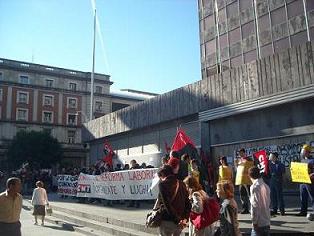
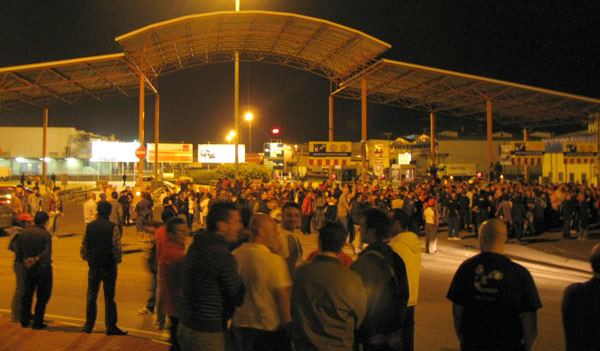
CNT picket in Bilbao
In the Southern Basque Country the impact was smaller, as the major unions did not join the strike, disgruntled by passive and manipulative attitude of the Spanish union duopoly. However in Navarre, the impact was similar to that of Spain with 74% of workers joining according to Gara and the airport completely paralyzed. Reports from industrial areas in the Western Basque Country, talk of some key industries paralyzed and industrial areas nearly stopped, as well as a total blockade of the harbors of Bilbao and Pasaia. Non-industrial sectors however were only mildly impacted.


Catalan Countries

Reports from the Catalan Countries tell of strong following in general and riots in Barcelona. With demonstrations in the thousands in many cities (Barcelona, Sabadell, Tarragona, Valencia, Lleida, etc.) and some arrests.
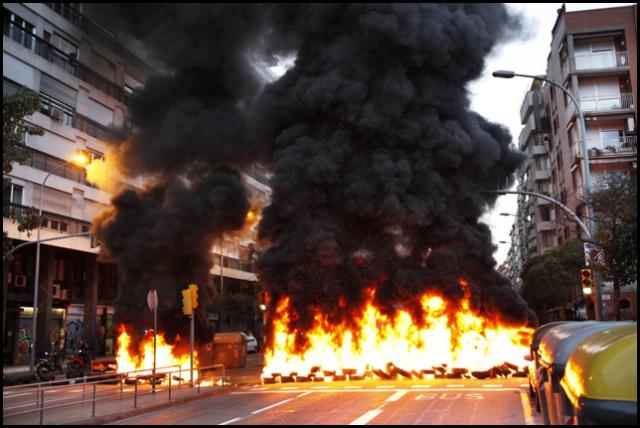
Fire barricade at Barcelona

Closing Mercavalencia at dawn


Asturias

In Xixon (Gijón) the walkout was generalized, with few incidents. The demo was called by Corriente Sindical de Izquierdas (CSI), SUATEA and CGT but was boycotted by institutionalist unions UGT, CC.OO. and USO, who were accused of making secret pacts with the patrons and government, trying to demobilize popular anger.


Aragon

The reports also talk of a general success, not just in Zaragoza but also in Teruel and other towns. They also talk very bad and  of the attitude of UGT-CC.OO, who posed for the photo and then left in most pickets. Combative unions in this country were CGT, Sindicato Obero Aragones (SOA) and CATA.

Closing El Corte Inglés, more images at NoblezaBaturra
There are also reports of police charges and arrests.


Andalusia

I could only find reports so far on Málaga, telling of irregular impact but stopping the key sectors. The demo was of several thousands.


Castile

The most important city by large is Madrid, which was strongly affected by the General Strike according to La Haine.

While the "official" UGT-CC.OO. demo gathered some 500 people, the alternative one called by other unions (CGT, Solidaridad Obrera, etc.) was massive (photos).

Very symbolically, regional public TV Telemadrid cut its emission, reminding somewhat of the impacting cut of TVE in the quasi-mythical general strike of 1988, which was a massive success.

While the unity and strength of genuine labor-unionism was an important element, the violence of police was another one. Police did not only charge against pickets, including the bycicle picket, but there are reports of seven live ammunition caskets being found after a specially violent charge in Airbus-EADS Getafe.
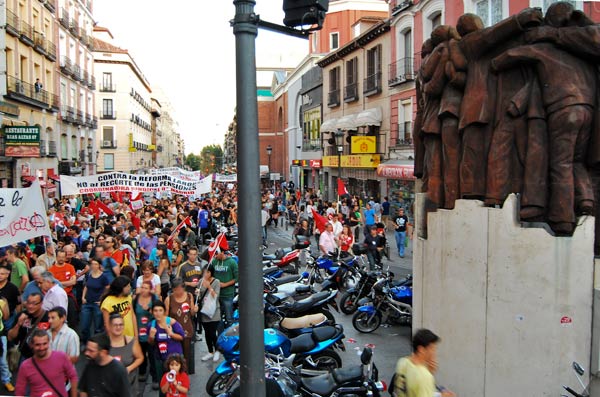
Madrid
Another city where the strike had major impact was Valladolid.

Valladolid

In Salamanca instead the reports tell of low following. 
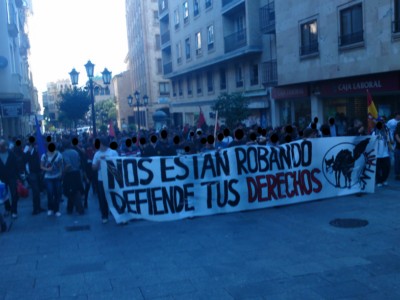
Salamanca
Elsewhere in Europe

There was a call for protests and demos to take place around Europe yesterday and I am aware of such protests in Ireland, Portugal, Italy and several Central European countries, however in the wealthy central bloc of the EU the impact of this call for mobilization seems to have been pretty low or nil, excepting the central demo at Brussels. 

Brussels
Dublin (Parliament gates)
Brief Analysis

Combative labor unions clearly made gains both in charisma and unity yesterday in the State of Spain, while traditional subsidized unions seem to have tried to make a posse strike instead to save their face before a growingly angry working class, which massively joined the strike in spite of all.

Much remains to be done at European level, which, in my understanding, is a key level of organization if we want to stop and reverse the offensive of Big Capital.


Some relevant links: CGT, CNT, Solidaridad Obrera, Rojo y Negro, La Haine.

Update: according to Cuestionatelotodo ("questioneverything") the sectorial impact was:
  • Metal 74%
  • Wood 59%
  • Construction 70%
  • Chemical 80%
  • Textile 77%
  • Mining 100%
  • Air transport 82%
  • Road transport 78%
  • Sea Transport 90%
  • Urban transport 85%
  • Markets 90%
  • Public education 60%
  • Private education 32%
By autonomous communities:
  • Andalusia 76.8%
  • Asturias 87%
  • Balearic Islands 72%
  • Canary Islands 70%
  • Cantabria 70%
  • Castile-Leon 72.3%
  • Castile-La Mancha 80.2%
  • Catalonia 80%
  • Valencian Country 78%
  • Extremadura 70%
  • Galicia 80%
  • Madrid 76%
  • Murcia 72%
  • Navarre 74 %
  • Western Basque Country 30%
  • La Rioja 71%

Monday, September 27, 2010

Mapuches take UN see in Chile


This happens after two days ago they briefly took other UN offices in Santiago (International Work Organization and Economic Committee for Latin America and the Caribbean). 

As the hunger strike of Mapuche prisoners goes beyond the 70 days and government and prisoners failed to reach an agreement last Friday, native organization Maulen Huanchu took yesterday the offices of the United Nations in Santiago de Chile with intent of remaining there indefinitely.

Source: Gara.

Tuesday, September 21, 2010

Testimonies of tortured by Spanish police


Political repression in the Basque Country, including arbitrary arrests, false accusations, trials without guarantees and tortures, is so common that I cannot certainly make mention of everything. In fact, I fear that I am so used to reading about repression that I don't even give it too much importance or even try to take it off my mind.


But at least now and then I must make mention so my readers get an idea of what is going on here. These is what happened, by their own accounts, to the last spat of arrested and tortured Basques, the victims of the reaction of the state to the confirmation by ETA that they were in a unilateral truce. All them were arrested by the Guardia Civil, a military police corps similar to the French Gendarmerie or the Italian Carabinieri, that has the worst reputation. The typical journey to Madrid by car may last some 4-5 hours but tortures continued once in police dependencies. Sexual abuse has become lately a common way of torture.

Sandra Barrenetxea had her upper clothes removed while being transported to Madrid. In the transport, she was systematically insulted, beaten and touched. Eventually a policeman took away her pants, forcing her to open her legs while another hit her on the head. She was forced to wear only her underwear in the interrogations and was threatened with rape repeatedly. In one occasion she was forced to lie her torso on a piece of furniture while the policemen tied her legs with a rope and threw cold water to her genitals between threats of rape.

Ugaitz Elizaran claims to have suffered more than 20 times the torture known as "the bag" (they put a plastic bag on your head and tighten it so you cannot breath and experience the agony of death). In one case, while suffering this torture, they tied his hands at the back and enveloped him in a mattress, with several policemen sitting on him. He tells that he even lost his sight once. Additionally they forced him to make physical exercises and beat him, as well as issuing threats against his relatives and friends, showing him a manipulated photo to make him believe, falsely, that his couple was also arrested.

Rosa Iriarte told that she was forced to touch a white narcotic dust, what caused her lose the feeling of her hands. Then they threw the same dust on her legs loosing sense in that part of the body as well. When they finally gave her a glass of water, she also ingested some of the substance, having all the mouth "asleep". Additionally she was forced to hear how the other arrested were tortured and was applied electrodes but no shocks (a threat).

Eneko Compains suffered the bag as well since the very moment he was introduced in the police van. He also denounced a very harsh psychological treatment with systematic threats against his relatives and a threat of anal rape with a stick. Curiously, he mentions that when he rejected to make a declaration at the police station the attitude of the cops relaxed. He asked to the physician for habeas corpus but his petition was rejected by the tribunal.

Aniaiz Ariznabarreta was, like Barrenetxea, deprived of her upper clothes in the journey to Madrid, suffering touchings and sexist insults. The same pattern was repeated at the police station for the four days of the arrest, when she was forced to stay naked and suffered sexual abuse (touchings on breasts and vagina). Ariznabarreta also reports that she was once enveloped in a blanket and then in a mattress, with a policeman sitting on her while the other five officers did not stop yelling, insulting and making threats.

Egoitz Garmendia was also applied the bag with some peculiarities (tape on his mouth and sometimes throwing water to his face when releasing the grip). He was heavily beaten and also enveloped in a blanket and/or mattress for policemen to jump on him (one on his genitals). He also reported repeated hits against his genitals (without the mattress) and threats of rape with a stick. In one occasion, when being brought back to the cell, they threw water on him, forcing him to stay naked with the only aid of a blanket (police cells are not warm, I can tell you).

Erika Bilbao was forced to stay in difficult postures, beaten and threatened, reporting as well a harsh psychological treatment full of threats against her loved ones. Like the rest, she could not rest because of continuous noise and yelling.

Joxe Aldasoro was kept in a dark room in which he could see nothing. When moved, he was blindfolded. Otherwise he reports continuous threats against his relatives and friends.

Urko Aierbe was beaten so badly that his leg was injured and he cannot walk normally now. His report includes the bag (twice), forced positions and continuous beatings.

Source: Gara.


Make up your own mind. But this is essentially what we read, hear or just know from experience that happens when someone is arrested, in particular (but not only) by the Guardia Civil. Spanish 'anti-terrorist' laws allow for incommunicado arrest without any guarantees for several days and when these are applied the usual thing to happen is torture of this or that sort. Later they may well let you free with or without charges, for the media your a "terrorist" anyhow and most won't listen to your denounces.

Sunday, September 19, 2010

Latest developments in the fragile Basque process


I'm not even going to call it "peace process" jet, just "process". Because the news are not really hopeful in general.


After rumors on the bilateralness of the truce, the Spanish government decided to dismiss these by the path of action and jailed a number of Basque politicians diffusely accused of belonging to the "all is ETA" conspiracy theory that prevails in Madrid since some 12 years ago. In effect they are accused to belonging to Ekin, a ghostly political avant-guard organization that would lead the similarly ghostly KAS bloc, including the Basque Nationalist Left, ETA and a host of other organizations. The KAS (Patriotic Socialist Coordination) bloc did exist in the 80s and 70s but it's not clear it does exist anymore nor that it ever included ETA at all and, in any case, it should be the same as the Basque Nationalist Left political movement (now illegal but still very real). No evidence of the existence of Ekin now or in the past exists (just police reports).

All the arrested denounced tortures, triggering some protests and, rather unusually, a pre-trial. All them been jailed "preventively".

But the most important meaning is to say, not just to ETA, but to all those hopeful of some kind of solution in the short run, who are most in the Basque Country (not so many in Spain it seems), that the State of Spain is not accepting the good will signals from the armed group.

It is also and foremost a message to the Spanish Right that the government is not renouncing to the repressive road to peace, a road that most here would consider impossible or even undesirable.

We are therefore witnessing, I understand, a sign of weakness of the Spanish socialdemocrats, who, the same as other "liberal left" parties elsewhere appear only to be able to govern under the ominous shadow of the right, specially the belligerant Reganist quasi-fascist far-right. This phenomenon is known as "violin government": supported by the left but effectively played by the right.

In this sense, ETA has now issued a new communication, which is published by Gara today but only in the print edition it seems.

The armed group responds in this communication to the Brussels Declaration issued by a number of senior public figures from South Africa, Ireland and Britain and declares to assume its part of responsability in this. The Brussels Declaration reads:

Statement by International Leaders in Conflict Resolution and Peace Processes

We, the undersigned, welcome and commend the proposed steps and new public commitment of the Basque Pro-independence [Movement] (Abertzale Left) to "exclusively political and democratic" means and a "total absence of violence" to attain its political goals. Fully carried out, this commitment can be a major step in ending the last remaining conflict in Europe. We note the expectation that the coming months may present a situation where the commitment to peaceful, democratic and no-violent means becomes an irreversible reality. To that end, we appeal to ETA to support this commitment by declaring a permanent, fully verified ceasefire. Such a declaration appropriately responded to by [Spanish] Government would permit new political and democratic efforts to advance, differences to be resolved and lasting peace attained.

Signatories:

-Nelson Mandela Foundation
-Archbishop Desmond Tutu (Peace Nobel Prize. South Africa).
-Frederik Willem de Klerk (Peace Nobel Prize. Former South African President).
-Mary Robinson (Former Irish President).
-John Hume (Peace Nobel Prize. Took part in the Good Friday Accord for Ireland).
-Albert Reynolds (Former Irish Prime Minister).
-Jonathan Powell (Chief of Cabinet form Tony Blair).
-Nuala 0'Loan (First Police Ombud in North Ireland).


The wording chosen by ETA seems subtle but I am not in condition to judge it until I buy the newspaper (if I do), as it doesn't seem that Gara is publishing it integrally online this time. The online article quotes the sentence: disposition to study jointly the steps needed by the democratic process, included the compromises to be adopted by ETA.

ETA hence seems to emphasize the democratic process of resolution (i.e. eventual self-determination) and seems to condition any permanent demilitarization steps to advance in the negotiation process. Nothing new really but I would not have expected anything else either. Meh, it's been more than 40 years now! And the last time they already issued a "permanent" declaration of ceasefire, what in the end lasted "only" one year. So issuing another would be futile rhetoric.

You may agree or not with what ETA says or does, but that is exactly what has been going on for the last 40-plus years. All my life. On one side there is a Spanish nationalist (Jacobin/Post-Fascist) state that has as principle the territorial integrity of the remaining state (after losing the Netherlands, Portugal, Belgium and most of Italy, most of America, Philippines, Cuba, Equatorial Guinea, West Sahara, etc.) as "sacred" and on the other there is this armed group and akin political movement saying that they do not settle for anything but the right of self-determination and sovereignty of the Basque People. They have been bumping heads forever (ETA is just the latest symptom, we can easily go back through the centuries to the Bagaudae with almost no stop in the struggle) and it does not seem likely they will suddenly find any kind of agreement possible.

The case of Ireland shows us that other possibilities do exist but a very different thing is to actually implement them, specially as the approach of Britain is generally less dogmatic than those of Jacobin Latin European states, derived ultimately from French Absolutism.

ETA says: if there is democratic will, it is possible to solve the conflict now and here.

It also attributes itself, with mariner language, the bravery of relaunching the opportunity for peace:

Before the close-mindedness of Spain and France, ETA has launched again the ship of opportunity for the democratic solution of the conflict. And it has taken the first decision without throwing the anchor, ready to sail into deeper waters.

They look as reference anyhow not only to Ireland but also to Central and Eastern Europe, where many new states have formed recently, as well as to Greenland and Scotland, where self-determination processes are ongoing with full normality.

They also make an appeal to international institutions and agents to impel the peace process: a democratic process that provides a permanent, just and democratic solution to a centuries old political conflict.

ETA confirms that it has been willingly for six full months without committing any attack. And complains that the various Spanish governments have wasted all opportunities for peace so far.

Source: Gara[es]. More briefly also at BBC[en].

Thursday, September 2, 2010

Mapuche prisoners: 52 days in hunger strike


The hunger strike of Mapuche prisoners in Chile reaches today the 52nd day. In practical terms this means that they are beginning to notice the hard effects of the fast, losing muscle tissue and beginning to affect major organs as the liver, kidneys and heart. Their life is at risk.


The strikers demand the abolition of the anti-terrorist law by which they are being judged, under accusations of attacks and road blockades demanding that their ancestral lands be returned to the Mapuche communities.

The government is showing signs of weakness in this nonviolent struggle, and is asking, since tuesday, that the prisoners stop their hunger strike on promises of law reform. This announcement was welcomed by Mapuche organizations that demand hurrying up the procedure.

The strike began on July 12 in the prisons of Concepción and Temuco and has been joined by other prisoners gradually. The anti-terrorist law is a fascist law passed by Pinochet dictatorship and allows the imprisonment of suspects without charges for unlimited periods. If found guilty, the penalty is multiplied by three automatically.

The law is seldom applied to white Chileans but is systematically used against Mapuches, who are fighting for the return of their communal lands and their right to self-rule. The independent Mapuche polity was invaded by Chile in the 19th century and has no recognized autonomy.

The Appeal Court authorized prison guards to use forced feeding on striking prisoners.

Source: Gara.

This fight has, as so many other important news, got no room in mainstream media, either in Spanish or English. Many wonder if this happened in Cuba or Venezuela, what kind of media reaction would it trigger. This in turn causes deep concern for the situation of freedom of speech and journalism in general in the so called Western World. And this is not the only case: what do you know of the real situation Louisiana oil spill and its real effects on the people living at the Gulf of Mexico? If you are only following mainstream media: nothing at all! A very bad situation for information freedom the one we have.


Sunday, August 29, 2010

Canarians get involved in West Sahara while the Moroccan tyrant choses repression again


Tenerife con el Sahara
reports[es] that a number of Canarian citizens have taken part in a protest for the rights of the Arab Democratic Sahrawi Republic at El Aaiun. The reaction of the Moroccan autocracy has been brutal, as usual.


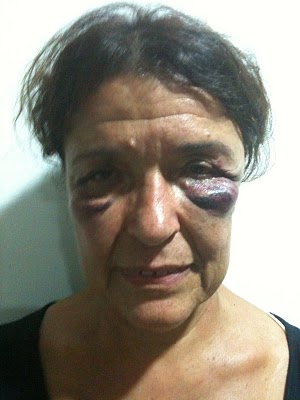
Carmen Roger one of the Canarian victims

After being beaten by the Moroccan occupation forces, the Canarians have been arrested at the "House of Spain". Two international observers, Mexican Antonio Velázquez Díaz and Catalan Isabel Terraza, are being besieged by the occupation forces at the homes of their Sahrawi host family. Tenerife con el Sahara claims that they are at serious risk, as well as the Sahrawi families besieged at their homes by the invader troops.

The international protests are organized by Saharaacciones which is promoting nonviolent protest in order to make the occupation and repression of the West Sahara more visible and hopefully push towards a democratic solution through the right of self-determination of the Sahrawi people:

We are demonstrating to make visible a vetoed territory, where we are unwelcome by the occupation forces, following the example set by the admirable peaceful resistance that the Sahrawi people are doing once and again since the beginning of the Intifada in May 2005.

Morocco may be pushing for greater involvement of Spain

This is what Pedro Canales argues at El Imparcial newspaper (found at Sahara Libre). According to him, Morocco wants Spain to take a more clear pro-Moroccan stand in regards to the West Sahara, a former Spanish province. As Spain cannot really control the high level of popular support for the Sahrawi cause, which is generally perceived as a treason to the formerly "Spanish" people of the Sahara by Madrid, nor can reign on the local and regional administrations in this matter, Morocco seems to have opted to do the same: leave the Moroccan popular discontent with Spain on matters such as the colonial outposts of Ceuta and Melilla or the treatment of immigrants, break loose.

However Canales seems to be writing for the Moroccan viewpoint and seems to think that greater Spanish involvement alone could change things. This is not possible because Spain already has a very shameful role by mere inhibition and cannot really take any stronger political stand against the Arab Democratic Sahrawi Republic. So if Spain would get involved, it could only do with a stand at least moderately opposed to Morocco's aspirations, so really Morocco is doing it wrong if Canales is right. After all some border riots at the Melilla fence won't get anyone worried this side of the Strait.

On the other hand, I guess it is always positive when the people, in this case the Moroccan people can express their discontent. It is a positive development that may be in the future will turn against the autocrat of Rabat. If the people can really express their anger and gets organized maybe in the near future we can hope to see a simultaneous solution to both colonial problems: Moroccan occupation of the Sahara and Spanish control of Ceuta and Melilla.

In any case, I don't think that Morocco really wants to press Spain to get itself "more involved" in the conflict of West Sahara because it can only backfire. For Moroccan imperialist interests the best situation is the status quo, with Spain inhibiting itself, what is as pro-Moroccan as it can get.

But that the people organizes itself and gets to speak out loud in any conflict is as such a good development. In an ideal democracy situation all these conflicts would not exist because it'd be up to each local people to self-determine their status and their future.

Friday, July 9, 2010

Puerto Rico: de facto coup by NPP?


What Puerto Rican dramatist
Roberto Ramos-Perea denounces[es] regarding the political situation in Puerto Rico sounds most worrisome.

He denounces that the pro-annexation New Progressive Party, which won the elections in 2008, lead by Senate President Thomas Rivera Schatz and Chief of Staff Marcos Rodríguez Ema, is making an institutional coup that has caused strikes and violent confrontations. The theoretical leader of the party and the country, Governor Luis Fortuño is claimed to be without will, without opinion and without public presence nor responsibility.

Ramos-Perea informs that the conflict began with the firing of more than 20,000 public servants with the pretext of solving public deficit along with strangling the budget of art institutions. Meanwhile the government hired at great cost many companies and advisors akin to the NPP.

The NPP also placed four party members in the Supreme Court, which totals seven members. Then it suppressed student participation in the University government causing a student strike that lasted 60 days, followed by a legal modification of the number of members of the University government (Junta de Síndicos), that again granted the NPP total control.

The NPP has also privatized a large fraction of the natural area known as "Karso del Noroeste", that gathers 1/3 of all water in the country. The new country's budget and associated laws will promote privatization and hand public funds to the private sector without surveillance. When approving these laws, the microphones of opposition representatives and senators were turned off.

Two weeks ago the FBI arrested Senator Héctor Martínez, right hand of Rivera Schatz, on corruption charges. Martínez was taped in his last instance of graft and is said to have links with narcotraffic. Rivera Schatz defense of the "innocence" of his friend caused even greater political upheaval.

In June 30, date in which the text seems to be written, student and citizen groups claimed their right to assist to the deliberations in the Puerto Rican Congress, being beaten and tortured by the police. The National Guard was mobilized and sent to the Capitol, causing more clashes and repression.

So far the synthesis of what Ramos-Perea denounces as happening these last months in Puerto Rico. I am somewhat surprised of not having known anything about this earlier, a clear sign of media disinterest or censorship.

If any reader can point me to more extensive information, I'd appreciate it.

Thursday, July 1, 2010

Spanish Inquisition: one step further.


Elected representatives will now, in the legal jurisdiction of Spain, be suspended if they don't parrot with enough vehemence the institutional doctrine promoted by the two official (and almost identical) parties: PP and PSOE.


According to the new wording of the electoral law, just approved by the Constitutional Commission of the Spanish Parliament, representatives elected in any list that is declared illegal after the elections will be suspended. The only way to avoid this suspension would be to repeat constantly the ritual words "terrorists" and "I condemn".

By the letter the popular representatives must formulate "voluntarily" before the "Electoral Administration" in the term of 15 days "an express and doubtless declaration of separation and rejection of the causes determining the declaration of illegality" of his/her list.

This however is not enough: the "lucky" representative will be placed under constant scrutiny and can be suspended at any time if "by act, omission or manifestation" he/she "would show contradiction" with the written declaration.

This process will happen by mere administrative procedure, with no judicial guarantees whatsoever.

Source: Gara.

It is of course a law intended primarily to prohibit one of the largest Basque political factions from having any institutional representation whatsoever under any circumstances but these McCarthyist laws are ample enough to allow the illegalization and persecution of anyone who dares to have different opinions, be them Basque or Spanish.

Furthermore, we must not forget that the Spanish "anti-terrorist" hysteria has been plagiarized by the USA and its empire since 2001. The same that Spain allowed the massacre of Hipercor to happen, the USA allowed 9/11 (if it did not directly engineer it), only to spark mediatic hysteria and rally the people around the Capitalist governments and their repressive policies in what I could not describe but as a de-facto coup against democracy, as it has allowed for further restrictions of human rights and civic freedoms everywhere, impelling almost total police control of the citizenship. All things that would have been unthinkable without this carefully engineered hysteria.

So beware, because it'd be not the first time that a "brilliant" Spanish idea like this would be copied worlwide.

Regarding the Basque political situation it can only make more difficult any path to peace. We must remember that ETA has been in an unspoken but real unilateral truce since more than a year ago and that the Basque Nationalist Left has repeteadly declared its will to achieve independence by peaceful and democratic means, yet the State only responds with more repression.

Thursday, April 22, 2010

Petition to Obama to speak against the institutional murder of Mumia Abu-Jamal


Mumia Abu-Jamal is probably the most famous political prisoner of the USA, along with Leonard Peltier. He is a journalist and a political activist of leftist ideas. Today, Spanish bi-weekly Diagonal interviews his attorney, Robert Bryan, who claims he was declared guilty, 28 years ago, in a clear case of institutional racism, with the judge openly telling to a colleague: "I'm going to get the nigger fried" and banning eight black people from taking part in the jury.

The case is now at an appeal court with a very technical twist on whether the case is similar or different from another case. Bryan blames the situation to poor defense in past trials and would like them to be repeated ex novo. He argues that this is very typical: poor people cannot afford a good defense attorney, what favors the more experienced public accusation. Mumia's former attorney did not even present the racial composition of the original jury in a past revision in 1995, what could have changed the case completely.

This is an example of why death penalty is an error, not just in the case of Mumia but in thousands of other cases in the USA and across the world. People are executed not for comitting a crime but for not being properly represented, for not being able to pay for a good attorney. Death penalty is a privilege reserved for the poor.
He also says that Mumia is being persecuted essentially for being an active voice, for not shutting up, for denouncing all kind of injustice and abuses. So the authorities only see one way to achieve this goal: killing him. However so far they have only achieved to make him globally famous. Bryan says he's not going to stop writing.

He wants to live, he does not want to die. He does not wish to be executed. But he will not shup up, he will not go silent just to save his own life.
He also makes an appeal to sign the petition asking US President Barack Obama to speak, as moral authority, in favor of a moratorium of death penalty for Mumia and the 20,000 people that are sentenced to death in the USA. You can read and sign the petition (in many languages) HERE.

Here there is the trailer of the movie on Mumia's life,
In prison my whole life:


Further information:
Mumia Abu-Jamal Legal Defense.

Thursday, April 8, 2010

And yet more political trials against Basques


The Spanish Inquisition (Audiencia Nacional, special centralized political tribunal) is now "judging" 40 Basque politicians, all members of the banned (but popular) party Batasuna (Unity). They are accused of "belonging to ETA" but not directly but by the fact of being members of Batasuna which in turn is accused of hierarchical submission to ETA.


The state attorney has asked for penalties of as much as 12 years of prison for Arnaldo Otegi, Joseba Permach and Rufi Etxeberria, who are accused of belonging to armed organization with rank of leaders, other 20 politicians are accused of lower ranking ETA "membership" and yet other 17 of "collaboration" with ETA.

Most of them are not in prison at the moment, though two, Otegi and J.L. Elkoro, are for other causes also of political nature. Yet another four of the accused are on bail of 50,000 euros (some 70,000 USD) each, while Rufi Etxteberria only recently left prison after being four years in "preventive arrest".

None of them has comitted any crime other than being active politically nor has their party, Batasuna. The essence of the accusation is the same that was used to declare Batasuna and its predecessors, Euskal Herritarrok (We the Basque People) and Herri Batasuna (People's Unity), ilegal in 2003: that these organizations were supposedly subordinated to ETA by means of their leaders. For this accusation to succeed in court no evidence was needed but ad-hoc police reports.

Source: Gara[es].

Tuesday, March 30, 2010

Venezuela arrests Basque internationalist


In a still obscure incident, the Bolivarian Intelligence Service (SEBIN) has arrested German-Basque internationalist activist Walter Wendelin at his arrival to Caracas.


Walter Wendelin, who has German nationality but is member of Basque internationalist movement Askapena (Freedom), arrived to Venezuela from Mexico, where he had taken part in the congress of the Party of the Democratic Revolution (PRD). According to Solidaridad Pueblo Vasco (Solidarity Basque People) his journey to Venezuela was meant to explain the new proposals of the Basque Nationalist Left.


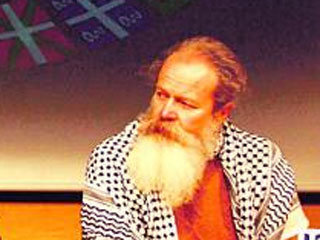
Walter Wendelin

According to the Venezuelan Association of Friends of the Basque Country, Wendelin has not been allowed access to an attorney and has been filtered that "he will be returned to Spain", what they protest that make no sense because he has never been charged with any offense in the European kingdom.

A demonstration has been called for tomorrow at the consulate of Venezuela in Bilbao.

Sources: Askapena, Gara, La Haine, Hala Bedi Irratia (live).

This arbitrary arrest may be related to the pressure put by the Spanish regime upon Venezuela, with judges and media attacking the American republic on false grounds of collaboration with ETA and FARC.


PSUV leader resigns

In a mostly unrelated episode, Venezuela Analysis reports that the former vice-president of the ruling Socialist Unified Party of Venezuela (PSUV), Alberto Muller Rojas, has resigned from politics. His advanced age and delicate health partly explain the resignation but Muller also mentioned that in the last three months the revolutionary process in Venezuela has been wretched, "everything that is going on isn't healthy for the revolutionary process". He said that the PSUV is infiltrated by the bourgeoisie and that the government is turning away from internationalism and heading towards "petty bourgeois nationalism".

Alberto Muller said some time ago to Hugo Chávez that he sits on a scorpions' nest.

Friday, March 26, 2010

Further anti-democratic reforms in Spain's law


The institutional two parties of Spain have agreed further reforms to the already outrageous Law of Political Parties that will make even more difficult that people with dissident opinions can run for political office in the European kingdom.


Particularly the new reforms would allow to:

1. Declare a party or list illegal already in the electoral campaign even if it fulfilled all the draconian ideological requirements to run.

2. Suspend elected representatives.

Source: Gara.


Spanish weakness and fear

The Basque Nationalist Left, which has recently insisted that they want to work democratically (originally , in the 1970s and 80s, they did not run but for local offices, considering all the rest of institutions illegitimate) has declared that it's nothing but weakness and fear to democratic confrontation what motivates these repressive laws.

Source: Gara.

Sunday, December 13, 2009

Greek Anarchists warn of the return of the Junta


While I think this is naively ignoring that the same fascist trend is way too apparent in all Europe (just ponder
the violent repression at "Hopenhagen" against peaceful environmentalists as example), it's still very worth mentioning, none the less because there seems to be already missing people, which is one of the most worrisome indications of Pinochetism.

The last days have witnessed unbelievable orgies of the Greek Military Junta.

Examples:

1) Officials with fire weapons in demonstrations

2) Police agents in motorbikes making raids against demonstrators

3) Police deployed behind peaceful demonstrators, indiscriminate and wild arrests

4) Made-up accusations, as the supposed murder attempt against the president of the Pritanea

5) Lots of vague accusations in order to dissuade youths and adults

6) Closure of schools with the pretext of swine flu and beatings of students who tried to arrive to them

7) Masked secret police kidnapping demonstrators

8) Increased level of collaboration between the Golden Dawn neonazis and police

9) Secret meetings between Chrysohoides [minister of "citizen protection"] and directors of TV channels and journalists to determine how to show the information in the media

10) Secret cameras, helicopters flying all the time

11) Zero tolerance: a rotten orange or a stone on a bank have become a serious crime and a pretext for a police attack

12) Prohibition of demonstrations and meetings in the most dynamic areas, with major police intimidation and scandalous investigation lines

13) Hacker attacks against Indymedia, squatter pages and TVXS (television without borders), suppression of comments.

14) Invasion and preventive arrests in many self-managed spaces

15) In an Orwellian style, anarchists and rebels are called "fascists and nazis"

16) Suppression of the academic asylum, as in the military dictatorship

And much more.

Some of these things only happened before in rare cases, while others happened during the military junta (1967-74), while yet others had never happened before, only now. Never before all this had happened together in such a short space of time!

It seems that the confrontation happening here, that they try to hide, the Indomitable December, has the power to activate a new emergency decree, a new "Plaster Model" [the pronouncement of the Junta in 1967].

These moments are more than historical. We are witnessing for the first time an attempt to impose a coup by the fascist Police. If they are able to commit all these crimes in a "parliamentary democracy", this Junta is not different and we all have to realize that. The Anarchist slogans on the streets are beginning to say that without twists: "Down with the Junta!"

There is complicity of attorneys, deans, upper classes, bourgeois media and the police, and we yet do not know what other local and foreign forces have been enlisted. We are beginning to hear of missing people, the climate is as tough as under the Junta.

This is not the time to remain silent! This is not the moment to relax!

Everybody to the streets! Sittings everywhere!

Please, help to bring down the Greek Military Junta!

The regime goes straight back to 1967!

Wake up!

Source: Alasbarricadas.org

Saturday, January 17, 2009

Latest: Basque town occupied after ecologist protest


The town of Urbina is right now under total police occupation (both Basque and Spanish police corps). There was a large demontration today against the High Speed Train (AHT-TAV by uits Basque and Spanish acronym) which developed peacefully under massive police control. After the demnstration ended, a group tried to enter the work area, not using violence at any moment, and then anti-riot police charged, injuring many. So far, "normal".
But since then the town has been totally occupied by the Ertzantza, with support of the Spanish military police known as Guardia Civil, who is running around arresting people (at least four confirmed so far, all them injured by the police and arrested in the ambulances) and entering gastronomical societies where people tried to refuge. Nobody apparently can get out of the town right now.

Source: Gara.

The High Speed Train, also known as "Basque Y" is a highly controversial developement that would connect by bullet train all three western Basque capitals and eventually these with the French and Spanish networks. This is being done at a high cost for rural areas and their inhabitants. It has raised strong opposition along the years but it is being imposed anyhow. Recently ETA intervened militarly and was demanded by the Assembly against the TAV to step aside. But even before this inoportune military intervention, the ecologist platform was already being criminalized by the media and the Spanish courts.

Right: poster calling for the national demonstration that has been brutally repressed (source).

Update: listening to Hala Bedi Irratia (a free radio from Gasteiz) right now in wait of news. The last figure of arrested is of at least 16.

A direct witness and victim has been just now telling that the Ertzaintza has been forcing people to the ground and beating them gratuitously, those beaten more brutally have been later arrested. When the policeman was asked "you arrest me because you beat me before, right?", the reply was "yes".

While there are many police controls all around the town, the news of strict siege appear now to be exaggerated. At least the person speaking in the radio could make it to Gasteiz but maybe it was the case for the first minutes.
.

Sunday, December 21, 2008

First time ever...


First time ever that people openly announce their joining illegal armed organization ETA. Nobody remembers anything like that. Maybe in the 60s?


A comunication sent to Gara newspaper declares that ten Basque citizens have decided to join ETA after being judged and persecuted as if they were militants when they were not. Four of them appear in a picture attached to the letter (left), though no names are mentioned.

They claim to be activists of the Basque Nationalist Left, who in different ways have worked in favor of Basque independence.

We have worked in different organisms of the Basque National Liberation Movement until heavily armed policemen came to arrest and torture us and we have been forced to run away.

They denounce that the political situation has been worsening, that there is no democracy, freedom of association, freedom of expression anymore in the Basque Country and that in the impossibility of working in their townsthey have decided not to surrender to the Spanish tribunals.

We had no option left than to face the Spanish persecution with weapons in our hands and we will make it with determination.

In spite of not being members of ETA, they wanted to kidnap and judge us as if we were. But this does not scare us, like many other people before us, we have decided to take up weapons and join Euskadi Ta Askatasuna.

Live to see. When you think you've witnessed virtualy everything...

Source: Gara
.

Thursday, September 25, 2008

Operation against Basque nationalists in the North


Commanded by French super-judge, Laurence Le Vert, French military police developed yesterday a major operation of search and capture of Basque acivists in the Northern Basque Country.


The police operation was centered at the see of Batasuna in Baiona (the party is legal in France) that was searched all day long but it also included arrests of many activists all around the Northern Basque Country: Xabi Larralde, Giulano Cavaterra, Frederic Karrikart and Gwenaëlle Morvan in Baiona, Patricia Martinon and Einaut Elosegi in Aiherra, Haritza Galarraga in Senpere, Maide Duhalde and François Lefort in Lekuine, Jokin Etxebarria in Urruina, Aurore Martin in Anhauze, Antton Etxebarri in Bunuze, Jon Irazola in Lekorne, Jean-Claude Aguerre in Jutsi. Two other people: Jon Goio and Zigor Goieaskoetxea, who are under a European arrest order, issued by Spain, could not be found in their domiciles.

The search of the offices of the Basque party in Baiona lasted all day long, time while the Cordeliers street was closed to the public. In the evening there was a protest demonstration, gathering some 250 people. Banners with the texts "Repression is not the way!" and "Batasuna resist!" were visible in many places of Baiona, both in the streets and at private homes. Other protests happened all through the Northern Basque Country.

The legal pretexts for this intervention appear to be two distinct issues: one one side the "Kalaka case" and the investigation of the attacks against a hotel at Bidarraitz, that would be the alleged background for the arrest of seven people, and on the other the case on the financing of the independentist movement, that (we must not forget) it is still legal in France, in spite of many bank accounts having been blocked judicially in relation to it.


Two images of the arrests

Batasuna denounced that this operation is in practice a covert illegalization of the nationalist party also in the North. Labor unions such as the Union of Patriotic Workers (LAB) and other human rights watchdog Askatasuna (freedom) and the youth movement Segi (go on) also denounced the agression against the Basque nationalist movement, denouncing the connivence between Spain and France.

But the reactions were not limited to Basque nationalists: the social-democrat Frantxua Maitia (regional councilor) declaredto be most surprised and sustained that Batasuna is a legal party that operates open and publicly. The Green Party also protested against the police intervention and said that it is an attack against freedom of political activity, warning to Paris that violence only brings more violence. But the major of Baiona, Jean Grennet, eluded to make any comments.

Simultaneously, the interior ministers of the two states controlling the Basque Country, M. Alliot-Marie and A. Rubalcaba, had a meeting, after which Alliot-Marie declined to comment if France ispreparing to illegalize Batasuna saying that such decision is not only competence of her ministry.


Images of the protests

________________________

Update (Sep 26):

Four of the arrested (Elosegi, Morvan, Etxebarria and Cavaterra) have been set free. Another person under arrest warrant, Mirentxu Lako (companion of Jean-Claude Aguerre), is still free because she was about to give birth, something that happened yesterday. This leaves the number of arrested people at 10, according to Askatasuna. The place of arrest is not clear, being rumored that they are in the prisions of Baiona and Pau, and the charges are not clear either. The search of the Batasuna see continued yesterday.

Dozens of people demonstrated again in several locations of the Northern Basque Country. Batasuna has called for a national demonstration at Baiona tomorrow Saturday at 16:00.

Batsuna also offered a press conference saying that France fears the growth of Basque nationalism in the North, directly confronted with the centralist Jacobine ideals of the French Republic, and that is the reason why it is trying to destroy this political structure and project.

Source: Gara.

In a separate article, Iñaki Altuna claims that the reason for this attack is the growing influence of Batasuna in the North, which, in coalition with Abertzaleen Batasuna (Patriots' Union), achieved historical success in the last elections, threatening the bipartisan monopoly of Northern Basque politics by the major French parties and demanding not anymore a mere departament but a true regional autonomy and the right of self determination for the North.

Update (Sep 27):

Yesterday nearly all arrested were set free. Only Jean-Claude Larralde remained in custody tonight. The search of the offices of Batasuna also appears to be over, after three days.

The legal pretexts are also somewhat more clear: there are three different causes being used here: the "Kalaka case", an alleged network of financing of the Nationalist Left, the attacks against the hotels at Bidarraitz, and specialy a preliminary investigation regarding the financing of the Communist Party of the Basque Lands.

None of the causes seem solid, as evidenced by all arrested being set free but they could easily cause the illegalization of Batasuna, that in the North has status of association, not political party, and could therefore be banned by a mere administrative decission. It is strongly speculated that this is after all the true goal of judge Le Vert.

Source: Gara.

Friday, September 19, 2008

Yet another Basque party is banned


As expected, the trial against the Communist Party of the Basque Lands (
EHAK by its Basque acronym) , has ended with their ban, the party that right now holds the key to who forms government in the Western Basque Country with its 9 seats. The details of the sentence are not clear yet but guess they do not seem to matter anyhow, considering what has been argued to illegalize other political groups in the last days (see my previous posts: 1, 2).

Source: Gara.

Thursday, September 18, 2008

10 years of jail for speaking out


Whoever dares to say that Spain is a democracy is absolutely wrong. And the increasing ammount of jail sentences for ideological "crimes"
(crimethink in Orwell's premonitory nightmare) is a good example of it. Kafka's works will also soon probably become compulsory reading for all wannabee lawyers, so they know in advance what the law is worth.

21 activists of the Basque rights watchdog Comitees for Amnesty and its successor Askatasuna (freedom) have been sentenced by the Spanish Neoinquistion (Supreme Court) to 8 to 10 years of jail for crimes such as denouncing torture, criticising judicial rulings or demanding the repatriation of Basque prisioners. The ruling admits that the struggle of these organizations has never been violent but it argues, based just on ad hoc police reports, that they are subservient of ETA because they share "the same project, the one promoted in political terms by the Nationalist Left, in which armed action is done in defense of the rights of the Basque Country", that they also aim "to depose Spain in the Basque Country". For that shared ideology they are officially described as "terrorist organization", even if they have always acted within the law.

One can just wonder how many new jails they will have to build if they want to apply the law to the many Basque citizens who also share that project and who also denounce tortures and other abuses daily.


image of the process

Source: Gara (in Spanish).

Wednesday, July 30, 2008

Freed Basque mayor: 'anything is ok against us'


The mayor of Arrasate (Mondragón) , Ino Galparsoro, was set free on bail two days ago after being arrested on unclear political charges some months ago. She was masively welcomed back in her hometown and has vowed to continue with her work.


We went to the 'Audiencia' [Audiencia Nacional, Spanish special tribunal] not knowing what was going on; in fact my name was not even in the instruction. It is clear that anything is ok against us and that attacking elected politicians was a path they were exploring. We arrived at 10:00 and the police report did not arrive until 11:00. In it they accused me of a couple of things: taking part in press conferences and proposing a bill in the name of Basque Nationalist Action [EAE-ANV, historical Basque left-wing nationalist party]. There was nothing else: that is why they jailed me.

Left-wing Nationalist elects, at a press conference, denounced that Galparsoro has been kidnapped by the state just because of being mayor and belonging to the Nationalist Left. They denounced that it is another example of the state of exception that the Basque people is subject to, that it was not a judicial decision but a political one taken by the Spanish government. They denounced the Spanish nationalist parties PSOE, PP and UPN as the direct responsible ones but also denounced the complicity of the so-called moderate Basque nationalist formations like PNV and Nafarroa Bai. They insisted in the nee to alow the Basque people to decide its own future.


Source: Gara

See also: my post on the arrest of Ino Galparsoro, three months ago.


Wednesday, July 16, 2008

Policemen guilty of 2001 Genoa summit abuses


15 of them have been sentenced to penalties that range to a maximum of 5 years of jail for the chief of the prision brigade that was in charge when most of the abuses happened. 30 others have been acquitted.


In that infamous day of the 2001 Genoa G8 summit, anti-riot police massively and indiscriminately arrested activists of all sorts, beating them brutally, causing one dead and comitting other abuses such as focing women to strip in front of male agents.

But judicial severity has been much harsher for activists, some of which have been sentenced (in a separate trial) to 11 years in jail.

There is still another trial under way against 29 policemen accused of abuses in a separate detention center.

(Source: Al Jazeera).

The Comitee Truth and Justice for Genoa asks in regard to this trial: is Italy still a democracy? They think the penalties are way too soft:

What is evidenced and scares is the consideration that have in our country the violations of fundamental rights: a minor crime destined to prescription in tribunals, totally irrelevant for politicians, that in all these years have been unable to pass a law against torture and fire the public servants (in some cases they have even been promoted!) involved in the processes for the Genoa G8 meeting. In Bolzanetto [the jail near Genoa] unacceptable abuses were comitted. Mistreatment to detainees is totally incompatible with democracy. In these years a climate of impunity has been promoted. We ask to the political forces and the Parliament: is Italy still a democracy?