That is what In Defense of Marxism and their friends of Socialist Appeal believe: that time is ripe for a mass party of Labor [at IDOM, at SA]. Hence they have launched the Campaign for a Mass Party of Labor.
It is difficult to judge from the distance but when I see stuff like what is happening to the working class and in general all residents in the Gulf of Mexico with the US government (a Democrat government that raised mass support in the last elections!) as corrupt and detached from its own people as to let them be poisoned and their whole social and environmental fabric destroyed only to help Big Oil corporations and how this big lie (added to the others) is slowly raising awareness and what is still powerless rage but can easily become in powerful collective action and organization, I'd dare say that they may well be right.
It is surely too early to plan or even dream of a revolution taking place in the USA. Class consciousness, while growing, is still too diffuse and Big Capital really seems in power, if not really anymore in control of the situation. But it is certainly the kind of context that strongly calls for sowing the seeds and nurturing the saplings that one day soon may become the forces driving such a necessary change ahead. The situation is certainly ripe, in the USA, in Europe and probably in many other places for the formation and/or strengthening of the instruments of class struggle and eventually class power: true total democracy.
This context was addressed quite well by Alan Woods recently: while the unions would want "social peace" and negotiate some sort of inter-classes sharing of wealth and living conditions, as was possible to some extent in the past (only in the developed world), this is not possible in the current conditions of radical adjustment that Capitalism is going through. In the present context and for the foreseeable future, Capital will only be able (and willing) to squeeze more and more, without any compassion, the working classes in order to foot the bill of their luxurious lifestyle and wealth-based power structure.
However I do not know if this appeal is "the right one", that's up to you to judge, or even if the Marxist-Leninist concept of political organization makes any sense in the context of Late Capitalism (Toyotism). I do agree although with the consideration that unions should have a central role however and that, ideally at least, the class organization should be one. Albeit one radically democratic.
Lev Davidovich Bronstein, best known to history as Leon Trotsky, was murdered today, 70 years ago in Mexico City by Catalan Stalinist Ramón Mercader, who infamously used a pickaxe for the crime (and almost failed).Trotsky led, together with Lenin and other bolsheviks, the Russian Revolution which, for the first time in history, brought a party of the Working Class to power. He was particularly relevant in organizing the Red Army, which became able to withstand not just the reactionary White forces but also the invading armies of Western powers that landed at several locations at the Russian coasts in support of the reaction.It was also responsible however for the eventual destruction of the Anarchist Free Territory in Eastern Ukraine, one of the two almost successful Anarchist large-scale socio-political experiences in the 20th century (the other was the revolutionary zone in Catalonia and Eastern Aragon during the Spanish Civil War).But surely Trotsky is best remembered as the main leader of the genuine Revolutionary Bolshevik faction after the death of Lenin, which was eventually defeated by the nationalist and fascistoid tendency lead by Stalin. As such, Trotsky was expelled from the party and exiled. Trotsky first had to go to the remote Alma Ata (now Almaty in Kazakhstan), then to Turkey, France, Norway and eventually Mexico, after European authorities decided they did not want such a revolutionary leader in their territories.In Mexico he was hosted by the famous couple of revolutionary artists Diego Rivera and Frida Kahlo. Soon after breaking with Rivera, he moved to his final residence a few blocs away, where the infamous Mercader found and killed him.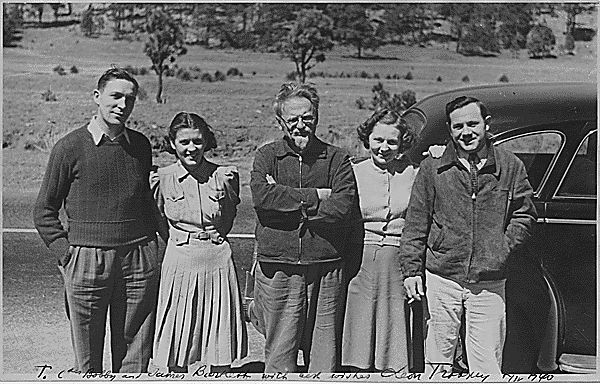 Trotsky and US trotskyists in Mexico, 1940, soon before his death
Interesting quasi-Keynesian economical theory the one explained by Alberto Garzón Espinosa at Altereconomía and developed originally by A. Badhuri and S. Marglin: European economies are in fact wage-led, not profit-led, hence destroying salaries will only sunk the economy further, what the system needs therefore is higher salaries. The problem is that the Economic Doctrine, as in the seminaries... oops, I mean faculties of economics of virtually all universities ignores such fundamentals. The Doctrine says, erroneously, that economies are by definition profit-lead. Demand is obviously driven mostly by the purchasing power of the people and if you destroy this purchasing power in order to minimize costs you destroy the demand and hence the economy. It doesn't matter how much the capitalist saves because he won't find a market for his super-cheap products if there is no demand. This is, by the way, the fundamental contradiction of Capital as described by Marx more than a century ago. And that's why The Capital developed the now deprecated Keynesianism, as mechanism of defense when it faced its first structural crisis in the 1930s. But then came Thatcher and Reagan and their hordes of neoclassical priest-economists and decided that somehow the remedy was worse than the illness (was it?) and launched Reaganomics: plunder today that, in the immortal word of Keynes himself, "the future will take care of its own business". Problem is that the future is today. Meh!Meanwhile they created The Bubble, temporarily replacing the wage-based demand by a credit-based one. It could not last of course and millions of people and even whole nations were pushed into irrational indebtment in order to generate a spurious demand not sustained by the economy itself, i.e. by the salaries. It was nothing but a pyramid scam (Madoff? Thousands like him rule the world today!) Whatever the case, the thesis defended by Garzón Espinosa is solid (not in vain it's consistent with the methodical analysis of the only economist worth that name ever: Karl Marx) and shows that the neoclassical remedies promoted by the FMI and acolytes, demanding salary reduction in order to reduce costs of a production that will nevertheless not find any significant demand, are fundamentally wrong. This is probably the case for any large economy anywhere but it's clearly true for Europe, which lives essentially on internal demand. However, and this is my criticism, in order to make it work properly, a good deal of protectionism would be needed as well, at least while other countries/regions resort to the neoclassical recipes of the FMI. Otherwise the regional demand would be largely "wasted" in foreign products, not supporting the local economies. This is contrary to the interests of the Global Capital, particularly in the Toyotist paradigm, so the recipe cannot in fact be implemented within the system. A change of system, a change of socio-economical paradigm is needed in order to save the economy, which is, let's not forget it, our very survival.
Admittedly I had never heard before of this Argentine economist with cathedra in Besançon but his opinions fit surprisingly well with what I think, so I will try to echo some of his thoughts.Source: Rebelión: Una conversación con Jorge Beinstein sobre la 'crisis general de la civilización burguesa': "Esta crisis es mucho más grave que la de 1929". Interview by S. López Arnal (in Spanish, obviously). Some excerpts:Nature of the crisis: Under the appearence of a curious convergence of many "crisis" (economical, energetic, enviromental, state, urban, etc.) what is actually happening is a general crisis of the burgeueoise civilization. In its immediate origin we find a chronic overproduction crisis lasting for almost four decades (...). Even if this chronic overproduction crisis appears as the trigger, the final catalyst of this civilizational crisis, we must clearly differentiate both concepts. (...) It happens that each historical overproduction crisis left open injuries, structural damage, parasitary degenerations (...) that at the beginning of the 21st century are finally causing a "general subproduction crisis": the general incapability of the system to reproduce itself in an expanded manner anymore, to keep growing in the long term. We are now going through the beginning of the end of a long historical transit (...). In principle we would be at the beginning of a long-lasting crisis-decadence but this is not more than a work hypothesis: History often turns out unexpected. Financial bubble:The global network of real state bubbles was evaluated in dossier at The Economist around 2005, soon before the debacle in the USA, as equivalent to the Gross Product of all rich countries together. This is a lot but it is littile when compared with the sum of derived financial products registered by the Bank of Basel that same year that were an speculative mountain worth 12 times the World Gross Product. The Greater Middle East wars:(...) they believed that the colonial wars in Iraq and Afghanistan would give them the control of a vast Eurasiatic zone stretching from the Balcans to Afghanistan, at whose core, the Persian Gulf and the Caspian Sea basins, are located about 70% of the global oil reserves. (...) This imperialist offensive was pushed by the Military-Industrial Complex (...). Since Reagan's presidency it became entangled with parasitary and predatory business (...) conforming an oligarchic and mafious system that nowadays constitutes the backbone of the imperial power. All that was expressed in an almost caricaturesque manner by the government of George W. Bush and his hawks, now Obama, in spite of his populist gestures, is just a puppet of that highly irrational power whose dynamics push the system towards disaster. The new president (...) is more of the same: militarist business continue their triumphant march generating a fiscal deficit without precedents in US history whose continuation could even cause the bankrupticy of the imperial state in the mid term. Senility crisis:It is necesary to look before 1930: this crisis is much bigger even if we just ponder the financial-economical aspects. Never before in the history of Capitalism was such a huge speculative mass accumulated at all, not just in absolute terms but especially when compared with the World Gross Product. Capitalism today is a mere predatory-parasitary system and that sets an essential qualitative difference with the past. (...)Never before did Capitalism suffer from such a huge crisis, which looks like the inverse phenomenon to the birth crisis of the modern system at the end of the 18th century (...). Now we face a senility crisis of the burgueoise world, with its economical system trapped in financial parasitism, with its imperial Military-Industrial Complex transformed in a decadent machine, its state structures degradated, etc. China: The talk about a "Chinese capitalist superpower of the 21st century" has been nothing but a mediatic hype that recycled the old and always failed illussion of reconversion of underdevelopement into develepoment thanks to the intensification of the burgueoise type transformations. Chinese growth, subordinated to the dynamics of global Capitalism, has arrived to its stagnation stage. (...) sooner or later, and it seems it will be very soon, the once prosperous Chinese industrial structure will enter in a deep crisis that will question in a very general manner the overall status quo. Prospects:Capitalism can survive but in a decadent manner, like has been doing for the last four decades. That will depend on the social and political convulsions caused by its decline (...). The neo-fascist coup attempt of the hawks does not need to be the last one of its kind: the US Industrial-Military Complex is suffering a severe cultural crisis: its internal prestige has declined but still has the instruments to generate a new reactionary alternative. This is a very serious possibility. (...) The only thing they can do is to apply succesive doses of tranquilizers, of partial remedies, insufficient measures in wait of some miracle, that is what doctors usually do with their ailing patients. Comparison with the fall of the Soviet Union:It is a very good comparison, that we can extend to many other pre-modern civilizations, consumed by parasitism and that finally imploded. Enviromental crisis:Enviromental degradation is at the very center of the current civilization crisis: it is tightly associated to the process of predation of natural resources (...) whose ultimate cause is found in technological reproduction of Capitalism. This one has followed a trajectory of some two centuries of creative destruction-predation in the Shumpeterian sense of the concept, that is: with a positive net result from the viewpoint of the expansion of the productive forces... until it has arrived now to a phase of growingly negative redits in civilizational terms, including the enviromental aspect. (...)Enviromental degradation is not a long term problem, a problem for the generations to come in a distant future: it is hitting now the economic activity, rural and urban life. Those who want to leave the matter aside in the name of economic urgencies have a very abstract vision, very detached from factual reality, from the problems of a possible reproductive reorganization, from the necessary energetic reconversion, etc.How the Left should act:We are right now immersed in the Capitalist crisis that looks as of long duration and without foreseable exit. Turbulences have just begun (...). In this new context, the Left should go into the offensive rapidly, developing a wide fan of struggles aiming to power. Gather the anti-system forces, de-estabilize the existing power systems, reduce their social legitimacy, make efforst of social and regional convergence. It is very difficult, almost impossible, to outline a general project for all the left movements around the planet. Nevertheless we can find some common elements: for instance, political democratization at all levels, fracturing the elitist dynamics that defined the neoliberal era: grassroots democracy versus burgeuoise pseudodemocracy. And, beginning from that, recycling of the productive web: of finances, of internal and external trade, etc. That implies nationalizations (...), not to serve the interests of the elites but to transform them into truly public, that is: democratic, with strong imprints of self-management, of administrative transparency, of popular control. It is necessary to deal with the social redesign of economy: redefine consume styles based on quality and durability, rejecting the consumerist dehumanizing, individualist madness. Consume to live and not live to consume. This kind of approach would allow us to adress rationally the energetic issue: facilitating a reconversion that will take some time and that should go through huge energy savings. It should also allow for the developement of strategies of reconstruction in the enviromental aspect. Socialism: The way out of the crisis that I have just outlined is nothing else but a march to Socialism. But what should we understand today as Socialism? Certainly not the kind of statist Socialism experimented through the 20th century, prisioner of a decisive ideological dependency from the military-industrial burgueois statism in rise since the end of the 19th century. (...)Now it is all changing very quickly: the burgueoise civilization drifts without direction, its great myths are beginning to collapse (...). Consequently Socialism today should adopt much more radical, revolutionary and democratic shapes than in the past (...)The emancipation movement must be thought and tried from clearly Communist final goals (...). Socialism concieved as plural path, as process of creative destruction, of institutional breakages, demolitions that allow for the instauration of solidarious, fraternal social structures of production and consume, not anymore as humanist complement of Capitalism but as its revolutionary superation: estabilishing decentralized political structures, incrementing, multiplying direct democracy. Much of that can be found in the revolutioanry movements of Latin America, though I am persuaded it is not just a regional exception. Marx:(...) We are indeed returning to Marx: to critical thought rooted on the rebellion of the exploited, irreconciliable enemy of conformism, of pseudo realist adaptation to what conservatives define as "possible". To the true Marx, not to parrot him but surely to march beyond him. To the Marx without dogmatic ties, to the irreverent Marx, who wrote "I am not Marxist", rejecting that way to become a provider of infallible recipes and eternal truths. Marx' ideas are necessary, unavoidable when we try to understand the current crisis, but they are also not enough. (...) when we try to understand the much more vast challenge of the civilization crisis, we lean on Marx to advance beyond his cultural universe. (...)Banners, slogans:(...) in the last decades we have been smashed by a conservative conformist avalanch that has no precedents in modern history because of its dimensions. It has been less than one decade that a slogan, which we would have laughed upon in the 60s and 70s because of its coyness, became rather popular: "another world is possible". We must begin thinking in terms of "revolution", "socialism", "postcapitalism", not as audacious ideas to share with some friends but as banners for action destinied to the great popular majorities. .
Surprising even for Maoists themselves, they have taken 8 of 10 Katmandu seats and lead in or have already won 82 of 151 constituencies where vote is being counted. Meanwhile, the Nepali Congress may get 28 seats and the Comunist Party (UML) 22. Minor parties would take the remaining 19 MPs, according to Al Jazeera.
I am a little confused because the total constituencies are 240, plus some other 335 seats being elected on proportional grounds and 26 nominated by the cabinet. Why are there only 151 constituencies being counted, what happens with the other 89? And the proportionally allocated seats?
Anyhow, the key of Maoist victory may have been that they have reached out to all ethnicities of Nepal and promised a federal republic.
Naturally neither the USA (who still has them classified as "terrorists"), nor India (that has its own strong Maoist guerrillas controlling many rural areas) nor the Nepali Army see that favorably. Maoist leader Pachendra has therefore made a conciliatory victory speech, promising to be a good neighbour of the two bordering giants: China and India.

Maoist leader Prachendra in a victorius speech
Whoever said that Marxism is dead, should think again.

 Posts
Posts