New blogs

Leherensuge was replaced in October 2010 by two new blogs: For what they were... we are and For what we are... they will be. Check them out.
Showing posts with label The Crisis. Show all posts

Thursday, September 30, 2010

Ireland to waste 30 billion euros in bailing out pointless bank


As a commenter explains under the extremely brief BBC news note, that is the cost of two years of public healthcare. All commenters agree: let it fall, use public money in public investment to generate much needed jobs instead. 


You are probably familiar with this image already: in yesterday's class war pan-European protests a demonstrator crashed this truck, representing the burden of Anglo Irish Bank to the Republic of Ireland, against the Parliament's gates. The incident has become known as cementgate, and is generating a number of silly jokes involving the words concrete and gate, as well as others such as constructive protest, crash, foundations, etc.

But the issue is much more serious: why should a state bail out a private bank? If anything it should nationalize it or, alternatively, just let it fall. Most business do not have the heavy state protection some banks do, nor see even a fraction of the absurdly high profits and disparate salaries for their managers. And most business, unlike banks, contribute to the real and not just the speculative economy.

Ireland is one of the European countries worst affected by the budget crisis, along Greece, Latvia and Hungary, all which are under IMF intervention (with the only result that their recession has aggravated many levels since then). I imagine that the least they can do is to waste 30 billion in a useless bank.

Can anyone tell me what do banks contribute to the real economy? I can't find a single idea, specially since they do not even issue loans anymore. 

Let them fall, all the banks except the public ones (which are the ones issuing money and which can lend directly to the public and even make a benefit from that).

Tuesday, July 13, 2010

Sovereign credit ratings... according to non-Anglosaxons


Specifically, according to Chinese company Dagong Global Credit Rating.

It is not trivial, considering that Anglosaxon companies may have a bias and that China, along with other East Asian countries like Japan, is a major investor in foreign debt.

Definitively the USA, Britain and other major Western countries like France, or even Germany, are not AAA for the Chinese financial watchdog. Notably the USA is rated as merely AA in both local and foreign currency with a negative outlook.

For reference, I must remind that the rating of AAA- of Spain by Standard and Poor caused hysterical reactions from the corporations and the politicians, both locally and at EU level.

Let's see the detail (major powers in bold type)

States that get AAA rating are Norway, Denmark, Luxemburg, Switzerland and Singapore. Australia and New Zealand also get this rating in their local currencies but only AA+ in foreign denominations.

AA+ is achieved by Canada, Netherlands, Germany and China. China also gets AAA in foreign denominations.

AA rating is given to Saudi Arabia and the USA, however the superpower gets a "negative" remark on its outlook.

AA- is obtained by South Korea, Japan, Great Britain and France. Japan however gets a full AA, without the minus, for credit denominated in foreign currencies. Japan, Britain and France get a "negative outlook" remark as well.

A+ is reserved for Belgium and Chile.

A is given to South Africa, Malaysia, Russia, Estonia, Poland and Spain. Poland gets an A- in foreign currency rating. Spain is the only in this bloc with the "negative outlook" remark.

A- includes important countries like Brazil and Italy, as well as Israel and Portugal. Israel credit looks weak but as long as it can get its yearly tribute from Washington guess it'll survive. Italy and Portugal however get the "negative outlook" remark.

BBB includes India, Thailand, Mexico, UAE, Kazakhstan and Hungary. The last two with BBB- in foreign currencies. Hungary and UAE get a "negative outlook" remark.

The category BBB- for both types of bonds is reserved to Indonesia.

BB+ includes Egypt, Venezuela, Nigeria and Romania, this last with a "negative outlook" remark.

A BB ranking is obtained by Greece, Turkey and Iceland. Iceland being the only one with the "negative outlook" remark in this group.

Vietnam gets a BB-, Mongolia and Philippines a B+, Argentine and Ukraine a B, Pakistan B- with "negative outlook" and Ecuador is ranked as CCC, the lowest of all surveyed countries.

The ratings are based on a number of factors, which are fulfilled only by the AAA rated countries:

... political institutions are mature and well-functioning; national development strategies are clear and implemented vigorously with obvious effect; the national security situation is stable; economic strength is strong, and they have powerful global competitive advantage; as the world economic recovery, their growth prospects are assured; they have well-developed financial systems and strong resistance to impacts; the Government maintains a stable fiscal records in long term; although the economic crisis yields the government deficit and debt increasing, the fiscal sustainability are maintained; the internal value of currency is stable; their debts are mainly denominated in local currency, or they have good external liquidity and ample foreign exchanges; the external value of the currency is stable.
Countries rated AA are considered less stable lacking one or two of these ideal components, what makes their solvency somewhat less guaranteed. States ranked A are only strong in two or three of these elements, etc.

The report also includes a comparison with Western rating agencies that makes evident that the Chinese agency is more demanding in order to give an AAA rating but compensate that by giving more AA and A ratings. B and lower segment ratings are similar.

Dagong rates several developing countries higher than its Western equivalents. Of course, one of them is China but also includes Saudi Arabia, Russia, Brazil, India, Indonesia, Nigeria, Venezuela and Argentina. Go BRIC, go! or are the Chinese more objective when rating the developing world?

They argue that:

Dagong holds that the national management capacity of these countries continues to improve, the economic growth potential is stable in the long term, fiscal stability and the resistance capacity against external shocks are getting better increasingly. Especially after the global financial crisis, the performance of these countries prove that they are more likely to turn the disadvantage into advantage in a short time, which could ensure the increase of national credit level.
What seems to make some good sense on light of what we have seen in the news in the last years.

In turn there are 18 countries getting lower ratings by Dagong than the usual NYC-based watchdogs. Of these, more than half are developed Western countries: Canada, the USA, a large list of European states and Israel. There's also a meaningful group of developing countries (UAE, Thailand, Mexico, Romania, Philippines and Ecuador) but these only rank one level lower, while the developed countries of Europe and North America see often their credit rankings reduced by several levels.

Chinese or Western bias? Considering the panic that they are inducing through the media over here about credit issues, I'd say that Western bias looks more likely. However can you trust the media these days?

The Chinese raters argue that:

As a result of the discordance among the growth rate of government debt, the growth rate of the economic output, and that of the fiscal revenue, this group of countries can only maintain their sovereign credit level on the basis of external financing. Since the beginning of 2010, fiscal risks in these countries have not only become the biggest source of systemic risk domestically, but also possibly the main source of the risk of a double dip for the world economy.

There's also a long list of 23 states that get similar ratings by all four companies.


Sources:

Saturday, July 3, 2010

Barroso saber-rattles to impose social degradation in Europe


The right-wing President of the European Comission, Joao Barroso, reportedly warned of military dictatorships coming to life in Europe if the so-called "austerity measures" (i.e. taxing the poor to give to the rich) find resistence.

This is reported by Heinz Dieterich[es] and the EU Observer[en].

According to the latter, the Secretary General of the European Trade Union Confederation (ETUC), John Monks, had the following exchange with Barroso:

The chief of Europe's trade union chiefs, John Monks, has warned that the austerity packages being imposed across the bloc will send the continent "back to the 1930s." He reported that European Commission President Jose Manuel Barroso also fears member states will turn their back on democracy - but for the opposite reason.

"This is extremely dangerous. This is 1931, we're heading back to the 1930s, with the Great Depression and we ended up with militarist dictatorship," the general secretary of the European Trades Union Congress (ETUC) said in an interview with EUobserver. "I'm not saying we're there yet, but it's potentially very serious, not just economically, but politically as well."

Mr Monks reported that Mr Barroso has similar concerns, but based on diametrically opposed reasoning. He said the commission chief believes the austerity packages will save Europe from returning to the darkest days of the last century rather than precipitating the fall.

"I had a discussion with Barroso last Friday about what can be done for Greece, Spain, Portugal and the rest and his message was blunt: 'Look, if they do not carry out these austerity packages, these countries could virtually disappear in the way that we know them as democracies. They've got no choice, this is it'."

"He's very, very worried. He shocked us with an apocalyptic vision of democracies in Europe collapsing because of the state of indebtedness."


For Dieterich, however this exchange is more than mere concern: it is a direct threat:

The European bourgeoisie states, in other words, an ultimatum to the worker and popular movement: pay submissively the costs of the crisis caused by Big Capital or we make you pay by means of the military boot. In political language: if you offer resistance to reduction of your life quality levels, we will move from the veiled bourgeois dictatorship (representative democracy) to open bourgeois dictatorship.

The level of the interlocutors is a clear sign of the seriousness of the threat: Barroso is the highest executive officer of EU and Monks the highest ranking officer of mainstream European labor unions. Dieterich also reminds that it was European bourgeoisie which invented fascism and its variants and which had no problem in 1968 to bring in the tanks to quell the revolt in Paris.

He also cites a report by Merryl Lynch-Capgemini that shows that while the World is immersed in the worst economic crisis since 1930, the number of hyper-rich and their profits keeps growing, a clear sing of who is paying for the crisis: not the oligarchs who caused it but the plain people who has no fault whatsoever (other maybe than being too naive about the real intentions of their rulers and elite class).

Dieterich however calls for a reaction more in the line of the 1840s: when it was becoming evident that revolution was at the gates, the International elaborated a program of action, which had a major impact in 1848 and set the basis for the Worker Movement as we know it. That program is now known as The Communist Manifesto.

Dieterich says that we now know better how Socialism must be (democratic planning, work value and principle of equivalence) as well as how its political structure needs to be (participative democracy) but that we lack, unlike in 1847, unions and intellectuals with class consciousness and critical theory, reason why the European people is "defenseless" in front of this kind of blunt threats.


-----------------------------------------------------

Update (July 4): On second thought, I'd say that the Spanish Armed Forces are so extremely lacking prestige and numbers that they could hardly serve as backbone of any authoritarian regime. The chance of effective military coup in Spain is nil. However in the particular case of the multiethnic realm, a situation somewhat similar to that of Yugoslavia in the 90s may be generated, that is: open war instead of the current low intensity conflict.

I was somewhat intensely involved in documenting and reporting on the West Balcans war in the 90s and I recall a potentially relevant conversation however. It happened in Skopje, Macedonia, in an interview with the leader of the small liberal party. I don't recall neither the name of the man nor that of his party but doesn't really matter.

He related an anecdote of a year or so before the war broke up, a conversation he had with a CIA agent he said. The Macedonian was telling the spy that he was confident in the future because, after all, Yugoslavia was finally, after the fall of the Soviet Bloc, "strategically irrelevant".

To this the North American agent replied mysteriously: "I would not be so happy if my country would become strategically irrelevant". Soon after the war broke up.

The case of Spain is very different: it is strategically most relevant, in particular because it is a platform to control the Gibraltar strait and potentially North Africa and because it hosts key US bases in that strategic area: the naval base of Rota and the air base of Morón de la Frontera. Also for several reasons France specially would not want Spain to break apart (fear of contagion, important neighboring ally, major investments).

So, for good or bad, open inter-ethnic war in Spain is not probably an option, unless powerful third parties would intervene, what does not seem likely at all.

So I would dare say that the threats are empty threats in this case. Greece instead still keeps a large conscription army which can effectively occupy the country, unlike the Spanish one, which can barely just reinforce the police force. However one of the dangers of a conscription army is that recruits can potentially take over it, if they are organized.

The real problem is overall lack of organization of the class forces and a self-defeating pactist dynamic of the mainstream unions. Without grassroots class organization the people is very weak and even police alone, with the help of the media, controlled by the same oligarchic forces, can keep high levels of repression.

But a coup? I don't think so: they'd lose all their remaining legitimacy and would disintegrate easily.

Wednesday, June 30, 2010

The financial coup and the end of Europe as we know it


Economist Michael Hudson has a new article at Counterpunch (Spanish language version at Sin Permiso) analyzing what he bluntly describes as financial coup.

Some key paragraphs:

A balanced budget in an economic downturn means shrinkage for the private sector. Coming as the Western economies move into a debt deflation, the policy means shrinking markets for goods and services – all to support banking claims on the “real” economy.

(...) The idea is to create an artificial financial crisis, to come in and “save” it by imposing on Europe and North America a “Greek-style” cutbacks in social security and pensions.

(...) It is diametrically opposed to the original liberalism of Adam Smith and his successors. The idea of a free market in the 19th century was one free from predatory rentier financial and property claims. Today, an Ayn-Rand-style “free market” is a market free for predators. The world is being treated to a travesty of liberalism and free markets.

(...) Latvia is the prime example. Despite a plunge of over 20 per cent in its GDP, its central bankers are running a budget surplus, in the hope of lowering wage rates.

(...) Beyond merely shrinking the economy, the neoliberal aim is to change the shape of the trajectory along which Western civilization has been moving for the past two centuries. It is nothing less than to roll back Social Security and pensions for labor, health care, education and other public spending, to dismantle the social welfare state, the Progressive Era and even classical liberalism.

(...) The problem is that there is not enough economic surplus available to pay the financial sector on its bad loans while also paying pensions and social security. Something has to give.

(...)

What really is causing the financial and fiscal squeeze, of course, is the fact that that government funding is now needed to compensate the financial sector for what promises to be year after year of losses as loans go bad in economies that are all loaned up and sinking into negative equity.

(...)

This is not the familiar old 19th-century class war of industrial employers against labor, although that is part of what is happening. It is above all a war of the financial sector against the “real” economy: industry as well as labor.

(...)

Latvia has been held out as the poster child for what the EU is recommending for Greece and the other southern EU countries in trouble: Slashing public spending on education and health has reduced public-sector wages by 30 per cent, and they are still falling. Property prices have fallen by 70 percent – and homeowners and their extended family of co-signers are liable for the negative equity, plunging them into a life of debt peonage if they do not take the hint and emigrate.

(...)

The explanation, of course, is that today’s economic planning is not being done by elected representatives. Planning authority has been relinquished to the hands of “independent” central banks, which in turn act as the lobbyists for commercial banks selling their product – debt. From the central bank’s vantage point, the “economic problem” is how to keep commercial banks and other financial institutions solvent in a post-bubble economy. How can they get paid for debts that are beyond the ability of many people to pay, in an environment of rising defaults?

(...)

This is why I say that Europe is dying. If its trajectory is not changed, the EU must succumb to a financial coup d’êtat rolling back the past three centuries of Enlightenment social philosophy. The question is whether a break-up is now the only way to recover its social democratic ideals from the banks that have taken over its central planning organs.


I could add many things but would be mere extensions on this analysis. Sadly enough, Hudson is right and, unless the People of Europe reacts very strongly, the continent will be plunged in a matter of years into the most dystopic scenario with the vast majority of citizens dumped into misery conditions, industries fleeing or dying out and mafias running the only remnants of the economy.

The corruption of the parliamentary representation system, with nearly all politicians being nothing but puppets of their financial patrons and with nearly no free media surviving, plus the destruction of effective state sovereignty is leaving Europe (and the World) on the hands of the big bankers, who have only one goal: to keep their profits high for as long as possible, concentrating all the wealth in their hands, without any real plan for the future other than that.

Capitalism has taken off its mask. It still tries to sell workers' austerity as something "good" but in fact they have no project whatsoever anymore. The Cold War illusion of welfare under capitalist conditions is all but dead now: class war has become very real.

But by the moment at least, the bad news is that the oligarchs are winning the war. For how long?

Sunday, June 20, 2010

Thousands against the High Speed Train in Bilbao


Thousands of Basque citizens demonstrated yesterday in Bilbao against the hyper-costly and destructive project of the High Speed Train (AHT by its Basque acronym).


While it was announced yesterday that budget constrains mean that another idiotic destructive project, the second Guggenheim Museum planned for the Urdaibai Nature Reserve, is being dropped by the illegitimate Basque autonomous government, the High Speed Train connecting the three Western Basque capitals is still being developed, splitting whole districts.


The figure 4790 (photo above) reflects the debt in euros that each Western Basque is being forced into for an elitist project that has no positive value for most and has a very negative impact instead.

The High Speed Train is like a fast highway, a walled corridor that divides the areas where it goes through in two, splitting the ecosystem and the social and economical tapestry of the country. And all for nothing, because traveling between the Western Basque capitals does not take more than an hour (by car, less than two by the actual conventional train). Additionally there is no current project either in Spain nor France that would link this infrastructure to other areas or cities.

Sources: Gara[es], Berria[eu], AHT Gelditu Elkarlana[eu-es-fr].

Friday, June 18, 2010

Iceland setting example: 10 bankers on trial


Unlike any other country affected by the hyper-abusive criminal practices of the banking sector (not the USA, not Britain, not Spain, not Germany, not Greece...), the small Nordic republic is doing the right thing: rounding up the corrupt bankers and putting them on trial.


Main stockholders and managers of three large Icelandic banks, Kaupthing, Landsbanki and Giltnir, are being prosecuted in their country for the crime of fraudulent appropriation of funds via ad-hoc loans from their own banks. The state administrators of the banks, now nationalized, are also considering raising charges against the auditor of these banks, Pricewaterhouse Coopers, for collaboration with the fraud.

The accused bankers are however exiled in foreign countries like the USA and the UK, and while their assets are being frozen, extradition is not yet granted.

Source: EstrategumTrading (in Spanish).

Friday, May 28, 2010

Eurozone's problem is Germany


Interesting review by Prof. Vincenç Navarro
at his blog[es] on how the real problem of the Eurozone is not really the rather normal finances of peripheral countries but in the lack of demand of the central countries, notably Germany.

Germany, supposedly the economic engine of the EU, has been pretty low in the last decade, with small GDP growth figures and high unemployment. What is worse: the domestic demand of Germany has been lower than the peripheral countries now being punished for precisely sustaining the economy of the Eurozone (and specially of Germany itself) with their demand.

This is because Germany, still with a social-democrat government then, chose not to use the huge surplus that conversion to the euro generated to increase its domestic economy by rising salaries (and hence demand) but to speculate in the peripheral countries feeding the housing bubble and the deficit escalation.

Germany is in fact the wealthy but savy cousin who wants to sell commodities to their less well off relatives. And oddly enough, it has worked for a while, thanks to German (and French) credit. But logically this was untenable in the long run and now the Germans (and the French) want their money back by any means, what implies the destruction of the demand for German products.

As I said before, Mr. Volkswagen: how do you expect us to buy your cars if we work for misery salaries and pensions?

Navarro mentions that Oskar Lafontaine, then minister of economy and now co-leader of the growing communist Die Linke party, left Schröeder's government and the SDP for that reason. Lafontaine proposed instead a more balanced approach, increasing the income of German workers and hence the internal demand, what would have created a much more balanced EU and not this neocolonial engender designed for Mr. Volkswagen exporting until the demand runs dry (what is happening right now).

So what really needs to be fixed is that historical error that highly imbalanced the demand in the Eurozone. The demand by Germany and other Eurozone countries need to rise, what probably means increasing local salaries.

That does not mean that other barbarities like the Spanish housing bubble do not need to be addressed, they do. In fact Spaniards could work for less or demand more commodities if housing prices were not so extremely high, and that's a good reason to explode this bubble. But that would cause serious trouble to banks, who have invested heavily in this worthless excercise of financial engineering.

That's after all the real problem we have in EU: if we do what is logical (explode bubbles, restore a healthy demand by rising income), then banks would sink. Nobody cares about that except banks themselves, because they can always be replaced by other more serious banks, private or public. Of course some private investors would suffer but most people would be unscathed.

But the interest of the people does not matter to policy-makers, specially as EU is anything but a democracy, so Brussels and the Eurozone oligarchs have decided that it's best to make people pay for the errors of the banks and re-level the Eurozone demand to misery levels by lowering income and making sure that the banks are paid back.

This is extremely short-sighted: it's bread for today and hunger for tomorrow. Even for the bankers. If there is only a very low demand in the Eurozone, then Mr. Volksvagen (my imaginary archetype of European capitalists) won't be able to sell nearly anything and the economy will become stagnant for a very very long time.

The problem is clear: who dares to hang the bell from the cat's (banks') neck? It's much needed if we want to avoid Europe from sinking into misery and self-destruction.

Nobody? Then I think I know where the first socialist revolution of the 21st century will happen.

Tuesday, May 25, 2010

A critique of the Latin American "new left" governments from the left


The always interesting James Petras addresses
at Voltaire Net the issue of the limits and frustration of the "revolutionary" governments in Latin America. It is a very critical article that emphasizes how far from socialism these governments are and how this is triggering increasing protests by the grassroots that are accused of "trotskism" or even of helping the reaction.

It is a very long article that I can hardly synthesize here but basically he's saying that these governments, in their diversity, are mostly populist developmentalist (nationalist) soft capitalist systems under a red banner, much like China (red outside, white inside), which have not even realized the much needed agrarian reform, with the partial exception of Venezuela.

Petras also mentions how the strong revolutionary movement that existed a few years ago in Mexico has fragmented and looks powerless against the narco-feudalization of the country for that reason. In this context, he also makes the controversial claim that mafias offer a way out of poverty by means of "armed struggle", which has obviously no pretense to have political implications but may be true for the subjectivity of the individual slum-dweller and his/her survival and potential success immediate needs.

Possibly the conclusions can be those outlined in this paragraph:

The workers and peasants are increasingly recognizing that they are not the beneficiaries of the economic successes, growth and stability, celebrated by the leaders of the developmental regimes. The left must encourage, organize and capitalize on the masses’ rising expectations for higher living standards in the face of record high commodity prices. In recent years, too often, the left has fallen prey to the ‘theater’ of a self-described “new left” and its “anti-neo-liberal” rhetoric, even as it increases the presence of multi-national capital (MNC). The new “state-MNC” partnerships exclude the working class from the profits and revenue which, instead, are distributed between new rising middle professional and technocratic classes and foreign investors.
Criticism of the Left by the Left, as it should be. The Right is obviously not out of the process yet but it is just a dead weight, unable to produce any socially meaningful project, just more robbery and exploitation of people and Earth, something that has become simply unbearable. So, in a sense, we can say that the Right is out of the process and fatally damaged by its own incapability of generating happiness.

However the institutional Left is also limited by its own subservience to Capital and their own political liabilities, including personality cult and lack of revolutionary ambition. On the other hand it's difficult to imagine how such peripheral economies (though every day less peripheral probably) can lead the revolutionary process, that at this stage can only be global.

Though maybe I'm wrong in this.

Saturday, May 15, 2010

Spanish budget cuts less than quarterly benefits of just four companies


I'd say this is a very relevant figure: it means that taxing these companies 25% on benefits would allow the government to keep spending. As there are many more companies, the tax could be much lower, of course.


According to the labour union Basque Workers' Solidarity (ELA), just four large Spanish companies, Banco Santander, Banco Bilbao Vizcaya Argentaria (BBVA), Telefónica and ENDESA, earned in the last quarter more (6.6 billion euros) than the local IMF's puppet, Rodríguez Zapatero, aims to cut in public spending this year (five billion euros).

But instead of taxing them, the government gives them public aid: 61 billion that would have been much better spent in much needed pensions, direct public investment and unemployment aid.

This is an outraging situation not restricted to Spain. In fact it's the generalized abuse in which EU countries, following US lead, have fallen in: tax the poor to give to the rich.

Nothing less than 3.7 trillion euros have been gifted to the banks after squeezing them from the public. And now they say it's time to cut welfare and salaries. Are we dumb or what?!

The public aid to banks reaches the 12% of the European GDP and is going to reach as much as 22%.

Meanhiwle stocks sink anyhow... I wonder if some remnant of common sense in the brains of the vampires is telling them that this rape is just the last untenable bubble and that they are going to even devour the very states and imperial that allow their mere existence. If so, it doesn't matter if you sell or buy because neither kind of paper is going to be worth anymore.

You know I have very bad opinion of Capitalism but something I never really expected it to do was to suicide in this stupid way. I though they'd fight till the last penny but seems that they prefer to destroy all society as long as they can have their dose of benefits today.

Damn junkies! They can never think of tomorrow!

Source: Gara[es].

Thursday, May 13, 2010

The reality of Capitalism


In these days when the Spanish government bows to Emperor Barack I and his court of EU and IMF bureaucrats, cutting the budget in anything but police and military spending, it's good to know what are these promoting at the expense of the common citizen.


Argentine sociologist, Atilio A. Boron, explains at his blog[es] with facts what is Capitalism. I use his data here with my own comments:

Population: 6.8 billion. Almost 100% live in Capitalist areas (with very few exceptions nowadays). Of which:

  • 1 billion (15%) are chronically undernourished
  • 2 billion (29%) have no access to medicines
  • 884 millions (13%) have no access to edible water
  • 924 millions (14%) have no home or live in precarious ones (slums)
  • 1.6 billion (24%) have no electricity
  • 2.5 billion (37%) have no sanitation
  • 774 million adults are illiterate
  • 18 millions die (are murdered by the system) every year because of poverty, most of them children under 5.
  • 218 million children (5-17 y.o.) work under slavery conditions in dangerous or degrading jobs such as soldiers, prostitutes, servants, agriculture, construction or the textile industry.
  • 25% of people have only 0.9% of all wealth, while 10% owns 71%. Data from 2002, when it had worsened in relation to 1998. It's most likely that the gap today is much wider.
  • In this 1998-2002 period the wealthiest 10% increased their wealth in 6.7%, fraction that, if distributed, would double the incomes of 70% of people, saving many many lives (and activating the market a lot).
He concludes:

After five centuries of existence this is what Capitalism has to offer. What do are we waiting to change the system? If Humankind has a future it will be Socialist. Under Capitalism instead there will be future for nobody, not for the poor and not for the rich. F. Engels' sentence, which is also R. Luxemburg's one: 'Socialism of barbarism' is today more real than ever before. No society can survive when its vital drive is greed and its engine is profit. Sooner or later it causes social disintegration, environmental destruction, political decadence and moral crisis. We are still in time but we cannot wait for too long.

Wednesday, May 5, 2010

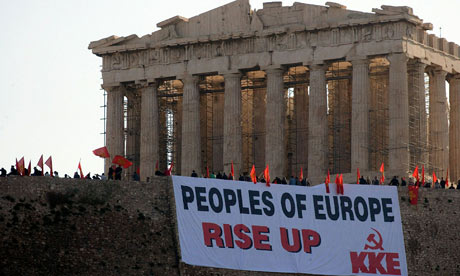
Greece and Europe can only do one thing: a Revolution


As the pace of the Greek revolution speeds up, with the first casualties in a burned down bank office and the Greek Parliament besieged daily by the angry people, one may wonder why is people so angry. After all, according to the Imperial media, it's all their fault and the government is doing what it must do to save the nation.


The answer is logically that people is not so naive: they have barely, if at all, benefited from the bad practices that have triggered the crisis (rather the opposite) and they have yet to see any of those white collar criminals being brought to court and their properties seized to help pay the national debt.

The answer is that the whole nation is being held for ransom for the corruption of a handful of oligarchs and, what is maybe even more important, their international accomplices.

That's simply not acceptable.

And obviously this means a regime change in Greece: one that can effectively arrest the criminals and issue the appropriate international capture orders for their accomplices in Washington and Brussels.

One that has no problem in nationalizing the product of past years' robbery when possible.

One that dares to declare bankruptcy if need be.


So Greece is set for a revolutionary regime change and that is most unlikely to be prevented because there is no alternative. The only question is the pace and exact extension of this change.

But what about the rest or EU. EU can live without Greece but can it live without half of EU members? Because the speculators' aim is already set to other Eurozone states. It seems by the signals that the Iberian peninsula will be next but Italy, Ireland and the very UK (out of Eurozone but of great importance by its size) are clearly in the agenda.

The European Union today.
Eurozone in blue, comitted to join the Eurozone in green, special statuses in red, non-EU states using the euro in purple.
Stripes signify those states clearly targetted by the Transnational Capital to be ripped off in a "controlled demolition" (Latvia included because it's already suffering the IMF blackmail).
Original map from Wikipedia (modified).

The goal is to recycle these countries into cheap labor zones for the Euro-Global Capital without these vampires losing a cent in the process. The 'problem' is that the plan may go awry and trigger a pan-European revolutionary process.

Maybe the level of popular organization is not yet high enough but, even if the Transnational Capital achieves its goals it can only be a temporary situation as the rage they will leave behind in some of the more privatized and less well-off states of EU, where people do already struggle to make ends meet, cannot really be contained in the mid run.

While the Greek spending spree may have been going on before the advent of the Global Crisis, in the rest of countries public spending has actually been a reaction, a much needed one, to this disintegration of the Capitalist World Order. Claiming that states have to cut spending in the midst of a general crisis is totally absurd: states must increase their spending to put up for the inability of the so-called "market economy" to generate jobs and salaries, which are after all the only ones that will generate demand for the beleaguered private companies, at least for most of them.

Cutting public acquisitive power is not an option, not even for German capitalists: it's a suicide.

If the European Bank must print more euros, so be it. If the euro has to be devaluated, that is not a problem but in fact good news for European companies, which would see their international competitivity improved greatly by such measure.

But EU institutions are not working for the good of the European common citizen (or should I say denizen?), EU institutions are only working for the good of some privileged elites and they don't care at all about the common European, not even about the common European small company. Only huge multinationals matter for them.

This situation obviously demands a regime change at EU level. A regime change that redefines EU as a social federation and not as a capitalist one, a regime change that establishes EU finally as a representative democracy and not a mere bureaucracy at the service of the transnational mafias.

It may take some time but it will be done. The only alternative is for EU to disintegrate completely and its various states (or fragments of states in some cases, as Spain for example is not going to survive this one in a piece, nor will the UK) let to fend off alone in the vast ocean full of sharks. That's not a realistic or at least desirable goal and it's something that goes against the common feeling of nowadays Europeans, for which a European union, this or another better one, is a default.

So the only alternative is pan-European revolution.

Let's do it, do you have a better plan for today, my dear unemployed bored and desperate reader?

_________

Note: you can read the declaration of a colleague of the dead bank workers blaming the deaths on the bank owners at Occupied London (in English) and Indymedia (original in Greek). Triggered by this tragic incident, the Greek bank workers are going to strike tomorrow even if the corporative guild forbids them to do so.


Monday, May 3, 2010

Greece and Spain like Latvia, Portugal to tax the rich instead.


There's a nice article of economist I. Esnaola at Gara today, illustrating how the "rescue plan" of the IMF-EU tandem is a recipe for disaster. It is exactly the same "medicine" Latvia got in 2008 and things have only got worse for them since then: growing unemployment (even higher than Spain!), "growth" of -18% in a single year, and all without being able to stop public deficit from running wild at all.


That's exactly what they want to impose to Greece, just that the Greek people seem much less sheeply than Latvians and may just send IMF, EU and everything of the like to the trash bin in the process.

Spain does not seem to need an IMF package: it is already applying one: on its own will nearly all state income is reliant on a growing VAT (consume tax, now to be raised to 18%) and from tobbacco, alcohol and gasoline special taxes. Meanwhile the wealthy enjoy the best deals, what makes Spain unable to collect enough money for its expenses.

Instead, the only conservative government of the three South European countries, that of Portugal, has decided to tackle the tax crisis by raising taxes to the wealthy segment, up to 45%. It's clear that they are the only ones who know how to deal with the budget crisis: redistributing and not just loading the scales against the working class even more.

Saturday, May 1, 2010

60% of Greeks wish for 'a genuine left-wing party'


Interesting review of the situation in Greece
by Fred Weston at Rebelión[es].

One one side he makes an analysis of the positions: the working class, the majority of the people wants some sort of radical change and is not willing to put up with the IMF-EU impositions that would cut pensions by even as much as 50%, among other Capitalist measures of the like of those imposed by Pinochet in Chile. The tamed labor unions and established "left" parties such as the Communist Party are just letting pressure go with limited demonstrations but don't seem willing to corner the "socialist" government and rather prefer to just pose the anger in the vague hope that the government will step back.

The problem is that the government cannot step back. After all social-democratic parties such as the PASOK are nothing but violin ones: supported by the left but played by the right. And making genuine left measures such as embargoing the debt and nationalizing companies and banks is well beyond their imagination and their real positioning.

Then Weston analyzes the opinion polls, which show that the PASOK is sinking but to the benefit of absolutely no other party: both the right (culprits of the ripoff and accomplices of the IMF-EU neocolonization) and the established left (the communist KKE and the 'new left' Syriza) remain static in vote intention. Here is where we come to know that 60% of voters would want 'a genuine left party' to vote for.

Easier say than done I guess but it's clear that there is popular demand, that the people is ready for such thing as a true socialist party that can face globalized Capitalism with some dignity for the good of the people.

The conditions are there: revolution is awaiting in Greece. How will it manifest.

PS- keep also an eye in neighboring Albania, where the right has rigged the elections bringing multitudes to protest in the streets of Tirana. We are now standing on a moment of uncertainty when everything becomes possible, except the old regime. It is impossible to predict how the situation will evolve locally and globally but we should expect many surprises and sudden twists. But of course expect growing discontent everywhere coalescing more or less rapidly into revolutionary options, which may eventually come to power.

Greece: why are not the thieves behind bars?, their properties confiscated?


Day after day we read about the Greek crisis and its ramifications. We know by now that a good deal of the responsability behind this case was that of a corrupt government and companies.


But we know little more about that. Some anecdotal details but not a word about any of the culprits being brought to trial or his/her property expropriated to pay for some of the national debt they used for their own benefit.

This is the most outrageous element of all the process: some oligarchs have brought a whole nation to heavy indebtedness and they are not even charged?! Their names are almost not mentioned, their practices nearly not inspected, their wealth (obviously the product of such anti-patriotic larceny) not even considered.

What's wrong?

It's as simple as this: some people and companies scammed a whole nation, they must be held responsible for it and their assets must be returned to the nation so it can face this challenge form a better position.

Yes or yes?

Wednesday, April 28, 2010

Should Greece declare bankruptcy?


It may be a realistic option considering the alternatives promoted by the FMI-EU tandem. Anyhow, after the BB+ rating by S&P it will not make much difference.


BBC reproduces a demonstrator's opinion, a bank worker's one to be more specific:

We should opt for bankruptcy. Goldman Sachs, Deutsche Bank, Wall Street, they lent us the money. (Far better) they lose their money and people don't lose their jobs.


But the case is: can small Greece, with only 10 million inhabitants and not so many natural resources other than sunny islands for turism survive alone? How?

I have little doubt that the Greek people have the organization to go in revolutionary spree. They may be the only ones in Europe in fact in such excellent revolutionary conditions. But, even if they succeed, what then?

A more realistic case may happen in Iberia, a far larger area and next on the list for catastrophic FMI-dictated austerity packages. Iberia does not have such a large well organized class struggle as of now but, in the case it would, it could indeed hold a very viable economically autonomous area (Spain alone is right now the 9th global economy by GNP, holding 2.5% of the World's GDP (nominal), almost half of Germany's). Even in the case of international ostracism it can find some economic space working with Latin America, largely a red zone already, for example. Geographically closer Arab countries such as Lybia and Syria are also potential partners for any ostracized Mediterranean power.

Of course, there are two problems:

One is the tight rope of the euro, which should be in fact the main problem to address at pan-European scale (from a liberal perspective), devaluating it significantly in order to boost exports, reduce imports and secure jobs and public services. The North European gang, lead by German Capital, is however getting too many benefits from this situation and unable to react fast enough to to protect the system they have created for their benefit. The fact that Germany exports mostly to EU countries says it all.

The other is military intervention. If anyone believes that the Empire is going to let countries leave without intervening, he/she is of course very wrong. The first line is indeed the local armies and police forces, normally with strong right wing, fascist-like tendencies. But they can succumb to popular pressure and nationalist feelings. They can indeed also be defeated by political ways or their intervention trigger organization of guerrillas and such. The second line is direct military intervention by NATO (with similar or even worse results).

Whatever the case, the foresight for the next years is drastic increase of class tensions and possibly revolutionary changes (or alternatively anachronistic, and hence doomed, fascist attempts) in Southern Europe (among other places: the oven is very hot everywhere).

This situation would be unthinkable just a couple of years ago but now it appears as almost unavoidable. Thank Goldman Sachs and the other global bankers for this.

Next the sight stops on other even more sizable countries: Italy, France, the UK... none of them too buoyant. A very bad scenario is also ripe for Eastern Europe (Latvia is the most outrageous case but the rest are not well off either) and even Northern Europe (Iceland could not scape the voragine either).

Sooner than later, Germany itself will have to face the consequences of this global disaster. Best would be to act at European level but the EU building is frail and patchy, undemocratic and controlled by the big corporations. It's not an instrument of change but of continuity.

However class organizations should coordinate and direct the fights at this level, as the state level is obviously too limited to produce results. So far workers in Greece, in Latvia, in the UK, in Italy... are fighting separate battles against the same enemy. This may help the collapse of EU but is not really an effective way of struggle. We should see masses of people striking at Madrid, Paris and Berlin in support of Greek workers... but it seems that this people's facet of Europe has yet to be created.

It will eventually because nowadays state governments are very much powerless and irrelevant, so the action has to be taken at pan-European levels, if not at global ones. But this stage has not yet arrived and hence it's easier to witness a collapse of EU than a pan-European revolution. Still I'd prefer the latter, strongly so, and I think it is the way to go.

Friday, April 23, 2010

Financial madness: how they rob us in daylight and how things will only get worse


There is an interesting spat of economic articles at
Global Research these days. Really too much for me to fully understand and analyze but indeed enough to get me on my toes because no one of them is the least hopeful.


The Goldman Sachs ripoff

Maybe the most visible to the usual media reader/watcher/listener is the new Goldman Sachs scandal, analyzed by Patrick O'Connor and Barry Grey at The Goldman Sachs Indictment. They blame the Zionist corporation of precipitating the collapse of the housing bubble in their benefit and they say that GS is going to get out of this one with just a fine, a drop on the ocean of what they robbed, largely because the Obama administration is largely made up with their men. Only one real person is indicted, a 31 years old junior trader, while the infamous GS CEO, Mr. Blankfein, nor their customer, Paulson Inc., are named in the cause.

Their actions—exhibiting an insatiable and manic drive for personal enrichment—have produced devastating consequences for tens of millions of ordinary people, not only in the United States, but around the world. Millions have lost their jobs, their homes and their life savings. Untold numbers of young people have lost their chance for a college education. Untold numbers of old people have been driven into poverty and an early death.
And Reagan, the prophet of late Capitalism, said that "greed is good"... What do you think? Good for whom?

This same story is also dealt with in another article by Robert Scheer. He begins with rough words:

The story of the financial debacle will end the way it began, with the super-hustlers from Goldman Sachs at the center of the action and profiting wildly. Never in U.S. history has one company wielded such destructive power over our political economy, irrespective of whether a Republican or a Democrat happened to be president.

At least the robber barons of old built railroads and steel mills, whereas Goldman Sachs makes its money placing bets on people losing their homes. On Tuesday, Goldman announced a 91 percent jump in profit to $3.46 billion for the quarter, while the dreams of millions of families continue to be foreclosed and unemployment hovers at 10 percent because of a crisis that that very company did much to cause.

And ends with even more discouraging words:

It is insulting to the spirit of populist revolt, which has been fundamental to the success of America’s grand experiment in democracy, that a fat-cat Republican-funded tea party revolt is now the vessel of popular anti-Wall Street discontent. That vessel ought to be our president, who campaigned as a champion of the common people.
Certainly Machiavelli himself would scold Obama badly. His ideal prince would cut the GS head quickly before more damage is made and also to score in popular support, which for Machiavelli is a critical asset for any leader worth that name (and who wants to stay as leader).


Mafianomics

I borrowed this subtitle from Mafianomics by Michael Werbowski. You thought the GS ripoff is bad enough? Well, I'm really sad to inform you that it is only the tip of the proverbial iceberg: the system is rotten to the core.

But Werbowski is kind of soft and imprecise: he complains about how bad is today's capitalist speculation and how immoral is profit for the sake of it, regardless of the pain it causes to society. But for a Red like myself this sounds a bit like idealizing some sort of cavalier feudalism or benevolent slavery and complaining that reality never meets the ideal. Capitalism is that way: rotten scam and organized robbery from the beginning. You should know better.

More interesting and detailed is the article by Ellen Brown titled Computerized front-running and financial fraud. Here we are placed in front of the daily reality of the mafioso scam.

It was initially just a patented program to take on the role of the specialist (the specialized brokers that are the pillars of the stock market) and make it more efficient and faultless. But, after the dot.com crash, the patent had to be sold and ended up in the "wrong hands": a private investment corporation. The program was hence altered to do exactly the opposite of what it was supposed to do: to take advantage of stock market weaknesses. This would have been illegal in EU but seems to be legal in the USA. Also other 132 such "improvements" have been patented after the original one by Keiser.

So nowadays there is a whole array of broker companies taking advantage, thanks to supercomputers, of mere instants in data transmission and processing to make their own speculative bids and ripoff everybody else, who do not have such means.

The details are even more complex and I'd say interesting and, of course, Goldman Sachs is denounced as the ring leader of this mafia, but you better read the original article to get the whole picture.


The new financial bubble.

Another rather worrisome piece is the article by Washington's Blog titled Are interest rate derivatives a ticking time bomb? Here we can read about one of the methods of institutional ripoff by well organized financial mafias and what is seemingly another bubble that will soon blow out on our faces.

What are interest rate derivatives? I could not get a clear idea, sincerely. It is a complex financial instrument designed to hedge financial risks. But, as the article states clearly, people tend to overestimate their ability to understand complex financial instruments. So I won't be so arrogant when even the bosses of the credit default swap scandal had no idea what they were dealing with. I'll better admit my own ignorance.

But whatever they are it is important to understand that they are based on notional values (i.e. the money on which they are based never really changes hands: it's essentially an accountancy tool) and that's the only way the derivatives' market is ten times the size of the global GDP. In other words, while the real economy (more or less, as GDP has some flaws too) amounts to 60-70 trillion USD, the derivatives' market is estimated in 600 trillion.

If that's not a bubble you tell me what is it.

The authors admit that, in theory, these complex financial instruments are designed to keep the balance of the scales but they also warn that theory and practice may not go hand by hand. And when George Soros himself warns against them, then it really gets worrisome:

I must state at the outset that I am in fundamental disagreement with the prevailing wisdom. The generally accepted theory is that financial markets tend toward equilibrium and, on the whole, discount the future correctly. I operate using a different theory, according to which financial markets cannot possibly discount the future correctly because they do not merely discount the future; they help to shape it. In certain circumstances, financial markets can affect the so-called fundamentals which they are supposed to reflect. When that happens, markets enter into a state of dynamic disequilibrium and behave quite differently from what would be considered normal by the theory of efficient markets. Such boom/bust sequences do not arise very often, but when they do they can be very disruptive, exactly because they affect the fundamentals of the economy…

The trouble with derivative instruments is that those who issue them usually protect themselves against losses by engaging in so-called delta, or dynamic, hedging. Dynamic hedging means, in effect, that if the market moves against the issuer, the issuer is forced to move in the same direction as the market, and thereby amplify the initial price disturbance. As long as price changes are continuous, no great harm is done, except perhaps to create higher volatility, which in turn increases the demand for derivatives instruments. But if there is an overwhelming amount of dynamic hedging done in the same direction, price movements may become discontinuous. This raises the specter of financial dislocation. Those who need to engage in dynamic hedging, but cannot execute their orders, may suffer catastrophic losses.

This is what happened in the stock market crash of 1987. (...)

There is much more but you better read it yourself.

Sunday, April 18, 2010

The volcano that collapsed all


I don't normally write on news that are on the main pages of all media, but the unpredictable consequences of the infamous volcano Eyjafjallajokull really deserve at least a few lines.


First of all, I admit I am guilty of copy-pasting the name of the volcano. Really it will take me more than just a few days to learn to spell that Icelandic word and therefore I have decided to call it simply Eyja, which I hope doesn't offend it.

And anyhow, it was just a matter of time before it was nicknamed somehow, yes or yes?


Impressive image of Eyja borrowed from Al Jazeera

Anyhow, Eyja's polluting power is such that in just a few days of eruption, otherwise not too destructive, it has created such an unprecedented chaos in modern globalized Europe that wealthy men are begging in Warsaw for a ride back home and airlines are rumored to be preparing to fire personnel. Meanwhile the roses from Kenya or the kiwis from Chile can't reach their European markets and the ash cloud has already reached East Asia causing widespread disruption there as well.

But this is probably only the beginning. Vulcanologists can't predict the duration of the eruption but, in any case, so far has only got stronger and stronger. It could be just two days more... or it could be two years. Nobody knows.

The closest precedent is that of Laki volcano, also in Iceland, in 1783, which lasted for eight months and historians link to crop failure and being one of the triggers of the French Revolution.

There are indeed no precedents for such a widespread closure of air space. The closest case experts can think of is the brief closure of US air space after 9/11. But even that is not comparable: now there's no way to predict how will be the situation just a few days ahead... though the most likely is that it will remain the same or even worsen.

And it is affecting the economy: businessmen can't fly to meetings and fairs (even presidents and prime ministers had to suspend their journeys), some imported food will soon become scarce in your local supermarket and some of the most profitable sectors, such as pharmaceutics, rely on air transport heavily. According to The Guardian, even if only 1% of the volume of British foreign trade is done by airplane, it is nothing less than 30% of its exporting value!

Add up all the many disruptions and their cumulative chain effects in the context of an already very severe economic crisis... and let your imagination fly - because there are no precedents, really.

Of course Eyja could stop tomorrow... but that's not very likely to happen.

Saturday, April 10, 2010

Unemployment: what fails and what works


I just stumbled upon
a pretty interesting program from Al Jazeera's Fault Lines on the problem of unemployment in the USA (it could be almost anywhere else: I know similar cases here in the Basque Country).


What fails? The so-called market, consumerism, individualism, taboo of socialism. In other words: Capitalism.

What works? Intelligent public subsidies and cooperatives (worker-owned companies that will never leave the community).

The full documentary lasts 30 mins.

Main US banks cheating on accounts to hide real debt levels


That's what Basque newspaper
Gara reports, citing the Wall Street Journal as source: that the largest US banks (Goldman Sachs, JP Morgan, Morgan-Stanley, Bank of America, Citygroup...) are using creative accountancy (legal but more than dubious) to make their quarterly results look much better than they in fact are. These tricks are exactly the same as those Greece used to hide its real debt and also those used by the ill-fated Lehman Brothers bank.

The effect is that their debt levels are underestimated by c. 42%.

But you know: you can't deceive everybody forever.

Wednesday, April 7, 2010

The Fed might be feeding zombies


Interesting analysis the one by Mary Bottary I just stumbled upon
at The Huffington Post.

There is an ongoing lawsuit by Bloomberg (the financial media giant) against the US Federal Reserve (known simply as the Fed), trying to force it to disclose the assets it is taking as guarantee for its loans. Legally the the Fed can only loan against investment grade assets but there are serious doubts that many such guarantees are anything but toxic assets without real value.

Bloomberg has won twice in court but it seems that the appeal chain will continue.

The ammount of public money being lent to financial institutions, estimated in 2-3 trillion US dollars, dwarfs the infamous bail-out of some 700 billion for the "too big to fail". The impression, unless those assets are disclosed and happen to be good (a most unlikely case, I'd say), is that the Fed is feeding zombie financial institutions with no real solvency.

The same author brings her analysis further at Global Research, with several links that I still have to explore in depth and even the fashion widget of the decade: a financial crisis tracker!

She there says that the flow of public money to the zombie banks is as large as 4.6 trillion dollars, nothing less than 32% of the US GDP (2008) and 130% the federal public budget of this country.

Of that public money a good deal is being used directly against the interest of the poorer US citizens, by artificially keeping the housing market high. The apportion of public money diverted to this endeavour is nothing less than 1.5 trillion dollars: double than the official bail-out.

In brief: yet another bubble, this one of a "defensive" nature and massively supported by public money. The great global Capitalist financial engineering ponzi scheme that has ruled our lives for the last decade (or probably the last several decades) is being kept under artificial support by the public institutions in charge to prevent such thing from ever happening.

Reality always beats fiction but this is not different from the best of the tales of the Grimm Brothers: the Emperor's clothes. A great lie has been spread but the truth is just before our eyes: the flamboyant neoliberal economy doesn't really exist anymore, at least at many many levels.

However some still believe that the economy is more financial engineering than real economy, that offer can stand alone by mere illusionism without a real demand to buy its products (a very clear and central case is the housing market... or rather lack of market... and not just in the USA), that the people can be robbed endlessly and still be consumers.

Sorry to inform you that such thing is impossible. This was understood by Marx and even by capitalists such as Henry Ford but was at some point this basic economical principle was ignored altogether. Now all the efforts are put to prevent the bubble to explode, as it should already have done, because they feel, with reason that the result will be more than just problematic. But there's no other way and we must face reality.

If the patient has to die, it's time to disconnect the artificial support. Because there's no new life without death and anyhow even the best health care cannot grant immortality.

There are no eternal orders, only Chaos is eternal.

Change must happen and the sooner we allow it, the less painful it will be.