
 Posts
Posts




Showing posts with label communism. Show all posts
Showing posts with label communism. Show all posts
Wednesday, September 8, 2010
100 million Indians strike against liberalization
Besides French, Indians also went to general strike yesterday, with the main goal of blocking the growing prices of basic products, specially food and oil, and of stopping the sale-out of public companies.
While the figure is high, we should remember that India has some 1 billion inhabitants of which maybe half are actual workers. On the other hand, the wide spread of irregular economy and mafioso pressures of the capitalist class surely also influenced the outcome. So I admit it is difficult to judge if this figure represents a mere 20-30% of strikers (still a major figure, specially for such a large and heterogeneous country) or it is in fact a much larger fraction of the regular workers.
Whatever the case it seems that the impact was very irregular with maybe 99% success in communist-ruled states of Kerala, West Bengal and Tripura and variable impact in other states. In Delhi and Mumbai, the strike was only apparent in the absence of rickshaws, whose drivers massively seconded the walk out. Other affected states were Manipur, Assam, Maharastra, Gujarat, Karnataka and Madhya Pradesh.
Sources: Insurgente, People's Daily, The Jakarta Post. The information I found is not too precise anyhow, so complementary accounts and links are welcome.


Saturday, August 21, 2010
70th anniversary of the murder of Leon Trotsky
Lev Davidovich Bronstein, best known to history as Leon Trotsky, was murdered today, 70 years ago in Mexico City by Catalan Stalinist Ramón Mercader, who infamously used a pickaxe for the crime (and almost failed).
Trotsky led, together with Lenin and other bolsheviks, the Russian Revolution which, for the first time in history, brought a party of the Working Class to power. He was particularly relevant in organizing the Red Army, which became able to withstand not just the reactionary White forces but also the invading armies of Western powers that landed at several locations at the Russian coasts in support of the reaction.
It was also responsible however for the eventual destruction of the Anarchist Free Territory in Eastern Ukraine, one of the two almost successful Anarchist large-scale socio-political experiences in the 20th century (the other was the revolutionary zone in Catalonia and Eastern Aragon during the Spanish Civil War).
But surely Trotsky is best remembered as the main leader of the genuine Revolutionary Bolshevik faction after the death of Lenin, which was eventually defeated by the nationalist and fascistoid tendency lead by Stalin. As such, Trotsky was expelled from the party and exiled. Trotsky first had to go to the remote Alma Ata (now Almaty in Kazakhstan), then to Turkey, France, Norway and eventually Mexico, after European authorities decided they did not want such a revolutionary leader in their territories.
In Mexico he was hosted by the famous couple of revolutionary artists Diego Rivera and Frida Kahlo. Soon after breaking with Rivera, he moved to his final residence a few blocs away, where the infamous Mercader found and killed him.
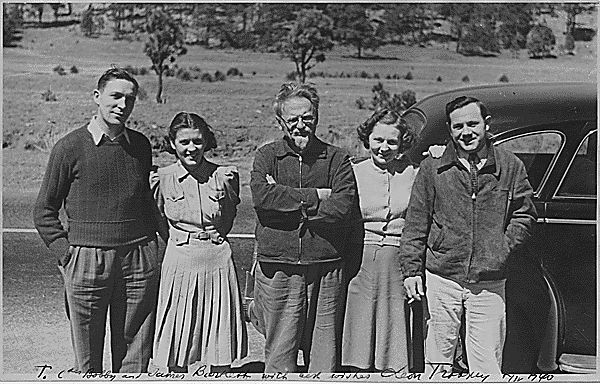 Trotsky and US trotskyists in Mexico, 1940, soon before his death
As disillusion grew on Stalin's authoritarian and criminal tendencies, Trotsky became the main reference for genuine Leninism, which was often also called Trotskyism. The current was formalized in 1930 as the Fourth International. This current however has been often marred by schisms and sectarianism, although has also inspired many genuine revolutionary leaders such as Che Guevara.
Crucial concepts in Trotskyism are that the revolution should be permanent and international, that Stalinist USSR was not a genuine but a deformed or degenerated workers' state. Nowadays some Trotskyist sectors favor the creation of a new Fifth International, idea now promoted by Venezuelan President Hugo Chávez.
For further reading on Trotsky and Trotskyism, you may find useful Trotsky.net and the commemorative series at In Defense of Marxism.
Friday, August 20, 2010
Indian Maoists seen from within
I just stumbled on a Spanish translation of an essay published in March in English but that was unknown to me until now.
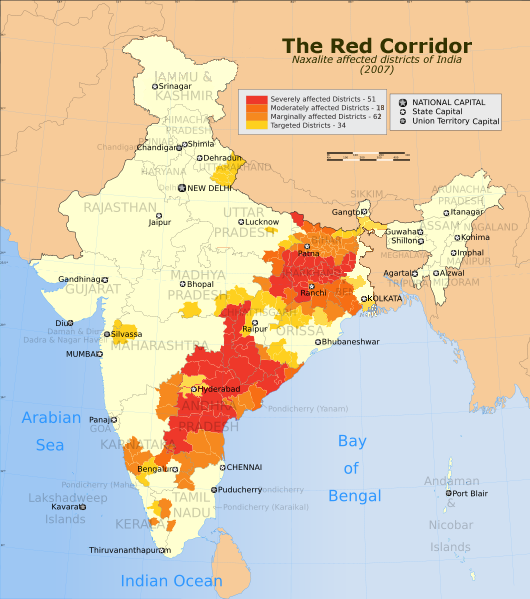 You may have heard from the Maoist guerrilla of India (also called Naxalites) and maybe even know that they have gained the hearts of many adivasi (tribals) in the Eastern part of the country through their opposition to predatory mining. You may have heard that India is since some time ago considering them the biggest threat to the state (above Islamic Fundamentalists and secessionist movements in Kashmir or the NE) and that there is some sort of low intensity war being waged in parts of India between the guerrillas and the state.
But probably you, like myself, know very little about what is really going on. Specially from the viewpoint of the guerrilla.
Therefore this essay, rather a first person report from inside the Maoist ranks, by acclaimed author Aundhati Roy, is a must-read. It was published almost simultaneously in British newspaper The Guardian with the title Gandhi but with guns and in the Indian magazine Outlook with the one of Walking with the comrades.
A very interesting read indeed. I include here a few fragments to entice you to read the whole story:
When a country that calls itself a democracy openly declares war within its borders, what does that war look like? Does the resistance stand a chance? Should it? Who are the Maoists? Are they just violent nihilists foisting an outdated ideology on tribal people, goading them into a hopeless insurrection? What lessons have they learned from their past experience? Is armed struggle intrinsically undemocratic?
...
We passed the house of the Superintendent of Police (SP), which I recognised from my last visit. He was a candid man, the SP: “See Ma’am, frankly speaking this problem can’t be solved by us police or military. The problem with these tribals is they don’t understand greed. Unless they become greedy, there’s no hope for us. I have told my boss, remove the force and instead put a TV in every home. Everything will be automatically sorted out.”
...
The first converts, the village chiefs and big landlords (...) were conferred the status of Dwij, twice-born, Brahmins. (...) As part of the Hindutva drive, the names of villages were changed in land records, as a result of which most have two names now, people’s names and government names. Innar village, for example, became Chinnari. On voters’ lists, tribal names were changed to Hindu names. (Massa Karma became Mahendra Karma.) Those who did not come forward to join the Hindu fold were declared ‘Katwas’ (by which they meant untouchables) who later became the natural constituency for the Maoists.
...

I looked around at the camp before we left. There are no signs that almost a hundred people had camped here, except for some ash where the fires had been. I cannot believe this army. As far as consumption goes, it’s more Gandhian than any Gandhian, and has a lighter carbon footprint than any climate change evangelist. (...) Should I write a play, I wonder—Gandhi Get Your Gun? Or will I be lynched?
...
KAMS [the Maoist women organization, with 90,000 members] campaigns against the adivasi traditions of forced marriage and abduction. Against the custom of making menstruating women live outside the village in a hut in the forest. Against bigamy and domestic violence. It hasn’t won all its battles, but then which feminists have?
...
A lot of the rape and bestial sexual mutilation was directed at members of KAMS. Many young women who witnessed the savagery then joined the PLGA and now women make up 45 per cent of its cadre.
...
Comrade Sumitra joined the PLGA in 2004, before the Salwa Judum began its rampage. She joined, she says, because she wanted to escape from home. “Women are controlled in every way,” she told me. “In our village, girls were not allowed to climb trees; if they did, they would have to pay a fine of Rs 500 or a hen. If a man hits a woman and she hits him back she has to give the village a goat. Men go off to the hills for months together to hunt. Women are not allowed to go near the kill, the best part of the meat goes to men. Women are not allowed to eat eggs.” Good reason to join a guerrilla army?
...
And what Chairman Mao said about the guerrillas being the fish and people being the water they swim in, is, at this moment, literally true.
...
When the Party is a suitor (as it is now in Dandakaranya), wooing the people, attentive to their every need, then it genuinely is a People’s Party, its army genuinely a People’s Army. But after the Revolution how easily this love affair can turn into a bitter marriage. How easily the People’s Army can turn upon the people. Today in Dandakaranya, the Party wants to keep the bauxite in the mountain. Tomorrow, will it change its mind? But can we, should we let apprehensions about the future immobilise us in the present?
...
I think of what Comrade Venu said to me: they want to crush us, not only because of the minerals, but because we are offering the world an alternative model.
Thursday, July 15, 2010
Psychic octopus prefers commie oysters
According to Facebook, which we know is the measure of all things and never ever lies, the famous German psychic octopus Paul, who accurately predicted the defeat of Germany and the Netherlands by Spain in the World Cup, among other stuff, has decided that Capitalism is doomed and Communism will overcome.

An analyst from Goldman Sachs speaking on condition of anonymity to this blog declared: it is obvious that the octopus prefers the color red and there is nothing psychic about it, Capitalism has triumphed and nothing will stop us from ruling the World forever, that is: until the total extinction of humankind in a few decades. Mwahahahahahahahahaha!
A less insane source, my little niece to be precise, declared: do you think I'm dumb? It's photoshopped!
However this blogger has not been able to confirm or deny the authenticity of the photo, as the psychic octopus is unavailable for comment. A press conference with direct translation from Common Octopus to German is scheduled for July 31. It is speculated that it will include a medium session with the immortal soul of Karl Marx himself, who was born a few kilometers away from where Paul hatched.
But anyhow, sincerely, I predicted that myself. So why am I not famous?!
Sources: Facebook, Ciudad Futura
Wednesday, June 23, 2010
Human existence: ownership versus community
This is something I woke up chewing on. And I think it's an important understanding of the human condition.
Let's go by parts.
Paleolithic primitive communism
As we know, most of the existence of our species and genus, of humankind, of the very evolution that shaped our being, happened in a hunter-gatherer context that has been called primitive communism because all was (is still in a few cases) shared. Working individually was unproductive and accumulation of wealth impossible. Hence individuals could be only understood within communities and communities were highly dependent on their individual components, whose abilities and knowledge (or potential for them in the case of the young ones) were the most precious assets that could be held, not by any individual but by the community as a whole. The other asset was maybe territory but this was a diffuse collective possession anyhow.
The only individually held property was surely stuff like weapons and tools and decorative objects such as necklaces. And as the economy was totally based on sharing (giving and taking freely as a matter of course) even these minor elements of private property were not important.
Even child care was shared to a great extent, so not even children were from this or that mother (or parents) but belonged fundamentally to the community.
Hence we evolved to have individual adaptative traits that were fit for cooperative work in small tightly knit communities. Communicating powers such as language and gestures, emotions such as love and shame, behaviors such as spontaneous altruism, all evolved for that cooperative purpose. We are natural born communists.
Neolithic and Industrial new orders
Things changed however as the Neolithic Revolution allowed for surplus production, accumulation of some wealth and eventually some specialization in diverse roles like warriors, priests (bureaucrats), specialized artisans and traders. The process was not immediate (early Neolithic sites still show no such distinctions) but took place almost everywhere sooner or later. As result some classes (occasionally converted in hereditary castes), specially warriors and priests, took control over the huge masses of farmers and benefited from their collective surplus in a dynamic that oscillated between symbiosis and parasitism but that really tended to the latter.
For several millennia this "neolithic with aristocratic rule" was the main socio-economic system. Again this changed with the Industrial Revolution, which allowed much more effective economy, generating larger surplus and allowing the development of other classes at the expense of the traditional ones. From the masses of farmers and the less numerous but more qualified artisans, arose the working class, now mostly dedicated to secondary (industrial) and tertiary (transport, services) economy. Farming gradually became a minor, residual, industrialized occupation. From the much smaller group of traders, and absorbing a good deal of the classical upper classes, whose previous accumulation of wealth was recycled into the new system, arose the bourgeoisie. Humankind had arrived to Capitalism.
Individualism
Both processes of "modernization" are different in many aspects but the economical basis and the psycho-social impact on us is largely similar: we are being deprived from our natural economy and social system and for that the natural community must be destroyed and the individual must be created.
This process has been often detected and sometimes denounced as a common activity of missionaries wherever tightly knit (tribal) communities still exist. The preachers, ideological avant-guard of the new "individualist" order, persuade the locals that they are not just members of a tribe and clan but whole individual beings, with individual souls bound to individual destinies even after death.
The process is of course imperfect because it is not so easy to destroy ethnic identities but, overall and in the long run, it tends to succeed, creating amorphous pseudo-communities of individuals with competing individual interests all under the umbrella of a huge apparatus, both political-legal (state and supra-state alliances) and economical (Capitalism).
Unlike in a natural communist society, such as those that can still be found among some surviving hunter-gatherers, individual property becomes central. It can be said, and this was what really got me thinking this morning, that the individual is defined by his/her property (or lack of it). And society largely qualifies you on such grounds.
Thanks to the virtual codification we call money, property does not need anymore to be just real state or material objects such as a ship or a gold hoard, it can be a bank account or deeds of some sort. But in any case it is property what makes the individual and the main measure of his/her value in our twisted reality.
Of course, there's another element that cannot be easily quantified: personal attributes, such as knowledge, skill, creativity, intelligence, sociability, health, beauty, fertility, etc. They can sometimes be monetized but their essence largely escapes the wealth scale. I'd call these traits personality rather than individuality, because they make what we can call the person, as opposed to the individual and his/her supposedly intrinsic egoism. They cannot be accumulated, they cannot be transfered except by altruistic deeds such as biological reproduction (genes) and social reproduction (memes) and while they can sometimes be used to accumulate wealth to some extent they are not really central to this process but pretty much peripheral and pre-Neolithic/pre-Industrial in nature.
While Capital, of course, also tries to grab the personalities and include them in their system somehow, these are nearly impossible to capitalize. I cannot sell you shares of my intelligence, you cannot sell me a fraction of your creativity or your beauty. At most you can rent it as a proletarian (work for a salary, as a physical or intellectual prostitute). However continuous rent of such attributes generally causes them to grow dry because these traits have not evolved for mere selfishness and because the alienation involved in the work process typically corrupts the soul, rending it arid and unproductive.
Luckily for Capital there are many souls to be raped for a few crumbs. Not all are for sale but there's always some, many surely, who are desperate enough to be bribed.
But I'm deviating from the main issue a bit. A necessary deviation maybe anyhow.
Conclussion
The key point I meant to expose in this, somewhat self-evident, essay is how we humans, at least most of us (studies seem to demonstrate that there is a natural born parasitic minority but they are a tiny fraction anyhow), have evolved for sharing, for communism, but that the socio-economical reality we are involved in since birth forces us to become individuals, stimulating our selfishness and deprecating our cooperative skills, which are largely laid waste (or at best recycled in a tainted form within the capitalist production system).
After all, what I'm talking here is of alienation. But surely in a wider sense than Marx did: not just alienation of the worker from his/her product but alienation of the person from his/her community.
Now immersed in what surely is the final crisis of Capitalism, we are forced to search for alternatives and our only valid reference is our own human nature, something that cannot really be altered so easily and something that is, at least to a very large extent, cooperative. Of course I'm talking of Communism. Not the so-called "communism" in the Stalinist systems of Russia and China, which are largely nothing but a state-directed bourgeois revolution, with a more advanced theoretical ideology but with similar practices to right-wing pseudo-socialist systems such as fascism, but something else.
Something else that must be deeply democratic at grassroots level, but democratic not only in the political aspect but also in the economical and communicational ones. There are no models, we have to create it from scratch... and that scratch is our human nature.
Sunday, June 20, 2010
The state and the people
James Petras has a new article where he deals with the issue of why US people hates the state. After reading it, it becomes obvious why: the state loads the common citizen with taxes and gives it mostly to the rich, the military-industrial complex, unwanted foreign wars, the hated state of Israel and to pay officers that spit on the face of workers and bow to the wealthy.
It's a most clear case of dictatorship of the bourgeoisie, as described by Marxist classics. There's almost no trace of the redistribution role of the state in favor of those worse off, as you might find in "welfarist" regimes such as those of Scandinavia.
I would have to say that it is exactly the same case in the state of Spain as well, even if the Basque autonomous regions have become exceptional to some extent in order to quell the otherwise endemic social unrest.
As there is no or little anti-state left in the USA (would be called anarchists or autonomists) this hatred of the state plays in the hand of the right, which have a discourse of "less state", even if their praxis is not substantially different.
What interests me most is that, in both the Anarchist (Libertarian) and the Marxist traditions, Communism is defined as the revolutionary stage in which the state is abolished, along with capitalist institutions, essentially private property. The difference between both currents is that Marxists accept a "transitional" role for the state (Socialism), while Anarchists reject it and demand the simultaneous abolition of Capital and state at once, replacing them by social and economical direct democracy at all levels.
The reason why Marxism has been more successful is that, if you are forced to fight, you need an army and hence a state (no difference between both, Machiavelli dixit).
But maybe the unusual situation of the USA may allow for the development, for the first time in history of a true Communist (by whatever name) revolutionary process in which both state and capitalism are confronted together, as the unity they are.
This is what Petras calls for: an anti-state Left movement in the USA.
Friday, June 18, 2010
China: communist or capitalist?
For me there's no doubt: it's capitalism under a "socialist" pretext, much like Mussolini's fascism and such, but anyhow, the following lecture by Fred Weston from In Defense of Marxism is a very interesting dip in the twists of this difficult-to-define type of system.
It's a long video, not sure of the exact time but probably more than an hour, however it's very worth watching (or just listening as you would with an audio) and the lecture as such takes only a little more than half of it, the rest being questions and answers on more or less related matters.
Source: In Defense of Marxism
Notice: I do not necesarily agree with all the details or viewpoints of Weston and, of course, I have no affiliation with the International Marxist Tendency, which is the political organization behind IDM (in fact I hold no affiliation to any single organization at this period of my life, though I do have sympathies and dislikes, of course). In any case I reckon that IDM has good information on class struggle worldwide and also generally good analysis that I share to at least some extent. One thing that I appreciate is that they communicate in a language that is not pretentiously erudite (as happens with some, let's say, "elitist pseudo-Marxists") and that they seem to acknowledge the natural diversity of the real struggles of the working class for dignity and self-rule.
Monday, May 17, 2010

Saturday, May 1, 2010
60% of Greeks wish for 'a genuine left-wing party'
One one side he makes an analysis of the positions: the working class, the majority of the people wants some sort of radical change and is not willing to put up with the IMF-EU impositions that would cut pensions by even as much as 50%, among other Capitalist measures of the like of those imposed by Pinochet in Chile. The tamed labor unions and established "left" parties such as the Communist Party are just letting pressure go with limited demonstrations but don't seem willing to corner the "socialist" government and rather prefer to just pose the anger in the vague hope that the government will step back.
The problem is that the government cannot step back. After all social-democratic parties such as the PASOK are nothing but violin ones: supported by the left but played by the right. And making genuine left measures such as embargoing the debt and nationalizing companies and banks is well beyond their imagination and their real positioning.
Then Weston analyzes the opinion polls, which show that the PASOK is sinking but to the benefit of absolutely no other party: both the right (culprits of the ripoff and accomplices of the IMF-EU neocolonization) and the established left (the communist KKE and the 'new left' Syriza) remain static in vote intention. Here is where we come to know that 60% of voters would want 'a genuine left party' to vote for.
Easier say than done I guess but it's clear that there is popular demand, that the people is ready for such thing as a true socialist party that can face globalized Capitalism with some dignity for the good of the people.
The conditions are there: revolution is awaiting in Greece. How will it manifest.
PS- keep also an eye in neighboring Albania, where the right has rigged the elections bringing multitudes to protest in the streets of Tirana. We are now standing on a moment of uncertainty when everything becomes possible, except the old regime. It is impossible to predict how the situation will evolve locally and globally but we should expect many surprises and sudden twists. But of course expect growing discontent everywhere coalescing more or less rapidly into revolutionary options, which may eventually come to power.
Saturday, April 10, 2010
Unemployment: what fails and what works
I just stumbled upon a pretty interesting program from Al Jazeera's Fault Lines on the problem of unemployment in the USA (it could be almost anywhere else: I know similar cases here in the Basque Country).
What fails? The so-called market, consumerism, individualism, taboo of socialism. In other words: Capitalism.
What works? Intelligent public subsidies and cooperatives (worker-owned companies that will never leave the community).
The full documentary lasts 30 mins.
Tuesday, December 1, 2009
Corruption as paradigm
I was reading to Martin Hutchinson at Asia Times Online and he makes a good an interesting analysis, pointing out some other hidden pockets of rot in the global economy after Dubai, namely: China, Britain and the USA. However, in spite of this rather sharp "discovery", he seems also outraged at the level of rot of the global economy and that I find extremely naive.
Probably Hutchinson is one of those liberal-conservatives who still believe in the promises of Capitalism, so his naivety is ideologically justified. Probably Hutchinson never bothered reading Deleuze and Guattari or any of the other Marxist authors.
So he has rosy glasses when looking at the reality of the liberal economic paradigm, even if he's naively critical of its corruption.
Following the Anti-Oedipus, Capitalism is a schizoid decodifying force, whose only morality is that it can borrow from pre-existent institutions such as religion and culture. In other words: Capitalism is a force of Chaos that spreads corruption and selfishness. And it does not spare those institutions that partner with it: these are also corrupted to the marrow.
Hence there is another more passive or resisting pole that they call paranoid, which is ideological and rooted in the old regime (the pre-bourgeois territorial system) which reacts cyclically in what D&G describe as a pendulum. This secondary pole is not really able to counter Capitalism but can maybe crop some of its excesses (and develop others of its own, as happens with Fascism or Islamism). But in practical terms it cannot escape or effectively counter the corrupting and demoralizing influence of Capitalism, which always persists and comes back with further disintegration once the misguided reactionary season is over.
There's no way out of this pendulum within the system. And there's no way outside the system but a socialist one, one that is also decodifying but creatively ethic. In fact there is a "thin red line" that goes through Capitalist society trying to make it more ethic, but obviously doomed to fail while selfishness and competion are the basic rules of the game.
But, well, the case is that we have a big rotten house, whose very pillars are deeply rotten and whose leaders refuse to cleanse for fear of catastrophe or rather self-perpetuating manipulations by the Oligarchy. The case is that there is no way out of the crisis with or without cleansing, the case is that we are facing a situation similar (but probably much worse) to that of the 1930s.
However now global war is rather unthinkable as an exit and some of the systemic problems are well beyond what they call economy, which is predating the planet to such unprecedented extent that has largely transferred brutal costs to the global ecosystem, making any standard liberal solution impossible.
There are many threads to pull from here, but what seems more striking to me is that in fact there is a serious possibility that the whole global system may implode with relatively low levels of institutional violence (aka war). Not just because of the nuclear threat but because no expansionist adventure would really solve anything anymore. There is many people in the high spheres thinking otherwise, of course, and this may cause some tragedies, but overall none of the problems will be solved that way - unlike what happened after WWII with the military-industrial complex meta-bubble, whose consequences are largely popping out right now.
There is no way and little purpose in securing global hegemony because the colonialist system is itself bankrupt at the very core and little can be done by mere control of some resources. Even a planetary empire would not be able to solve anything at all.
So what now? Considering the low levels of class and even species conscience that exist right now, I'd say that the system will collapse, with some painful outbursts, rather slowly... until an alternative can be built. However, as the system implodes uncontrolled in a chain reaction of sorts, the alternative will appear from the bottom, built on anger and desperation.
Interesting times these we live in.
.
Tuesday, November 10, 2009
Ancestral communism
I have the feeling that most of us, modern urbanites don't really have a good grasp on how hunter-gatherer societies are or used to be. I was just correcting someone who claimed that slavery existed among ancestral foragers, for example... but worst was the example given: the Vikings!
A lot of people don't seem to understand well the difference between agrarian and hunter-gatherer societies; in many other cases I have needed to object that Amazonian or Papuan natives are not true foragers but actually jungle farmers, and therefore have social structures that are more complex and quite different. But there are very few modern examples of real hunter-gatherers, mostly on the verge of extinction, but there are some, namely: Bushmen, Pygmies, Australian Aboriginals, Negritos, Andamanese and some Arctic peoples like the Inuit and the Nganasan (am I missing any?). These are diverse enough to constitute a good example of how real Paleolithic societies, our ancestors, might have been.
Victor Grauer has been exploring them in his latest posts at Music 000001 but yesterday's post is particularly insightful and synthetical. He makes clear that foragers like Bushmen and Pygmies have a set of values that are highly egalitarian and cooperative, while allowing for a great deal of individuality too. He makes a difference between these social values, transmitted generation after generation, that secure social cohesion and persistence, and the reality not always as idyllic as some would expect.
There are occasional problems in such "utopic" societies, like murder or wife beating or mere petty cheating. However the worst practices of "more advanced" societies are to be found nowhere:
What we do not see are evidences of: cannibalism, head-hunting, endemic warfare, female mutilation, prostitution, slavery, blood-feuds, raiding, etc.
Thursday, April 30, 2009
Labor Union takes over bankrupt Chrysler
All roads lead to Socialism it seems.
As giant US car-maker Chrysler filed for bankrupticy (which is uspposed to be only a temporary measure), it was revealed that the confidential deal leading to this protective measure involved a 10% public stake (8% by US government and 2% by Canadian provincial governements), an alliance with Italian car-maker FIAT, that gets a 20% stake, and a majority stake by a union-run VEBA (probably affiliated to UAM, not 100% sure right now).
This in Spanish legal code would be roughly a "Labor Corporation" (Sociedad Anónima Laboral), which is considered a good alternative to the somewhat restrictive pure cooperative system, and allows private capital as long as it has no more votes than workers. The essentials are the same though: the control of the company now belongs to the workers.
In turn the current owners, mostly private equity firm Cerberus and, secondarily, Daimler, will forfeit their stakes. Bondholders will be given $2 billion in exchange of forgiving heir $7 billion debt; this has been approved by the banks, that hold 70% of Chrysler's debt, but not by hedge funds, who have been accused by the White House of blocking the deal, against their own interest and that of the company and the nation. The final decission will be taken by a tribunal.
As part of the deal Chrysler will recieve also $14 billion in public loans.
If the bankrupticy deal is ratified in court, the giant car-maker company will from now on be owned by its workers and won't be anymore a symbol of Capitalism.
I want to think that this is how Communism will become real. Not sure though. What do you think?
.
Tuesday, April 14, 2009
Beinstein on The Crisis
Admittedly I had never heard before of this Argentine economist with cathedra in Besançon but his opinions fit surprisingly well with what I think, so I will try to echo some of his thoughts.
Source: Rebelión: Una conversación con Jorge Beinstein sobre la 'crisis general de la civilización burguesa': "Esta crisis es mucho más grave que la de 1929". Interview by S. López Arnal (in Spanish, obviously).
Some excerpts:
Nature of the crisis:
Under the appearence of a curious convergence of many "crisis" (economical, energetic, enviromental, state, urban, etc.) what is actually happening is a general crisis of the burgeueoise civilization. In its immediate origin we find a chronic overproduction crisis lasting for almost four decades (...). Even if this chronic overproduction crisis appears as the trigger, the final catalyst of this civilizational crisis, we must clearly differentiate both concepts. (...) It happens that each historical overproduction crisis left open injuries, structural damage, parasitary degenerations (...) that at the beginning of the 21st century are finally causing a "general subproduction crisis": the general incapability of the system to reproduce itself in an expanded manner anymore, to keep growing in the long term.
We are now going through the beginning of the end of a long historical transit (...). In principle we would be at the beginning of a long-lasting crisis-decadence but this is not more than a work hypothesis: History often turns out unexpected.
Financial bubble:
The global network of real state bubbles was evaluated in dossier at The Economist around 2005, soon before the debacle in the USA, as equivalent to the Gross Product of all rich countries together. This is a lot but it is littile when compared with the sum of derived financial products registered by the Bank of Basel that same year that were an speculative mountain worth 12 times the World Gross Product.
The Greater Middle East wars:
(...) they believed that the colonial wars in Iraq and Afghanistan would give them the control of a vast Eurasiatic zone stretching from the Balcans to Afghanistan, at whose core, the Persian Gulf and the Caspian Sea basins, are located about 70% of the global oil reserves. (...) This imperialist offensive was pushed by the Military-Industrial Complex (...). Since Reagan's presidency it became entangled with parasitary and predatory business (...) conforming an oligarchic and mafious system that nowadays constitutes the backbone of the imperial power. All that was expressed in an almost caricaturesque manner by the government of George W. Bush and his hawks, now Obama, in spite of his populist gestures, is just a puppet of that highly irrational power whose dynamics push the system towards disaster. The new president (...) is more of the same: militarist business continue their triumphant march generating a fiscal deficit without precedents in US history whose continuation could even cause the bankrupticy of the imperial state in the mid term.
Senility crisis:
It is necesary to look before 1930: this crisis is much bigger even if we just ponder the financial-economical aspects. Never before in the history of Capitalism was such a huge speculative mass accumulated at all, not just in absolute terms but especially when compared with the World Gross Product. Capitalism today is a mere predatory-parasitary system and that sets an essential qualitative difference with the past. (...)
Never before did Capitalism suffer from such a huge crisis, which looks like the inverse phenomenon to the birth crisis of the modern system at the end of the 18th century (...). Now we face a senility crisis of the burgueoise world, with its economical system trapped in financial parasitism, with its imperial Military-Industrial Complex transformed in a decadent machine, its state structures degradated, etc.
China:
The talk about a "Chinese capitalist superpower of the 21st century" has been nothing but a mediatic hype that recycled the old and always failed illussion of reconversion of underdevelopement into develepoment thanks to the intensification of the burgueoise type transformations. Chinese growth, subordinated to the dynamics of global Capitalism, has arrived to its stagnation stage. (...) sooner or later, and it seems it will be very soon, the once prosperous Chinese industrial structure will enter in a deep crisis that will question in a very general manner the overall status quo.
Prospects:
Capitalism can survive but in a decadent manner, like has been doing for the last four decades. That will depend on the social and political convulsions caused by its decline (...). The neo-fascist coup attempt of the hawks does not need to be the last one of its kind: the US Industrial-Military Complex is suffering a severe cultural crisis: its internal prestige has declined but still has the instruments to generate a new reactionary alternative. This is a very serious possibility.
(...) The only thing they can do is to apply succesive doses of tranquilizers, of partial remedies, insufficient measures in wait of some miracle, that is what doctors usually do with their ailing patients.
Comparison with the fall of the Soviet Union:
It is a very good comparison, that we can extend to many other pre-modern civilizations, consumed by parasitism and that finally imploded.
Enviromental crisis:
Enviromental degradation is at the very center of the current civilization crisis: it is tightly associated to the process of predation of natural resources (...) whose ultimate cause is found in technological reproduction of Capitalism. This one has followed a trajectory of some two centuries of creative destruction-predation in the Shumpeterian sense of the concept, that is: with a positive net result from the viewpoint of the expansion of the productive forces... until it has arrived now to a phase of growingly negative redits in civilizational terms, including the enviromental aspect. (...)
Enviromental degradation is not a long term problem, a problem for the generations to come in a distant future: it is hitting now the economic activity, rural and urban life. Those who want to leave the matter aside in the name of economic urgencies have a very abstract vision, very detached from factual reality, from the problems of a possible reproductive reorganization, from the necessary energetic reconversion, etc.
How the Left should act:
We are right now immersed in the Capitalist crisis that looks as of long duration and without foreseable exit. Turbulences have just begun (...). In this new context, the Left should go into the offensive rapidly, developing a wide fan of struggles aiming to power. Gather the anti-system forces, de-estabilize the existing power systems, reduce their social legitimacy, make efforst of social and regional convergence.
It is very difficult, almost impossible, to outline a general project for all the left movements around the planet. Nevertheless we can find some common elements: for instance, political democratization at all levels, fracturing the elitist dynamics that defined the neoliberal era: grassroots democracy versus burgeuoise pseudodemocracy. And, beginning from that, recycling of the productive web: of finances, of internal and external trade, etc. That implies nationalizations (...), not to serve the interests of the elites but to transform them into truly public, that is: democratic, with strong imprints of self-management, of administrative transparency, of popular control. It is necessary to deal with the social redesign of economy: redefine consume styles based on quality and durability, rejecting the consumerist dehumanizing, individualist madness. Consume to live and not live to consume. This kind of approach would allow us to adress rationally the energetic issue: facilitating a reconversion that will take some time and that should go through huge energy savings. It should also allow for the developement of strategies of reconstruction in the enviromental aspect.
Socialism:
The way out of the crisis that I have just outlined is nothing else but a march to Socialism. But what should we understand today as Socialism? Certainly not the kind of statist Socialism experimented through the 20th century, prisioner of a decisive ideological dependency from the military-industrial burgueois statism in rise since the end of the 19th century. (...)
Now it is all changing very quickly: the burgueoise civilization drifts without direction, its great myths are beginning to collapse (...). Consequently Socialism today should adopt much more radical, revolutionary and democratic shapes than in the past (...)
The emancipation movement must be thought and tried from clearly Communist final goals (...). Socialism concieved as plural path, as process of creative destruction, of institutional breakages, demolitions that allow for the instauration of solidarious, fraternal social structures of production and consume, not anymore as humanist complement of Capitalism but as its revolutionary superation: estabilishing decentralized political structures, incrementing, multiplying direct democracy. Much of that can be found in the revolutioanry movements of Latin America, though I am persuaded it is not just a regional exception.
Marx:
(...) We are indeed returning to Marx: to critical thought rooted on the rebellion of the exploited, irreconciliable enemy of conformism, of pseudo realist adaptation to what conservatives define as "possible". To the true Marx, not to parrot him but surely to march beyond him. To the Marx without dogmatic ties, to the irreverent Marx, who wrote "I am not Marxist", rejecting that way to become a provider of infallible recipes and eternal truths.
Marx' ideas are necessary, unavoidable when we try to understand the current crisis, but they are also not enough. (...) when we try to understand the much more vast challenge of the civilization crisis, we lean on Marx to advance beyond his cultural universe. (...)
Banners, slogans:
(...) in the last decades we have been smashed by a conservative conformist avalanch that has no precedents in modern history because of its dimensions. It has been less than one decade that a slogan, which we would have laughed upon in the 60s and 70s because of its coyness, became rather popular: "another world is possible". We must begin thinking in terms of "revolution", "socialism", "postcapitalism", not as audacious ideas to share with some friends but as banners for action destinied to the great popular majorities.
.
Source: Rebelión: Una conversación con Jorge Beinstein sobre la 'crisis general de la civilización burguesa': "Esta crisis es mucho más grave que la de 1929". Interview by S. López Arnal (in Spanish, obviously).
Some excerpts:
Nature of the crisis:
Under the appearence of a curious convergence of many "crisis" (economical, energetic, enviromental, state, urban, etc.) what is actually happening is a general crisis of the burgeueoise civilization. In its immediate origin we find a chronic overproduction crisis lasting for almost four decades (...). Even if this chronic overproduction crisis appears as the trigger, the final catalyst of this civilizational crisis, we must clearly differentiate both concepts. (...) It happens that each historical overproduction crisis left open injuries, structural damage, parasitary degenerations (...) that at the beginning of the 21st century are finally causing a "general subproduction crisis": the general incapability of the system to reproduce itself in an expanded manner anymore, to keep growing in the long term.
We are now going through the beginning of the end of a long historical transit (...). In principle we would be at the beginning of a long-lasting crisis-decadence but this is not more than a work hypothesis: History often turns out unexpected.
Financial bubble:
The global network of real state bubbles was evaluated in dossier at The Economist around 2005, soon before the debacle in the USA, as equivalent to the Gross Product of all rich countries together. This is a lot but it is littile when compared with the sum of derived financial products registered by the Bank of Basel that same year that were an speculative mountain worth 12 times the World Gross Product.
The Greater Middle East wars:
(...) they believed that the colonial wars in Iraq and Afghanistan would give them the control of a vast Eurasiatic zone stretching from the Balcans to Afghanistan, at whose core, the Persian Gulf and the Caspian Sea basins, are located about 70% of the global oil reserves. (...) This imperialist offensive was pushed by the Military-Industrial Complex (...). Since Reagan's presidency it became entangled with parasitary and predatory business (...) conforming an oligarchic and mafious system that nowadays constitutes the backbone of the imperial power. All that was expressed in an almost caricaturesque manner by the government of George W. Bush and his hawks, now Obama, in spite of his populist gestures, is just a puppet of that highly irrational power whose dynamics push the system towards disaster. The new president (...) is more of the same: militarist business continue their triumphant march generating a fiscal deficit without precedents in US history whose continuation could even cause the bankrupticy of the imperial state in the mid term.
Senility crisis:
It is necesary to look before 1930: this crisis is much bigger even if we just ponder the financial-economical aspects. Never before in the history of Capitalism was such a huge speculative mass accumulated at all, not just in absolute terms but especially when compared with the World Gross Product. Capitalism today is a mere predatory-parasitary system and that sets an essential qualitative difference with the past. (...)
Never before did Capitalism suffer from such a huge crisis, which looks like the inverse phenomenon to the birth crisis of the modern system at the end of the 18th century (...). Now we face a senility crisis of the burgueoise world, with its economical system trapped in financial parasitism, with its imperial Military-Industrial Complex transformed in a decadent machine, its state structures degradated, etc.
China:
The talk about a "Chinese capitalist superpower of the 21st century" has been nothing but a mediatic hype that recycled the old and always failed illussion of reconversion of underdevelopement into develepoment thanks to the intensification of the burgueoise type transformations. Chinese growth, subordinated to the dynamics of global Capitalism, has arrived to its stagnation stage. (...) sooner or later, and it seems it will be very soon, the once prosperous Chinese industrial structure will enter in a deep crisis that will question in a very general manner the overall status quo.
Prospects:
Capitalism can survive but in a decadent manner, like has been doing for the last four decades. That will depend on the social and political convulsions caused by its decline (...). The neo-fascist coup attempt of the hawks does not need to be the last one of its kind: the US Industrial-Military Complex is suffering a severe cultural crisis: its internal prestige has declined but still has the instruments to generate a new reactionary alternative. This is a very serious possibility.
(...) The only thing they can do is to apply succesive doses of tranquilizers, of partial remedies, insufficient measures in wait of some miracle, that is what doctors usually do with their ailing patients.
Comparison with the fall of the Soviet Union:
It is a very good comparison, that we can extend to many other pre-modern civilizations, consumed by parasitism and that finally imploded.
Enviromental crisis:
Enviromental degradation is at the very center of the current civilization crisis: it is tightly associated to the process of predation of natural resources (...) whose ultimate cause is found in technological reproduction of Capitalism. This one has followed a trajectory of some two centuries of creative destruction-predation in the Shumpeterian sense of the concept, that is: with a positive net result from the viewpoint of the expansion of the productive forces... until it has arrived now to a phase of growingly negative redits in civilizational terms, including the enviromental aspect. (...)
Enviromental degradation is not a long term problem, a problem for the generations to come in a distant future: it is hitting now the economic activity, rural and urban life. Those who want to leave the matter aside in the name of economic urgencies have a very abstract vision, very detached from factual reality, from the problems of a possible reproductive reorganization, from the necessary energetic reconversion, etc.
How the Left should act:
We are right now immersed in the Capitalist crisis that looks as of long duration and without foreseable exit. Turbulences have just begun (...). In this new context, the Left should go into the offensive rapidly, developing a wide fan of struggles aiming to power. Gather the anti-system forces, de-estabilize the existing power systems, reduce their social legitimacy, make efforst of social and regional convergence.
It is very difficult, almost impossible, to outline a general project for all the left movements around the planet. Nevertheless we can find some common elements: for instance, political democratization at all levels, fracturing the elitist dynamics that defined the neoliberal era: grassroots democracy versus burgeuoise pseudodemocracy. And, beginning from that, recycling of the productive web: of finances, of internal and external trade, etc. That implies nationalizations (...), not to serve the interests of the elites but to transform them into truly public, that is: democratic, with strong imprints of self-management, of administrative transparency, of popular control. It is necessary to deal with the social redesign of economy: redefine consume styles based on quality and durability, rejecting the consumerist dehumanizing, individualist madness. Consume to live and not live to consume. This kind of approach would allow us to adress rationally the energetic issue: facilitating a reconversion that will take some time and that should go through huge energy savings. It should also allow for the developement of strategies of reconstruction in the enviromental aspect.
Socialism:
The way out of the crisis that I have just outlined is nothing else but a march to Socialism. But what should we understand today as Socialism? Certainly not the kind of statist Socialism experimented through the 20th century, prisioner of a decisive ideological dependency from the military-industrial burgueois statism in rise since the end of the 19th century. (...)
Now it is all changing very quickly: the burgueoise civilization drifts without direction, its great myths are beginning to collapse (...). Consequently Socialism today should adopt much more radical, revolutionary and democratic shapes than in the past (...)
The emancipation movement must be thought and tried from clearly Communist final goals (...). Socialism concieved as plural path, as process of creative destruction, of institutional breakages, demolitions that allow for the instauration of solidarious, fraternal social structures of production and consume, not anymore as humanist complement of Capitalism but as its revolutionary superation: estabilishing decentralized political structures, incrementing, multiplying direct democracy. Much of that can be found in the revolutioanry movements of Latin America, though I am persuaded it is not just a regional exception.
Marx:
(...) We are indeed returning to Marx: to critical thought rooted on the rebellion of the exploited, irreconciliable enemy of conformism, of pseudo realist adaptation to what conservatives define as "possible". To the true Marx, not to parrot him but surely to march beyond him. To the Marx without dogmatic ties, to the irreverent Marx, who wrote "I am not Marxist", rejecting that way to become a provider of infallible recipes and eternal truths.
Marx' ideas are necessary, unavoidable when we try to understand the current crisis, but they are also not enough. (...) when we try to understand the much more vast challenge of the civilization crisis, we lean on Marx to advance beyond his cultural universe. (...)
Banners, slogans:
(...) in the last decades we have been smashed by a conservative conformist avalanch that has no precedents in modern history because of its dimensions. It has been less than one decade that a slogan, which we would have laughed upon in the 60s and 70s because of its coyness, became rather popular: "another world is possible". We must begin thinking in terms of "revolution", "socialism", "postcapitalism", not as audacious ideas to share with some friends but as banners for action destinied to the great popular majorities.
.
Subscribe to:
Posts (Atom)
