New findings at Sibudu cave (KwaZulu-Natal, South Africa), add evidence in favor of a very ancient use of bow and arrow by Homo sapiens. These findings are small stone points which keep traces of blood and bone from the impacts and also of the resin used to glue them to the shafts. Forensic analysis of this evidence seems to discard that they were used as hand-held spear points but must have been shot with much greater energy. However I cannot find any reasoning that excludes their possible shooting with atlats. The BBC article that is the source of this information claims that this finding pushes the use of bow and arrow back some 20,000 years, however bone points found at the same site two years ago, and also dated to c. 60 Ka, already suggested this.
New evidence in form of unmistakable stone-tools' marks on bone, push back the earliest known systematic use of tools to an species that was surely not still "human" (in the sense of belonging to the genus Homo) but to Australopithecus afarensis or another similar (but unknown) species. This happened some 3.4 million years ago in the central-northern Ethiopian highlands. Australopithecus afarensis, the species to which the famous fossil Lucy belonged to, is the only hominin species known to have lived in that space-time. However until now it was commonplace to think that they were vegetarians and did not use tools. It seems now that such ideas were wrong and that Lucy's species, with a brain barely larger than that of a chimpanzee, was already using not just random rocks but sharp ones able to cut meat. Forensic analysis leaves no room to doubt the marks are product of cutting tools and not animal fangs or paws. This has potentially interesting implications for the evolutionary history of human brain and intelligence, as well as our highly precise hand, both tightly associated to tool use. More detailed news stories at Science Daily and BBC.Ref. Shannon P. McPherron et al., Evidence for stone-tool-assisted consumption of animal tissues before 3.39 million years ago at Dikika, Ethiopia. Nature, 2010. Pay per view.
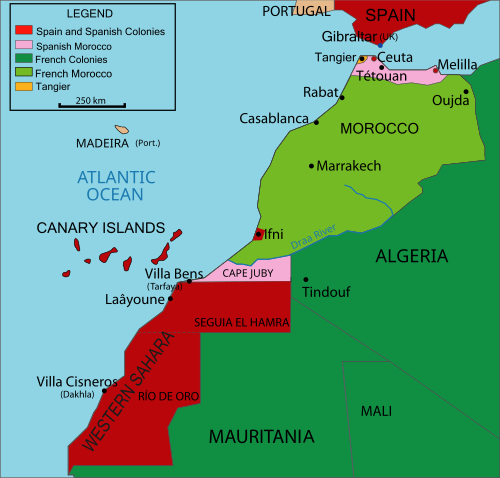
There is a rather interesting historical review at Le Monde Diplomatique (in English) on how the then Spanish provinces of Saguía el Hamra and Río de Oro (then legally as much part of Spain as Madrid, by the way - so good for the unalienable unity of the fatherland) ended up in Moroccan hands with the blessings of the USA and France.  Map of the colonial West Sahara and Morocco in the mid 20th century (from Wikipedia).
Mundo Neandertal[es], citing newspaper Público[es], mentions today that Spanish researchers (a branch of the Atapuerca team) working in Olduvai gorge have found elephant bones with cut marks (sign of human meal) in association with bones of Homo ergaster, the ancestor of our species, dated some 1.3 million years ago. Femur and radius of H. ergaster found at Olduvai
 Sivatherium reconstruction
There is a new paper on 'African' mtDNA L(xM,N) with a focus on trans-Saharan flow:Nourdin Harich et al., The trans-Saharan slave trade - clues from interpolation analyses and high-resolution characterization of mitochondrial DNA lineages. BMC-Evolutionary Biology 2010. Open access.The authors conclude that all or most of this mtDNA flow happened in recent times within the trans-Saharan slave trade, mostly in the last few centuries of Arab domination. I think that this position is simply untenable (and I'd dare say falling into 'romantic' Orientalism per many of the reasonings like: some harems could be enormous, reaching even the extravagating number of 14,000 concubines) but there is interest anyhow in the data managed (from many other different studies mostly) and specially in the many nice distribution maps provided.They do not only fall into pseudo-romantic visions of the slave trade and its importance but also fall in another pool of moving sands: excessive reliance on the molecular clock age estimation methods, when they draw their conclusions.I really fail to see how MC age estimates of c. 10-15,000 years ago (L3) can justify a recent shared ancestry within the slave trade. They would actually point, if anything, to late Paleolithic or Epipaleolithic migrations (Capsian culture?) There is only one case with a more recent date in all the L3 comparisons but it's not between an Tropical and Mediterranean Africans but between one Jordanian and one North American (Afro-American?) Instead there are many L3 cases with older age estimates: up to 37,000 years ago.They do not have age estimates for the other haplogroups, specially some L0 and L2 sublineages that also permeate the Sahara-Red Sea barrier.As I have said before, some of these lineages look very old North of the Sahara (see here) and may have been pouring towards the North and NE since around the out-of-Africa migrational episode, which may be c. 120,000 BP, quite roughly.They fail to analyze two particular haplogroups that are apparently more common North of the Sahara and East of the Red Sea: L3k and L3i respectively (L3i is plotted on a map but North African specific L3k is totally ignored).As I said above, the best is the distribution maps, which allow for a quick visual impression of the distribution of the L(xM,N) lineages. Form these I think that:- L0a shows a clear South-East Africa-West Asia distribution, with some very high concentrations in this last region. I previously mentioned that I think that L0a1b2 and L0a1c (?) are clear candidates for a Middle Paleolithic flow to West Asia related to the OOA migration.
- L1b surely had a Middle Sahelian origin but also clearly permeates across the Sahara. Within it, L1b1a2 is typical of the Red Sea area, while L1b1a5 is found in Mauritania and Cyprus (per Behar 2008). I think that its expansion happened some time after the L3 one (29 CR mutations to the root vs the 23 of L3) but may well belong to the late phase of the Abbassia Pluvial.
- L2a is so ubiquitous that cannot be analyzed as a whole. The timeline of its expansion is surely the same as that of L1b (again 29 CR mutations to the root) but it's much more impressive in its dimensions. Some of the high level sublineages (L2a1j) are exclusive of the Mediterranean, while some others are shared across the desert and surely deserve specific attention if we want to clarify anything.
- L2d. The map concentrates this lineage in West Sahara but (from Behar 2008) it's actually also present in Ethiopia, Algeria and Yemen. It's another candidate for an old lineage beyond the Sahara.
- L3b also looks pretty much North African/West Asian but has also presence in West and East Africa.
- L3d is an even more clear case of a North African/West Asian lineage: rare south of the Sahara and very common north of it.
- L3e looks by the map as split in a North African and a Bushman clades, however by Behar's data the situation is much more complex: scattered in many distinct African and West Asian populations, all very suggestive of an old spread within the L3 explosion (OOA related).
- L3f looks like spread from Sudan in all directions early on as well.
- L3i is shown as the Red Sea-South Arabia lineage it is and is a very strong candidate for OOA migration remnant in Southern Arabia. Can never be attributed to 'slave trade' but it's most probably the "little sister" (niece in fact) of M and N. It is actually closer to the L3 root than M and N by CR mutation count, so it's surely older, just that it did not reach South Asia.
- L3x is a very similar case, however it should be slightly more recent than L3i, with an age similar to that of the N and R explosions in further Asia.
- I'm wondering if L3w is just another name for L3k. It does not exist in PhyloTree but the distribution (Algeria, Ethiopia) is reminiscent of the one reported for L3k elsewhere.
There's no mention to L6 and L4b, both of which are also candidates for participation in the OOA flow to South Arabia.In brief: it seems that the preconceptions of the authors are preventing them to reach to rational conclusions. The paper has some interest but this lays mostly on the illustrations (maps). Hopefully, as it happened with the similarly confused Balaresque paper, someone else (Morelli in this case) will take the bull by the horns and do something better with all that data.Related posts:
Mundo Neandertal mentions today this paper by P.J. Texier et al., where it's revealed that people some 60,000 years ago at Howiensoon's Poort, South Africa, used decorated ostrich eggshells (possibly as containers, I guess). The decorations are often repeated in what seems to be a cultural expression.This adds to other evidence of "advanced" culture in South African MSA, like the use of bow and arrow in the same site and that of Nassarius shell decorations at nearby Blombos.
Fascinating, extremely fascinating, breaking news today: Middle Stone Age sites of Mozambique, dated up to 105,000 years ago, has been found that tools retained abundant remains of sorghum, which was harvested and processed into palatable food (bread, porridge or maybe just beer).
Julio Mercader. Mozambican Grass Seed Consumption During the Middle Stone Age. Science, 2009. (Paywall but the supplementary material is freely accessible and an important read for those who speculate on possible contamination, which seems to have been very carefully ruled out).
News articles on the discovery can be found at Yahoo News, and at Science Daily. According to the latter, besides sorghum, other relevant plant remains have been identified: wine palm, false banana, pigeon peas and the "African potato", a medicinal plant.
However this does not imply farming but it's a clear precursor that was until now believed to have evolved only much later, in the Mesolithic.
I found this highly significative news at a discussion at Music 000001, thanks to Glen.
Update (Mar 9 2013): the paper is available at Julio Mercader's profile in Academia.edu → DIRECT LINK. He also has some other very interesting materials on that area near Lake Malawi and in general on African Prehistory.
A new mtDNA M lineage has been detected among a Malagasy fisherman ethnicity: the Vezo (4/101 = 4%). It's been named M16 and appears to hang directly from the M node. Three other individuals with this lineage have been found among African Americans (though it has not yet been detected in mainland Africa). M16 has also been found in one citizen of Dubai (UAE) and one (1/127 = 0.8%) among the Mikea hunter-gatherers/horticulturalists of SW Madagascar, believed to be a remnant of pre-Austronesian colonization of the island.
Haplogroup M16 is characterized by 11 coding region mutations and 8 control region ones. M16 has two subclades: M16a (found only in one Vezo individual) and M16b (including all other carriers). They estimate (following the new refined method of Soares et al. - but notice that they give a very recent age to the relevant Pan-Homo split: only 6.5 Mya, when it can well be of 8 and even 10 Mya for what I know) that the MRCA of this lineage lived some 9500 years ago (CI: 1.9-17 Kya), with that of M16b having lived 1700-3900 years ago (CI: 0-8.2 Kya).
Both Mikea and Vezo also show other ineages that are absent among the central Merina ethnicity (arguably a more direct descendant of Austronesian colonists), namely: M*, M7c3 and F3b.
Francois-X Ricaut et al., A new deep branch of eurasian mtDNA macrohaplogroup M reveals additional complexity regarding the settlement of Madagascar. BMC Genomics, 2009. Open access.
A court case against the corrupt dictators of Equatorial Guinea, T. Obiang, Gabon, O. Bongo, and Congo, Republic, D. Sassou-Nguesso, who own many luxuries in France, has been halted on demand from the public attorneys on ground that the NGO that initiated the prosecution has no ability to do so. Transparency International will appeal to the supreme court. This seems just another move by the ultra-conservative French government to prevent the prosecution of their loyal puppet tyrants in Middle Africa. When people asks where is "neocolonialism", it's there: in undemocratic corrupt tyrants appointed and protected by the metropolis who suck the blood of their countries. Source: Al Jazeera..
Important paper the one that David Beard mentions at Archaeology in Europe:Stephen J. Lycett, Understanding Ancient Hominin Dispersals Using Artefactual Data: A Phylogeographic Analysis of Acheulean Handaxes. PLoS ONE, 2009. (Open Access). Lycett analyzes the structure of Acheulean handaxes of Africa and Eurasia and concludes that there is very strong support (>94% likelihood) for an out-of-Africa scenario. In all maximum parsimony trees, Eurasian axes appear as derived from African ones, possibly indicating that a migration (H. erectus or H. ergaster, depending on your naming preferences) from Africa to Eurasia happened along that techno-cultural spread. Acheulean was first developed in Africa, some 1.6 million years ago. The most ancient confirmed date for Eurasian Acheulean is that of 'Ubeidiya (Palestine), dated to c. 1.4 million years ago though often thought of as a penetration without further consquences, followed by European ones (southern Spain, c. 900,000 BP) and more recent ones (c. 780,000 BP) in Palestine and other European areas (c. 600,000 BP). South Asian Acheulean is less well dated but most findings seem to be older than 800,000 BP. However in Lycett trees, South Asian handaxes' typology appears consistently as older than European one (but more recent than the African types). He does not seem to have analyzed the very old Iberian or Palestinian tools though. .
Yet another discouraging setback by the fanatic ultraconservatives of this our planet: the president of Mali, Amadou Toumani Touré, has vetoed a law that recognizes more or less equal rights to men and women. Muslim groups had protested it. The law acknowledged rights that are considered basic and normal almost anywhere that is not an ultra-machoist remain from the Middle Ages: it acknowledges that wifes are not slaves of their husbands but that marriage implies mutual loyalty and protection, it betters women's inheritance rights and marriage is not allowed in most circumstances below the age of 18. Ironically one of the concepts that Muslims have protested most against is the recognition of marriage as a secular institution. I say ironically because, unlike in Catholicism and other Christian sects, marriage in Islam has always been a secular institution. Apparently, President Touré was a strong backer of the new law, but, as it's happening with the estabilishment of public healthcare in the USA, a lot of misinformation and outright lies have been circulating confusing the matter, causing him to send the law back to parliament. Feminist groups, that had been campaigning for such a reform for a decade or more, are "discouraged" indeed. Source: BBC..
New archaeological research at Pinnacle Point, South Africa, evidences that people living there some 75,000 years ago had elaborate techniques of fire usage in order to alter the properties of rock (silcrete specifically) to best fit their manufacturing needs.Lead researcher, Kyle Brown, from Arizona University, experimented with their hypothesis, based on field evidence: he left a piece of silcrete beneath their fire pit and the next morning he found the color had changed exactly as with their material evidence and the rock had become much more easy to flake and work into replicas of the prehistorical tools they had been studying.For him:Here are the beginnings of fire and engineering, the origins of pyrotechnology, and the bridge to more recent ceramic and metal technology.
Read more at Science Daily..
It was claimed some years ago (Savolainen et al., 2002) that dog domestication had happened apparently in East Asia, reasoning based on the genetic diversity of the animals sampled in that region. But now new research by Adam Boyko and colleagues challenges this after having sampled numerous dogs through Africa, while in honeymoon, Boyko has found that the diversity there is comparable to that found in East Asia. But the study does not challenge the fundamental notion that the domestic dog descends from the Eurasian grey wolf (Canis lupus), so Africa cannot be the place where it was first domesticated. Where then? The question remains unanswered by the moment and East Asia could still be the place but the evidence is inconclusive. The highest diversity found in Africa and East Asia so far doesn't seem to correspond to anything but the fact that village dogs, in contrast to purebreeds and mixes from these breeds, are intrinsecally much more diverse genetically. It is rural disinterest for dog breeding what has preserved that higher diversity, not any aboriginal pervivence. It may be worth remembering here too that the oldest dogs found in the archaeological record belong to the Aurignacian culture of Europe, specifically in modern Belgium. It is also interesting to mention in this regard that this dog is apparently not the direct ancestor of modern dogs, at least matrilineally. (Note: I found another media article claiming that there are dog remains from Britain from before 100,000 BP, what would make the domestication a Neanderthal achievement - I cannot confirm this claim though). Source: BBC. .
What follows would be quite funny, wouldn't it be because it's directly linked to the deaths of hundreds of people in what seems to be a somewhat serious threat to the secular system in Nigeria.The "Taliban", as they are known in Nigeria, have raised in arms in order to suppress "Western" (secular) education that dares to claim such dangerous and erroneous things like that Earth is not flat and that rain is created by evaporation in the water cycle. The Nigerian "Taliban" leader, Mohammed Yusuf states it clear:Like rain: we believe it is a creation of God rather than an evaporation caused by the sun that condenses and becomes rain. Like saying the world is a sphere. If it runs contrary to the teachings of Allah, we reject it. We also reject the theory of Darwinism.
Having a feeling of deja-vu... in Wacko, Texas... you know. The Nigerian "Taliban" are right now being shelled by the army in their stronghold of Maiduguri, after they initiated a violent campaign that has claimed the lives of at least 140 people in just three days. Source: BBC..
Swiss archaeologists have uncovered what could be the oldest African ceramic fragment, provisionally dated to c. 9400 BCE, which they describe as "very ornate". The discovery was made in the Dogon Country. Now they are digging at Ounjougou, a location they believe has a lot of potential. Source: SwissInfo, via Archaeoforums..
Fascinating news brought by Mundo Neanderthal: 40 hairs of some Homo indiviual(s) have been found fossilized in a hyena coprolite in Gladysvale, South Africa (not far from Johannesburg). They have been dated to 195-257,000 years ago, what makes our species a good candidate. The paper by L. Blackwell et al. has been published at the Journal of Archaeological Science, vol 36, issue 6 (paywall - visit Mundo Neanderthal for images and map, and further info in Spanish)..
The film Querida Bamako (Dear Bamako), co-directed by Txarli Llorente and Omer Oke (former Director of Immigration in the Western Basque autonmous government) got the first prize for fiction movies in the Festival of Poor Cinema of Cuba, plus the especial mention of the foreign press.A Basque documentary, Sicarios del Capital (Hitmen of Capitalism), of Gregorio Subersiola, got the Zero Poverty prize in the section of documentary, videoart or experimental work. It deals with the political violence in Colombia, where people is murdered every other day, mostly for oposing the government and the ultra-wealthy.This Festival of Gibara is focused in low-budget films from around the world, but, according to Omar Oke, it is a festival that gathers many films and lots of talent, because what they mean by "poor" is only about budget.Oke evaluated positively the success of his film because, while commercial cinemas have rather ignored it, it has got a very good circulation in parallel and even alternative circuits. Thanks to this subdistribution it has been watched by many people in many festivals, at schools, at NGO meetings...Oke has another film already finished: La Causa de Kripan (Kripan's Cause), which deals on female castration. He is still awaiting for donors to finish post-production. Oke (l) and Llorente (r) before their movie's poster
Source: Gara..
The numbers of western chimpanzees (P. troglodytes verus) have plummetted by 90% in less than two decades in Ivory Coast, their main stronghold. Deforestation for cash crops and related expansion of uncontrolled hunting are the culpirits. In 1989-90 there were some 8-12,000 chimpanzees in Ivory Coast, now there is just none in most areas. Only those living in Taï National Park seem to have survived these two last decades. Source: BBC.

 Posts
Posts