New blogs

Leherensuge was replaced in October 2010 by two new blogs: For what they were... we are and For what we are... they will be. Check them out.
Showing posts with label Western Sahara. Show all posts

Sunday, August 29, 2010

Canarians get involved in West Sahara while the Moroccan tyrant choses repression again


Tenerife con el Sahara
reports[es] that a number of Canarian citizens have taken part in a protest for the rights of the Arab Democratic Sahrawi Republic at El Aaiun. The reaction of the Moroccan autocracy has been brutal, as usual.


Carmen Roger one of the Canarian victims

After being beaten by the Moroccan occupation forces, the Canarians have been arrested at the "House of Spain". Two international observers, Mexican Antonio Velázquez Díaz and Catalan Isabel Terraza, are being besieged by the occupation forces at the homes of their Sahrawi host family. Tenerife con el Sahara claims that they are at serious risk, as well as the Sahrawi families besieged at their homes by the invader troops.

The international protests are organized by Saharaacciones which is promoting nonviolent protest in order to make the occupation and repression of the West Sahara more visible and hopefully push towards a democratic solution through the right of self-determination of the Sahrawi people:

We are demonstrating to make visible a vetoed territory, where we are unwelcome by the occupation forces, following the example set by the admirable peaceful resistance that the Sahrawi people are doing once and again since the beginning of the Intifada in May 2005.

Morocco may be pushing for greater involvement of Spain

This is what Pedro Canales argues at El Imparcial newspaper (found at Sahara Libre). According to him, Morocco wants Spain to take a more clear pro-Moroccan stand in regards to the West Sahara, a former Spanish province. As Spain cannot really control the high level of popular support for the Sahrawi cause, which is generally perceived as a treason to the formerly "Spanish" people of the Sahara by Madrid, nor can reign on the local and regional administrations in this matter, Morocco seems to have opted to do the same: leave the Moroccan popular discontent with Spain on matters such as the colonial outposts of Ceuta and Melilla or the treatment of immigrants, break loose.

However Canales seems to be writing for the Moroccan viewpoint and seems to think that greater Spanish involvement alone could change things. This is not possible because Spain already has a very shameful role by mere inhibition and cannot really take any stronger political stand against the Arab Democratic Sahrawi Republic. So if Spain would get involved, it could only do with a stand at least moderately opposed to Morocco's aspirations, so really Morocco is doing it wrong if Canales is right. After all some border riots at the Melilla fence won't get anyone worried this side of the Strait.

On the other hand, I guess it is always positive when the people, in this case the Moroccan people can express their discontent. It is a positive development that may be in the future will turn against the autocrat of Rabat. If the people can really express their anger and gets organized maybe in the near future we can hope to see a simultaneous solution to both colonial problems: Moroccan occupation of the Sahara and Spanish control of Ceuta and Melilla.

In any case, I don't think that Morocco really wants to press Spain to get itself "more involved" in the conflict of West Sahara because it can only backfire. For Moroccan imperialist interests the best situation is the status quo, with Spain inhibiting itself, what is as pro-Moroccan as it can get.

But that the people organizes itself and gets to speak out loud in any conflict is as such a good development. In an ideal democracy situation all these conflicts would not exist because it'd be up to each local people to self-determine their status and their future.

Tuesday, August 3, 2010

How West Sahara was given to Morocco


There is a rather interesting historical review
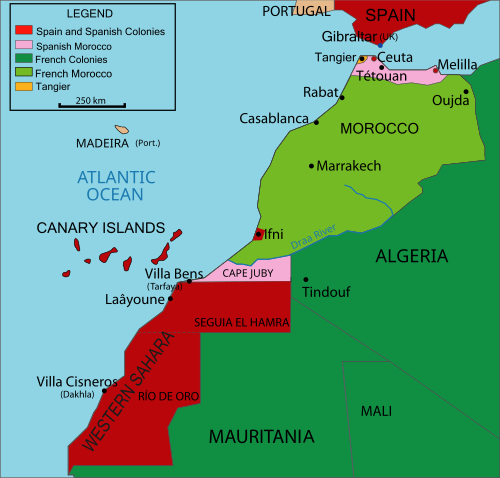
at Le Monde Diplomatique (in English) on how the then Spanish provinces of Saguía el Hamra and Río de Oro (then legally as much part of Spain as Madrid, by the way - so good for the unalienable unity of the fatherland) ended up in Moroccan hands with the blessings of the USA and France.

Map of the colonial West Sahara and Morocco in the mid 20th century (from Wikipedia).

Apparently the USA saw Algerian interest in supporting the Sahrawis as part of the Cold War geopolitics, so, by default, it supported Morocco discretely. Spain was reluctant to yield the territory and specially if it appeared they had been kicked out, however it eventually yielded to pressure in the context of an uncertain regime change.

The appointed Sahrawi council (Yemaa or D'jemaa) however declined to play the rubber-stamping role that the USA, France, Morocco and Mauritania had devised for them and instead declared its own dissolution and transfered its power to the recently created POLISARIO Front, which proclaimed the Sahrawi Arab Democratic Republic.

To Moroccan disillusionment the African Union Organization, as well as most African states, also recognized the rebel republic and the weakest part, Mauritania, soon yielded to Polisario attacks and recognized the country's independence in 1979. Morocco became isolated in Africa. However, later on, the Moroccan tyranny (it's a police state where people fear speaking freely, I can tell you), with massive support from Saudi Arabia, the USA and France, managed to build their version of the Great Wall, forcing the Polisario out of most of the country and preventing them from attacking the much coveted phosphate mines and foreign fishing ships that had no authorization from the Republic.

All this only barely dealt with in the Le Monde Diplomatique article but it is still interesting to read to understand how the imperialist interests of the USA and France played in favor of the last absolute monarchy of Africa... and to read how Kissinger view the issue on his own words.

However, in spite of a two decades long cease fire, the wound is still open and the war might start again at any moment. Moroccan official maps, of the kind you find only there, have no borders south of Oujda, as the fascist monarchy claims all the desert for them: a good bunch of Algeria, all Mauritania and, who knows, maybe even Mali.

Further reading (in Spanish) at Sahara Libre, where you can find news of the ongoing conflict such as the violent repression of striking workers yesterday, the long hunger strike of Dr. Abbas Mohammed Chej Sebaj or how lobbyists in the USA are trying to bring the now unemployed Louisiana fishermen to the rich Sahrawi banks.

Thursday, February 4, 2010

Sign against the exploitation of Sahrawi waters


The EU is paying Morocco to fish in occupied Western Sahara. You can help by signing
this petition, whose text follows (bold type is mine):

Petition:

Stop EU fisheries in Western Sahara!

To the European Commissioner for Fisheries,

No state in the world has recognised the Moroccan annexation of Western Sahara. Still, the EU is paying millions of Euros annually to the Government of Morocco to allow EU vessels to fish in the waters of Western Sahara. The EU fisheries activities in Western Sahara must immediately come to an end.

Morocco continues to refuse to cooperate with the decolonization process in Western Sahara, thereby defying more than 100 UN resolutions that insist on the Saharawi people’s right to self-determination. Simultaneously, Moroccan authorities commit human rights violations against Sahrawis who voice their political views. No EU states, nor the UN, recognise the Moroccan sovereignty over Western Sahara.

In this context, cooperating with Morocco in exploiting Western Sahara’s natural resources is highly unethical, and clearly jeopardizes the UN’s efforts to find a peaceful solution to the conflict.

According to the UN, the natural resources in Western Sahara cannot be exploited without regard to the wishes and interests of the people of the territory. However, the EU is transferring European taxpayers’ money to the Government of Morocco for access to Western Saharan waters, without even consulting the Sahrawi people.

The EU has the legal and moral obligation to stop subverting the UN peace process in Western Sahara, by respecting the Sahrawi people’s right to self-determination over their land and their resources.

We urge the European Commission to put an immediate stop to the granting of all licenses to EU vessels fishing in Western Saharan waters, and we demand that no further EU fisheries operations take place in Western Sahara until a peaceful solution to the conflict has been found.

Yours sincerely,

Sign the petition!

The petition was published on 06.11.2009 and has now 10414 signatures.

I would add: pay the taxes to the Arab Sahrawi Democratic Republic and, with their agreement, send that useless NATO navy to ensure the safety of our fishermen and fight against Morocco for the sovereignty of West Sahara.


Friday, December 18, 2009

Aminatu won! She's back in West Sahara.


Sahrawi human rights activist Aminatu Haidar, who has fought a brave nonviolent struggle for 33 days, with the only weapon of hunger strike, is reported to have arrived to her home in El Aaiun (West Sahara).


She has arrived accompanied by her sister Leila and the doctor who attended her at Canary Islands. Supporters were waiting for her at the ariport and the Moroccan occupation authorities returned her passport after arrival.

Her return has caused demonstrations of happiness and support in the Sahrawi capital, where people went to the streets chanting Long live the Sahrawi People, out with Morocco. Occupation police forces attacked them and cut access to the Haidar home. The Committee for the Defense of the Right of Self-Determination of the West Saharan People (CODAPSO by its Spanish acronym) denounced Moroccan police for arbitrary arrests and violence against demonstrators.

Before leaving for Sahara, Aminatu Haidar declared that this is a victory for International Law, for Human Rights, for international justice and for the Sahrawi cause.


Aminatu Haidar when leaving the hospital for the airplane that would bring her back home

24 hours before leaving Lanzarote, she had willingly gone to hospital, as her health was already very poor and was suffering of stomach pains and dehydration.

Source: Gara (link 1, link 2).

Tuesday, December 15, 2009

UN trying to find a solution for Haidar


The Secretary General of the United Nations, Ban Ki-Moon, has met the Moroccan foreign minister in an attempt to solve the situation of Sahrawi human rights activist
Aminatu Haidar, illegally expelled to Spain in November and since then in hunger strike in demand of her right to return to West Sahara, largely occupied by Morocco since 1975.

Ban Ki-Moon also talked by phone with the Spanish foreign minister. The responsability of this Kafkian situation lays on both the shoulders of Morocco, who could not legally expel her or deprive her of the Moroccan nationality, and on those of Spain, who could not accept her, being an illegal immigrant who has not asked for any sort of polytical assylum.

Source: Swissinfo (found via Hala Bedi Irratia).

Al Jazeera also has a report and video on the situation of Haidar, who is holding her hunger strike at the Tenerife Airport bus station, needing already help and a wheelchair for something as basic as going to the toilet.

Wednesday, December 9, 2009

POLISARIO Front warns that if Aminatu Haidar dies, the truce is over


Aminatu Haidar is a Sahrawi citizen and human rights activist who was expelled from the territory occupied by Morocco to Canary Islands (Spain) after she wrote down in her police file that her country of residence is Sahara (meaning West Sahara or the Sahrawi Arab Democratic Republic, as is officially recognized by many countries).

Since then she has mantained a hunger strike for more than 20 days and her life now is at increased risk. However she refuses to be hospitalized on fear of Spanish manipulations or forced feeding. She has also rejected the offer of political assylum by Spain and demands to be returned to Moroccan-administered territory.

I have several times thought of covering the matter but, with so many things going on, I have failed to do it until now.


Aminatu Haidar is known as the Sahrawi Gandhi

Anyhow, the case is that the POLISARIO Front (acronym of Frente POpular para la LIberación de SAguía el Hamra y RÍO de Oro, names of the former Spanish provinces in West Sahara) has declared that if Aminatu Haidar dies, they will abandon their long standing UN-sponsored truce, that has given no results besides diplomatic blah-blah, and return to armed struggle. It was none less that Taleb Omar, leader of the Front and Prime Minister of the disputed Republic who made this warning to the Spanish state news station RNE, so it is something that must be taken very very seriously.

Oddly enough, Taleb Omar demands that the Law of Foreigners is strictly applied in this case, which would result in Haidar being expelled to Morocco immediatly (and Morocco would have to accept her because of the bilateral treaties on this matter). He had very rough words for Spain, which is accused again of being accomplice of the Moroccan tyranny (also a privileged ally of the USA and France) and compared disfavorably the role of Spain in the Sahrawi case with that of Portugal in the similar case of East Timor, where the former metropolis had a proactive commitment to the independence of its ex-colony.

Source: Rebelión.

Sunday, November 1, 2009

Sahrawis could face death penalty


Seven
Sahrawi citizens are being subject in Morocco to military trials for "treason". Their crime, to meet with the refugees at the Tindouf camps in Algeria and therefore having contact with the Polisario Front.

They were originally kidnapped by the occupation forces upon their return to West Sahara. Other five people were similary kidnapped but abandoned then in the desert.

The seven activists are jailed in the infamous high security prison of Salé, near Rabat. They are being accused of "attack against territorial integrity, against national security and meeting the enemy, and could even face the death penalty.

Morocco is an authoritarian regime where the monarch's power is absolute. It is, together with Swaziland, the last monarchy of Africa. In the 1970s, Morocco annexed unilaterally the former Spanish colony of West Sahara against the will of the people, sparking the continuity of the anti-colonialist guerrilla. The annexation is not recognized internationally and Morocco is in fact an occupying power.

Source: Rebelión.
.