New blogs

Leherensuge was replaced in October 2010 by two new blogs: For what they were... we are and For what we are... they will be. Check them out.

Wednesday, August 18, 2010

Mitochondrial Eve lived some 200,000 years ago


Just for the record.


Contrasting several simpler and more complex models of mtDNA molecular clock evaluation seem to show coincidence at least in this aspect our shared oldest grandma (by purely matrilineal ancestry) lived some 200,000 years ago.

Krzysztof A. Cyrana and Marek Kimmel, Alternatives to the Wright–Fisher model: The robustness of mitochondrial Eve dating. Theoretical Population Biology, 2010. Pay per view.

According to the news article at Science Daily:

Each model has its own assumptions, and each assumption has mathematical implications. To further complicate matters, some of the assumptions are not valid for human populations. For example, some models assume that population size never changes. That is not true for humans, whose population has grown exponentially for at least several thousand generations. Other models assume perfect mixing of genes, meaning that any two humans anywhere in the world have an equal chance of producing offspring.

Cyran said human genetic models have become more complex over the past couple of decades as theorists have tried to correct for invalid assumptions. But some of the corrections -- like adding branching processes that attempt to capture the dynamics of population growth in early human migrations -- are extremely complex. Which raises the question of whether less complex models might do equally well in capturing what's occurring.

"We wanted to see how sensitive the estimates were to the assumptions of the models," Kimmel said. "We found that all of the models that accounted for random population size -- such as different branching processes -- gave similar estimates. This is reassuring, because it shows that refining the assumptions of the model, beyond a certain point, may not be that important in the big picture."


Mammoths died off because of forest expansion


That is the conclusion reached by Brian Huntley and colleagues of Durham University, UK, as reported by BBC (sorry but I cannot find a more direct reference at this time).

According to the British scientists, after running several models for the extinction of mammoth and other megafauna of the Ice Age, the model that is most plausible is that they went extinct because of loss of grasslands and not human hunters' pressure.

During the height of the ice age, mammoths and other large herbivores would have had more food to eat. But as we shifted into the post-glacial stage, trees gradually displaced those herbaceous ecosystems and that much reduced their grazing area.

Update (Aug 19):

Found the relevant paper:

Judy R. M. Allen et al., Last glacial vegetation of northern Eurasia. Quaternary Science Reviews, 2010. Pay per view.

There is also an alternative news article at Science Daily (typically a literal transcription from the press release) that uses maybe less absolute terms than the BBC one:

The change from productive grasslands across large areas of northern Eurasia, Alaska and Yukon to less productive tundra-like habitats had a huge effect on many species, particularly on the large herbivores like the woolly rhinoceros and woolly mammoth. Mammoths and other mega-mammals found it increasingly difficult to find food. We believe that the loss of food supplies from productive grasslands was the major contributing factor to the extinction of these mega-mammals.

Monday, August 16, 2010

Zaragoza-Brussels march for social rights


It began last Saturday and it's expected to reach Brussels on September 27 after many journeys varying from 17 to more than 50 kilometers, mostly through France.


People who wish to join for whatever length is asked to write to marchaabruselas@gmail.com, including name, mail address, telephone and journeys planned to take part in, or calling to telephone +34-679213259. Marchers are expected to bring their luggage, shoes, basic aid kit and sleeping utilities (sleeping bag, tent). A van accompanies the march to take care of luggages and people who need to rest.

The slogan is "March to Brussels. Against labor reform, for social rights" and one for the callers is anarcho-syndicalist union CGT, a splinter of the historical CNT (they mention other organizations but I have not been able to find out yet).


More photos and info (in Spanish) at CGT (includes detailed schedule and other info) and Rojo y Negro (photos).

From the second site:

We march against the spoliation of working classes and the destruction and privatization of the public sector in all Europe.

We march against Labor Reform and social cuts in the State of Spain.

We march against the Spanish government and the rest of European governments, who reduce salaries to public employees, freeze salaries, freeze pensions, increase VAT equally for the rich and the poor.

AND ABOVE EVERYTHING ELSE, we march because taxes are not being raised for the rich, fiscal paradises are not being destroyed, submerged economy is not being persecuted, tax fraud is not being attacked, no responsibilities are demanded to those who have caused the crisis, no embargoes nor prison are being applied against bankers, speculators and billionaires who are taking the public money.

Saturday, August 14, 2010

Yet another labor activist murdered in Colombia. Yet another mass grave found.


Germán Restrepo, 58, president of the packagers' union was murdered yesterday in the city of Medellín, where he lived and worked.

He is the last one of a long list of labor unionists murdered in Colombia in the last years: 547 since 2002, 32 in 2010 alone.

As denounced by the president of Unitary Workers' Central (CUT), Tarsicio Mora, many of those crimes remain without any investigation at all.

Medellín, the second largest Colombian city, remains one of the most dangerous places in the country, with death squads and criminal gangs acting impunely.

Source: Agencia de Prensa Rural[es]


Another mass grave found in the Colombian NE

The same site reports that yet another mass grave has been discovered in the department of César, near the Venezuelan border. 140 bodies were recovered,, mostly women, all them victims of the paramilitary terror that plagues the country with the consent and support of the state.

It is estimated that some 140,000 people have been victim of paramilitary terror only in this department. This figure does not include displaced persons.

Friday, August 13, 2010

Richer than Bulgaria


The title of this article makes reference to one of the online comics I follow regularly, The Noob (a satire of massive online RP games), which, in a recent release, got the councilors of the starring Clichequest gaming company arguing about Blizzard (a real company that was recently in the news on gamers' privacy issues) as follows:

Boss (irate): We'll sue them!
Councilor 1: But they're richer than Bulgaria!
Councilor 2: I've heard that they have nuclear warheads.

Actually Blizzard is not richer than Bulgaria (and don't worry about their imaginary nukes, of course) but if they would have said richer than Mongolia, they would have been damn right.

And Blizzard is not any particularly large company. There are indeed about 150 corporations that are richer than Bulgaria, what means they are ten times richer or more than the gaming company (and Mongolia too).

I think this is an important point when we try to understand things such as capitalism, globalization and the reduced power of states. For some reason the pun got stuck in some corner of my head and, many weeks later, today, I decided to check what kind budgets actually manage large corporations, which corporations are these and how they compare with countries.

After some consideration, I think that company gross revenue figures compare well with state GDP (nominal) as both represent overall money flows, a measure of accountant if not truly objective nature (see my recent article on the magical nature of money maybe).

Wikipedia is of great help in these matters. I just had to compare their list of companies by revenue with their list of countries by GDP (nominal).

And I found that only a handful of countries are actually richer than Wal Mart, the largest company by this measure. And who says Wal Mart, easily says Exxon, Shell or BP, which are straight behind the commercial giant.

All them and many more are indeed richer than Bulgaria... and even richer than Sweden in the case of Wal Mart or richer than Finland in the case of BP. There are only 21 so-called sovereign countries richer than Wal Mart.

And as we run through the list of hyper-wealthy and therefore hyper-powerful companies, soon we reach some that we have never heard of. In place 18th is something called Glencore International AG, that, after clicking in the hotlink, happens to be dedicated to trading raw materials and such. This rather unknown company is richer than, not just Bulgaria, but also than New Zealand, Ukraine, Hungary or Algeria.

And by the way, the Wikipedia article is pretty much merciless with it: Glencore's history reads like a spy novel... tax evasion and illegal business in Iran... presidential pardon by Bill Clinton... dealing with rogue states... investments in Colombia... But well, I don't want to deal here too much in the peculiarities of specific companies, because surely they are all pretty much the same at the end of the day.

I will take instead as example instead a much more modest company, whose headquarters are located in my hometown and whose building (left) is still the tallest one by far in Bilbao. I'm talking of BBVA. I just chose it because it's a semi-local company, the pride of Basque bourgeoisie (though nowadays it is rather controlled by Spanish owners and has moved much of its infrastructure to Madrid).

It's not even the largest company of Spain (that's Telefónica, where I once worked) not even the largest bank either (Banco Santander is) and only ranks 129th globally, having a fraction of the wealth of Wal Mart or BP. But, uh-oh, it's still richer than Bulgaria (and Sudan, Oman, Syria, Luxembourg, Slovenia, Serbia, Guatemala, Uruguay, Latvia, Jordan, Jamaica or Botswana)

So does that mean that mean that if Mr. Francisco González, executive chairman of BBVA, meets Mr. Georgi Parvanov, President of Bulgaria, are they equals? Protocolarily the answer is no way but in practical terms they are indeed.

And, moving the scenario to the other side of the Atlantic, what does that mean when the Governor of Louisiana, for instance, a state with a GDP of 168 billion USD (roughly like Pakistan or Nigeria) meets the CEO of BP, whose revenue is of some 246 billion USD?

I'll leave the answer open.

Thursday, August 12, 2010

Lucy's knives


New evidence in form of unmistakable stone-tools' marks on bone, push back the earliest known systematic use of tools to an species that was surely not still "human" (in the sense of belonging to the genus Homo) but to Australopithecus afarensis or another similar (but unknown) species. This happened some 3.4 million years ago in the central-northern Ethiopian highlands.


Australopithecus afarensis, the species to which the famous fossil Lucy belonged to, is the only hominin species known to have lived in that space-time. However until now it was commonplace to think that they were vegetarians and did not use tools.

It seems now that such ideas were wrong and that Lucy's species, with a brain barely larger than that of a chimpanzee, was already using not just random rocks but sharp ones able to cut meat. Forensic analysis leaves no room to doubt the marks are product of cutting tools and not animal fangs or paws.

This has potentially interesting implications for the evolutionary history of human brain and intelligence, as well as our highly precise hand, both tightly associated to tool use.

More detailed news stories at Science Daily and BBC.

Ref. Shannon P. McPherron et al., Evidence for stone-tool-assisted consumption of animal tissues before 3.39 million years ago at Dikika, Ethiopia. Nature, 2010. Pay per view.

Wednesday, August 11, 2010

Very bad looking steady black flow from the Louisiana oil spill spot


Just posted
at Florida Oil Spill Law with time stamp of 3:00 am today (local time, I presume):


I am more and more concerned. Well, more like beginning to panic, admittedly. They have no damn idea of what kind of forces they are dealing with and the only thing it seems to matter is profit and/or cutting losses.

Even if the doomsday scenario hypothesis does not become true (and I do not know what to think really), such an uncontrolled flow of oil and methane is a true disaster. It was already the worst oil-related disaster ever but it will be even worse, as it seems it is going to run uncontrolled for months or who knows for how long.

I am in Europe, many many kilometers away... but if you follow NOAA predictions (which only reach to mid-July) the oil has already reached the Atlantic Ocean and will keep flushing in that direction (all that is not skimmed or end ups into beaches and such). Eventually it will reach here too, as the Gulf Stream ends in the Atlantic coasts of Europe. Typically that is a blessing, allowing for several degrees of temperature above what is usual for these northernly latitudes, but now it seems it may become a curse.

Brain appears non-hierarchical, Internet-like


New research by the University of Southern California seems to confirm the non-hierarchical model of brain organization.


In the past it was common to believe that the brain was organized hierarchically, this preconception was challenged by the network hypothesis, which has been gradually growing in popularity. However neither model had much empirical support so far.

Now Richard H. Thompson and Larry W. Swanson have found that, at least for a particular region of the brain of rats, the reality is non-hierarchical but that of a complex network.

Richard H. Thompson and Larry W. Swanson, Hypothesis-driven structural connectivity analysis supports network over hierarchical model of brain architecture. PNAS 2010. Pay per view (depending on geography and time of access).

Press articles at Science Daily and BBC.

Campaign for the freedom of Bradley Manning


US soldier Bradley Manning is allegedly the whistleblower who unveiled
a large number of secret or confidential documents that evidenced troops' total disregard for the lives of civilians, and the apparent support of Taliban guerrillas by Pakistan.

He has been compared to Daniel Ellsberg, who unveiled the so-called Pentagon Papers in the 1970s.


Antimilitarist organizations Courage to Resist, Codepink and Veterans for Peace are launching a campaign in support of this brave and bold soldier who dared to challenge authority and unveil some of the ill-guarded secrets of the imperial oligarchy.


There was already a first demonstration at Washington D.C. this past Sunday (photo above) and tomorrow there will be another one at Oklahoma City.


On August 4th, another, rather massive, demonstration was held at Quantico Base, Virginia, where the soldier is being held prisoner (photo above).

See also: Bradley Manning Suport Network.

Tuesday, August 10, 2010

Expert who denounced BP found dead


Mathew Simmons, former chairman of Simmons & Co. International, advocate of peak oil theory and heavy critic of BP's management and misinformation on the Louisiana oil disaster was found dead yesterday in the bath tube, allegedly drowned after suffering a heart attack at the age of 67.


Simmons became rather prominent in the last months as he denounced in the media that there must exist another much bigger leak, some five or six miles away from the one reported and seemingly "killed". For him what we could see in the underwater cameras could not account for the real figures of the spill, even when these were minimized by BP and the US government.

More controversially he proposed to tackle the problem using a controlled nuclear explosion.

But crucially he denounced that nothing was being done apparently to quell the main spill, in a most serious case of environmental crime. He also suggested early on that the USA should have taken military control of the problem instead of letting the fox, BP, to take care of the chickens (oil disaster).

Suspicion of assassination is of course widespread through the Internet because the most prominent critical voice on this disaster has been silenced this way. See for instance: Alexander Higgins' Blog, .

In this sense I must mention that the modus operandi, if we are in front of a murder, is very similar to the one used by the Mossad in Dubai some months ago, to murder Hamas member Mamouhd al Mabouh, whose death was for more than a week officially believed to be caused by a heart attack... until French laboratories confirmed the presence of such a high tech poison.

Some 300 videos of Simons' opinions on the oil spill can be found at YouTube.

Update (Aug 12): just to mention that three people working for BP cleanup operations have died. One apparently shot himself, another one died of an apparent heart attack and drowning at a swimming pool (curious coincidence with Matt Simmons' death) and the other is only mentioned by number (source).


Anarchists Against the Wall


I've just now come to know of this nonviolent movement of Israeli anarchists and other anti-Zionists against the wall of shame that Israel has set to enforce apartheid in Palestine.


Looks promising, specially as they have been growing slowly but steadily along the years. With the many differences, I can hint to a parallel with the antimilitarist struggle we held in the 1980s and early 1990s against conscription in the state of Spain, which was a total success.

The keys of the success were, I understand: nonviolence, pedagogy, grassroots organization and the fact that the system was so rotten and delegitimized that it was relatively easy to pull it down. Of course people went to jail for that... but that was part of the plan.


Similarly the state of Israel and its apartheid and criminal genocide is morally bankrupt and it is just a matter of time until it falls.

This kind of struggle is what is needed in order to mend the wounds. It is important, I think, that the lead is being taken by people with no religion when it is that farce of religious sectarianism what is used as pretext for apartheid and colonization.

I am glad that it is expanding more and more.

Read more at: Anarchists Against the Wall and Ilan Against the Wall.

Child soldier's confession under torture is legal evidence for USA


The outrageous case of Guantanamo Nazi prison, which has not yet been dismantled by Barack Obama in spite of his electoral promises, goes one step further as Omar Khadr is going to face a farce trial under his military captors who took him from Afghanistan when he was 15 years old.

The accusation, for which he could face a life sentence, is to throw a grenade killing a US soldier, in the context of the US/NATO invasion of Afghanistan in 2002, of more than questionable legitimacy itself.

The only evidence: his own confession, obtained under the system of torture that is well known to operate in the colonial base in Cuba.

Under international law, child soldiers are to be considered victims.

Under any sensible law as well, confession obtained under tortures or possible tortures cannot be evidence. Otherwise it is going back to the times of the Inquisition.

However the military tribunal that is to judge Omar Khadr has accepted this only piece of "evidence" as valid. Khadr is however still hopeful that justice will prevail and rejects to enter a plea bargain.

The young Omar Khadr, now 23, has seen some of the best years of his life wasted in one of the worst prisons on Earth.

While he initially cooperated with his captors, he is now set not to accept the impositions of the farce trial and may even dismiss his military attorney out of lack of faith on the system.

The world doesn't get it, so it might work if the world sees the US sentencing a child to life in prison, it might show the world how unfair and sham this process is. And if the world doesn't see all this, to what world am I being released to? A world of hate ... and discrimination.
I hate to say this but he is damn right. It may cost him dearly but it is on this kind of fearless heroism that justice is built upon.

Source: Al Jazeera


____________

Update (Aug 13):
Daphne Eviatar reports at the Huffington Post on the first day of the farce-trial which was suspended indefinitely (or for 30 days, not fully clear) after the defense lawyer suddenly collapsed while interrogating a witness.

It is interesting the report on the actual facts that seem to transpire in the trial: Omar Khadr was not just a minor at the time of the alleged "crime" (fighting in a war, defending his country from a foreign invasion if anything) but there is absolutely no evidence that he even fought at all. There are reports that the person who threw the grenade, killing a US soldier, was someone else and that Khadr did not even participate in the combat at all, where he had been brought by his father in a clear case of parental coercion.

They also report that he was shot in the back twice in spite of being unarmed, (i.e. a civilian minor) surviving almost miraculously. Daphne Eviatar asks: who is the real war criminal here?

Sunday, August 8, 2010

The killing fields of Colombia


As one fascist president takes over his equally fascist predecessor in Colombia, one of the largest mass burials known to exist in the country is being unearthed at
La Macarena, just 200 km south of Bogota. Some corpses are still fresh.


The Colombian paramilitary forces, promoted by the state in their fight not against the guerrilla but against the civilian dissidence (human rights' activists, leftist politicians, labor unionists...) and heavily involved in traffic of cocaine and its cheap derivative: crack, have murdered maybe 50,000 civilians, many of them social activists but many others mere random peasants used for training and then presented sometimes as guerrillas in the scandal of the false positives.

In many cases, the paramilitary forces used random peasants as victims for training their new recruits. The gangs' rookies had to disembowel and dismember these innocent people as means of initiation and training. They were also expected to do the same kind of hyper-violence when taking over a village, so peasants learned to fear them.

The new president, J.M. Santos, former minister of defense, is tainted with that blood and we can hardly expect any solution under his leadership, which represent only the continuity of mafias, death squads, generalized repression and the domination, under the shadowy protectorate of the USA, of the old oligarchic families, to which he belongs.

Source: La Haine.

See also this previous post.

Saturday, August 7, 2010

Louisiana oil disaster: the more I read/watch, the more pessimistic I am


In theory they have capped it and that's about it. In practice it is extremely worrisome that they are systematically falsifying, hiding, photoshopping the truth.


Like this bubbling methane seep captured yesterday by one of BP ROVs but hidden by something as simple as darkening the image:


It's just an example. There's a lot more really depressing and hidden-under-the-carpet stuff at Florida Oil Spill Law and Alexander Higgins' blogs. You have to like research journalism though.

It is also worrisome, beyond the immediate disaster the consequences that the lack of a grassroots political organization of the working class can carry: millions of people are being affected by this, including not just the disaster as such but criminal mismanagement at all levels, directly affecting health and jobs, as well as the whole ecological balance of one of the most diverse seas on which these rely and where is the response?

There is only limited response because there are not class organizations beyond unions and sectorial activist groups in the USA. As some member of the fishing community of Louisiana put it already months ago: "we are expendable". It only matters to pretend that everything is under control and to minimize losses to the big corporations.

Even if the doomsday scenario forecast by several people of the oceanic bottom ripping off and causing a huge tsunami and releasing cataclysmic amounts of usually frozen methane to the atmosphere fails to happen (I really hope so), the damage caused by corporate interests is already immense and will grow in the following months as the remainder and future residues of oil and corexit poison spread around. This should warrant people going out to the streets in protest at least every other weekend... but nobody is mobilizing this anger and frustration and the corporative masters and their politician and judiciary minions do as they please therefore.

Friday, August 6, 2010

Superconductor strange behavior only explained by String Theory


US scientists have found that the strange behavior of
cuprates, a superconductor copper composite group of materials, have a resistivity and rate of electron scattering which are directly proportional to temperature, instead of being proportional to the square of the temperature as happens in other superconductors, which are ruled by Fermi's laws.

According to co-researcher Hong Liu: there's really no theory of how to explain that.

Except String Theory.

Using a key property of String Theory, known as gauge-gravity duality, which states that each quantum (gauge) phenomenon has an analogue in the realm of gravity, they found that black holes seem to behave in the gravitational field exactly as non-Fermi liquids, like said cuprates, do in the quantum one.

Source: Science Daily

Ref. Thomas Faulkner et al. Strange Metal Transport Realized by Gauge/Gravity Duality. Science 2010. Pay per view.


It is not the first time that the String Theory, that should unify Quantum Mechanics and General Relativity, seems to be confirmed empirically in this strange world of "warm" superconductors. I already mentioned previous research a year ago.

However opponents seem whinny about the supposed non-demonstrability of String Theory, which actually has to do with some complains regarding the impossibility to falsify it at the "usual" particle accelerator energies. But I suspect that they are rather too inclined to materiality and lack holistic vision, which is necessary for a theory of all, an explanation not just of this universe but of the metaverse itself, of "God" if you wish. Of course, such explanation must also work in this world but there is no reason to think that this universe is the only thing existing, specially because we know it has a beginning, it is finite, hence there must be something else. It is more than probable that to explain some phenomenons at the very edges of this universe, as happens with black holes, the big bang and others, we need to explain not only the 3+i dimensional sub-reality we exist in but all, absolutely all, even what we cannot perceive easily. Only String Theory reaches that far, which is a virtue rather than a defect.

But hyper-materialists are uncomfortable with a reality with more than the usually experimented dimensions and surely they were uncomfortable with relativity and its folding of space and time in the past as well. They prefer particles to be objects, even if they have to be Newtonian non-dimensional points, and that is a psychological barrier. But what's wrong with a string or a brane? Nothing, in fact it's more natural for the relativistically-minded: you don't need anymore an unreal punctual electron immersed in quantum uncertainty but you actually have a most reasonable string that vibrates, which is actually what electrons or photons seem to do, as they are neither here nor there as punctual particles or they are particle and wave at the same time... only brane mechanics, i.e. String Theory, can explain that, it's pure logic... at least for me.

Is it an issue to need more dimensions? Not at all. There must be something else than this universe and therefore there must be further dimensions, maybe infinite. This is also pure logic. I am persuaded that great thinkers of the past such as Spinoza or Einstein would have agreed with this theory. But I learned the basics of these physics from one of the most celebrated geniuses of our time, Stephen Hawkins. So it sounds quite interesting. Authority however is no proof, the proof is in superconductors, it seems.

Thursday, August 5, 2010

Money, debt, magic...


The Chaotist current (a rare esoteric school of thought of the second half of the 20th century) provided me with some useful tools to understand the nature of Reality and how magic (or
magick as they spell it) is nothing but the ability to persuade others as in the case of publicity (or of course the more classic but otherwise similar case of illusionism). In this sense it is a useful break up with the dominance of rationalism and materialism in modern thought helping us, once you get pass their esoteric formalisms, which are nothing but a cover up, a misleading cue and/or an elaborate joke, to understand the deep reality behind mere objectivism. That is the mental or subjective reality and the social reality that arises from the interaction of these subjectivities.

Another contemporary current that heavily dwelt in the importance of subjectivity but from a Marxist and more rationalist and revolutionary perspective, was Situationism. That's the kind of forces that LSD and the like liberated, I guess.

Maybe the most important concept I appropriated from Chaotism is that of godform, which, as I understand it, means some concept believed by many to be true, turning to have some sort of life of its own, not being fully controllable by anyone in particular. Typical cases of godforms are, of course, gods or equivalents such as Yaveh, Vishnu, Zeus, Allah, 'God' (Deus), Buddha, Tao, Baron Samedi, Pachamama, Yemaya, etc.

Regardless of their values and connection with aspects of reality or interactions between them, what really imbues them of a life of sorts is the belief of their followers. They feed on faith and die off when people stops believing in them.

Ideologies are also godforms, again regardless of their goodness or evilness: they feed on faith and can die off if people stops believing in them. Only the most powerful magi (some prophets, messiahs, caliphs, popes, buddhas, ayatollahs, master propagandists or great revolutionary leaders) can have some control over them, however, human life span is rather brief, while that of godforms transiting the social continuum can be much longer (though eternal is just an exaggerated claim).

But the godform of our time above all others is Money. As everyone with a critical mind who has studied Economics (as I did for some time) knows this discipline is not any science but a doctrine and dogma. Of course, it has some scientific elements of sorts, nothing can exist against the daily reality check, but these are just tools for the main objective of the discipline that is to create a cult around certain school of economics, namely liberalism.

Money as such is merely a token of debt, which by virtue of its token nature can be circulated more easily than merchandises. I produce something with my recognized work and I get paid in said tokens, which represent social debt in my favor which I can the spend in things I need or desire. It requires some historical developments such as social and economical complexity and private property, but otherwise it is that simple. Either it is a consensus valuable item, such as cows, salt, shells or gold, or it is guaranteed by the power of social organization itself, namely the state, in which case it can be perfectly a paper note or even a mere accountancy annotation on a register, which is what you use nowadays when you write down a check or pay with a debit card.

But their token or merely accountancy nature makes control of money, such an important social and economic tool, a key resort of power. You can gain control of money by accumulating it but the real power is in issuing it. There are two ways of issuing money: physically creating it, which is normally a privilege of the state (though historically often subcontracted to private minters), or virtually creating it by means of accountancy magic (i.e. lending well beyond what one has, a privilege of banks mostly). The differences between the various types of effective money supply are typically called M1, M2, M3 and by other similar names (M1 means physical cash plus "real" accounts while M3 means the whole amount of virtual money circulating in accountancy annotations). M3 can be many times M1, as you can see in this graphic for the Eurozone (the USA does not anymore publish M3 figures, surely to hide some grave economic facts caused by over-printing and over-lending by the Fed):


There are much worse cases than EU, indeed, specially in regard to disparate growth of M3 in comparison to M1 and M2. As the exclusive components of M3-M2 are almost never in the hands of common people (as well as most of M2-M1), the disparate growth of this kind of virtual inflationary money supply generally means that the elite becomes richer while the commoners lose.

But maybe more important than all these esoterisms of the Economic "science" it is the fact that bankers can lend money they do not own (they lend on account of your deposited money) and that gives them key control over all the monetary flux, specially if they act with some consensus (oligopoly) and have the complicity of the states, much more if they meet regularly at global level (Davos, Trilateral Commission, etc.) and have secretariats and offices to ensure that their wishes come true (IMF, OCDE, World Bank, etc.).

Where do I want to go? Actually I mostly wanted to introduce a couple of economic articles published at Global Research:

Zoltan Zigedy writes from Hungary on the debt trap imposed by the IMF to his country (and so many others - I recently mentioned India for example)


For decades, left critics of the International Monetary Fund (IMF) have maintained that the IMF is merely a tool for enforcing the interests of financial elites, especially those in the US. Predictably, this view has been scornfully dismissed by those in power and their media lackeys who posture the institution as the benefactor of needy countries. The persistent history of the IMF’s extortionate funding, linked to austere cuts in social spending, is simply dismissed as pressing fiscal responsibility on countries lacking the spine to address their profligacy. Such are the myths that sustain faith in global capitalism.

But a close look at the IMF in action reveals the politics lurking behind its high-sounding mission statements. Read the whole article...

It is painfully ironic that Hungary, the poster child of EU and IMF draconian deficit contention policies and former socialist bloc recycling to capitalism is subject to such a extortion by the imperial financial oligarchy.

Naturally this is raising nostalgia for communism because, whatever the faults and limitations of the old system, nobody ended up begging in the streets or having to live on welfare for lack of jobs.

It reminds me when, 21 or 22 years ago, I went on a visit to the European Parliament with people of the movement against the Leizaran highway (as unpaid and informal journalist for an alternative news agency). Besides of our host, we were welcomed and briefed by some liberal MEP who said that EU was ready to welcome specifically Hungary "if they adopted democracy". I had to ask an uncomfortable question: what if Hungary adopted democracy but kept a socialist economic system? He replied that in that case they could not enter EU because blah blah market economy blah blah.

I had to ask, you know. I was barely 20 but I knew already that it was not a matter of mere formal democracy.

The other article, by Ellen Brown, is quite curious because it is an apology of the Commonwealth Bank of Australia... before it was privatized.

The bank was created with zero capital and a small loan from the government on the quite reasonable belief that central banks are backed by the whole wealth of the country (i.e. by the moral authority of the government as social organizer and representation). It was the only bank with zero capital, yet it worked perfectly well (what illustrates well the virtual and faith-based nature of money).

But woe! The bank not only lent at low rates to private financiers, as most central banks do, but it also lent to the general public at similarly low rates and kept a reputation as "the people's bank" until its privatization 15 years ago. Of course, that's considered "socialist" by Thatcherian/Reaganist standards but it's what used to work and therefore it is being demanded again.

Wednesday, August 4, 2010

Genetic flow across the Strait of Gibraltar


Researchers from the University of Geneva try to address the somewhat complex problem of genetic flow across the Strait of Gibraltar, between SW Europe and NW Africa, in a new paper:


Mathias Currat et al., Human genetic differentiation across the Strait of Gibraltar. BMC Evolutionary Biology, 2010. Open access.

They analyze a number of genetic variables such as Y-DNA, mtDNA, blood groups ABO and Rh, and other antigen/antibody systems (HLA, MNS and GM) and produce a number of statistical analysis for them. However they acknowledge that their modeling on continuous, rather than punctual, gene flow, may have some difficulties providing clear-cut answers.

Still they do produce results that are in general favorable for the P scenario (flow since 20,000 years ago), excepting to some extent the Y-DNA, which is probably a secondary sex-biased element overall.

Above: The scenarios are described in page 10 and in the supplementary material. P is "Paleolithic" flow beginning 20,000 years ago (Ibero-Maurusian or Oranian culture) among small populations, N instead is "Neolithic" flow among larger populations. PN is intermediate and PNI is intermediate but also considering the Islamic expansion (though details are not provided).

They also produce results of quite greater affinity within each region (SW Europe and NW Africa) than between them, as expected.


Notice in this graph (and also fig. 3) how autosomal markers' curves and that of mtDNA (MT-HV1, in blue) are very similar, however while mtDNA tends to lesser homogeneity within regions, it strongly tends to higher homogeneity instead across the Strait. This I interpret as meaning greater affinity across the strait in the Paleolithic, before the primarily male expansions reflected in the Y-DNA, altered the scenario.

Sadly no graphs for each of the two regions is provided, what does not allow us to make a more detailed assessment, like whether the Y-DNA expansion happened at both coasts or not, and, if so, if they were fully comparable or somehow different. I say this because the apparent SW European origin of North African mtDNA H (c. 25%) detected by Cherni 2008, and probably other haplogroups like V and K, would be consistent with a more European-like population before the E1b1b1 expansion in the context of Capsian culture (in North Africa) which is probably associated also to the expansion of Afroasiatic languages. However I see no reason to support a similar male-biased expansion in SW Europe.

Let the authors conclude:

Conclusion

While contrasted conclusions were obtained by previous studies based mostly on single genetic loci, our study clarifies the role of the Strait of Gibraltar regarding its permeability to gene flow. Indeed, our multi-locus approach led us to take into account variations between loci when trying to infer past history of human populations around the Gibraltar area. We were thus able to show that the Y chromosome on one side, and HLA-DRB1 on the other side constitute two extreme cases of very strong and very weak (respectively) genetic differentiations between populations across the Strait. The lack of genetic differentiation for HLA-DRB1 is particularly interesting because it can be explained by balancing selection (with a coefficient of selection estimated here to be around 2%). Given the huge worldwide dataset available for this locus, a better understanding on the mechanisms of selection at HLA loci could be very helpful to the study of human evolution, and more generally MHC. Our results obtained for Gibraltar have to be confirmed by further studies in other areas, especially where gene flow between populations is reduced. This work thus constitutes a step forward towards a better characterization of the combined effects of selection and demography on the genetic structure of populations, and especially on their genetic differentiation.

Tuesday, August 3, 2010

Indian economy seen from Mexico


Economist
Alejandro Nadal writes in La Jornada (found at La Haine) about the Indian miracle, its horrors and limitations. I translate here the whole text because I feel it is very worth reading.

The economy of India keeps high rates of growth since some years ago and for many it is an example to follow. It is said that the experience of the subcontinent is evidence that Neoliberalism can work. Reality is very different: the evolution of Indian economy is a pathological process that feeds on social inequality and environmental destruction.

India kept a modest growth after independence in 1947. The project of industrialization sustained a reduced but stable expansion (4%) between 1950 and 1980. The income per capita increased an average of 1.3% yearly in that period. The commercial balance remained with a permanent deficit and the economy was closed to the trade and capital flows.

The global debt crisis in the 1980s submitted India to the dictates of the International Monetary Fund and in the 1990s neoliberal style reforms were imposed, what meant a radical turn in economic policy. In the last ten years India had an average annual growth of 6.8%. International press has presented this as an economical miracle.

In these years inequality and poverty have worsened in India. Today 42% of that country's people (1.173 billion) lives with less than one dollar per day. 75% lives with two dollars a day and the economic model is not going to revert such an unequal structure.

In spite of the growth rates of 6-7%, the increase of formal unemployment in India is minimal and does not go beyond a yearly 1% growth. By the way, that means that economic expansion is built on most important productivity increases. This is related to the strategy of orienting investment towards exports, what requires bringing salary costs down to minimums in order to be able to compete. For that reason the rationalization of productive chains is accompanied of strong cuts in employment.

In spite of the miracle in growth rates, India keeps a chronic deficit in its external accounts and needs to finance it. For that purpose it has chosen to receive capital flows, both in form of direct foreign investment as portfolio investments (short term capital). But this implies an enormous cost: macroeconomic policies must respect game rules that have nothing to do with the needs of the Indian people.

Monetary policy is dominated by the need to attract capital to the Indian economic space. This implies keeping high interest rates. Besides, only the privileged ones have access to credit, all this imprinting a regressive hue to distribution of wealth by privileging the active portfolio of the wealthiest strata and deepening inequality. That is why it is irrelevant: what matters is to keep the flow of capital that allows financing the external deficit.

All this implies that India has now the highest reserves in history (some 230 billion dollars). In this it resembles China, but the difference is that the latter has a huge surplus in its trade balance while India suffers a chronic deficit. Indian reserves are not such: they are a resource that can evaporate at any moment.

Fiscal policy is ruled by the dogma of balanced budget and, as capital owners must not be incommoded in order not to affect investments, the fiscal balance is achieved cutting social expenditure and reducing the amount of resources for environmental preservation.

The opening to foreign investment is done by giving concessions to extractive, lumber and touristic industries. This causes the expropriation of the lands in which the minerals are found (iron in Chattisgarh, bauxite in Orissa, etc.) or which are covered by dense forests, which are easily accessible commercial wealth. Many of those lands are the home of aboriginal peoples or adivasi (Sanskrit word meaning first inhabitants of the forest). The adivasi are less than 8% of Indian population but they are 40% of the people deprived from valleys, hills and river basins. The cession of their lands to the megacorporations in extractive and touristic industries is one of the most violent traits of the neoliberal miracle in India.

Economist Amit Badhuri, professor emeritus of the Jawaharlal Nehru University in New Delhi, has described this process as predatory growth. It must be said it is not any metaphor: it is in effect a complex economical and political process in which the losers give their way of life to a growth that privileges only a few and cannot raise the level of life of the majority.

The parallel with Mexico is extraordinary. Actually the only different thing are growth rates. All the rest is identical: the same model, the same injustice.

Video: French police brutally attacks homeless women and toddlers in peaceful demo


The video does not have sound.


Context: the protesters, mostly original from Ivory Coast, were expelled from their homes in a banlieue NW of Paris because of some dark real state plot (i.e. corruption, robbing the poor).

In a related news, French President Nicolas Sarkozy is promoting new legislation that would revoke citizenship for those French nationals of foreign origin which have willingly attacked the authorities. One wonders if these poor women and their babies are included in his xenophobic plans.

We live under fascism, they call it democracy.


Source: La Haine[es]

How West Sahara was given to Morocco


There is a rather interesting historical review
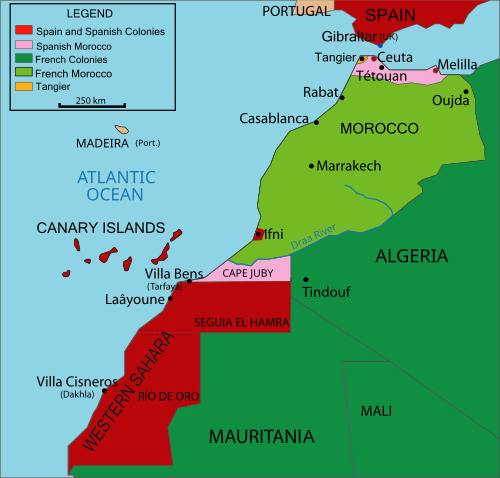
at Le Monde Diplomatique (in English) on how the then Spanish provinces of Saguía el Hamra and Río de Oro (then legally as much part of Spain as Madrid, by the way - so good for the unalienable unity of the fatherland) ended up in Moroccan hands with the blessings of the USA and France.

Map of the colonial West Sahara and Morocco in the mid 20th century (from Wikipedia).

Apparently the USA saw Algerian interest in supporting the Sahrawis as part of the Cold War geopolitics, so, by default, it supported Morocco discretely. Spain was reluctant to yield the territory and specially if it appeared they had been kicked out, however it eventually yielded to pressure in the context of an uncertain regime change.

The appointed Sahrawi council (Yemaa or D'jemaa) however declined to play the rubber-stamping role that the USA, France, Morocco and Mauritania had devised for them and instead declared its own dissolution and transfered its power to the recently created POLISARIO Front, which proclaimed the Sahrawi Arab Democratic Republic.

To Moroccan disillusionment the African Union Organization, as well as most African states, also recognized the rebel republic and the weakest part, Mauritania, soon yielded to Polisario attacks and recognized the country's independence in 1979. Morocco became isolated in Africa. However, later on, the Moroccan tyranny (it's a police state where people fear speaking freely, I can tell you), with massive support from Saudi Arabia, the USA and France, managed to build their version of the Great Wall, forcing the Polisario out of most of the country and preventing them from attacking the much coveted phosphate mines and foreign fishing ships that had no authorization from the Republic.

All this only barely dealt with in the Le Monde Diplomatique article but it is still interesting to read to understand how the imperialist interests of the USA and France played in favor of the last absolute monarchy of Africa... and to read how Kissinger view the issue on his own words.

However, in spite of a two decades long cease fire, the wound is still open and the war might start again at any moment. Moroccan official maps, of the kind you find only there, have no borders south of Oujda, as the fascist monarchy claims all the desert for them: a good bunch of Algeria, all Mauritania and, who knows, maybe even Mali.

Further reading (in Spanish) at Sahara Libre, where you can find news of the ongoing conflict such as the violent repression of striking workers yesterday, the long hunger strike of Dr. Abbas Mohammed Chej Sebaj or how lobbyists in the USA are trying to bring the now unemployed Louisiana fishermen to the rich Sahrawi banks.