New blogs

Leherensuge was replaced in October 2010 by two new blogs: For what they were... we are and For what we are... they will be. Check them out.
Showing posts with label France. Show all posts

Sunday, September 19, 2010

French Inquisition persecutes Israel boycott activists


A French court has accepted a denounce by the Zionist Lobby (specifically an organization called "National Bureau of Vigilance Against Antisemitism", which looks similar to the USA-based Anti-Defamation League, or as it's popularly known: "Defamation League") has brought charges against the
Coordination of Appeals for a Just Peace in the Near East (CAPJPO by its French acronym) for allegedly constituting an "offense of incitement to discrimination, hatred or violence against a group of people on account of their belonging to the Israeli nation", for filming and posting the video below (a festive boycott protest at a Carrefour supermarket against Israeli imports).

Source: Jews Sans Frontieres.

The accusations, obviously meant to criminalize the anti-apartheid movement for a free Palestine, have only been brought against the main promoter of the action and not against the many other signatories, including a Jewish organization (IJAN) and a state-wide party (New Anti-Capitalist Party), which would have been inconvenient for the Zios to attack.

Well, the least I can do is to post here the video again:


Who is the Nazi? Who is persecuting in our dear Europe freedom of speech and democracy? Who is the Antisemite here? We must remember that Palestinians are, by nature of their language, Semites, at least as much as any Jew (many of which don't even speak Hebrew fluently or at all). Furthermore, as I have argued before Palestinians are much more likely to be the genuine descendants of ancient Jews (and Canaanites, etc.) than the Euro-Mediterranean Jewish diaspora, which seems rather related to Lebanese and Cypriots (Phoenicians?). Yes Semitic as well, but not the only ones. The modern Antisemitism is irrational hatred against Arabs, and in this Zios are avant-guard. Hitler would be very proud of them. After all you don't need to be German to be a Nazi, you can perfectly be Jewish or whatever.

I'm damn tired of the tolerance and official protection provided to these Zionazi groups. Jews are not persecuted anywhere anymore, Israel is a genocidal imperialist project that has no right to exist from the viewpoint of Justice and the rights of the peoples. It's time to stop once for all this abhorrent situation in the Mediterranean. It's time to dismantle Israel or what is the same: the Jewish racist state of apartheid and genocide in the land of Palestine.

And it's about time for Europe to fully break all links to Israel and ostracize it as the rogue fascist state it is.

Tuesday, September 7, 2010

Strike journey paralyzes France and London


Workers in the French Republic have gone today on general strike in opposition to Sarkozy's plans to cut pensions and rise the minimum retirement age. The date has been chosen in order to make the greatest effect on the parliamentary debate to happen this autumn. School teachers also went on strike yesterday in protest for mass cuts in public education, suppressing 7,000 jobs.

About 60% of workers did not go to work today in the Northern Basque Country (left: demo at Baiona/Bayonne). Meanwhile official and union sources disputed if the mobilizations across the republic reached 1.1 million of 2.7 million.

Besides pensions, the issue of racist mass deportations of European citizens of Roma ethnicity has also been present in the massive protests.

Meanwhile, in London, subway workers have walked out against some 800 job cuts. The strike has been rather strong and has caused major difficulties in the English capital today.

Sources: Berria, Al Jazeera, The Guardian, BBC (links: France, London) [British media seem to be hiding the London Tube strike]

Wednesday, August 4, 2010

Genetic flow across the Strait of Gibraltar


Researchers from the University of Geneva try to address the somewhat complex problem of genetic flow across the Strait of Gibraltar, between SW Europe and NW Africa, in a new paper:


Mathias Currat et al., Human genetic differentiation across the Strait of Gibraltar. BMC Evolutionary Biology, 2010. Open access.

They analyze a number of genetic variables such as Y-DNA, mtDNA, blood groups ABO and Rh, and other antigen/antibody systems (HLA, MNS and GM) and produce a number of statistical analysis for them. However they acknowledge that their modeling on continuous, rather than punctual, gene flow, may have some difficulties providing clear-cut answers.

Still they do produce results that are in general favorable for the P scenario (flow since 20,000 years ago), excepting to some extent the Y-DNA, which is probably a secondary sex-biased element overall.

Above: The scenarios are described in page 10 and in the supplementary material. P is "Paleolithic" flow beginning 20,000 years ago (Ibero-Maurusian or Oranian culture) among small populations, N instead is "Neolithic" flow among larger populations. PN is intermediate and PNI is intermediate but also considering the Islamic expansion (though details are not provided).

They also produce results of quite greater affinity within each region (SW Europe and NW Africa) than between them, as expected.


Notice in this graph (and also fig. 3) how autosomal markers' curves and that of mtDNA (MT-HV1, in blue) are very similar, however while mtDNA tends to lesser homogeneity within regions, it strongly tends to higher homogeneity instead across the Strait. This I interpret as meaning greater affinity across the strait in the Paleolithic, before the primarily male expansions reflected in the Y-DNA, altered the scenario.

Sadly no graphs for each of the two regions is provided, what does not allow us to make a more detailed assessment, like whether the Y-DNA expansion happened at both coasts or not, and, if so, if they were fully comparable or somehow different. I say this because the apparent SW European origin of North African mtDNA H (c. 25%) detected by Cherni 2008, and probably other haplogroups like V and K, would be consistent with a more European-like population before the E1b1b1 expansion in the context of Capsian culture (in North Africa) which is probably associated also to the expansion of Afroasiatic languages. However I see no reason to support a similar male-biased expansion in SW Europe.

Let the authors conclude:

Conclusion

While contrasted conclusions were obtained by previous studies based mostly on single genetic loci, our study clarifies the role of the Strait of Gibraltar regarding its permeability to gene flow. Indeed, our multi-locus approach led us to take into account variations between loci when trying to infer past history of human populations around the Gibraltar area. We were thus able to show that the Y chromosome on one side, and HLA-DRB1 on the other side constitute two extreme cases of very strong and very weak (respectively) genetic differentiations between populations across the Strait. The lack of genetic differentiation for HLA-DRB1 is particularly interesting because it can be explained by balancing selection (with a coefficient of selection estimated here to be around 2%). Given the huge worldwide dataset available for this locus, a better understanding on the mechanisms of selection at HLA loci could be very helpful to the study of human evolution, and more generally MHC. Our results obtained for Gibraltar have to be confirmed by further studies in other areas, especially where gene flow between populations is reduced. This work thus constitutes a step forward towards a better characterization of the combined effects of selection and demography on the genetic structure of populations, and especially on their genetic differentiation.

Tuesday, August 3, 2010

Video: French police brutally attacks homeless women and toddlers in peaceful demo


The video does not have sound.


Context: the protesters, mostly original from Ivory Coast, were expelled from their homes in a banlieue NW of Paris because of some dark real state plot (i.e. corruption, robbing the poor).

In a related news, French President Nicolas Sarkozy is promoting new legislation that would revoke citizenship for those French nationals of foreign origin which have willingly attacked the authorities. One wonders if these poor women and their babies are included in his xenophobic plans.

We live under fascism, they call it democracy.


Source: La Haine[es]

How West Sahara was given to Morocco


There is a rather interesting historical review
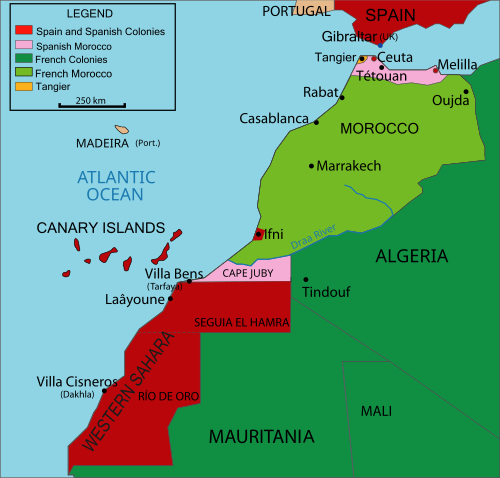
at Le Monde Diplomatique (in English) on how the then Spanish provinces of Saguía el Hamra and Río de Oro (then legally as much part of Spain as Madrid, by the way - so good for the unalienable unity of the fatherland) ended up in Moroccan hands with the blessings of the USA and France.

Map of the colonial West Sahara and Morocco in the mid 20th century (from Wikipedia).

Apparently the USA saw Algerian interest in supporting the Sahrawis as part of the Cold War geopolitics, so, by default, it supported Morocco discretely. Spain was reluctant to yield the territory and specially if it appeared they had been kicked out, however it eventually yielded to pressure in the context of an uncertain regime change.

The appointed Sahrawi council (Yemaa or D'jemaa) however declined to play the rubber-stamping role that the USA, France, Morocco and Mauritania had devised for them and instead declared its own dissolution and transfered its power to the recently created POLISARIO Front, which proclaimed the Sahrawi Arab Democratic Republic.

To Moroccan disillusionment the African Union Organization, as well as most African states, also recognized the rebel republic and the weakest part, Mauritania, soon yielded to Polisario attacks and recognized the country's independence in 1979. Morocco became isolated in Africa. However, later on, the Moroccan tyranny (it's a police state where people fear speaking freely, I can tell you), with massive support from Saudi Arabia, the USA and France, managed to build their version of the Great Wall, forcing the Polisario out of most of the country and preventing them from attacking the much coveted phosphate mines and foreign fishing ships that had no authorization from the Republic.

All this only barely dealt with in the Le Monde Diplomatique article but it is still interesting to read to understand how the imperialist interests of the USA and France played in favor of the last absolute monarchy of Africa... and to read how Kissinger view the issue on his own words.

However, in spite of a two decades long cease fire, the wound is still open and the war might start again at any moment. Moroccan official maps, of the kind you find only there, have no borders south of Oujda, as the fascist monarchy claims all the desert for them: a good bunch of Algeria, all Mauritania and, who knows, maybe even Mali.

Further reading (in Spanish) at Sahara Libre, where you can find news of the ongoing conflict such as the violent repression of striking workers yesterday, the long hunger strike of Dr. Abbas Mohammed Chej Sebaj or how lobbyists in the USA are trying to bring the now unemployed Louisiana fishermen to the rich Sahrawi banks.

Wednesday, July 28, 2010

Catalonia bans bullfights


The Catalan Parliament has approved a law that bans bullfights since January 2012. The decision was taken with 68 votes in favor, 55 against and nine abstaining. Catalonia is the second autonomous community of the Kingdom of Spain that bans bullfights, the first one being the Canary Islands, which forbade them in 1991. There is only one active bullfight plaza in all Catalonia.


While the vote was made on individual convictions, the vast majority of Catalan nationalist deputies voted for the ban while most Spanish nationalist ones voted against.

I am totally in favor of forbidding such cruel rituals and therefore I welcome the law and hope it's extended to other territories in Iberia and France, as well as America. However I disagree with those who oppose all kind of bull-themed fiestas such as encierros (running the bulls), recortes (dribbling the bull attacks much as in Knossos' frescoes) and vaquillas (similar with bullocks and open to public participation), which are essentially harmless to the animal (human participants know the risks they take). The important point is that the bulls are not tortured and also to prevent damage to horses, also suffering in the most cruel and well-known variants of bullfighting.

In my hometown there is a huge bullfight plaza that is almost unused except for the fiestas in late August. I have yet to meet a person who likes bullfights but there seem to be some in social strata I don't mix with. But I know a lot of people who enjoys vaquillas (or enjoyed them when younger). I would think that the plaza could have much better use as some sort of public venue, as for concerts (used on occasion) or massive popular assemblies - or just to gain a much needed new park after its demolition.

Source: Gara.

Monday, July 19, 2010

France riots as police keeps killing the underdogs


Is France heading for another massive urban revolt like the one in 2005? All suggests so even if the media is not paying much attention so far.


There were riots in Grenoble over the weekend as police killed Karim Boudouda, 27, allegedly member of an armed robbers' gang in what was perceived in his hometown of Grenoble by many people as an illegal execution with racist and classist undertones.

The authorities declared that the policemen acted in self-defense after Boudouda fired one shot.

While the conflict was still hot the Gendarmerie shot and killed another person known as "Luigi" (22, father of a young girl) who apparently forced his way through a road blockade at Sain-Romain-sur-Cher, in Central France.

In response a group of people, mostly masked and armed with iron bars and axes, assaulted and ravaged the local police station.

The two police agents are under preventive arrest.

The reaction of the authorities has been to treat the matter as a mere public order episode, deploying three extra police brigades in Grenoble and now sending in the Army as well to Saint Aignan.

There is some speculation that the murders may have been intentional in order to divert public opinion from the L'Orèal scandal that is tarnishing the image of President Sarkozy (the infamous fascist owners of L'Orèal illegally paid huge amounts to Sarko's presidential campaign). Sarkozy whose image of tough ruthless man was forged in the 2005 riots may therefore be trying to gain public support by repeating his more than dubious feats.


Whatever the case, the facts are that angry semi-organized mobs have been attacking property in the well-off suburbs of Grenoble, burning some cars, still far from the record of more than 300 destroyed in 2005.

Some 20 people have been arrested so far.

Source La Haine[es] (link 1, link 2)


Update (Jul 20): Gara informs today that the person killed at Saint Romain is Luigi Duquenet, of Roma ethnicity. The editorial opinion article of the Basque newspaper argues that militarization is not any solution when the problems of the suburban neighborhoods have been fed by the state. They argue that while the state does not properly address the marginalization of these areas, they will keep exploding cyclically at any provocation because the rage is there and is very much justified.

Tuesday, July 6, 2010

Neolithic surgery was prime quality


A rare finding of a burial with an extremely clean femur amputation has been reported some 60 kilometers south of Paris (Boulancourt), dated to c. 7000 years ago.


The quality of the surgery is what has astonished archaeologists because the amputation is very clean and precise, showing no signs of infection, what indicates it was done in a quite sterile context using a very sharp tool. It is also believed that the patient was anesthetized.

The style of the burial, in fetal position, suggests me that he belonged to a Danubian cultural context. This was however the western frontier of this cultural group, south and west being only known other cultural groups (Cardium Pottery and Domenic-Megalithic).

I would think of opium being used for anesthesia because Western Danubians are one of the first peoples known to have cultivated this poppy but it is also possible that they used other herbs, whose knowledge has been partly lost to us.


Source: The Epoch Times (via Archaeology in Europe).

Wednesday, April 21, 2010

Paris protest climbers denounce murderous police intervention


I mentioned
a few days ago that a group of Basque climbers made a protest action in Paris, hanging two banners in French and English from the landmark monument with the message: "PSOE-UMP what have you done with Jon Anza?"

PSOE and UMP are the acronyms of the ruling parties in Spain and France respectively. Jon Anza was an ETA militant who mysteriously disappeared a year ago in Toulouse only to reappear last month in the most obscure circumstances at the morgue of a local hospital, where his corpse had been all this time, in what seems to be another case of dirty war that splatters not only Spain but also in full the French government and legal system.

Yesterday the four climbers made a press conference at Baiona (Bayonne) to denounce the murderous attitude of the French police that almost killed one of the climbers.


They had designed the hanging system of the banners and the climbers in a way that made it difficult for the authorities to disentangle it without causing the fall of the climbers. This was done in order to ensure that the banners stayed for as long as possible.

As they explained in the conference, they had designed it so climbers acted as counterweight and that if any single climber was untied, the other would fall. This they expected to force the use of two cranes, which would significantly delay the removal of the banners. Naturally they explained this to the firefighters and police who arrived.

Soon one policeman was on top of the firefighters' crane and asked to one of the climbers: "are you going to collaborate?" to what the reply was "yes", explaining him the system used to install the banner and that if he untied either one, the other would fall. The policeman replied that he already knew that.

Regardless, he was untied and spoused, what caused the fall of the other climber. This other climber tried to save his own life by grabbing a repairs structure at the side of the monument but failed to hold. Miraculously, he managed to land on his feet, what saved his life in spite of the serious injuries (both ankles broken and head concussion).

"It was a miracle I did not die", he said.

Askatasuna (Freedom, prisoner rights watch organization, declared illegal in Spain) has therefore put a denounce against the police demanding responsabilities and have declared that they will keep on with their protests.

Source: Gara.

Friday, April 16, 2010

Postcards: Basque rural sports: climbing in Paris


As you may know, mountaineering and climbing are among the most popular Basque sports. Sadly Paris is kinda flat, so the climbers had to choose this strange artificial structure, known as the Arch of Triumph:


The climbers protested for the death in obscure circumstances (stinking to state terrorism) of ETA militant Jon Anza, whose corpse was "found" 11 months after he went missing at the morgue of a hospital of Toulouse, having been there all the time.

One of the climbers fell and broke both ankles, as well as suffering cranial concussions, however his life is out of risk. Seven people were arrested.

Source: Gara.

Update (Apr 18): the person who fell down did so because a policeman, on top of a firefighters' crane, suddenly cut the rope he was hanging from. Luckily another of the climbers managed to grab the rope, getting his hands burned in the attempt, and probably that way saved the life of his comrade (source).

Sunday, April 4, 2010

And yet another ETA communication


It seems that the previous communication was outdated before being published because of the shooting at Paris that left one policeman dead. So we have another one today at Gara (in Basque). A Spanish-language synthesis can be read here.

Today is also the Aberri Eguna (Day of the Fatherland), which may also explain the timing.

Synthesizing:

Paris shooting

They argue that the shooting at Paris was caused by the French police, who "kidnapped" four ETA members at a forest at Dammarie-lès-Lys and who shoot against one of these "neutralized" militants. Even if seemingly the policeman who shot did it aiming to the floor and not the arrested person, this, in the opinion of ETA, triggered the shooting that caused one victim among the French forces.

They say that at that moment, the other three members of the commando, who were around, approached the place with intention of avoiding confrontation, issuing a clear warning to the French policemen for them to drop their weapons and leave the spot. According to ETA, while two policement proceeded to retreat, the other two attempted to confront them with their weapons, what caused the ill-fated shooting.

They put all the blame on the French police, declaring that the attitude of no-confrontation (except in self-defense) with French forces is a well known policy of ETA

Warning to France

ETA suggests that the French government and people should meditate about where do they want to allow themselves to get carried by the "repressive high" of the Spanish authorities. They say that, beyond the hypocrite expressions of solidarity and "false condemnations", the Spanish authorities "could not hide their happiness at the belief that these events would cause further repressive steps by the French government".

Call for negotiation

ETA makes also a call to the Spanish and French governments to "abandon the useless path of repression" and to embrace dialogue and negotiation, "in favor of a democratic solution based on the respect to the will of Basque citizens".

Two camps

In relation to the National Basque holiday, today, they mention that, since last year, the political picture has been clarified, with only two projects: "the project of negation, that forces us to remain chained to France and Spain" and the project of "independence, which opens the gate to social, political, cultural and economical development in the Basque Country".

[Opinion note: it's quite obvious that ETA is capitalizing on the artificiality of the mutilated "democracy" allowed to Basques these days]

International peace drive

ETA welcomes the international initiative in favor of a negotiated solution but warns that this cannot be only achieved by a mere ETA leaving armed struggle ("the deactivation of armed response does not solve the political conflict"), demanding guarantees and compromises by all parties.

They also announce that in a future communication they will address this matter in greater depth.

Update: a Spanish language full version of the communication is available at La Haine.


Update (Apr 5): Reactions:

French Police denies ETA's version but does not offer one of its own. They say that the claim of an officer shooting towards a prisoner on the floor is false and that "contradicts the elements of the investigation". However it does not offer any alternative version with the detail ETA does.

French police unions have also protested the communication as "repulsive" and denying it "any credibility".

This side of the border reactions have a more political tinge, even with little variation of what is usually said. Ruling Socialist Party's Councilor of Interior (chief of the Basque Autonomous Police corps), R. Ares, declared that the communication is a good opportunity for "those radical Basque nationalists who bet for doing politics and just politics to ask terrorists to vanish or to distance themselves definitively from ETA".

Conservative (PP) speaker, L. Barreda, called the communication "the highest expression of cynicism". Basque Nationalist Party (EAJ-PNV) president, I. Urkullu, ratified their intsitutional loyalty with the sentence "we don't want noting to do with ETA".

Basque Solidarity's (EA) secretary general, P. Urizar, declared that "we expected more, although maybe it is our fault for expecting more". For United Left-The Green's coordinator general, M. Arana, suggested that ETA was in this communication ratifying its primacy over the political movement.

By the Nationalist Left, Miren Legorburu made a positive evaluation, declaring that now it is Spain and France who have to take a clear stand in favor of "a democratic solution based on the respect to the will of the Basque people".

Sunday, March 21, 2010

New ETA communication


Basque guerrilla ETA has issued yet another communication. The full text in Basque, along with a synthesis in Spanish, can be read
at Gara.


Votes or bombs?

After denouncing the persistent and growing political repression by Spain, they argue that while the Basque Nationalist Left has clearly replied to the riddle "votes or bombs" by choosing votes and that it is now the Spanish state the one who must allow the people to speak democratically.

In this sense they declare that ETA is ready to do whatever is necessary for a democratic solution to be reached. However they ratify themselves into the defense of the rights of the Basque Country. "Until Freedom is achieved we won't give up!", they conclude.


Analysis

ETA has not attacked in the last many many months (since August 2009), excepting the "accidental" (not planned) shooting last week at Paris, that got one gendarme killed. And it seems unlikely that this is because they can't. It's obviously some sort of informal, undeclared, unilateral truce. However arrests and dirty war by the states have not stopped, signal that Spain and France are not interested in talking.

Meanwhile, much as happened some ten years ago, diverse Basque independentist parties and organizations have been gathering forces. Many are opposed to violence and hence this informal truce may be rather directed to them than to the Spanish and French galleries.

However it is not totally impossible that there are some secret negotiations of some sort, however they must be, if any, very preliminary.


What fuels the conflict? Differences between the Spanish nationalist and Basque nationalist positions:

  1. Subject of sovereignity: is it "the Spanish people" or "the Basque people"? The latter, with barely 6% of the population has no chance whatsoever of imposing its will in the larger state, clearly dominated by the Castilian or Spanish ethnicity.
  2. Borders: is Navarre part of the Basque Country? The people of Navarre have not yet been asked on the matter, however the Spanish nationalist parties usually win the elections there.
  3. Language: the Spanish constitution imposes the Spanish (Castilian) language as obligatory to be known by every citizen, instead other languages like Basque are not and can only be used in official venues where it is regulated that way by lesser laws. For example, judges in the Basque Country do not need to speak Basque, while janitors usually must. In Navarre, the strange dissection of the territory, ensures that only in those areas where Basque is already dominant, the old language enjoys some minimal protection.
  4. Culture and education: which version of history should be taught to children one that emphasizes Spanish history or one that emphasizes Basque (and therefore Navarrese) history? Should the term Euskal Herria (Basque Country in the wide sense, a traditional term) be used or scrapped. Should the Basque banner be allowed or forbidden in Navarre? Which map should be used in weather forecasts? Have Western Basques the right to use the Navarrese symbols (after all they were once part of Navarre and only removed against their will)?
  5. Legislation and self-government: which should be the limits, if any, to Basque self-rule? Should judges be appointed by Spain or by Basque institutions? Should Spanish police and military be allowed to operate within the Basque borders without authorization of the Basque governments? Should Spanish laws apply at all in Basque territory? To which extent?
  6. Fascist inheritance: Spain has failed so far to review and amend the dark decades of fascist dictatorship, from which the current monarchy arose, granting the King and the Army the constitutional right to intervene in politics. Of the two major Spanish parties one, the Christian-Democrats, is not really different from the former Fascist party. The many crimes of the dictatorship have so far remained not just unpunished but also almost not investigated.

Tuesday, March 16, 2010

More doubts and dark spots in the Anza case


The more than murky
case of Jon Anza, ETA militant who disappeared 11 months ago and was found dead at the morgue of Hospital Purpan at the very city he went missing, Tolouse, but after almost a year of fruitless queries and demands is only gaining complexity as days pass.

Yesterday the French Republic practiced the autopsy on the corpse without allowing any physician of the trust of the family to be present. People demonstrated demanding transparency and sensibility towards the family in a case that has already become one of the darkest episodes of the French Justice system since the time of the Dreyfuss affair and were attacked by hordes of gendarmes.


After the mock autopsy, the state attorney in charge, A. Kanayakis, announced the results (confirmation of the previous version: Anza died of complications after a heart attack) and also her resignation from the case, which now passes to an instruction judge.

The Hospital Purpan had by then reported to the press that they had issued three formal notices to the police and missing people office while Anza was still alive, getting no answer.

Meanwhile Spanish newspaper El Mundo, akin to the right but which also played a central role in the uncovering of the GAL network more than a decade ago, reported that two Spanish policemen fled by those dates from a Tolouse hotel, where they had registered by their real names, forgetting two pistols under the matresses.

This newspaper also reported earlier that Anza was custodian of 300,000 euros, while he carried only 500 when he was found.

Monday, March 15, 2010

Most Northern Basque voters in favor of self-rule and against the high speed train


The referendum organized by Batera with the help of most municipalities in the Northern Basque Country on whether the region must be a distinct territorial collectivity 78% of votes in favor and 19% against and 3% issued blank votes.


However, being an unofficial poll, the participation was relatively low, fluctuating between 10 and 48% of citizens, depending on the canton. The results by canton are:

  • Baiona: 81.7% in favor, 15.7% against (participation: 10%)
  • Garazi: 75.6% in favor, 19.5% against (participation: 28.4%)
  • Iholdi: 85.1% in favor, 10% against (participation: 47.9%)
  • Hazparne: 89% in favor, 10% against (participation: 16.6%)
  • Beskoitze: 79% in favor, 17.7% against (participation: 29.6%)
Source: Kazeta.


The eight communes affected by the high speed train will have this ballot, disdained by Paris, next Sunday because yesterday they voted on this environmental issue, with all villages voting massively against (between 86 and 96%).


Democracy in the Basque Country: people votes, the government ignores.

Source: Kazeta.


In the (almost meaningless but official) regional elections for the artificial Aquitaine region, the participation was of 48% (low but above the French average), with the Socialist (PSF), Gaullist (UMP) and Christian-Democrats (Forces Aquitaine) being first, second and third force. The Basque nationalist list Euskadi Europan, with 6.7% of votes, was fifth, after Europe Ecologie (also participated by Basque nationalists) which got 11.85% of the vote. Overall the vote to Basque nationalist lists keeps growing, reaching now almost 18%. The communes affected by the high speed train punished severely the large officialist lists.

Source: Kazeta.

Saturday, March 13, 2010

The strange case of the Glozel findings.


I just now have got to know about this confuse issue of never proven alleged archaeological forgery at
Glozel, at the outskirts from Vichy, central France.

It looks quite intriguing.

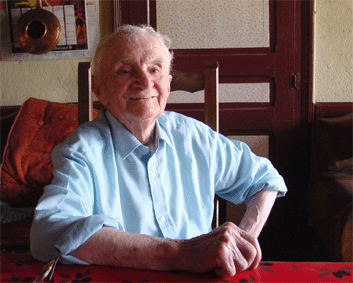
And the death last month of the main actor, Emile Fradin, at the venerable age of 102 years, seems to have triggered renewed interest for the issue.


Emile Fradin

Via Archaeology in Europe, I found this article at The Age. The case for a barely literate peasant under 20 years of age to have forged all those artifacts looks extremely unbelievable, more so when he never made real money of them, rejecting all offers of purchase of his findings.

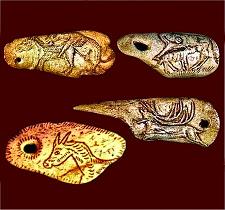
The findings, if real, would seem some sort of secret collection: they were organized in shelves and they include items from three different types and periods (per the analysis of F. Henri in 1972): engraved bones from 17-15,000 BP (early Magdalenian), pottery is from 5,000 years ago (Chalcolithic) and the written clay tablets are from some 2500 years ago (barely pre-Celtic).

The engraved bones certainly look Magdalenian-like.

The inscriptions remind, with some differences, the Iberian script. At least they are within the context of early Mediterranean scripts.

However why all these materials had been gathered together into a single mysterious collection appears to have no explanation than the site being the hoard of some early archaeologist of Antiquity or the Middle Ages (the Templars have been speculated about, as usual, but the lack of Christian iconography makes this unlikely in my opinion).

Sources:
- Tejiendo el mundo[es] (from where I borrowed the images)
- Musée de Glozet [fr]

Friday, March 12, 2010

Missing ETA member... at a French morgue


For almost a year different people have asked openly or just wondered in the privacy of their their own minds where was Jon Anza, the ETA member who had gone missing. Most of course suspected he had been killed by the Spanish police, either intentionally or "accidentally" in an "excess" of torture. Some were surely happy about it, others indifferent, others worried, sad or angry. But the question was there.


He had not disappeared in Spanish territory though but in French lands. ETA itself announced it: Jon Anza had not arrived to an expected meeting: he had disappeared while at the train.

Now Jon Anza, what is left of him, appears at at the morgue of Tolouse. The details are yet unclear but everybody is wondering how is it possible that the French Police could not know earlier, much earlier, that the corpse was that of a "most wanted" man, whose medical file they had in their hands all the time.

The news was filtered by the French police to France 3 yesterday afternoon, seemingly just after informing his family that they believed so but were yet in wait of the DNA tests, which should be finished by today.

According to the "official" version, Jon Anza arrived normally at Tolouse on April 18th, and, in April 29th, eleven days later, he "fainted" or "was injured, disoriented and had a heart attack" and was brought to a hospital where he remained until his death, 13 days later.

In spite of the huge mediatic echo at both sides of the border, the detailed information provided by ETA itself (that even informed the French police of the fact that the fingerprints from a hideout were those of Anza, and, of course, of the Bayonne-Tolousse train journey he realized and where he went missing), the protests demanding to know what had happened to the militant... the French Justice system was apparently unable to even take a look at the corpses in the morgue of Tolouse?

I don't know what to think but it's really incredible.

Gara, which is the source of this information, reports that the website of the Ministry of Interior where such information is displayed, shows Jon Anza as still missing (one among 42 adult individuals) and only one unidentified corpse: that of a woman at Marseilles.

How has the corpse of Jon Anza remained unidentified at the morgue of Tolouse and yet never figured in that list? Or has been all the time identified and someone gave order of not reporting? Or...?


Update:

The state prosecutor, Anne Kayanakis, says she did inquire at Purpan Hospital of Tolouse (where the corpse has been all this time, according to what is said now) and she was told that there was no corpse without identification. Error or conspiration?


According to her, Jon Anza was brought to the hospital with a cardiac-respiratory arrest on April 29th. He stayed at the hospital after reanimation and died on May 11th.

His corpse remained at the hospital's morgue for all this time, when in a "merely casual" way, a member of the Legal Medicine Institute commented to a police friend that there was an unidentified corpse there.

Not just she did inquire the hospital but also the law obligues all medical centers to report any unidentified corpse to the police. But this didn't happen either.

Also Anza's relatives have been denied access to the corpse by the prosecutor, after order directly from the Ministry of Justice of Paris. What are they trying to hide?

Source: Gara.


Update:

The largest Basque labor union (an important referent in this undemocratic situation we suffer), Basque Workers' Solidarity (ELA) has declared that the official version is just unbelievable and demands an independent investigation.

T. Fernánez at Gara (among other similar opinions) emphasizes that if the official version has anything to do with reality, then Jon Anza should have been identified some 10 months ago or, otherwise, be buried at the cemetery of Cornebarrieau. He illustrates the situation with two real examples of unindentified victms attended at the same hospital facility as supposedly was Jon Anza.

Relatives and friends of Jon Anza, along with their attorneys, insist that the only believable version is that the ETA militant was kidnapped, tortured and murdered by Spanish policemen in French territory, in a death-squad style action as used to happen with the GAL. They make a call to go to the Tolouse morgue on monday at 8:30 am to demonstrate against the imposition that no physician with the trust of the family is present at the autopsy.


Update (Mar 14):

All political parties, even the Spanish nationalist ones,
have declared that an investigation must happen. The differences are in the details: the Spanish bloc rejected accusations of "dirty war" and declared their trust in the official version, although they did agree that the matter deserves investigation. On the other side, the Basque Nationalist Party suggested that it looks like a work from the Spanish police.

Update (Mar 15):

Thousands of people demonstrated at Donostia (San Sebastian) under the slogan "End epression and dirty war". For a change police did not show up and the demonstration could end without inccidents.


Wednesday, March 10, 2010

Northern Basques will vote on "territorial collectivity"


The referendum is not backed, and even doubtfully claimed to be "anti-constitutional" by the French Republic but has the support of 90 majors and many other people.


Making it coincident with the upcoming regional elections in March 14 and 21, 91.5% of Northern Basques will finally be able to express their opinion on whether the country should become a territorial collectivity within the French Republic or not.

At the moment and since two centuries ago, when the historical provinces were abolished and replaced by a centralized and arbitrary administrative structure imposed by Paris, Northern Basques have enjoyed no self-rule whatsoever (other than municipalities), what has severely damaged the economy and the culture of the country.

The recent creation of a distinct Chamber of Commerce, out of private initiative, also seeks to revert this awful situation.

Source: Gara.


Wednesday, February 10, 2010

Is there a G-spot?


Debate rages on the issue... at least at
El Reg, where they seem to find it quite amusing.

While early last month a research by King's College's fellows demonstrated that the G-spot is nothing but "a figment of women's imagination", based on self-reporting by twins, some week later French scientists criticized the findings questioning why the G-spot should be something genetic. These criticisms were made at the G-Day conference, whose organizer, Sylvain Moumain suggested that, while the G-spot exists in some 60% of women, the British are just unable to find it. In the words of gynecologist Odile Buisson:

I don't want to stigmatise at all but I think the Protestant, liberal, Anglo-Saxon character means you are very pragmatic. There has to be a cause for everything, a gene for everything. It's totalitarian.

The debate seems to be far from closed.

Thursday, January 7, 2010

National identity in 21st century France


Maite Ubiria reviews today at Gara about the many unsolved problems of Jacobin French identity with motive of the half centenary of the death of Albert Camus (author of The Stranger, among other titles) and the failure of the institutionalized debate that President Sarkozy has tried to propel personally on French identity.

Sarkozy pretended to offer some sort of state funeral to the illustrious writer and philosopher but the Camus family fought against this and hence the Algerian-French author will remain buried at his modest but cosy tomb at Lourmarin, Provence.

The figure of Camus is arguably relevant to this absurd debate on French and European identity that some percieve as threatened by the every day more visible Muslim community, turning to an obsolete Christian faith that anyhow nearly nobody professes anymore. The stubborn atheism of his character Mersault even in the death row impressed me in my youth as did his strange honesty.

While Sarkozy insists to empty halls about the Catholic identity of France, the very French identity of the hexagon is at the stake. A plurality of opressed nations within the French Republic declined to participate in this absurd scenification of a debate: Caribbean creoles, Corsicans and others expressed their disdain.

From the French Caribbean colonies (Guadaloupe, Martinique, etc.) the mayor of Le Prechêur (Martinique), Marcelin Nadeau, complained that we have our language but the territorial collectivities we have cannot define its development in our schools nor have competences to determine what our children learn. The unemployment in these islands is of some 30% and every year a thousand of arable lands are lost largely because of tourism and real state speculation. For Nadeau another important pending issue is the recovery of the memory and historical reparation (for colonialism and slavery). As illustrative example, the case of acclamated Martinican director Guy Deslauriers, whose latest film The Aliker Case, on the execution of a Martinican militant of the 1930s, was rejected any subsidies by the Frech ministry of culture (that is much more generous to metropolitan authors) and could only be produced thanks to popular subscription.

This issue of memory is also central to Corsican grievances. While France claims to be the motherland of Human Rights, the fact is that it was in Corsica where such ethical construct was first written and promulgated in Corsica by national hero Pasquale Paoli, almost totally ignored in French versions of history books. This is also the case of the many Corsican resistents to fascism and the ill-known fact that they managed on their own to liberate the island from Italian occupation already in 1943. But their hero and martyr Jean Nicoli is nowhere to be found in French history books used in schools compulsorily.

Brittany is another of the aggraviated nations within the Republic. The list of offenses is similar but in the Breton case there is not even a minimal autonomy. Emile Granville speaker of the Breton Party and liutenant mayor of Redon states that in view of the French denial, Bretons can only try to bypass the state and attempt to be acknowledged as what they are at European level.

For the smaller nations (Basque, Catalan), whose nationalist forces are gathered in the Federation of Regions and Peoples, the problem is about the same. Its speaker Peire Costa denounces that this pseudo-debate is only a propaganda attempt in favor of cultural uniformity and centralism, which are in fact the problems that hide behind it. For Costa, it is just nothing but a Jacobin assault, orchestrated by the summit of the state, that has as main target the diversity generated by immigration but that is also an assault against the so-called regional languages and cultures.

Apart of the dominant French ethnicity, the French Republic includes the following distinct nations or ethnically distinct territories (more or less):

In Europe:
Non-european colonies with some population:
Corsica and the other overseas colonies have some minimal and variable autonomy. West Flanders and the Northern Basque Country have no recognition at all, not even at department level.

France, Spain and Italy epitomize the urgency for self-determination of the the peoples of Western Europe, much as Kabylia, Kurdistan and Palestina do for the so-called Middle East. While so many nations have achieved self-rule in the last century in Central and Eastern Europe (from Poland to Kosovo), the problem of decolonization in West Europe remains much of an open wound.

Monday, December 7, 2009

The demographics of British Neolithic (2)


I wrote yesterday on the new research by Collard et al. that suggests that Britain experimented a rapid population increase in the few centuries that followed the arrival of farming to the island. Afterwards a reader has sent me a copy of the paper (a million thanks again) and I can now comment a bit further with better knowledge of the matter.

But first of all the sequence:


This graph, which is central to the research, represents the archaeological findings with a C14 date for the whole island of Great Britain (I understand). As you can see the population explodes after c. 6000 calBP (calibrated C14 dates, our best equivalent to "years ago" since 1950 - equivalent to c. 3950 BCE in this case), even if we discard the monuments. The demic growth was some 400% in four centuries, maybe more.

Later, by the second half of the millennium, the population decreased very sharply again but, thanks to agriculture surely, remained higher than in the Epipaleolithic (250%?). Since then it remained stable, although it is difficult to interpret the growth in monumental sites in the second half of the 3rd millennium BCE in terms of demography.

As the authors argue this explosion is difficult to conciliate with a process of gradual incorporation of farming by the natives and fits best with the model of colonization from the mainland.


Regional differences

Most of the Neolithic colonization (or demic explosion) process happened in two specific areas: SW England and central Scotland. The rest of the island was unaffected or only affected in a secondary and less intense manner. Naturally (climate) SW England experienced a much more intense demic explosion than Scotland, which began slightly before and ended also somewhat later.

This is the situation at the apogee of SW English Neolithic, 5600-5700 calBP ("hotter" colors like white imply greater density, black implies same density as in Epipaleolithic):


The Scottish Neolithic apogee was apparently some 100 years early and here is shown already receding (but was not much more extense nor intense anyhow).


Armorican ('French') origins

The authors argue that the migrations were two, both originated in NW France but in different subregions.

The first wave was that affecting SW England and seems to have originated in the Megalithic area of Lower Normandy, with some elements also from the (non-Megalithic) Neolithic of Nord-Pas-de-Calais.

One hundred years later more or less, a second wave original from Brittany (also within the Dolmenic Megalithism cultural area) touched in coastal Wales and reached Scotland. There are no traces of any other migration.

Both Lower Normandy and Brittany, as well as the inland areas between the Seine and the Loire rivers, were a homogeneous cultural region that is only second in Europe to develop the Dolmenic Megalithic cultural set (earliest known are in Southern Portugal and nearby districts of Spain, soon after Neolithization, c. 7000 BP). In Celtic and Roman times it was known as Armorica, meaning the Sea Country, as a whole it has no other collective name so guess that talking of Armorican Neolithic or Armorican Megalithism makes full sense.

This ancient country would be in any case the main source of the Neolithic colonists that this paper suggests.


Questions

Why did the population decline so sharply after the initial explosion? Did they over-exploit their environment? Is the initial abrupt growth an artifact of archaeological research?

If the arrival of Neolithic to Great Britain (and NW Iberia at least) is product of the spread of Dolmenic Megalithism, does this imply that we should begin to consider Megalithic expansion as a demic phenomenon in general, with all the implications it would have in population genetics? I find this hard to believe but I am not totally sure. If so, should we consider Portugal as the origin?

What happened in the "black" (or even dark red) areas that are about half of the island? It does not look like there was any colonization there. How did they become Megalithic then?

Why did the people of Great Britain began building so many monuments since 2500 BCE? This is precisely a very hot period in Europe, when Indoeuropeans (Kurgan) took over West Germany and Scandinavia, but also just after the formation of the first West European civilizations in southern Iberia (VNSP and Los Millares) and not long before the increase in trade associated to the Bell-Beaker phenomenon. Does all this imply some sort of increase in political organization?


Source: Mark Collard et al., Radiocarbon evidence indicates that migrants introduced farming to Britain. Antiquity, 2009.