New blogs

Leherensuge was replaced in October 2010 by two new blogs: For what they were... we are and For what we are... they will be. Check them out.
Showing posts with label Mexico. Show all posts

Thursday, September 9, 2010

Clinton wants to occupy Mexico


US Secretary of State, Hillary Clinton has declared that she wants the USA to intervene in Mexico "against drug gangs", the same it has been doing in Colombia and other countries. In fact she likened the decaying situation of Mexico to Colombia, however she claimed that the Plan Colombia, that has allowed the USA to establish an effective protectorate over the South American country, has been a success, what is plainly false - unless by success you mean taking over a whole country.


In this sense we must not forget that, on a similar pretext, the, until this year, famously demilitarized and rather prosperous, Republic of Costa Rica, allowed a few weeks ago the USA to take over it. Additionally the USA also controls Haiti, a major narcotrafficking hub (because of deep poverty and lack of democracy, thanks to Uncle Sam again). And we must not forget that, what used to be considered the main US base in Central America, Honduras, suffered a reactionary military coup last year, ousting the legitimate President and turning the country in a factual autocracy with US blessings.


Geopolitics of Middle America
Dark blue: USA and protectorates, light blue: US allies and their colonies
Red: Bolivarian bloc (ALBA), pink: other left-leaning governments
Green: Mexico

So now Hillary wants to add Mexico to the cyclops' menu. But this has rallied all Mexican politicians against. Even if this would not be the case, Mexico may indeed be a too big and too resentful piece of meat to swallowed by giant Uncle Sam. Mexico lists among the 20 largest economies of Earth, has a reasonably strong popular movement, and has many historical reasons to be wary of the USA, which took Texas, California and all what is between them and also partly invaded the Aztec country again during the Mexican Revolution.

There is already a lot of opposition in Mexico to the North American Free Trade Agreement (and the less known Security and Prosperity Partnership of North America) which is considered by many as the main culprit of the degeneration the country is suffering in the last decade or two.

The country's political system is however pretty much blocked by the fact that the PAN (conservatives) won the last elections by means of massive vote rigging. However the left is divided between those supporting AMLO and the PRD (social-democrats) and those who see no or little change possible with them. It is a clear case of "revolution needed urgently" and that is precisely why the USA wants to get greater direct control, probably. However it may well backfire, because a US invasion, even if sanctioned by Mexican institutions, would provide a rally point for all proud Mexicans who are never really happy about their beefy neighbor by the North.

News source: The Guardian.

Wednesday, August 18, 2010

Indian Megalithic wares and other Archaeonews


Stone Pages' weekly newsletter
Archaeonews has arrived again at my mailbox bringing some interesting informations:


Tamil Nadu Iron Age findings

Sengalur village (Puddukotari district, Tamil Nadu, India) hosts some 300 Iron Age burials of Megalithic style, described as stone circles with or without cairn packing, stone circle with cist burial of different types, cist burial with an extension in the front, urn burials, urn burials with capstone, menhir and rectangular shaped structure.

They are being excavated by the Archaeological Survey of India (ASI), reaching also to the nearby villages of Sittanavasal, Melapatti and Nathakadu, producing a large catalog of material culture from that period, that includes terracotta figurines, beads made of glass, semi-precious stones and terracotta, broken bangles (glass bracelets) and potsherds inscribed with graffiti.

Source: The Hindu


Other news

The newsletter also includes other archaeological news such as:

  • Looting seems to have destroyed more than half of ancestor stones at Cross Rivers State (Nigeria). More at The Sun.
  • Teotihuacan dwellers used the bones of their relatives for buttons and other quotidian objects. More at National Geographic.
  • Most ancient known house of Britain found at Scarborough, dated to 8500 years ago (Epipaleolithic). More at BBC and many other news sites.

Tuesday, August 3, 2010

Indian economy seen from Mexico


Economist
Alejandro Nadal writes in La Jornada (found at La Haine) about the Indian miracle, its horrors and limitations. I translate here the whole text because I feel it is very worth reading.

The economy of India keeps high rates of growth since some years ago and for many it is an example to follow. It is said that the experience of the subcontinent is evidence that Neoliberalism can work. Reality is very different: the evolution of Indian economy is a pathological process that feeds on social inequality and environmental destruction.

India kept a modest growth after independence in 1947. The project of industrialization sustained a reduced but stable expansion (4%) between 1950 and 1980. The income per capita increased an average of 1.3% yearly in that period. The commercial balance remained with a permanent deficit and the economy was closed to the trade and capital flows.

The global debt crisis in the 1980s submitted India to the dictates of the International Monetary Fund and in the 1990s neoliberal style reforms were imposed, what meant a radical turn in economic policy. In the last ten years India had an average annual growth of 6.8%. International press has presented this as an economical miracle.

In these years inequality and poverty have worsened in India. Today 42% of that country's people (1.173 billion) lives with less than one dollar per day. 75% lives with two dollars a day and the economic model is not going to revert such an unequal structure.

In spite of the growth rates of 6-7%, the increase of formal unemployment in India is minimal and does not go beyond a yearly 1% growth. By the way, that means that economic expansion is built on most important productivity increases. This is related to the strategy of orienting investment towards exports, what requires bringing salary costs down to minimums in order to be able to compete. For that reason the rationalization of productive chains is accompanied of strong cuts in employment.

In spite of the miracle in growth rates, India keeps a chronic deficit in its external accounts and needs to finance it. For that purpose it has chosen to receive capital flows, both in form of direct foreign investment as portfolio investments (short term capital). But this implies an enormous cost: macroeconomic policies must respect game rules that have nothing to do with the needs of the Indian people.

Monetary policy is dominated by the need to attract capital to the Indian economic space. This implies keeping high interest rates. Besides, only the privileged ones have access to credit, all this imprinting a regressive hue to distribution of wealth by privileging the active portfolio of the wealthiest strata and deepening inequality. That is why it is irrelevant: what matters is to keep the flow of capital that allows financing the external deficit.

All this implies that India has now the highest reserves in history (some 230 billion dollars). In this it resembles China, but the difference is that the latter has a huge surplus in its trade balance while India suffers a chronic deficit. Indian reserves are not such: they are a resource that can evaporate at any moment.

Fiscal policy is ruled by the dogma of balanced budget and, as capital owners must not be incommoded in order not to affect investments, the fiscal balance is achieved cutting social expenditure and reducing the amount of resources for environmental preservation.

The opening to foreign investment is done by giving concessions to extractive, lumber and touristic industries. This causes the expropriation of the lands in which the minerals are found (iron in Chattisgarh, bauxite in Orissa, etc.) or which are covered by dense forests, which are easily accessible commercial wealth. Many of those lands are the home of aboriginal peoples or adivasi (Sanskrit word meaning first inhabitants of the forest). The adivasi are less than 8% of Indian population but they are 40% of the people deprived from valleys, hills and river basins. The cession of their lands to the megacorporations in extractive and touristic industries is one of the most violent traits of the neoliberal miracle in India.

Economist Amit Badhuri, professor emeritus of the Jawaharlal Nehru University in New Delhi, has described this process as predatory growth. It must be said it is not any metaphor: it is in effect a complex economical and political process in which the losers give their way of life to a growth that privileges only a few and cannot raise the level of life of the majority.

The parallel with Mexico is extraordinary. Actually the only different thing are growth rates. All the rest is identical: the same model, the same injustice.

Saturday, July 31, 2010

Oaxaca: police attacks civilians at San Juan Copala


The communities in resistance of the Triqui people or Oaxaca, Mexico, whose uphill struggle against the paramilitaries of UBISORT, supported by the state,
was mentioned here before on two occasions, denounced yesterday that the state police has attacked the people of San Juan Copala, murdering two young sisters: Selena and Adela Ramírez López, 18 and 15 years old respectively. Two men are also reported missing: Alfredo Martínez and Hipólito Merino.

The attack happened at noon (12:15 local time) when groups of heavily armed UBISORT militias and state policemen entered the autonomous village of San Juan Copala, taking the town hall by force.

Earlier, on July 26th, UBISORT paramilitary groups shot for hours against the village, injuring María Rosa Francisco, 35, when she went for wood. She is still missing. They also killed dozens of domestic animals.

On July 29th, Anastacio Juárez, brother of the leader of UBISORT Rufino Juárez, was murdered. The murder bears, according to the locals, the signature of an guvernamental execution, as there are precedents in which high leaders of repression have been murdered so they cannot speak in court and this serves also to rally the paramilitary bandits and to criminalize the popular movement that has been so far strictly nonviolent.

By 14:20 yesterday, the state police left the town but the paramilitaries are still entrenched in the town hall.

Full communications at La Haine (in Spanish).

Wednesday, June 9, 2010

Oaxaca caravan stopped


I reported yesterday on the solidarity caravan with the Triqui people of Oaxaca, that has constituted itself in autonomous municipality in order to confront the many abuses of the oligarchy, suffering since then the attacks and total siege of a paramilitary gang called UBISORT, which is supported by the authorities and oligarchs.

The caravan made most of its planned journey in spite of police harassment while solidarity demonstrations took place in Mexico City, Buenos Aires, Barcelona and Greece. However upon arrival to the Triqui district they decided to stop and go back to Huajanapan de León because it was very apparent that UBISORT militias were ready to ambush them, shooting at the distance in sign of warning.

The demonstration at Mexico DF was also attacked and the reports say that Oaxaca City is now full of policemen in plain clothes.

The caravan has yet to decide if they make a second attempt to breach the paramilitary siege of the indigenous community, which is in dire need of everything.

More information (in Spanish) at La Haine, Indymedia Chiapas and Radio Plantón (audio).

Tuesday, June 8, 2010

Civilian caravan set to breach paramilitary control in Oaxaca


Not substantially different from what happened this past week at the Mediterranean but much less likely to reach the front pages, or even any page at all, of the international media.


I already reported a month ago on how a paramilitary gang, UBISORT, at the service of the Oaxacan oligarchy, lead by Governor Ulises Ruiz, attacked a civilian caravan in the Mexican state of Oaxaca, when they tried to breach their siege of the indigenous autonomous municipalities, murdering two, Betty Cariño and Jiry Jaakola.

Now the civil society of the southern Mexican state is willing again to risk their lives to challenge the impunity of the death squads and to bring emotional and material support to the isolated indigenous community of San Juan Copala, where several journalists and activists have already been murdered in the struggle between the democratic self-rule of the people and the landlords.

The risk is huge, like the Zionists, the paramilitary gangs at the service of the Mexican and multinational oligarchy are ready to kill. The members of the Misión Copala know this but still they march.


The Triqui people have no water, electricity, food nor medicines because of the siege by the death squads.

Spanish alternative information site La Haine is covering this new caravan on daily basis starting today (in Spanish language only).

Saturday, May 1, 2010

Oaxaca: death squads murder civilians


The Solidarity Caravan with the autonomous municipality of San Juan Copala, Oaxaca, Mexico, was ambushed by death squads (UBISORT) that declared having the support of the governor, Ulises Ruiz. Two to five people killed.


These tragic and despicable events unfolded these last few days (May 28-30) as a popular caravan in solidarity with a besieged free municipality in the southern Mexican state. The paramilitaries, masked and very young, attacked the caravan killing at least two people: Mexican human rights activist Beatriz 'Bety' Cariño and Finnish internationalist Jyri Antero Jaakkola. A group of activists and journalists had to seek refuge in the forest with some of their members injured. Others were kidnapped but eventually set free.


Bety Cariño was a veteran human rights activist and founding member of the Indigenous Communitarian Radio Network of SW Mexico.


Jyry Jaakola was a human rights obsever from Finland.

The autonomous (self-ruled) municipality of San Juan Copala has been in the last weeks besieged by police, troops and death squads, which have forced people to stay in their homes under effective death threat. Snippers of UBISORT watch the streets and can at any time murder anyone.

This is the most sad situation that the illegitimate government of the right wing PAN (which rigged the elections by all accounts) has brought to Mexico: militarization, death squads and mafia wars. This is the destiny for the US colonies in America or elsewhere (see Iraq or Afghanistan: not much difference).

But Mexico has an alternative: a growingly strong popular movement that will eventually turn the tides.

Sources: La Haine[es] (includes videos), Oaxaca en Pie de Lucha[es].

Update: photos of Basque demonstrations against the attacks of Oaxaca at La Haine now.

Saturday, March 6, 2010

Behind the "religious conflict" in Chiapas: a fundamentalist army


It has been presented by the Mexican government and some media as conflict between "Protestant" and "Catholic" natives but what is in fact going on?
According to La Jornada the real issue is the formation of paramilitary militia of Evangelical (fundamentalist Protestant) ideology self described as El Ejército de Dios (God's Army).

This "religious" death squad has already been involved in many violent actions, including the murder of a local politician. They are apparently in connivance with the police, both at state and federal levels, as well as to the Evangelical groups that perturb neighboring Guatemala (there as well in connivance with the army and the totalitarian and genocidal regime of Ríos Montt, who was preacher of these cults).


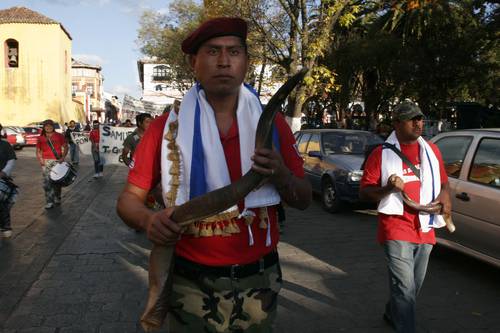
"Orangist" marches in Chiapas, what else?

This God's Army is not indigenous and has as program to de-indianize their adepts. Recently they marched through the city of San Cristóbal de las Casas with the music of the Imperial March of Star Wars (the music associated with Darth Vader, you get the point, right?) Their aggresive discourse is similar to that of the undemocratic Mexican government, opposed to the Zapatista bloc, against whom they act essentially.

Wednesday, May 13, 2009

New paper on Mexican genetics


An interesting freely available study has just been published: Irma Silva-Solezzi et al. Analysis of genomic diversity in Mexican Mestizo populations to develop genomic medicine in Mexico. PNAS, 2009.

Results
We analyzed data from 300 nonrelated self-identified Mestizo individuals from 6 states located in geographically distant regions in Mexico: Sonora (SON) and Zacatecas (ZAC) in the north, Guanajuato (GUA) in the center, Guerrero (GUE) in the center–Pacific, Veracruz (VER) in the center–Gulf, and Yucatan (YUC)in the southeast. Considering that Zapotecos have been shown as a good ancestral population for predicting Amerindian (AMI) ancestry in Mexican Mestizos (16), we included 30 Zapotecos(ZAP) from the southwestern state of Oaxaca (Fig. 1). For comparative purposes, we included similar data sets from HapMap populations: northern Europeans (CEU), Africans (YRI), and East Asians (EA), including Chinese (CHB) and Japanese (JPT). A HapMap-like database with SNP frequencies in Mexicans and HapMap populations was generated (http://diversity.inmegen. gob.mx).

Some assorted images:

Fig.1. Map showing areas sampled and diversity compared to HapMap standard samples. All populations are Mestizos except ZAP who are Native American Zapotecos.

Fig. 2. Plots of the Mexican and HapMap samples: A includes YRI (Yorubans), B without YRI.


Fig. 3A. Poulation structure of Mexicans and HapMap samples.

No novel conclusions, I'd say. As is known (at least by Mexicans) Northwesterners (represented here by SON) are "whiter" than average. All Mestizo Mexicans are basically a mixture of Europeans and Native Americans with very small apportion of African ancestry (more notable in Guerrero and some Veracruz individuals).

It is interesting to see anyhow how when a true Amerindian sample is introduced, a clear distinction appears with the East Asian HapMap sample that, by itself, can only be a poor approximation to Native American genotype. To a lesser extent surely it could be argued that CEU may not represent well the SW European ancestry of Mexicans but guess the differences are much less extreme (Europeans in general cluster all very close to CEU when in intercontinental contexts).

For further references on medical genomics regarding Mexico check this article at Science Daily.

.

Wednesday, April 29, 2009

Swine flu: farm pigs and corporate pigs?


Just a brief note on the ongoing mediatic inflation of swine flu "pandemic".


The most interesting rumor right now is that Ronald Rumsfled is the one behind it. Not just his company Gilead Sciences Inc. is the developer of Tamiflu and will therefore get huge profits from any flu-related panic, as does its actual producer Roche, but also some people are douncing that it is only the last lab-created biological agent, which is being experimented on Mexicans primarily. Again the diabolic Rumsfeld would be behind.

An alternative and more commonly accepted explanation is that the flu has been indeed derived from pigs at a farm at Veracruz that uses a huge ammount of local water resources and throws the residues near the drinking water sources. In such appaling conditions, that have been denounced to no avail by local activists, it is no wonder that pig viruses cross to humans.

Additionally to whichever actual origins the virus has, some authors are also considering the socio-political implications of the flu. Petras argues that it is being used already as a further reason to crack down on Mexican migration to the USA, while Werbowski ponders the social control experiment that the state of emergency declared in Mexico has.
.

Monday, September 8, 2008

14,000 BP remains at underwater Yucatan caves


Again from
Stone Pages - Archaeonews.

These may be some of the oldest Paleoindian settlers of America and certainly the oldest ones found at the moment. The remains of four people have been found in several underwater caves at Yucatan Peninsula, Mexico. They are dated (C14) between 11,000 and 14,000 BP.

One of the skeletons, a woman dated to 13,600 BP, has been named Eva de Naharón, while another male, known as Chan Hol might be even older than Eva.

At that time, sea levels were 200 m. lower and the Yucatan Peninsula was a large dry prairie extending much further into the Caribbean.

An important issue is that neither of he skeletons show North Asian features but rather South Asian ones (not sure if by this they mean South Asia as in India or as in Indochina) what brings some doubts on the mainstream theory that says that America was colonized from Beringia.

Link to article.

Sunday, August 3, 2008

Rebelión review: transgenics, oil, WTO and the dirty secrets of the King


Spanish language counter-info site
Rebelión is always worth a good read. But guess most of my readers are not fluent in this language and that's actually a very good reason to abstract some of their articles in Leherensuge. Right now there are four items that specially called my attention:

1. Interview with Marie-Monique Robin, author of the best-selling book "The world according to Monsanto", focused on Argentine agriculture.

(...) Nowadays the [transgenic soy] production uses 18 million hectareas. What does this mean? Just one thing: increase of monocultive. It is a fact that, for me is, unquestionable and confirms what I had already noticed in another visit I three years ago. The sentence: 'A people that is dedicated to monocultive is comintting suicide' is patent in this case. What we have to understand is that the expansion of transgenic soy is detrimental for small and middle farmers, who are forced to abandon food production for the people. First, because the seeds provided by Monsanto multinational known as Roundup Ready (RR Soy), are fumigated with the herbicide Roundup, causing the rest of the lands to become polluted, because it is a very volatile herbicide. That means that the small farmers must abandon their farms because their crops are simply destroyed by the herbicide. The soy itself causes severe health problems, and this has been confirmed by a report of the Italian Hospital of Rosario. But it also becomes a horrible social problem. Not regulating the production of transgenic soy is giving the key of national agriculture to investors that have nothing to do with farming.

(...)

What is the so-called 'substance equivalence principle', adopted by Argentina?

This principle, intially accepted by the USA, has no scienfic basis to validate it. Nevertheless, by impeding that the GMOs are considered as food additives, the biotechnological companies could avoid toxicological tests and prescind of special tagging of their products. This decission, that allowed to commercialize the GMOs without any evaluation, was accepted also in Argentina. Thanks to these lies, the GMOs arrived to the country and from it invaded Brazil and Paraguay, where they were not authorized. As Brazil did not accept the transgenics, Monsanto set its headquarter in Menem's Argentina and from it elaborated its strategy that ended up polluting a good deal of South America.

(...)

In Argentina the media do not mention that Monsanto has been declared guilty in the USA and France for false publicity, that they have not anymore the right to claim that their products do not affect the enviroment. I have confirmed in several countries the modus operandi of Monsanto: they bribe... In the book and the film it is demonstrated that there were scientists that were bribed for more than 20 years to tell lies. Now we know that Roundup causes cancer. It is clear that it will be forbidden eventually, as happened with so many other Monsanto products in the past (PCBs, dioxines, among others), which polluted the planet for forty years and were finally forbidden. Roundup is extremely toxic, in Argentina more than half of the croplands are sprinkled with a product that is not biodegradable, that reaches the freatic layers, that pollutes the soil. At the present rythm, the soil will become useless in the mid-term. (...) When an Argentine mother gives soy milk to her children, she is giving them a product contaminated with a toxic product.

(...)

What Monsanto is interested in is in selling Roundup and keep the patents on the seeds to later demand rolaties from other peoples' production. Today in countries like India, there are only trasgenic seeds. Monsanto bought all seed producing companies and farmers must pay royalties to Monsanto every time they use their GM seeds. Otherwise they send the police in. It is a perfect business. The same has been attempted by Monsanto in Argentina. irs claimed they would not demand royalties but in 2005 they changed their discourse by that one of: either you pay us or we are heading for a major conflict.

(...)

2. Tom Kuchard of Ecologistas en Acción writes on the WTO new failure: WTO is not the solution but the problem.

It is excellent news those of the failure of the of the last (exclussive, anti-democratic and illegiimate) meeting of the World Trade Organization (WTO). The antiglobalization movement s pleased that it has been blocked by the moment a new liberalization of world trade.

He claims that the WTO goals can only favor the northern powers like the USA and EU. While some southern countries could also gain something from cheaper exports to the north, they would lose huge income in import taxes that they need desperately for public spending in key issues such as healthcare and education. Besides there has been no evaluation on how free imports would affect the local labor, probably just dumped into poverty and job unstability by decissions they cannot influence.

We face masive global crisis affecting food, energy, the financial system and the consequences of global warming, that intensify each other reciprocally. The commerce model promoted by the WTO deepens the crisis even more. The inability to end with hunger is another evidence of the failure after three decades of deregulation of agricultural markets. Neither the WTO nor other free trade treaties, bilateral or regional, that are being negoiated at this time, will be able to solve the food crisis, because the trade liberalization has eroded the ability of the nations to feed themselves.

He puts a lot of blame in the European Union because the agreements it is promoting further international competition without any sort of guarantee, creating new and greater conflicts only. He also accuses EU of ignoring the danger of global warming and doing nothing of value to stop the Earth from warming more than 2ºC. He argues that the global trade (ignored in carbon emissions "contability") is the main causant of global warming, that EU is doing nothing to supress the imports of products such as soy or palm oil, grown on deforested areas, in spite of deforestation being one of the main sources of hothouse-causing C02 emissions.

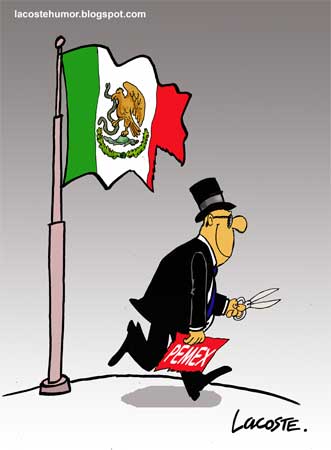
3. Herberto López Blanch writes on the threat of privatization of PEMEX, the Mexican public oil company.

He mentions that referenda in 9 states and the federal district sent a very clear message to Congress: 86% voted against allowing the private sector to participate in pertroleum extraction, refining, transport, distribution and storage; 84% rejected the approval of the privatization laws that are being debated now in the federal Congress. Andrés López Obrador (arguably the democratically elected President of Mexico, as the last elections are mostly considered massively rigged) declared: 'They have privatized more than one thousand major public companies, among them Teléfonos de México, national railroads, ports, airports, mines, banks, they are giving away the national electric industry and now what they ambition most is to grab the national oil wealth and that cannot be allowed'.

Privatization has been pentrating the Mexican economy even before the FTA was signed and the conservative PAN took power in 2000. The extremely controversial US company Haliburton, formerly with Dick Cheney as CEO, alone has already achieved drilling rights in more than 170 locations valued in some 4,000 million dollars.

Article 27 of the Mexican Constitution expressly forbids giving away concessions or contracts for the extraction of petroleum or radioactive minerals. Mexican oil was nationalized in 1938.


4. Former colonel denounces publically the dark business of the King of Spain.

Amadeo Martínez Inglés, who was colonel of the Spanish Army until he fell off with the government in the early 90s, has written a public letter to the President of the Cortes (parliament) denouncing the chief of state King Juan Carlos I for the follwing issues:
  1. Participation in the military coup of February 13 1981, a wll known but seldom discussed affair, where he worked in collaboration with many politicians and high level generals in a strange maneouvre that they eventually abandoned when one of the involved soldiers, litutenant-colonel Tejero decided to go on his own.
  2. Participation in the creation of the death-squads known as Grupos Antiterroristas de Liberación (GAL), who were responsible of the murder (and sometimes kidnappng and tortures) of many Basque citizens in the 80s and early 90s.
  3. Acquiring private wealth in an exaggerated and illegal manner, making his family one of the wealtiest in Europe and the World and recieving many millionaire bribes for obscure favors, benefitting ilegally of his statute and immunity before the law. The wealth of the Spanish royal family reaches the 1790 million euros, according to several foreing publications (in Spain this issueis taboo)
  4. Being systematically corrupt, accepting all sorts of bribes.
  5. Channeling millions from the reserved state funds for his many romances and also paying off extortions from some of them. (Popular wisdom knows well that the king is a drunkard and a whore-goer but nothing of this is ever discussed in the mainstream media).
  6. A possible murder. In March 1956 he killed in very dark circumstances never really investigated his younger brother Alfonso, then 14, who apparently enjoyed the favors of his father who was against Franco and disliked the submission of prince Juan Carlos to the dictator. The fascist authorities then ruling Spain made everything possible to make that appear as an accident.
In the last paragraphs, after asking the parliament to demand the king to answer for these charges, he threates to go to international instances, claiming that it would be incongruent that the Spanish judiciary can judge foreign chiefs of state and that the chief of state of Spain is instead immune to prosecution.

He finishes with the following remark: Spain cannot have anymore a in the post of chief of state a person of such awful moral stature, confessed manslaughterer, presumpt murderer, and also, presumptly by the moment as well, conspirator in military coup, corrupt and terrorist.

Thursday, July 31, 2008

Mexico: heading towards a revolution?


Mexico doesn't make it to the headlines too often but it's a most important country: it is the third largest country of America (and the 11th worldwide) and its GNP ranks among the largest in the world (12th or 14th, depending on the system used), being the third or fourth power in America in economical terms, after the USA and Brazil (Canada is lower in one scale but higher in another). Additionally Mexico is a most important neighbour of the still first global power: the USA.


But it is extremely unstable. And the situation has grown worse in the recent years after the controversial ascension to power of the tory Felipe Calderón in elections that way too many consider to have been rigged.

A most interesting critical window to Mexican reality is the bi-weekly magazine Contralínea, self-described as making "research journalism". The current number alone is an excellent, yet often terrifying, outlook to a country that looked about to explode even before the global economic crisis came into the scene.

Just some brief excerpts here:

In the opening article, Narcotraffic, destabilization and lost war, Z. Camacho and Y. Tinoco say: Official informations offer account of the catastrophic failure of war against narcotraffic, the main offer of Calderonism: 10,000 dead (10% of them from the Mexican Army, the Navy or some of the police corps), fall in the erradication levels of marihuana and poppy crops, and inability to improve the levels of decomissioning of drugs traded in Mexico. DEA unhappy with the performance of Sedena in the erradication of psychoactive crops.

Later they mention the opinion of José Luis Sierra, a Washington Post advisor, who says: It seems there is not consistent policy from the state to fight drug traffickung and its causes, the only thing that matters is image. (...) The consequence of using the armed forces in a war that apparently has no end and lacks sense of victory will be the demoralization of the armed forces themselves. Furthermore, the other big cost is that it is being paid with the lives of soldiers themselves, who are given orders to fight against an enemy that is protected by parts of the goverment itself.

One of the main components of the problem is the absurdly high benefits that narcotics yield, precisely because they are illegal. According to Guillermo Garduño: a kilogram of heroin has a market value of USD 32,850; that of cocaine is worth USD 7,280. And the real cost of heroin is 500 dollars and that of cocane 300: the profit level is monstruous and there is absolutely no product that can have such margins. For a peasant, a single poppy harvest is worth 10 good corn ones.

In another article E. Ramírez analyzes the economic situation of Mexico, whose growth has dropped from 4.8% to 2.7% in the last year, while the food prices have been steadily climbing some 8-9% every year since 2005. Overall inflation has also been growing, together with unemployement, while the direct foreign investment (mostly from the USA, followed by EU) has dropped significatively. The author complains that there is no system to provide small credits to the common investor and that overall the government lacks of any consistent economic policy.

This opinion is shared by N. Egremy, who in another article ponders the Mexican foreign policy, that in her opinion, based on that of political analists, works with patches and oscilates between 'deep integration' with the USA and European 'neocolonialism'. She considers that Mexico, once a relevant regional actor has been replaced in the eyes of the USA by the more independent and dynamic Brazil and Argentina. This chaos in foreign policy has caused greater interventionism by the USA but has also allowed for a huge meddling by Spain and Spanish companies, benefitted from the loss of the anticolonialist sense of history that dominated the 'old regime' of the PRI.

Back to the internal context, P. Monroy thinks that the disastrous socio-economic situation is warming up for a massive explossion like the ones that shattered Argentina some years ago. While the 38 richest Mexcian families (including the second richest man of the World, Carlos Slim) concentrate almost 15% of the GDP, the less affluent 10% of the population only controls 1.6% of it. Everybody seems to agree that the tolerance of Mexicans is at the limit. Historian and social researcher C. A. Aguirre is quoted claiming that the country walks, as in the last period of the Porfirian regime, towards a social explossion like the one that happened in 1910. She mentions the many many popular mobilizations hat have affected the country in the latest years and how the guvernamental response has been basically that of militarization and repression. No real solutions are provided though.

Finally it's worth mentioning that the labor union UNT is preparing a massive general strike for September that may cripple the country. The union leaders complain that the working class has lost like 70% of their purchasing power since 1970 and that the goverment is ignoring their plea. Public servants will join the strike because
most of them don't earn enough to subsist and many have to even rely on begging in spite of having a job.

Tuesday, April 29, 2008

New Marcos book soon to be published.


Corte de Caja
will be the original title (sorry but no idea what may that mean in Mexican Spanish) and takes the form of interview by Mexican journalist Laura Castellanos.

In the advance found at Rebelión, the subcomandante Marcos mentions his admiration for Fidel Castro, whom he compares with historical heroes like Emiliano Zapata and Pancho Villa, and Che Guevara, whom he believes was way before his time, that he belonged to a generation not yet fully born. More critical he is with modern left-wing American leaders: he gives the benefit of doubt to Evo Morales, feels plainly disillusionated with Lula and is also relatively critical with Hugo Chávez, of whom he says that has a foot in mediatic politics with aftertaste to "caudillo" and another in the movement that is awakening in Venezuela.

On the Colombian guerrilla FARC he says that they have a huge mediatic campaign against them, trying to link them with drugs trade. On the other Mexican armed group, the People's Revolutionary Army (EPR), he declares to have no contacts with them and that they differ in their strategies: that the EPR is focused in military action, while the Zapatistas are instead dedicated to popular organization.

Regarding the Zapatista movement itself, he says that we are like in 1993 [before the armed uprising of January 1st 1994]. They neither see nor hear us. The disadvantage is that they have already seen and heard us and now just pull us to the side.

But he also believes that the situation of Mexico is of total destruction. That if the elites believe that the people is going to put up with a dictatorship of the party, of the state, they are wrong. No. The country won't stand it.

He also meditates that he was maybe too active in the media early on and that, in contrast, this book may be his last interview.


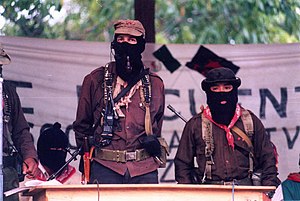
Marcos with comandante (major) Tacho 1999