
 Posts
Posts




Showing posts with label India. Show all posts
Showing posts with label India. Show all posts
Wednesday, September 8, 2010
100 million Indians strike against liberalization
Besides French, Indians also went to general strike yesterday, with the main goal of blocking the growing prices of basic products, specially food and oil, and of stopping the sale-out of public companies.
While the figure is high, we should remember that India has some 1 billion inhabitants of which maybe half are actual workers. On the other hand, the wide spread of irregular economy and mafioso pressures of the capitalist class surely also influenced the outcome. So I admit it is difficult to judge if this figure represents a mere 20-30% of strikers (still a major figure, specially for such a large and heterogeneous country) or it is in fact a much larger fraction of the regular workers.
Whatever the case it seems that the impact was very irregular with maybe 99% success in communist-ruled states of Kerala, West Bengal and Tripura and variable impact in other states. In Delhi and Mumbai, the strike was only apparent in the absence of rickshaws, whose drivers massively seconded the walk out. Other affected states were Manipur, Assam, Maharastra, Gujarat, Karnataka and Madhya Pradesh.
Sources: Insurgente, People's Daily, The Jakarta Post. The information I found is not too precise anyhow, so complementary accounts and links are welcome.


Friday, August 20, 2010
Indian Maoists seen from within
I just stumbled on a Spanish translation of an essay published in March in English but that was unknown to me until now.
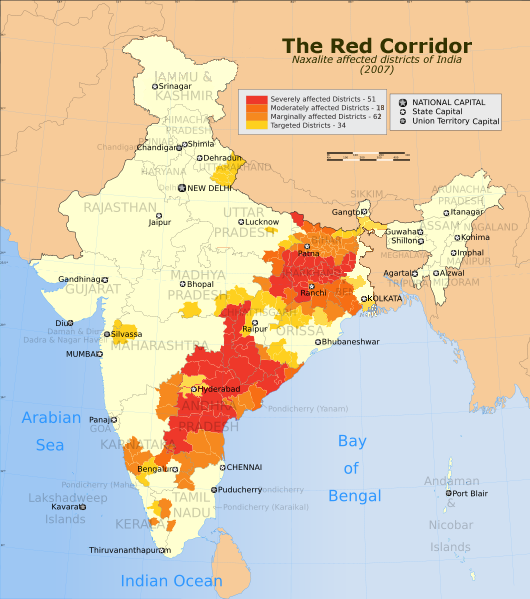 You may have heard from the Maoist guerrilla of India (also called Naxalites) and maybe even know that they have gained the hearts of many adivasi (tribals) in the Eastern part of the country through their opposition to predatory mining. You may have heard that India is since some time ago considering them the biggest threat to the state (above Islamic Fundamentalists and secessionist movements in Kashmir or the NE) and that there is some sort of low intensity war being waged in parts of India between the guerrillas and the state.
But probably you, like myself, know very little about what is really going on. Specially from the viewpoint of the guerrilla.
Therefore this essay, rather a first person report from inside the Maoist ranks, by acclaimed author Aundhati Roy, is a must-read. It was published almost simultaneously in British newspaper The Guardian with the title Gandhi but with guns and in the Indian magazine Outlook with the one of Walking with the comrades.
A very interesting read indeed. I include here a few fragments to entice you to read the whole story:
When a country that calls itself a democracy openly declares war within its borders, what does that war look like? Does the resistance stand a chance? Should it? Who are the Maoists? Are they just violent nihilists foisting an outdated ideology on tribal people, goading them into a hopeless insurrection? What lessons have they learned from their past experience? Is armed struggle intrinsically undemocratic?
...
We passed the house of the Superintendent of Police (SP), which I recognised from my last visit. He was a candid man, the SP: “See Ma’am, frankly speaking this problem can’t be solved by us police or military. The problem with these tribals is they don’t understand greed. Unless they become greedy, there’s no hope for us. I have told my boss, remove the force and instead put a TV in every home. Everything will be automatically sorted out.”
...
The first converts, the village chiefs and big landlords (...) were conferred the status of Dwij, twice-born, Brahmins. (...) As part of the Hindutva drive, the names of villages were changed in land records, as a result of which most have two names now, people’s names and government names. Innar village, for example, became Chinnari. On voters’ lists, tribal names were changed to Hindu names. (Massa Karma became Mahendra Karma.) Those who did not come forward to join the Hindu fold were declared ‘Katwas’ (by which they meant untouchables) who later became the natural constituency for the Maoists.
...

I looked around at the camp before we left. There are no signs that almost a hundred people had camped here, except for some ash where the fires had been. I cannot believe this army. As far as consumption goes, it’s more Gandhian than any Gandhian, and has a lighter carbon footprint than any climate change evangelist. (...) Should I write a play, I wonder—Gandhi Get Your Gun? Or will I be lynched?
...
KAMS [the Maoist women organization, with 90,000 members] campaigns against the adivasi traditions of forced marriage and abduction. Against the custom of making menstruating women live outside the village in a hut in the forest. Against bigamy and domestic violence. It hasn’t won all its battles, but then which feminists have?
...
A lot of the rape and bestial sexual mutilation was directed at members of KAMS. Many young women who witnessed the savagery then joined the PLGA and now women make up 45 per cent of its cadre.
...
Comrade Sumitra joined the PLGA in 2004, before the Salwa Judum began its rampage. She joined, she says, because she wanted to escape from home. “Women are controlled in every way,” she told me. “In our village, girls were not allowed to climb trees; if they did, they would have to pay a fine of Rs 500 or a hen. If a man hits a woman and she hits him back she has to give the village a goat. Men go off to the hills for months together to hunt. Women are not allowed to go near the kill, the best part of the meat goes to men. Women are not allowed to eat eggs.” Good reason to join a guerrilla army?
...
And what Chairman Mao said about the guerrillas being the fish and people being the water they swim in, is, at this moment, literally true.
...
When the Party is a suitor (as it is now in Dandakaranya), wooing the people, attentive to their every need, then it genuinely is a People’s Party, its army genuinely a People’s Army. But after the Revolution how easily this love affair can turn into a bitter marriage. How easily the People’s Army can turn upon the people. Today in Dandakaranya, the Party wants to keep the bauxite in the mountain. Tomorrow, will it change its mind? But can we, should we let apprehensions about the future immobilise us in the present?
...
I think of what Comrade Venu said to me: they want to crush us, not only because of the minerals, but because we are offering the world an alternative model.
Wednesday, August 18, 2010
Indian Megalithic wares and other Archaeonews
Stone Pages' weekly newsletter Archaeonews has arrived again at my mailbox bringing some interesting informations:
Tamil Nadu Iron Age findings
 Sengalur village (Puddukotari district, Tamil Nadu, India) hosts some 300 Iron Age burials of Megalithic style, described as stone circles with or without cairn packing, stone circle with cist burial of different types, cist burial with an extension in the front, urn burials, urn burials with capstone, menhir and rectangular shaped structure.
They are being excavated by the Archaeological Survey of India (ASI), reaching also to the nearby villages of Sittanavasal, Melapatti and Nathakadu, producing a large catalog of material culture from that period, that includes terracotta figurines, beads made of glass, semi-precious stones and terracotta, broken bangles (glass bracelets) and potsherds inscribed with graffiti.
Source: The Hindu
Other news
The newsletter also includes other archaeological news such as:
- Looting seems to have destroyed more than half of ancestor stones at Cross Rivers State (Nigeria). More at The Sun.
- Teotihuacan dwellers used the bones of their relatives for buttons and other quotidian objects. More at National Geographic.
- Most ancient known house of Britain found at Scarborough, dated to 8500 years ago (Epipaleolithic). More at BBC and many other news sites.
Tuesday, August 3, 2010
Indian economy seen from Mexico
Economist Alejandro Nadal writes in La Jornada (found at La Haine) about the Indian miracle, its horrors and limitations. I translate here the whole text because I feel it is very worth reading.
The economy of India keeps high rates of growth since some years ago and for many it is an example to follow. It is said that the experience of the subcontinent is evidence that Neoliberalism can work. Reality is very different: the evolution of Indian economy is a pathological process that feeds on social inequality and environmental destruction.
India kept a modest growth after independence in 1947. The project of industrialization sustained a reduced but stable expansion (4%) between 1950 and 1980. The income per capita increased an average of 1.3% yearly in that period. The commercial balance remained with a permanent deficit and the economy was closed to the trade and capital flows.
The global debt crisis in the 1980s submitted India to the dictates of the International Monetary Fund and in the 1990s neoliberal style reforms were imposed, what meant a radical turn in economic policy. In the last ten years India had an average annual growth of 6.8%. International press has presented this as an economical miracle.
In these years inequality and poverty have worsened in India. Today 42% of that country's people (1.173 billion) lives with less than one dollar per day. 75% lives with two dollars a day and the economic model is not going to revert such an unequal structure.
In spite of the growth rates of 6-7%, the increase of formal unemployment in India is minimal and does not go beyond a yearly 1% growth. By the way, that means that economic expansion is built on most important productivity increases. This is related to the strategy of orienting investment towards exports, what requires bringing salary costs down to minimums in order to be able to compete. For that reason the rationalization of productive chains is accompanied of strong cuts in employment.
In spite of the miracle in growth rates, India keeps a chronic deficit in its external accounts and needs to finance it. For that purpose it has chosen to receive capital flows, both in form of direct foreign investment as portfolio investments (short term capital). But this implies an enormous cost: macroeconomic policies must respect game rules that have nothing to do with the needs of the Indian people.
Monetary policy is dominated by the need to attract capital to the Indian economic space. This implies keeping high interest rates. Besides, only the privileged ones have access to credit, all this imprinting a regressive hue to distribution of wealth by privileging the active portfolio of the wealthiest strata and deepening inequality. That is why it is irrelevant: what matters is to keep the flow of capital that allows financing the external deficit.
All this implies that India has now the highest reserves in history (some 230 billion dollars). In this it resembles China, but the difference is that the latter has a huge surplus in its trade balance while India suffers a chronic deficit. Indian reserves are not such: they are a resource that can evaporate at any moment.
Fiscal policy is ruled by the dogma of balanced budget and, as capital owners must not be incommoded in order not to affect investments, the fiscal balance is achieved cutting social expenditure and reducing the amount of resources for environmental preservation.
The opening to foreign investment is done by giving concessions to extractive, lumber and touristic industries. This causes the expropriation of the lands in which the minerals are found (iron in Chattisgarh, bauxite in Orissa, etc.) or which are covered by dense forests, which are easily accessible commercial wealth. Many of those lands are the home of aboriginal peoples or adivasi (Sanskrit word meaning first inhabitants of the forest). The adivasi are less than 8% of Indian population but they are 40% of the people deprived from valleys, hills and river basins. The cession of their lands to the megacorporations in extractive and touristic industries is one of the most violent traits of the neoliberal miracle in India.
Economist Amit Badhuri, professor emeritus of the Jawaharlal Nehru University in New Delhi, has described this process as predatory growth. It must be said it is not any metaphor: it is in effect a complex economical and political process in which the losers give their way of life to a growth that privileges only a few and cannot raise the level of life of the majority.
The parallel with Mexico is extraordinary. Actually the only different thing are growth rates. All the rest is identical: the same model, the same injustice.
Friday, July 23, 2010
Forget the $100 laptop, India develops one at much lower price
The current model developed in India actually costs only 35 dollars, they expect the price to drop to 20 and even as little as 10 dollars soon.
The device has been developed by the Indian Institute of Technology and the Indian Institute of Science. It has a touchscreen system, Linux operative system (get used: Windows is out, Linux is in), web browser, PDF reader and video conferencing capabilities, being flexible enough to incorporate other stuff.
Source: The Guardian (includes a short video of the official presentation)
Thursday, July 15, 2010
Geopolitics of the 21st century: shares of global wealth in 2015
This map represents the share of the World Domestic Product (Purchase Power Parity) in 2015, according to the latest (2010) estimates by the IMF (direct source: Wikipedia). Countries with less than 1% of WDP(PPP) not shown.

Click to enlarge
(In lighter blue: countries closely allied with the USA)
(In lighter blue: countries closely allied with the USA)
By 2015 the Chinese GDP(PPP) will be almost as large as that of the USA and China should overcome the USA in this measure before 2018. Another thing is the nominal GDP but this depends a lot of the artificially-set exchange rate of the renminbi (yuan).
By 2015 India will also be the third global power measured in these macroeconomic figures, having displaced Japan but still a long way to go to rank in the 1st tier. Otherwise the list of 19 countries concentrating more than 1% of global wealth is exactly the same as today but the order will have changed somewhat in favor of developing countries, with much higher growth rates and much better resistance so far to the global economic crisis.
In fact the crisis seems to be largely a crisis of the imperial World order: a clear sign of decline of the neo-European imperial system inaugurated some 500 years ago. It is also a sign of decline of the Anglosaxon-dominated industrial global economy of the last 2-3 centuries, a subset of the previous and its apogee.
A century ago...
Besides that, the situation also reminds me of the other great systemic crisis we know well: the one triggered by Germany surpassing Britain in GDP at the beginning of the 20th century, leading to the two World Wars and, eventually, the global hegemony of the USA.
There are many differences, of course, but there are also similitudes.
Some of the differences are that:
- the main scenario now is not in Europe but in Asia,
- that the USA (in the role of early 20th century Britain) is not deploying anything like splendid isolation, but rather has a huge imperial system and is the active self-designed paladin of the old world order, encompassing a large list of wealthy and powerful countries, notably Japan and Germany.
- that nuclear weapons make a world war most unlikely to happen as such
- that the rising stars have huge numbers of people to feed and keep content (one thing is GDP and another very different one GDP per capita)
- that China is far from being the militarist power Germany was and favors instead soft power
In my opinion, the comparison is still valid anyhow and has the following "casting":
- The USA in the role of Britain, the established but declining first global power
- China in the role of Germany (including Austria-Hungary), the dynamic but somewhat isolated challenger
- India in the schizophrenic role of both France and, specially, Italy: the third power in the geostrategic scenario: a more modest rising star with high dependence on who controls the seas
- Russia as herself and the Ottoman Empire: the semi-colonies of Germany (China) which made up somewhat for its lack of overseas territories
It's very approximate but you get the idea, right? Not sure if Japan should play the role of France or what but India and Italy give me much of the same vibe indeed, including the parallel between the Hymalayas and the Alps, as well as the fact that, much like Italy became relevant in parallel to Germany, India has done the same in parallel to China.
Europe definitively seems to have no major role, specially as it's far away from the Asian scenario. The only chance it could have would be through a real political and military union but that is far from happening. That's probably one of the reasons why Europe is being hit so hard in this economic crisis: it has lost some of its strategic relevance and is therefore disposable.
So which are the new Balcans? Obviously the Greater Middle East, including Central Asia. SE Asia could also play such role to some extent but also that of Scandinavia if they are luckier.
The parallel is, admittedly, only valid to some extent but it is still valid.
What really made me think of this parallel is the fact that for the first time in many many decades, the established global power is going to be soon replaced in the macroeconomic realm by someone else, exactly what provoked WWI.
So what?
These macroeconomic figures are no trivial fact: they represent real power much better than any other data. You can have as many recruits as you wish (soldiers, spies, lobbyists, etc.) but in order for them to be effective you have to be able to pay them, train them and specially equip them. Nowadays GDP generally gives a much more real measure of military prowess than number of troops or any other such figure. The same is true in the plane of economic and political influence.
Then... should we expect a WW-III? I hope not and I do not think so (nuclear deterrence). But we should expect localized wars in the line of Afghanistan and Iraq, as well as political instability (coups, revolutions) associated to this global confrontation each day more apparent.
Then is it more like a Cold War II? Yes, I think so. However, the USSR was never in position to really challenge the USA as China is right now. On the other hand, the USSR had a much more solid and exportable ideology China has abandoned in favor of capitalist competition (but consider Nepal, the Indian Maoists and even the Thai Red Shirts). Finally China is being careful of not overspending in the military department, as the USSR did with catastrophic results, as well as not to challenge prematurely the US hegemony and allow the Empire to get stuck itself in its own new editions of the Vietnam War, knowing that it cannot win them and that they'll cost it dearly.
But China also has its own challenges: in order to succeed economically, it must exploit mainly its own population in a phenomenon I call "internal colonialism". This is obviously bound to produce growing discontent, whose unavoidable revolutionary results are by the moment being deferred by means of certain redistribution of the newly acquired national wealth. China also faces major ecological problems, which are partly its own and partly interconnected with the rest of the world, such as global warming. Another problem is their partial dependence of its main rival as market for its products. Additionally, China has some unsolved geostrategic issues, notably securing access to the oil resources, along with the chain of US military bases/allies offshore, specially Taiwan.
Well, interesting and intriguing scenario the one we are heading into, right?
Europe definitively seems to have no major role, specially as it's far away from the Asian scenario. The only chance it could have would be through a real political and military union but that is far from happening. That's probably one of the reasons why Europe is being hit so hard in this economic crisis: it has lost some of its strategic relevance and is therefore disposable.
So which are the new Balcans? Obviously the Greater Middle East, including Central Asia. SE Asia could also play such role to some extent but also that of Scandinavia if they are luckier.
The parallel is, admittedly, only valid to some extent but it is still valid.
What really made me think of this parallel is the fact that for the first time in many many decades, the established global power is going to be soon replaced in the macroeconomic realm by someone else, exactly what provoked WWI.
So what?
These macroeconomic figures are no trivial fact: they represent real power much better than any other data. You can have as many recruits as you wish (soldiers, spies, lobbyists, etc.) but in order for them to be effective you have to be able to pay them, train them and specially equip them. Nowadays GDP generally gives a much more real measure of military prowess than number of troops or any other such figure. The same is true in the plane of economic and political influence.
Then... should we expect a WW-III? I hope not and I do not think so (nuclear deterrence). But we should expect localized wars in the line of Afghanistan and Iraq, as well as political instability (coups, revolutions) associated to this global confrontation each day more apparent.
Then is it more like a Cold War II? Yes, I think so. However, the USSR was never in position to really challenge the USA as China is right now. On the other hand, the USSR had a much more solid and exportable ideology China has abandoned in favor of capitalist competition (but consider Nepal, the Indian Maoists and even the Thai Red Shirts). Finally China is being careful of not overspending in the military department, as the USSR did with catastrophic results, as well as not to challenge prematurely the US hegemony and allow the Empire to get stuck itself in its own new editions of the Vietnam War, knowing that it cannot win them and that they'll cost it dearly.
But China also has its own challenges: in order to succeed economically, it must exploit mainly its own population in a phenomenon I call "internal colonialism". This is obviously bound to produce growing discontent, whose unavoidable revolutionary results are by the moment being deferred by means of certain redistribution of the newly acquired national wealth. China also faces major ecological problems, which are partly its own and partly interconnected with the rest of the world, such as global warming. Another problem is their partial dependence of its main rival as market for its products. Additionally, China has some unsolved geostrategic issues, notably securing access to the oil resources, along with the chain of US military bases/allies offshore, specially Taiwan.
Well, interesting and intriguing scenario the one we are heading into, right?
Wednesday, June 30, 2010
Some Archaeo News
The compilation of archaeological news by the team of the reference site Stone Pages strikes with a new update, some of whose snippets I found of some significance:
- Çatalhöyuk team to announce new findings this summer (more at Hürriyet)
- Guernsey's only gallery grave (passage dolmen) dug by archaeologists (more at BBC)
- Possible indications of Neolithic at Andrah Pradesh discovered by freelance archaeologist (more at The Hindu - not a very clear story)
- Neanderthals and Sapiens probably diverged long ago because of teeth morphology (more at Science Daily).
I already mentioned this last story earlier in relation to the latest Neanderthal Genome controversial molecular clock guesstimates, which caused palaeoanthropologist Aida Gómez, of the Atapuerca team, pointing to her older works on the matter saying: no way, it's more like one million years. It seems that the story is still bouncing around, now in English.
Tuesday, May 18, 2010
Some archeological news
Stone pages' Archaeo News bulletin is back to normality and I think these items are worth mentioning:
- England: discovered cairn complex at Otley, Yorkshire. More at The Northern Antiquarian.
- Australia: ongoing research at Kimberley hopes to find clues of earliest inhabitants. More at The Australian.
- USA: underwater black chert source at North Carolina suggest coastal migration of Paleo-Indians. More at Star News.
- Oman: a 5000 years old cemetery. More at Gulf Times.
- Bahrain: Dilmun culture's burial mounds will be researched before massive development destroys them. More at Gulf Daily.
- India: stone circles' complex largely destroyed in development at Thiruporur, Tamil Nadu. More at the Megalithic Portal (another reference site).
 One of the surviving stone circles of Thiruporur (from the Megalithic Portal)
 You can discuss these news and much more at Stone Pages' forums.
Wednesday, March 24, 2010
US agent behind the Mumbai attacks
Michael Chossudovsky already said it more than a year ago: the Mumbai attacks were planned and executed by the USA intelligence services.
Now, with the arrest and trial of David Coleman Headley at Chicago, it seems that he was right. However as soon as light seemed to be thrown on the massacre, the evidence is being hidden under a mountain of secrecy.
That's what M.K. Bhadrakumar exposes at Asia Times Online: that Headley's plea bargain will allow the actual big terrorists behind him to escape unharmed, while he gets a low sentence and the real plot behind him, that surely involves the CIA, will be classified top secret. He won't be even extradited to India but judged in Chicago under a plea bargain that includes not naming the four liasons he had in Pakistan.
This, I understand, underlines the delicate geopolitical situation of India, trapped in the "great game" of two major enemies (the USA is no real ally nor is China of course) both allied with its main direct rival: Pakistan, in order to fulfill the divide et impera leit motiv of the imperialist policies in South, Central and West Asia.
Sunday, March 7, 2010
Geopolitics of today (or "BRICs are heavy")
I finally made a satisfactory map that reflects as well as possible the imperfect multipolarity of today's geopolitics:
 Click to expand
Legend:
- Red shades: The Empire (dark red: USA and dependencies, bright red: other NATO members, other "central" US allies and their colonies, pink: other important US allies/EU members, stripes: under military occupation).
- Turquoise: Russia (stripes: under military occupation), Cyan: main allies
- Blue: China, lighter blue shades: under Chinese influence
- Orange: India, lighter orange shades: under Indian influence
- Green: Brazil, light green: other Mercosur countries, dark green: ALBA
- Dark Grey: other regional powers
- Regular Grey: other countries
Notice that I could not mark all US/NATO allies on risk of almost all the map becoming pink and that way maybe exaggerating the influence of The Empire even more. On the other hand I may have maxed the areas of influence of China (excepting Pakistan) and India. Many countries, of course, play multilateral diplomacy and try to keep a pretense of independence, what makes more difficult to decide what side are they in. The use of similar colors for Brazil/Mercosur and ALBA is somewhat justified but was mostly chosen to underline the differences between the USA/NATO bloc and the "Latin-Americanist" powers in the American continent. Anyhow, the latest developments in Honduras, Colombia and Haiti have clearly pushed Venezuela and Brazil closer in a joint bid to support the independence of Latin American and Caribbean nations, which obviously plays in their interest rather than in that of the USA, as imperialist power.
Overview:
There are two basic elements in the reality reflected in this map: The Empire and the BRIC.
The Empire is incredibly large (even if I tended to reflect only its strongest influence) and is clearly based on naval hegemony, which is supported by proportionally large navies, not just from the USA but also from France, UK, Italy, Spain, Australia and Japan in particular.
BRIC is an acronym that stands for Brazil, Russia, India and China. Even if it's an informal group, it has no other entity that reflect the four major powers that are still independent from The Empire. Each one of them has its own geostrategical interests and also different cultures and political systems. The only thing in common they may have is that they all are more or less confronted with The Empire... with one exception: India.
India:
It seems that India and China perceive each other as most direct rivals. Also India has a large maritime facade and hence clear naval interests in the Indian Ocean specially, which is also the ocean where The Empire has an arguably weaker presence. However India has with good reason distrusted The Empire in the past and instead kept stronger ties with the former USSR. The China-USA entente and the conflicts with Pakistan (an ally of both USA and China) on Kashmir, led the South Asian republic to act that way. However it has played both sides and has always kept major ties with Israel and other members of the Western bloc.
In the current circumstances, India still keeps good relations with Russia but the approach between Moscow and Beijing is pushing the old friend somewhat apart and throwing India in the arms of The Empire.
China and Russia:
But, of course, the most important power of all BRIC countries is nowadays China. And it is the growing conflict between China and the USA what really describes the scene. We can't still talk of a new Cold War, very specially because the Chinese take due care in no pushing the conflict to military but economic and diplomatic terms but, in any case, the conflict is clear and growing stronger, as knows anyone who reads the news.
China however is relatively weak in the military aspect, even if less so than in the past, and hence its growing alliance with the decadent but heavily armed Russia is of crucial importance. The "thirdworldized" Russia with loads of ICBM nukes, offers China an almost ideal ally: China does not dispute Russia its political and military clout on Central Asia but rips many of the economic benefits, not just of Central Asia but also of Siberia. It also offers China a military shield that prevents a direct conflict with The Empire.
On its side Russia also feels threatened by The Empire, which has been growing towards its borders and even threatens it with new missile deployments. The latest developments (defeat of Georgia, pro-Russian government in Ukraine, restive Turkey) may imply that Russia is scoring some goals but still it does feel threatened by NATO and siding with China is the best alternative it has (as together they control most of non-tropical Asia, while divided they would only play in the hands of their common rival).
China's worries are mostly a fear of being blockaded out of the oil supplies from the Middle East. Hence it's following two parallel strategies: on one side, cooperation with Russia to keep The Empire out of Central Asia (and as much as possible of The Middle East as well, for example protecting Iran) and, on the other side, securing as much as possible the shipping lines to West Asia (for which it has recently obtained bases in Bangladesh and Sri-Lanka).
In parallel, China is painfully working to weaken the imperial bloc in its immediate area of East Asia itself (seducing South Korea and even Japan and Taiwan as much as possible, supporting little Cambodia against Thailand, etc.), as well as gaining random friends in Polynesia and Africa and, specially, making business even where The Empire makes military alliances.
Brazil:
The other BRIC power is Brazil, whose confrontation with the USA has been growing hot in the last year. Brazil has been playing, even more than China, a soft diplomatic game, gradually strengthening its position both internally and internationally. While it has got its bad moments with the Bolivarian bloc led by Venezuela, the crisis of Honduras seems to have eventually opened its eyes. And if that did not, the growing US military presence in Colombia and the unbelievable massive invasion of Haiti have put things clear for Brazil: there's no room for two powers in America... unless they fight each other. Surely Brazil would like to grow in power more gradually and without conflicts but it seems that those days are now gone and The Empire is striking back. That situation obviously pushes the Bolivarian bloc (the ALBA) and the Brazilian-led bloc (Mercosur) into each other's arms.
The latest growing tensions around the Falklands/Malvinas disputed archipelago, as well as the repeated protests of Venezuela against the US-Colombia-Netherlands siege, show that the issue is serious.
However Brazil in comparison with the Asian BRIC countries has three disadvantages:
Overview:
There are two basic elements in the reality reflected in this map: The Empire and the BRIC.
The Empire is incredibly large (even if I tended to reflect only its strongest influence) and is clearly based on naval hegemony, which is supported by proportionally large navies, not just from the USA but also from France, UK, Italy, Spain, Australia and Japan in particular.
BRIC is an acronym that stands for Brazil, Russia, India and China. Even if it's an informal group, it has no other entity that reflect the four major powers that are still independent from The Empire. Each one of them has its own geostrategical interests and also different cultures and political systems. The only thing in common they may have is that they all are more or less confronted with The Empire... with one exception: India.
India:
It seems that India and China perceive each other as most direct rivals. Also India has a large maritime facade and hence clear naval interests in the Indian Ocean specially, which is also the ocean where The Empire has an arguably weaker presence. However India has with good reason distrusted The Empire in the past and instead kept stronger ties with the former USSR. The China-USA entente and the conflicts with Pakistan (an ally of both USA and China) on Kashmir, led the South Asian republic to act that way. However it has played both sides and has always kept major ties with Israel and other members of the Western bloc.
In the current circumstances, India still keeps good relations with Russia but the approach between Moscow and Beijing is pushing the old friend somewhat apart and throwing India in the arms of The Empire.
China and Russia:
But, of course, the most important power of all BRIC countries is nowadays China. And it is the growing conflict between China and the USA what really describes the scene. We can't still talk of a new Cold War, very specially because the Chinese take due care in no pushing the conflict to military but economic and diplomatic terms but, in any case, the conflict is clear and growing stronger, as knows anyone who reads the news.
China however is relatively weak in the military aspect, even if less so than in the past, and hence its growing alliance with the decadent but heavily armed Russia is of crucial importance. The "thirdworldized" Russia with loads of ICBM nukes, offers China an almost ideal ally: China does not dispute Russia its political and military clout on Central Asia but rips many of the economic benefits, not just of Central Asia but also of Siberia. It also offers China a military shield that prevents a direct conflict with The Empire.
On its side Russia also feels threatened by The Empire, which has been growing towards its borders and even threatens it with new missile deployments. The latest developments (defeat of Georgia, pro-Russian government in Ukraine, restive Turkey) may imply that Russia is scoring some goals but still it does feel threatened by NATO and siding with China is the best alternative it has (as together they control most of non-tropical Asia, while divided they would only play in the hands of their common rival).
China's worries are mostly a fear of being blockaded out of the oil supplies from the Middle East. Hence it's following two parallel strategies: on one side, cooperation with Russia to keep The Empire out of Central Asia (and as much as possible of The Middle East as well, for example protecting Iran) and, on the other side, securing as much as possible the shipping lines to West Asia (for which it has recently obtained bases in Bangladesh and Sri-Lanka).
In parallel, China is painfully working to weaken the imperial bloc in its immediate area of East Asia itself (seducing South Korea and even Japan and Taiwan as much as possible, supporting little Cambodia against Thailand, etc.), as well as gaining random friends in Polynesia and Africa and, specially, making business even where The Empire makes military alliances.
Brazil:
The other BRIC power is Brazil, whose confrontation with the USA has been growing hot in the last year. Brazil has been playing, even more than China, a soft diplomatic game, gradually strengthening its position both internally and internationally. While it has got its bad moments with the Bolivarian bloc led by Venezuela, the crisis of Honduras seems to have eventually opened its eyes. And if that did not, the growing US military presence in Colombia and the unbelievable massive invasion of Haiti have put things clear for Brazil: there's no room for two powers in America... unless they fight each other. Surely Brazil would like to grow in power more gradually and without conflicts but it seems that those days are now gone and The Empire is striking back. That situation obviously pushes the Bolivarian bloc (the ALBA) and the Brazilian-led bloc (Mercosur) into each other's arms.
The latest growing tensions around the Falklands/Malvinas disputed archipelago, as well as the repeated protests of Venezuela against the US-Colombia-Netherlands siege, show that the issue is serious.
However Brazil in comparison with the Asian BRIC countries has three disadvantages:
- Like India, it is a naval oriented country with a large maritime facade. Hence it's potentially more exposed to the Imperial naval hegemony. But, unlike India it's much closer to the USA and its area of immediate interests.
- It competes with the largest global power for Latin America, which the USA still considers its "backyard".
- It is the only BRIC power that has no nuclear weapons. It might develop them (as did India not long ago) but that would mean breaching international agreements (NPT) and giving hence a pretext to the USA to behave even more aggressively.
On the other hand it has some major advantages:
- Latin America in general is fed up with the USA and is clearly willing to try something new. Brazil has the potential of playing a leading role in this aspect and the recent formation of a distinct Latin American and Caribbean association without the USA nor Spain is a clear step in this direction.
- Not only Latin America but eventually even large parts of Africa, very specially South Africa (particularly sympathetic to Brazil and India, and leader of a large bloc, not represented in the map) and the former Portuguese colonies, could be interested in some sort of cooperation with Brazil and other Latin American nations with common goals of emancipation and development.
- The legitimacy of the people: unlike the other US rivals (China and Russia) and unlike most US allies (vassals) in the region, Brazil and its allies (excepting Cuba) are clear democracies, with more or less "progressive" leaning. Machiavelli himself would applaud that as a great asset.
- Oil: Venezuela seems to have become the largest oil reserve in the World, replacing Saudi Arabia in this position. Brazil itself has discovered large deposits offshore and there are others in Cuba, Haiti and the Falklands, fueling the confrontation with the USA and Britain. But also allowing for some decent bargaining as well.
The Empire:
The Imperial bloc lead by the USA has clear advantages: the largest share by far of the global GDP, a huge military, presence almost anywhere on Earth, lots of nukes, total naval hegemony... But it has also some disadvantages, namely: overextension, huge debt (largely caused by military overexpending), being dominated by a small oligarchy with very peculiar interests, often conflicting with those of the people and even The Empire itself (particularly Zionism), and now a brutal overproduction crisis that might well seal its fate once for all.
Overgrowth crisis are not alien to large empires. Rome itself faced one after consolidation and languished for centuries in it, while the British Empire decayed largely because it was too large to be defended against its own peoples. But the closest parallel is surely the Habsburgian Empire of Charles V and Philip II, who similarly were forced to overexpend in military adventures, often ill fated, almost everywhere (Germany, the Mediterranean, Britain...). At the time there was no larger empire and the Habsburgs thought they had no rival... but soon they had to experience a harsh reality check and declare bankrupticy, as well as making huge concessions to their rivals.
This is in fact what The Empire is facing today: the crisis is, as we all know, far from over and it is affecting severely both major pillars of the bloc: the USA and EU. It is primarily an structural overproduction crisis but it's also a debt crisis (with China getting rid of less and less solid US bonds) and an overextension crisis as well.
Just count the unfinished major wars The Empire is involved in: Palestine, Iraq, Afghanistan, Colombia-plus, Yemen, Somalia. Not to mention the never accoplished threat of attacking Iran, the extreme instability of most US vassals in Latin America (Colombia, Mexico, Honduras and poor occupied Haiti at least), which can any day turn against their master by popular acclamation, and those of other regions (Egypt, Morocco, Pakistan, Thailand and even some European countries like Greece).
And then count the cost: the nominal US public debt is of almost 8 trillion USD but, in fact, more than 5 trillion are excluded from these accounts. Only counting the nominal fraction, the US public debt has never been so high since the late 1950s (as percentage of GDP, c. 70%) and, when we count all the real debt, it's as high as at the height of WWII (again as percentage of GDP, c. 115%). This kind of heavy indebtment, paid with the booty of conquest maybe but not without serious economic implications, is again another striking parallel with the Habsburgian Empire of Charles V and successors, very specially as most of it is wasted in both cases in military expenses.
But, of course, The Empire remains as of today as a mighty power, the only real superpower on Earth. Meanwhile, the Frances, Englands and Ottoman Empires of our day (the BRIC and particularly China) bid their time as much as they can avoiding direct confrontation as much as possible.
And this is the scenario we have now. Though admittedly it may well be obsolete in a decade or less.
Addendum: naval might:
Aircraft carriers may well reflect with some approximation the real naval might of each of the powers at play. They are as follows:
NATO and allies:
- USA: 11 ships in use, 1 projected
- Britain: 2 ships in use, 2 projected
- Italy: 2 ships in use
- Spain: 2 ships in use
- France: 1 ship in use
- Australia: 2 ships projected
- Japan: 2 ships projected
- Thailand: 1 ship projected
Total Empire: 18 aircraft carriers in use, 9 projected
BRIC:
BRIC:
- India: 1 ship in use, 2 projected
- Russia: 1 ship in use
- Brazil: 1 ship in use
- China: 1 ship projected
Total BRIC: 3 aircraft carriers in use, 4 projected
Sources: most data freely adapted from diverse Wikipedia articles and maps. See also this post on the China-US competition, this one on the latest US invasion of Haiti and its geostrategical implications and maybe this one on how Venezuela is being surrounded by US military deployment.
Sources: most data freely adapted from diverse Wikipedia articles and maps. See also this post on the China-US competition, this one on the latest US invasion of Haiti and its geostrategical implications and maybe this one on how Venezuela is being surrounded by US military deployment.
Note: of course, the secondary title is a silly wordplay with the superb record of L7, Bricks Are Heavy.
Thursday, February 25, 2010
New research may reinforce human continuity through the Toba event in India
Found first via Anthropology.net but ratified and complemented through search engines on my own.
The international archaeological team lead by Michael Petraglia, Ravi Korisettar and J.N. Pal, seem to be on the path of reinforcing with hard data the theory that humankind would have survived in India through the Toba supervolcano event, c. 74,000 years ago, as reported by Oxford University.
No human remains seem to have been found yet but the data on lithic tools and the remains of other animal species all point to continuity and not the massive destruction that the thick ash layer would have suggested.
All this suggests that the ancestors of Eurasians (and by extension also the native peoples of Oceania and America) were alive and kicking at least 74,000 years ago in India, more than 15,000 years before that the often misleading "genetic clocks" tend to suggest.
In the words of Michael Petraglia:
This exciting new information questions the idea that the Toba super-eruption caused a worldwide environmental catastrophe. That is not to say that there were no ecological effects. We do have evidence that the ash temporarily disrupted vegetative communities and it certainly choked and polluted some fresh water sources, probably causing harm to wildlife and maybe even humans.
See also:
· Petraglia's team website.
· M. Petraglia et al., Middle Paleolithic Assemblages from the Indian Subcontinent Before and After the Toba Super-Eruption. Science 2007.
· James B. Harrod, Synopsis of Paleo-India. OriginsNet.org, 2007 (PDF).
Friday, February 12, 2010
The recolonization of India?
India (then also including other countries, like Pakistan and Bangladesh) used to be considered the central piece of the British empire, the jewel of the crown. It was not, of course, to the benefit of Indians themselves but to the benefit of the British Empire and more precisely of the British capitalists. It was such a common place that when the Nazis outlined their plans for the conquest and colonization of Russia, they said they wanted it to become "the India of Germany".
Since independence however India has maintained a highly protectionist policy, for good or bad. This has to some extent favored the national capital up to the point that some years ago Mittal bought European steel industries becoming a global number one in the sector. Any pragmatic economist will have to admit that protectionism, even if it has some downs, is generally beneficial for the national capital and hence for the nation as whole, very specially if such country is not in a hegemonic position. Neither France nor Germany, much less Russia, Japan or China would have developed their economies without some level of protectionism. The situation might have been slightly different for the great powers of the Capitalist era, Britain first and the USA later, but even these have practiced protectionism to some extent and continue to do so.
Now I read at Asia Times Online that India is yielding to the pressure by USA and specially EU to broadly open its market. An Indian diplomat, speaking anonymously, seems to have declared that there is an understanding between the EU and his government that tariffs should be removed from 90% of all goods traded by both sides.
Is this good for India? On one side, Indian products would have an increased and comparatively affluent market, on the other, European capitalists may find interesting to outsource part of their production to the Asian giant, where salaries are much much lower and de facto regulations on workers' rights and environmental issues are much lower in general. On first sight, it might even look beneficial for India and perilous for Europe, at least for the European working class, mostly unable to compete with a huge and overexploited labor force, sometimes highly qualified.
But there are serious issues for India too: European subsidized food producers, heavily reconverted by the dark magic of Brussels' policies into large mechanized landowners can totally disrupt the Indian primary sector, dumping masses of farmers into increased misery. EU also has a GNP that is 14 times that of India, which means that, even if it may be a good market for certain Indian products, it will also have the upper hand in all negotiations: it won't be an equal partnership for sure.
Finally there is serious concern over all social issues, including ecology and labor rights. It is well known that labor in India, specially unqualified labor and notably large numbers of children, are exploited in very poor conditions. Certifications exist denying such practices but they are generally not worth the paper they are written on. Of course, neither Brussels nor New Delhi are paying any attention to such concerns: they are only interested in what may benefit their respective capitalist classes. For example a business lobbyist grunted at a draft of such treaty because it would include products considered to be of critical importance to the exporters he represented. This means that EU will pressure for a deal that is not as good for Indian exporters and is better for European capitalist interests.
Meanwhile social and environmental pressure groups are kept at bay from the halls of the EU decision-makers. And that's surely the case also in India.
Is this part of the price (price or prize?, hard to say: look at poor Mexico for comparison) that India gets for sliding towards the Atlantic bloc? How good or bad is it going to be for India and particularly for the Indian people? And for Europeans too, barring a few capitalists: is it going to be any good? After all commodity prices are relatively low in Europe and quality standards are generally high, so one wonders what will India export: pieces for car makers, some textiles, raw steel and loads of tea and other "exotic" commodities that can't be produced in Europe.
I would like second opinions, of course, but I'm under the impression that any such treaty will leave India too dependent on EU for a balanced national development.
Thursday, May 21, 2009
Socialism, decentralization and participation in Kerala
Just found this interesting e-book (in Spanish) on the Keralan way to socialism and development though decentralization and direct democracy:
ESTADO KERALA, INDIA: UNA EXPERIENCIA DE PLANIFICACIÓN PARTICIPATIVA DESCENTRALIZADA. RICHARD W. FRANKE, MARTA HARNECKER, ANDRÉS SANZ MULAS Y CARMEN PINEDA NEBOT, 2009. (PDF document).
Sadly I have not been able to find it in English version by the moment, though I presume that there exists one.
The paper is a critical reflexion on the achievements and limitations of the rather successful Keralan policies of the last half century, marked by a strong interest in decentralization and cooperative and participative development. The Indian SW state of Kerala has got an elected communist government since independence, except for a recent interlude at the hands of the Congress Party, that has applied innovative policies within the Indian and global capitalist frame, including a radical agrarian reform early on. Kerala is the Indian state with the highest human development index and 91% of its inhabitants are literate (compared with only 66% in all India).
.
Friday, December 19, 2008
Chossudovsky claims USA behind Mumbai attacks
Finally a decent answer to the cui bono? question that any intelligent person should ask in these cases. I won't claim it's the only possible one but it makes some sense, what is interesting in itself, and it's signed by a respectable analyst who has been claiming for years that Bin Laden is nothing but a puppet of US intelligence, as I do believe too.
Link: India's 9/11. Who was behind the Mumbai attack? Washington is fostering political divisions between India and Pakistan, by M. Chossudovsky.
The Canadian author claims that the USA exerts much more control over the dark alleys of Pakistani intelligence agency than the new civilian government (that obviously was not interested at all in such attack but rather in improving the relations with its neighbours) and that the main reason for the attack is to sabotage the Indian-Pakistani diplomatic improvements (divide et impera), promote further internal ethnic tensions in both countries and justify even further the intervention in Afghanistan (already declared primary goal by the new Emperor Barack I) and neighbouring Pakistani tribal areas. He also claims that the FBI, along with British M16 and Israeli Mossad, is manipulating the investigation and that, as happened with the Bali attacks, the true masterminds of the crime will never been found.
.
Monday, December 15, 2008
The Muslim World in the Global Crisis
There's a pretty interesting article by Spengler at Asia Times Online on the very apparent lack of viability of Muslim states within the context of the Global Economic (not just "financial", whatever some say) Crisis (not just "recession" certainly).
While I don't know how accurate this guy may be in his catastrophic forecasts, his reasoning makes some sense certainly. He argues that countries like Pakistan, Iran, Indonesia and even Saudi Arabia area already economically unviable and in the brink of disaster. The case of Pakistan, with its huge mostly illiterate population and nuclear weapons, is certainly the most worrying maybe but the case is that all these countries have a very bad prognosis, with bankrupt or nearly bankrupt governments totally dependant on subsidies to the vast poor masses for mere survival, subsidies that they cannot afford anymore as The Crisis grips the global economy and makes everybody to keep a close watch of their ficnances, including international lenders and donors.
Spengler argues that many more "Somalias" are to be expected soon in the future all through the Muslim World and that Pakistan is very likely to be one of them. This concern is also reflected in other articles in the same magazine, for example, Seeram Chaulia (I'd think he's an Indian, right?) argues that Pakistan is the only state in the world that negotiates with a un on its own head and he calls for an international mandate (something that sounds like an impossible endeavour, specially considering the situation in nearby Afghanistan and Iraq, much less populated and with no nuclear arsenal, as well as the failure of Ethiopian "mandate" in Somalia - not to mention the most dubious ethics of such "international police" projects).
Certainly I don't think that such colonialist intrvetions are possible anymore, certainly not at such huge scale as would be needed in Pakistan and certainly not in a time when the masses are largely politicied and are the enemy any potential invader must fear the most. Guerrilla warfare has long demonstrated that military intervention is often just not viable and, when it is, it becomes incredibly costly. The successes of the tiny ill-equipped colonial expeditions of Cortes, Pizarro, Judar Pasha or, more modernly, the less known conquerors of India and Africa... are not anymore replicable. This kind of military invasions are something of the past and are generally bound to fail nowadays. Even Napoleon had to admit that his worst error was invading Spain, where he just got a costly and impossible to win guerrilla warfare (that's the origin of the word guerilla, by the way, Spanish term meaning "small war"). Today all or nearly all the world, and very specially the strongly ideologized Muslim countries, has extremely high possibilities of becoming another "Spain" (or Vietnam or Afghanistan...) for those who dare to intervene in them. Not any realistic solution at all.
Back to Spengler's article, he also claims to have reliable sources that suggest that the recent attack to Mumbai's center was not any suicidal action but actually a larger operation by at least 30 people with relatively high expectations of survial. Naturally he mentions that such kind of military activity are much more likely to draw better combatants than the merely desperate (and probably scarce) suicidal volunteers. He claims that the Indian authorities are hiding information on the assault precisely because some 20 attackers apparently managed to escape the police and military siege, a shame they just cannot assume publically.
He also ponders my favorite question in such situations "cui bono?" (I thought it was spelled "qui bono" but seems I was wrong): to whom does this benefit? But provides no clear answer.
Monday, September 22, 2008
Major Indian megalithic monument destroyed
From Stone Pages - Archaeonews: Megalithic site in India being destroyed.
Real state developers have all but destroyed an important Iron Age megalithic monument at the village of Vellarpatti, near Madurai (Tamil Nadu). The monument, including cairn circles (stone rings?), menhirs (standing stones) and burial slabs, is dated to 1000-500 BCE and is one of the most important ones in that part of India.
Nevertheless the archaeological and cultural authorities have failed to protect the site and developers have removed most of it to build a road, a modern temple, an industrial area as well as delimiting parcels for further developement.
The site is, at a later date, also associated to the Pandya king Nedunchezhiyan.
Thursday, April 17, 2008
More on the food crisis
Al Jazeera has a couple of interesting articles on the food crisis. One is specifically on Haiti, where last week's food riots triggered the alarms on the crisis somewhat, the other is more focused in India but it deals with some reasons behind the crisis that can be extrapolated to the whole planet, it is a very interesting interview with an Indian ecologist: Dr. Vandana Shiva.
Haiti has seen rice prices double in the last few months. Rice is not a local produce but it became staple food in the Caribbean country when import taxes were lowered after the fall of the Duvalier dictatorship: this allowed everybody to buy rice then but destroyed the local agricultural economy, making the poor country even more dependent from the exterior.

Aristide, 'Titid', was again claimed as the legitimate Haitian president in the food riots last week.
India is not yet at the levels of food stress of Haiti, Philippines or Egypt. But it's builiding up, with many people going hungry for hours or days, and the reasons are largely the same: agriculture has become a globalized industry, where benefits are more important than feeding the people. This doesn't happen in the rich developed countries, by the way: in the USA, EU, Japan... agriculture is protected by the state, making sure that local farmers, or at least some of them, get much more than just market price for their produce.
Dr. Shiva says:
There is a huge agrarian crisis but it's not from the beginning of our freedom, it's not a leftover of feudalism. The agrarian crisis is a result of globalisation. The farmers who are committing suicide in India are precisely in those areas where genetically engineered cotton is being grown by Monsanto.
He points out that, at the same time that India and the USA signed a nuclear treaty, they also signed an agricultural one, almost ignored by the media that leaves India exposed to foreign food imports, specially from the USA.
With the price rise, I can see about 70 to 80 per cent of India will be pushed into hunger and starvation.
Asked for a short term solution, Dr. Shiva says:
There is a very short term solution: give up the industrial agriculture using fossil fuels, high cost imports. Give up the forced linking with an international commodity market. Allow farmers to grow and give them a just price.
We can solve the problem tomorrow. I work with 400,000 farmers in India growing organic food. We have doubled yields and doubled output on farms. Nobody is dying of starvation in the villages where there is organic farming.
He warns that, if the government does not adress the problem of having the people fed, riots will increase and can even overthrow governments. After all it's a matter of life or death.
Tuesday, April 8, 2008
Manjusri on Indian Caste genetics
Manjunat blogs today on Absurdities of Caste Genetics in India, questioning the validity of many assumptions and arbitrary distributions that have been done in genetic studies that have emphasized without due knowledge the importance of castes in Indian society. Interesting: some authors simply don't seem to have a clue on whatever they are talking about, creating outmost confussion.
Subscribe to:
Posts (Atom)
