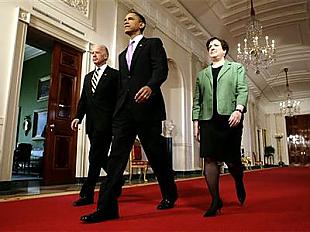
The people of the USA made a revolution of sorts some 240 years ago... but since then they have been very sheepish, specially since Hollywood and such became a feature. That means that the system works (or used to), no doubt: people are brainwashed and fed and there's absolutely no room for political dissidence, which is dubbed "anti-Americanism" and either ghettoed or jailed. Panem et circensis. If it worked for the Roman oligarchs, why not now? But unlike in Rome, for whom the word "socialism" meant nothing, in this Empire the price of bread, opium and mass entertainment keeps going up... Worse: after the criminal abuses of Bush Jr. and camarilla, including a self-inflicted murderous attack against US soil in 2001 to rally the masses around the Imperial-Zionist war project, a lot of people was really fed up. Most of them got alligned with Obama, who offered "hope", "change" and a fresh face and discourse. But the US political system, as all the others in the West, is designed for change not to be possible and for politicians to be mere puppets of the corporations, who control the media and the parties and nearly everything else. This status quo in favor of a handful of oligarchs was ratified by the Supreme Court recently, giving corporations civil rights that mean that as "virtual persons" they can contribute money to politics (bribe politicians more effectivey and officially) just like any other John Doe.In essence all the political machinery is in the hands of corporations, regardless of whether this or that party or politician rules. This of course means that they are in the hands of the political agents that control corporations, notably the Zionist International but also other such hierarchies as the Opus Dei, a Catholic order conceived as a brainwashing cult for profit and that has controlled the authoritarian and obscurantist Church of Rome for the last many many decades, since Karol Wojtila rose to the throne of Peter.Obama is not different: his 'change' is nowhere to be seen (no plan for Guantamo's closure, a government full of rabid Zionists like Rahm Emmanuel, support for terrorist regimes like the ones in Mexico, Colombia and Honduras, not to mention Israel), the 'hope' he managed to sell is vanishing like a bad headache. I say all this because I was reading yesterday to James Petras on the appointment of Elena Kagan, a totally grey unexperienced attorney but with the right Zionist connections, to the Supreme Court of the North American republic. It's something very much unbelievable if you think on it: such a powerful and alegedly prestigious organ as the Supreme Court filled with carpetbaggers of a foreign lobby? What has become of the proud republic?I fear that the answer is: a mere puppet of multinational corporative power, no mater who is in charge. One detail that Petras insists on is the fact that of the 9 members of this Supreme Court, there is not one who is not Catholic or Jewish. Six Catholics and three Jews in a nation that is mostly Protestant and where Jews represent barely 2% of the population (but about 50% of the wealthy and powerful). Where are the Protestant judges? Where are the agnostic judges? The Hindu, the Buddhist, the Muslim judges? They just don't seem to exist. Surely some of those had much more brillian careers than Kagan (not difficult, really) but they seem to lack the right connections to climb the ladder. As Petras says, this smells to barn. You could say I am just bitching (sure I am, why not?) but it's more serious than that: it means that the system, which should represent the people of the USA is not working as it should. The people have become just an amorphous mass to be rallied by the media at election campaigns and not anymore any real actor of US politics. The twin-single-party system does not allow for any dissidence to be articulated in a way that has the slightest chance within the system. Many of those genuine believers in democracy were rallied after Obama in the last election, they even created a short-lived popular movement of sorts... but what is left of that? You put all your hopes in a man who later betrays them for some unspeakable interest such as Zionism. And then what? Despair. Where's the grassroots movement that rallied behind the Obama illussion? Why are not them demanding their "leader" and Congress to fulfill their promises? Is a downgraded healthcare system all they could hope for? Is this what they fought for?I doubt it.
33 Latin American and Caribbean countries have decided at Cancún, Mexico, to create a new continental bloc without the USA and Canada, but with Cuba. This is the first international organization including all or most of Latin America that is not overseen by the USA or Spain. It is continuation of the Rio Group but it aims to establish a real organization, which will be outlined at next year's meeting at Venezuela. Full Declaration of Cancún at the Cuban Ministry of Foreign Affairs [es].
Admittedly I had never heard before of this Argentine economist with cathedra in Besançon but his opinions fit surprisingly well with what I think, so I will try to echo some of his thoughts.Source: Rebelión: Una conversación con Jorge Beinstein sobre la 'crisis general de la civilización burguesa': "Esta crisis es mucho más grave que la de 1929". Interview by S. López Arnal (in Spanish, obviously). Some excerpts:Nature of the crisis: Under the appearence of a curious convergence of many "crisis" (economical, energetic, enviromental, state, urban, etc.) what is actually happening is a general crisis of the burgeueoise civilization. In its immediate origin we find a chronic overproduction crisis lasting for almost four decades (...). Even if this chronic overproduction crisis appears as the trigger, the final catalyst of this civilizational crisis, we must clearly differentiate both concepts. (...) It happens that each historical overproduction crisis left open injuries, structural damage, parasitary degenerations (...) that at the beginning of the 21st century are finally causing a "general subproduction crisis": the general incapability of the system to reproduce itself in an expanded manner anymore, to keep growing in the long term. We are now going through the beginning of the end of a long historical transit (...). In principle we would be at the beginning of a long-lasting crisis-decadence but this is not more than a work hypothesis: History often turns out unexpected. Financial bubble:The global network of real state bubbles was evaluated in dossier at The Economist around 2005, soon before the debacle in the USA, as equivalent to the Gross Product of all rich countries together. This is a lot but it is littile when compared with the sum of derived financial products registered by the Bank of Basel that same year that were an speculative mountain worth 12 times the World Gross Product. The Greater Middle East wars:(...) they believed that the colonial wars in Iraq and Afghanistan would give them the control of a vast Eurasiatic zone stretching from the Balcans to Afghanistan, at whose core, the Persian Gulf and the Caspian Sea basins, are located about 70% of the global oil reserves. (...) This imperialist offensive was pushed by the Military-Industrial Complex (...). Since Reagan's presidency it became entangled with parasitary and predatory business (...) conforming an oligarchic and mafious system that nowadays constitutes the backbone of the imperial power. All that was expressed in an almost caricaturesque manner by the government of George W. Bush and his hawks, now Obama, in spite of his populist gestures, is just a puppet of that highly irrational power whose dynamics push the system towards disaster. The new president (...) is more of the same: militarist business continue their triumphant march generating a fiscal deficit without precedents in US history whose continuation could even cause the bankrupticy of the imperial state in the mid term. Senility crisis:It is necesary to look before 1930: this crisis is much bigger even if we just ponder the financial-economical aspects. Never before in the history of Capitalism was such a huge speculative mass accumulated at all, not just in absolute terms but especially when compared with the World Gross Product. Capitalism today is a mere predatory-parasitary system and that sets an essential qualitative difference with the past. (...)Never before did Capitalism suffer from such a huge crisis, which looks like the inverse phenomenon to the birth crisis of the modern system at the end of the 18th century (...). Now we face a senility crisis of the burgueoise world, with its economical system trapped in financial parasitism, with its imperial Military-Industrial Complex transformed in a decadent machine, its state structures degradated, etc. China: The talk about a "Chinese capitalist superpower of the 21st century" has been nothing but a mediatic hype that recycled the old and always failed illussion of reconversion of underdevelopement into develepoment thanks to the intensification of the burgueoise type transformations. Chinese growth, subordinated to the dynamics of global Capitalism, has arrived to its stagnation stage. (...) sooner or later, and it seems it will be very soon, the once prosperous Chinese industrial structure will enter in a deep crisis that will question in a very general manner the overall status quo. Prospects:Capitalism can survive but in a decadent manner, like has been doing for the last four decades. That will depend on the social and political convulsions caused by its decline (...). The neo-fascist coup attempt of the hawks does not need to be the last one of its kind: the US Industrial-Military Complex is suffering a severe cultural crisis: its internal prestige has declined but still has the instruments to generate a new reactionary alternative. This is a very serious possibility. (...) The only thing they can do is to apply succesive doses of tranquilizers, of partial remedies, insufficient measures in wait of some miracle, that is what doctors usually do with their ailing patients. Comparison with the fall of the Soviet Union:It is a very good comparison, that we can extend to many other pre-modern civilizations, consumed by parasitism and that finally imploded. Enviromental crisis:Enviromental degradation is at the very center of the current civilization crisis: it is tightly associated to the process of predation of natural resources (...) whose ultimate cause is found in technological reproduction of Capitalism. This one has followed a trajectory of some two centuries of creative destruction-predation in the Shumpeterian sense of the concept, that is: with a positive net result from the viewpoint of the expansion of the productive forces... until it has arrived now to a phase of growingly negative redits in civilizational terms, including the enviromental aspect. (...)Enviromental degradation is not a long term problem, a problem for the generations to come in a distant future: it is hitting now the economic activity, rural and urban life. Those who want to leave the matter aside in the name of economic urgencies have a very abstract vision, very detached from factual reality, from the problems of a possible reproductive reorganization, from the necessary energetic reconversion, etc.How the Left should act:We are right now immersed in the Capitalist crisis that looks as of long duration and without foreseable exit. Turbulences have just begun (...). In this new context, the Left should go into the offensive rapidly, developing a wide fan of struggles aiming to power. Gather the anti-system forces, de-estabilize the existing power systems, reduce their social legitimacy, make efforst of social and regional convergence. It is very difficult, almost impossible, to outline a general project for all the left movements around the planet. Nevertheless we can find some common elements: for instance, political democratization at all levels, fracturing the elitist dynamics that defined the neoliberal era: grassroots democracy versus burgeuoise pseudodemocracy. And, beginning from that, recycling of the productive web: of finances, of internal and external trade, etc. That implies nationalizations (...), not to serve the interests of the elites but to transform them into truly public, that is: democratic, with strong imprints of self-management, of administrative transparency, of popular control. It is necessary to deal with the social redesign of economy: redefine consume styles based on quality and durability, rejecting the consumerist dehumanizing, individualist madness. Consume to live and not live to consume. This kind of approach would allow us to adress rationally the energetic issue: facilitating a reconversion that will take some time and that should go through huge energy savings. It should also allow for the developement of strategies of reconstruction in the enviromental aspect. Socialism: The way out of the crisis that I have just outlined is nothing else but a march to Socialism. But what should we understand today as Socialism? Certainly not the kind of statist Socialism experimented through the 20th century, prisioner of a decisive ideological dependency from the military-industrial burgueois statism in rise since the end of the 19th century. (...)Now it is all changing very quickly: the burgueoise civilization drifts without direction, its great myths are beginning to collapse (...). Consequently Socialism today should adopt much more radical, revolutionary and democratic shapes than in the past (...)The emancipation movement must be thought and tried from clearly Communist final goals (...). Socialism concieved as plural path, as process of creative destruction, of institutional breakages, demolitions that allow for the instauration of solidarious, fraternal social structures of production and consume, not anymore as humanist complement of Capitalism but as its revolutionary superation: estabilishing decentralized political structures, incrementing, multiplying direct democracy. Much of that can be found in the revolutioanry movements of Latin America, though I am persuaded it is not just a regional exception. Marx:(...) We are indeed returning to Marx: to critical thought rooted on the rebellion of the exploited, irreconciliable enemy of conformism, of pseudo realist adaptation to what conservatives define as "possible". To the true Marx, not to parrot him but surely to march beyond him. To the Marx without dogmatic ties, to the irreverent Marx, who wrote "I am not Marxist", rejecting that way to become a provider of infallible recipes and eternal truths. Marx' ideas are necessary, unavoidable when we try to understand the current crisis, but they are also not enough. (...) when we try to understand the much more vast challenge of the civilization crisis, we lean on Marx to advance beyond his cultural universe. (...)Banners, slogans:(...) in the last decades we have been smashed by a conservative conformist avalanch that has no precedents in modern history because of its dimensions. It has been less than one decade that a slogan, which we would have laughed upon in the 60s and 70s because of its coyness, became rather popular: "another world is possible". We must begin thinking in terms of "revolution", "socialism", "postcapitalism", not as audacious ideas to share with some friends but as banners for action destinied to the great popular majorities. .
If you're a fan of nature documentaries you have surely watched now and then the real adventures of our chimp cousins at the Gomba reservation. In that case, the names and even personality of these chimpanzees will be very familiar, as thanks to modern media you have become for a brief but intensive time a guest in their home. But the researchers were not just filming documentaries, they were researching chimpanzee sociology and, by extension, also ours. They have found that alpha males among chimps are not always the largest more brutish guys. Sometimes they are: Frodo a very large male, weighting 51 kg, never ever groomed others and yet he was the alpha male for some time. In contrast, Wilkie, weighting only 37 kg. (under male chimp average) became the alpha male with a most diplomatic strategy, grooming others almost compulsively. Freud, an intermediate guy weighting 44 kg (above average) used both strategies, grooming at times and imposing himself by force in other occasions. Source: Science Daily, based on materials of the University of Minnesota..
It is a very interesting question to make. After all, it is a country divided along ethnic lines that one could well argue that never finished its unification process, where the periphery, particularly Basques and Catalans, often feel opressed by an ethnic Castilian/Spanish rule.But in theory all Spanish citizens are equal. And that has been largely the case since 1715, when the new Bourbon monarch supressed the self-rule of the realms of the Crown of Aragon, after the War of Spanish Succession. While it is often argued by Spanish historians that Spain was founded in the late 15th century, the reality is that it was only formed as a unitarian state (with the Basque exception) with this first Bourbon monarch, Philp V, more than 200 years later, after the other European posessions of the crown were lost (mostly to Austria).I have been checking the origins (place of birth and/or where the family was estabilished) of all Prime Ministers (and the few non-monarchical chiefs of state) of Spain since this Philip V, founder of Spain as we know it (and also first to estabilish the charge of Secretary of State, that would later become Prime Minister - or "President of the Goverment", as the office is nowadays officially known in Spain). Skipping the interim ones and those who ruled less for than a full month (most of which are hard to find out about their origins, as they are widely unknown) , they make a total of 115, of which 95 can be safely known their origins and these were within modern Spain.But before jumping to conclussions, let's define (admittedly with some arbitrariety) which are the ethnicities of Spain. I avoided to use the 15 (and two colonial bits of Morocco) modern Autonomous communities as such. It could have been a criteria but really many of those communities are just but capricious subdivisions of Castile with little or no distinct personality. Instead, I followed a more historical approach:
Raw data and maps from Wikipedia (English and Spanish language versions).
Bolivian President Evo Morales has been ratified by popular suffrage in referendum, getting a support that seems (still awaiting overall official results) higher than 63% nationwide and as high as 78% in some of the most populous departments, while getting also very good results in the restive provinces controlled by the opposition. Most other governors have been too but a handful have seen the people demanding their resignation, these include to opposition politicians and one guvernamental one.
The destituted governors include two from the opposition and one from the guvernamental Movement towards Socialism (MAS). The governor of Cochabamba, conservative, rejected the poll as "illegal" and challenged the government to replace him.While President Morales made a call to dialogue and collaboration in the aftermath of the referendum, Rubén Costas, governor of Santa Cruz and most vocal opposition leader, insulted the President calling him "dictator" and "macaque" and denounced the constitutional reform project that is being debated as a product of "Aymara fundamentalism", vowing to continue with his project of autonomy for his white and mestizo dominated gas-rich province.Bolivia is one of the few countries of America that still has an indigenous majority(55%), nevertheless Morales is the first Native American President of the republic and one of the very few of his kind in the history of Latin America, dominated by white and (secondarily) mestizo politicians and businessmen.The anti-indigenous discourse of the opposition leaders is clearly becoming more and more racist, as their backers are mostly white Bolivians (est. 15% of the total population) who fear that their economical and political hegemony, inheritance of Spanish colonial rule and US neocolonialism, is going to be removed forever under the policies that are nationalizing the strategical sectors like oil and gas to protect them from multinationals' voracity and private mismanagement.This is the actual context of eastern provinces' claims for autonomy, a claim that never existed before when the whole country was under creole control.Source articles (in Spanish):
- Gara: Morales ofrece negociación a los opositores tras su triunfo
- Rebelión: Evo Morales alcanza récord histórico y el mandato de ir por la Constitución
- Rebelión: Las tres salidas de la derecha
This time are the Irish. The count is not finished when I write this but the government is admitting defeat. Admittedly this Treaty of Lisbon is the same as the European Constitution by another name. It has been submitted to referendum in five states so far, four when it was "the Constitution" and this last time, in Ireland, as mere treaty. Of the five, three have voted against (France, Netherlands and Ireland) and two in favor (Spain and Luxemburg). All the other approvals (European Council, Comission and Parliament, state parliaments) have been not any exersise of direct democracy and certainly there are many doubts they do represent the will of the people. As for those who voted in favor I only know one person in my enviroment, my conservative brother, who admitted he was against but thought it was not good for Spain to say no to EU. Typical of him: think A and do B out of calculation. I voted against, of course. My reasons for doing so can't be said to be anti-Europeist. I am rather Europeist actually. I think they are in line with the important leftist fraction that voted NO and would do the same again if consulted. Basically I read the Constitution and thought: no declaration of rights, what the heck? Additionally it did not make the decision making process more democratic, it just provided for a qualified majority of states to take decissions more easily. Basically it pretends to persist in the Europe of states (decission making) and corporations (no social rights, wild free market), while advancing nothing or nearly so towards greater democracy. Certainly there is another conservative faction that is against this EU, mostly because they are natonalists of the dominant nations (constituent states) and fear Brussels red tape. The possitions of both opposition camps are very different: one is at least mildly Europeist but wants another more social and democratic EU, the other is just anti-Europeist. The Yes camp, pseudo-pragmatic, compromised with what EU already is, is not able instead to muster sufficient consensus beyond the political corridors, among the European people. Which is the solution? The actual solution will be more talks and a compromise in the same line. As Barroso put it, there is no plan B. Europeans must choose between accepting the plan A or accepting the plan A anyhow. Not very democractic, really, nor smart probably either. The ideal solution would be to call elections for a constituent European Parliament, with the specific mandate of writing that constitution, after years of debate. The resulting agreement should be put to referendum in every single state and there should be a plan B for every state that prefers to remain apart, assuming it's approved overall. I am not voting in favor of any constitutional proposal that does not include a good bill of rights in any case, nor for anything that leaves the decision making process in the hands of states and Brussels bureaucracy. No. That is the EU people is voting against. The question is not more or less integration (that may be an issue for the conservative camp) but more or less democracy. If it's not substantially more democratic than what we have now, we are going to vote against. We don't want a EU that is just about free game for thebig corporations, police coordination and costly buraucracies. We want a EU that is about Europeans, about the people, about our rights, about our jobs, about our enviroment, about our homes. We want to know that, after voting yes, our opinions will matter more, not less. They can play all the game again: Reach a "new" old agreement out of pathetic laziness (that's all they seem able to do with our many taxes) . But they can't change the sociological reality: this EU is not valid anymore, we need something dramatically more democratic, where the bureaucrats, including those more than dubious European Bank managers are directly or almost directly accountable to the people. If they keep going through the path of elite obscurantism and corporative economy, we are going to have a broken EU that will break apart easily. It's not a viable path. It's a path of self-defeat.
Surprising even for Maoists themselves, they have taken 8 of 10 Katmandu seats and lead in or have already won 82 of 151 constituencies where vote is being counted. Meanwhile, the Nepali Congress may get 28 seats and the Comunist Party (UML) 22. Minor parties would take the remaining 19 MPs, according to Al Jazeera.
I am a little confused because the total constituencies are 240, plus some other 335 seats being elected on proportional grounds and 26 nominated by the cabinet. Why are there only 151 constituencies being counted, what happens with the other 89? And the proportionally allocated seats?
Anyhow, the key of Maoist victory may have been that they have reached out to all ethnicities of Nepal and promised a federal republic.
Naturally neither the USA (who still has them classified as "terrorists"), nor India (that has its own strong Maoist guerrillas controlling many rural areas) nor the Nepali Army see that favorably. Maoist leader Pachendra has therefore made a conciliatory victory speech, promising to be a good neighbour of the two bordering giants: China and India.

Maoist leader Prachendra in a victorius speech
Whoever said that Marxism is dead, should think again.

 Posts
Posts