New blogs

Leherensuge was replaced in October 2010 by two new blogs: For what they were... we are and For what we are... they will be. Check them out.
Showing posts with label Gravettian. Show all posts

Tuesday, June 15, 2010

Paleolithic rock art discovered in Romania


Stone Pages' Archaeonews reports in this issue, among other interesting archaeological news, that mural art has been found in Coliboaia cave, at Bihor County, northwest Romania, by local speleologists.

The findings have been confirmed by an specialist team, lead by Jean Clottes, dating them provisionally between 23,000 and 35,000 years ago, in the Aurignacian or Gravettian periods.

The art depicts several animals in black paint, including a bison, a horse, a possible feline, two bear heads and two rhinoceroses. There are several engravings as well

Head of rhinoceros (from Bradshaw Foundation)

As far as I know, it is the easternmost case of Paleolithic mural art in Europe.

Sources: Bradshaw Foundation (includes two more images), PHYSORG

Thursday, December 18, 2008

North African mtDNA derived from Iberian one


Found at
Dienekes' Anthropology Blog, original paper at DOI: 10.1353 (paywall).

MtDNA H lineages from Tunisia are less diverse and within the variability found in Iberia. Therefore they are most probably a derivate. This fits terribly well with what I have been pondering in the last months or even years about the early origins of North Africans and specifically of Oranian culture (also known as Iberomaurusian) , so I'm quite excited about it.

Let's reconsider all elements:

Genetics:
  • North African mtDNA H derived from Iberian H (also notice the relatively high concentration haplogroup V in Tunisia and nearby areas, that must be of European origin as well)
  • North African mtDNA U6 less diverse than Iberian one. The lack of U6 elswhere in Europe and the greater diversity of its derived subclade U6a in NE Africa, has led some scholars to think it arrived from West Asia. But overall Iberia has by large the highest diversity of this clade, followed by Morocco, including haplogroups U6b and U6c, that are not found in NE Africa. See my earlier post on U6 and the Maca-Meyer paper on the matter.
  • Odd rather common R1b ill-studied clades in NE Africa (Sudan, Upper Egypt) and also in Northern Cameroon, where it's dominant among some groups. While in this case the diversity argument is not so clear (most Iberian and European R1b belongs to a single subclade - but not all), we can't forget that Y-DNA is potentially much more susceptible to drift and that, in Western Europe, was affected by the LGM bottleneck and the Epipaleolithic demographic movements after it may have spread into Africa. R1b is not dominant but it's still a somewhat important haplogroup in NW Africa (I understand that the Capsian/Afroasiatic countertide replaced it largely by E1b1). Most North African R1b haplotypes connect much better with European than with West Asian clades in fact (there is one exception though).
Archaeology:
  • The curious synchretic SE Iberian Gravetto-Solutrean culture dates from c. 22,000 BP (late 20th century calibrations, today it'd be probably somewhat older, like 25,000 BP maybe). The Solutrean of Mallaetes and Parpalló is among the oldest ones (only surpassed by that of Dordogne) but, unlike what happened in the Franco-Cantabrian region, where it became dominant soon after, in SE Iberia, it suffered a Gravettizing reaction that created a unique techno-cultural complex. Some of their artifacts fit extremely well with the back-tipped style found in North Africa, that also follow the all-covering Solutrean style of retouch.
  • The Oranian culture of North Africa, concentrated along the coasts, was early on called Iberomaurusian because the affinities with Iberian techno-complex appeared evident. Later, as doubts about its origin mounted up, it was renamed Oranian. In the last times it has been common to claim that Oranian arrived from Sudan or Egypt but that is not the least clear in fact. What does appear to have migrated from that area is the Epipaleolithic, maybe even Mesolithic (grain-gathering) Capsian culture, that has a more interior distributon and that was probably the one spreading Afroasiatic (Berber) language in the area. Oranian earliest dates are of c. 20,000 BP and its human remains are considered Crô-Magnon type, a type that was most common in Europe with the Gravettian culture (though in Mediterranean Iberia also within the "Solutrean").
  • The Qurta rock art of Upper Egypt (right in the crossroads where later Capsian may have originated) is incredibly similar to European rock art, specially to that of Côa valley in Portugal (see previous post on this matter). This artwork is dated to c. 16,000 BP.
All these archaeological elements fit in a chronological sequence Iberia-NW Africa-NE Africa that would be partly reversed later on with the Capsian (which did not arrive to Iberia though). The rather good match with genetic identifiers also seems to support this scheme. Maybe some corners need to be polished but I am every day much more persuaded that the ultimate origin of North Africans is in Europe, specifically in Iberia, rather that West Asia - even if later waves from the Nile and West Asia itself may have obscured this correlation.
.

In Archaonews


You may already know of
Archaeonews, the archaeological news section of Stone Pages (one of my favorite sites around the net that deals primarily with Megalithism), section that is mirrored at Archaeoforums. Usually I pick up one or two news as they arrive but, as I have been rather inactive and uninterested in everything intellectual for the last months, many have piled up - and many are very interesting actually. In this post I will try to ammend my laziness of late times, listing all those I would have surely mentioned anyway:


Huge fortress revealed in Wales. The Gaer Fawr fortress has been described as "the Milennium Stadium of the Iron Age" because of its unsual dimensions. A masive piece of egineering, with five terraces cut in the hillside. Being the area a dense forest its dimensions were not really understood until now. The apogee of the site is from 900-800 BCE (Late Bronze Age) but it was in use until Roman times. (forum links 1, 2)


Oldest European cremation burials found in Neolithic Istanbul. They are also the oldest of that kind in Anatolia. The urn necropolis has been found as the subway is being laid in the Turkish city, in the district of Marmaray and date to some 8000 years ago, long before other peoples ever adopted cermation anywhere in Europe. (forum link)


Neanderthals did not hurl weapons, Sapiens did. H. sapiens right humerus from c. 28,000 BP (Gravettian culture) are clearly rotated in a way that can only derive from frequent missile throwing since childhood. No Neanderthal remains show this feature, what means that they probably fought in close combat most of the time, be it against hunting prey or other peoples. While the authors suggest that projectile weapons may have dated from 100,000 BP in Africa, the evidence gathered in their study appears inconclusive for the supposed Sapiens military/hunting advantage over Neanderthals they claim, because Neanderthals had already lost most of their territory by that time. Now, I imagine that they could not study earlier remains because of the scarcity of them (Gravettian Cromagnons left many human remains in comparison with other older or more recent cultures), so maybe the hypothesis stands after all. (forum link)


Oldest marihuana stash found in Uyghuristan. The finding of 780 grams, still keeping their green color and psychoactive properties (but not the characteristic smell), belongs to the Gushi culture (Tocharians) and is dated to c. 700 BCE. It was found alongside a mummy of what is believed to be a Tocharian shaman. The article describes him as "fair-haired and blue-eyed" but while I can accept that hair preserves well in such exceptional conditions, I really suspect that the journalist was letting his/her imagination fly when describing the eyes, a most perishable part of the body. Otherwise the eyes would be the news, not the cannabis. (forum link)


Dugout oak canoe found in Black Sea. It is not dated but must be from long ago. The unusual lack of oxygen and aboundance of hydrogen disulfide at the deep layers of the Black Sea have allowed it to arrive to us in excellent condition. It was found by local fishermen off the Bulgarian coast. (forum link)


New Gravettian art set found in Russia. The portable artwork found at Zaryak (some 160 km SE of Moscow), carved on mammoth bone, is being compared to that of Kostienki and Avdeevo, and is dated to c. 22-21,000 years ago. It includes engravings of mammoths and diagonal cross patterns, as well as two "venus" statuettes (ritually placed in pits surrounded by colored sand), the style resembles very much that of Avdeevo, further south. (forum link)


Wednesday, July 16, 2008

Gravettians belonged to haplogroup H


At least in Italy.
A new paper by D. Caramelli confirms that the 28,000 years old individual known as Paglicci 23 carried the Cambridge Reference Sequence, or, in other words, a common variant of mtDNA haplogroup H.

It is a most important finding, specially as it confirms quite directly the mainstream conceptions about modern Europeans being descendant mostly from Paleolithic ones.

If I don't understand it wrongly, the individual should be one of the earliest belonging to the Gravettian techno-complex (or culture), as Julien Riel-Salvatore mentioned in 2006 that Paglicci Cave has some of the oldest Gravettian remains of Italy dated to c. 28,000 BP (uncalibrated).

Paglicci Cave (Gargano, Apulia, Italy) is a most important archaeological site, that has yielded some 45,000 remains of different types, including mural and portable art. Yet it is at imminent risk of collapse and, as far as I know, the requests of archeologists for funds to prevent this disaster have been ignored.

(Thanks to Dienekes for pointing me to this little jewel).

Saturday, April 19, 2008

European Paleolithic geography


So where is Isturitz, what is Magdalenian, what the heck are you talking about?

Ok, let's recapitulate:

1. A week ago, I commented on Aurignacian origins. Aurignacian culture is believed to be the first manifestation of Homo sapiens (we and our ancestors) and it's known to have penetrated pretty fast in most of Europe, displacing the former inhabitants, the Neanderthals. I also posted a map by A. Mellars:


Aurignacians began experimenting with rudimentary art and eventually also colonized, even if sparsely, the Mediterranean shores of the Iberian peninsula.

2. Haven't yet posted on it, I think, but the next thing to happen, many thousand years later was the developement or arrival of Gravettian culture. Gravettian technology shows some correlation with Neanderthal-made Chatelperronian but it's also true that similar technologies were in use among West Asians and possibly other peoples. Earlier, when Paleolithic research was concentrated in France, it was thought that Chatelperronian and Gravettian were two phases of the same cuture (Perigordian) but this is not sustained anymore and now it's believed that Gravettian culture evolved in Central-Eastern Europe or even arrived from outside the continent (though there's lack of evidence for this yet). It is likely that the Crô-Magnon type, strictu sensu, is associated with this culture.

Gravettian is also a pan-European culture and replaced Aurignacian everywhere, even if in many places it looks intrusive (older techniques remain). In fact it reached further than Aurignacian, incorportaing Eastern Europe and even penetrating into the Caucasus and Zagros areas (West Asia) and with connections as far east as the Altai. With Gravettian art became something much more common. Some of the most fascinating examples are the venus figurines, like the one of Lespuges:


3. In Western Europe, Gravettian didn't last long alone. A new techno-culture appeared locally, the Solutrean and replaced Gravettian rather fast, specially in the Franco-Cantabrian region. Instead, in Mediterranean Iberia, Gravettian showed to be strong enough and survived in a hybrid form with Solutrean (Iberian Gravetto-Solutrean), that is probably at the origin of North-African Ibero-Maurusian culture later on.

Solutrean was therefore primarily a culture of the Franco-Cantabrian region:


The Franco-Cantabrian region
(red dots are main sites of Paleolithic art, light green are areas that were over sea level in the past, white shows glacial areas).


Gravettian also survived in Italy and Eastern Europe. Central Europe is believed by many to have been too cold to be inhabited, at least densely, in this time, as the Solutrean phase is coincident with the Last Glacial Maximum, some 20,000 years ago. Another area that was affected by this episode was the Zagros region of West Asia, where human inhabitation probably became impossible or very hazardous then.

Solutrean peoples were very advanced for their time, knowing the needle, the fishing hook and maybe even the bow and arrow. They also advanced quite a bit in art expression.

4. After some milennia, Solutrean evolved into Magdalenian locally in the Franco-Cantabrian region. While many sites with transitional industries are known, there are some questions still to answer because the Magdalenian is surprisingly similar to old Aurignacian, even if much more refined. Since c. 13,000 BP, as the greatest cold went away, Magdalenian expanded into Central Europe. It also shows signs of late expansion into Mediterranean Iberia but with a very marked Gravetization anyhow (Parpalloan) and lacking the characteristic bone tools of this industry elsewhere.

Magdalenian is, of course, best known for its magnificient mural art, though these peoples also made potable art, like their predecessors.


Horse from Lascaux cave (Franco-Cantabrian region)

And here is where the Isturitz findings fit in: Magdalenian, Franco-Cantabrian, bone tools... whale bone tools! Makes sense, right?

Where is Isturitz? Quick graphic answer:


Is that better? Hope so.

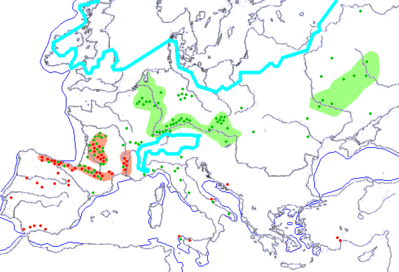
Another interesting map is this one of European Paleolithic art:


Red: mural art. Green: portable art.
Cyan thick lines: glacial maximum: areas under ice. Blue lines: ancient coastline.

It helps getting an idea of where did humans dwelt in the Upper Paleolithic. Yet the Mediterranean, even if not so dedicated to art as other areas, also had some population density probably.