
 Posts
Posts




It has been news in Spain and Europe recently certain reports that claim that the Iberian Kingdom is "a menace for the Eurozone" and blah-blah. Of course, the conservatives have echoed them in an attempt to win the next elections.
Economics Nobel Prize Paul Krugman deals at Sin Permiso with the reality of this local aspect of the global crisis. As I suspected, the reality is quite clear: there is no debt problem in Spain, which has only a very moderate indebtment, well below the OECD average, only surpassed by Italy and Greece in the Eurozone, and by Japan out of it.
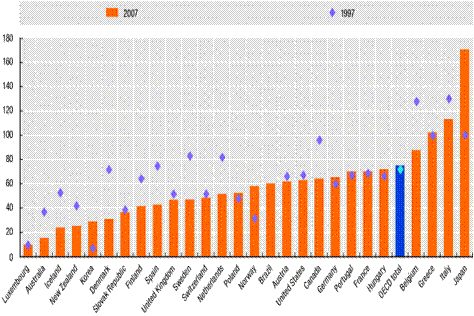
Public debt as percentage of GDP (source: OECD)
In fact, by these standards of indebtedness, central Eurozone countries like Germany or France are in much more perilous positions.
So what's the real problem with the Spanish economy? As Krugman explains, the case is that in the last decade or two there has been a terrible speculative bubble of mainly real state prices, that has caused salaries (and prices) to go up. Not much more has sustained the Spanish economy in all this time and now that the bubble is over (even if housing prices are still not dropping too much) Spanish workforce is accustomed to "high" salaries, what makes it non-competitive in the global market and particularly in the EU.
He says that the recipe now should be inflation but, as Spain has not anymore monetary autonomy, it can't do that.
However what Krugman, after all a capitalist economist, even if Keynesian, does not deal with are the following issues:
In Spain the main expense, by large, of any family or individual worker is housing. If housing prices don't fall, salaries can hardly decrease. But there are such powerful olygopolistic interests in the housing bubble that real state prices, excepted maybe some vacation localities, are not yet falling. We the people expect, reasonably, drops of 30-50% in housing prices but so far, almost two years after the real state/credit bubble crash, housing costs have not varied at all. Homes remain unsold and people has to struggle to pay for them or wait painfully in provisional situations until the "invisible hand" of market finally acts.
Also credit remains extremely elusive. My brother, an engineer with a stable job as executive director of a small but well-doing company, had to get a state-subsidized home. And when he asked for credit to pay for it, he was told that ok... but only because it was not much money, otherwise he would not get any credit. Another brother of mine, an economist with experience and a stable job, is still living in a shared apartment. Myself I have got in lenghty but futile arguments with my landlord after he decided to raise the rent almost 20%. It's still cheap in comparison with most other stuff you can find around.
There is a structural problem in the Spanish economy and that is house prices. Workers' basic expenses are housing, food, clothing and basic services such as electricity, gas or water. Of these housing is by far the most costly and can be almost as much as a regular worker earns. With this situation it's plainly impossible that salaries can go down. How are you going to work for less than 1000 euros/month if housing alone may cost you 700 or more? You must decline any such offer because it's not absolute money what counts but how much can you pay for it.
So, in my humble opinion, what Spain needs, in the context of capitalist market forces, is not inflation but deflation. And that means first of all, forcing housing prices down severely. As the market forces do not seem to work in this still speculative context (even if now is a resistence speculation rather than a benefit driven one) the government should intervene somehow. But that is beyond the ideological scope of the system: neither the socialdemocrats nor the conservatives will do such thing.
So what happens? That unemployment climbs up until almost unheard of levels: more than four million people right now are searching for a job... but, of course, they can't still accept salaries that would not allow them to pay the rent (or mortgage). Other living costs are not low either but housing is the main one and therefore the main problem.
EU rules on "free market" do not help, because they introduce too many constraints on what a government can do. For example, if a (most reasonable) law would be made to force empty homes to be sold/rented or expropriated at half cost, that would violate the EU directives and put the state in serious legal trouble. If the state would increase its debt to massively build subsidized homes at cheap prices, as is much needed, EU would again complain.
So I guess that there is no realistic exit within the parameters of capitalism and EU. So I wonder: what are all those grunters complaining about? Spain is a perfectly normal capitalist economy where oligopolies work to maximize benefits at the cost of the working class. Just business as usual.
Maybe they fear that the working class may get unruly and shatter the status quo? Maybe that's what they are really worried about but they should then address the needs of the people and not just those of the corporations and the tiny elite that owns them. But that would be "socialism" and that's not what EU nor Spain are about.
Update: I just stumbled upon this analysis by Michael Hudson on the reappointment of Ben Shalom Bernanke as director of the US Federal Reserve. And, guess what?, he has exactly the same analysis for the USA than I was making here for Spain: that while housing prices don't fall, salaries will remain high and the economy won't be competitive. Sadly enough, in the USA as in Europe, this is not a policy that rulers are willing to consider.


